Day 270: The Secret Garden

Cover for The Secret GardenBest Book of the Week!
The Secret Garden was one of my favorite books as a young girl. I recently had occasion to reread it and was surprised to find it just as entertaining as I remembered. I also noticed for the first time how beautifully written it is.

We might be inclined to sympathize with ten-year-old Mary Lennox at the beginning of the novel. After all, she has survived a cholera outbreak in India that killed her parents, and she was left alone when the remaining servants abandoned the house. But Mary is spoiled and bad-tempered. She goes to live with her uncle, Archibald Craven, in Yorkshire, and she doesn’t like anything she sees. The food is horribly bland. The house is located on a desolate stretch of moor, and her uncle isn’t even there, so she is to be kept by servants. Well, she knows how to handle servants.

To her surprise, the English servants are not afraid of her temper; they expect her to do as she’s told. Largely left to her own devices, she explores the huge, rambling house and the gardens around it. Her young maid Martha tells her the story of a secret garden that used to belong to Uncle Archibald’s wife. His wife died, and he had the garden locked and the key buried.

Running around outside, Mary starts to improve her health and temper. She makes friends with a robin, and Martha’s mother sends her a jump rope. Soon she is rosy-cheeked and stops turning her nose up at the food.

Mary makes the acquaintance of the taciturn gardener, Ben Weatherstaff, and eventually finds the door and the key to the secret garden. The plants are dead, because it is early spring, but she wonders if the garden can’t be revived with a little help. She gives Martha some of her allowance to buy gardening tools, and Martha’s young brother Dickon delivers them. Dickon is a fascinating boy who roams the moors and makes friends with the animals, and with Mary. Soon, both Mary and Dickon are working every day in the secret garden.

Her nights have occasionally been disturbed by someone crying. One night she follows the noise and finds that a boy is living in the house, her cousin Colin. He is an invalid who has not been out of his bed for years, and he is even more spoiled than Mary. After putting him in his place, Mary begins to feel sorry for him. She reads him stories and tells him about the secret garden as if it were story, but he soon figures out that it is true. Eventually, she and Dickon take him out into the garden in a wheelchair.

This book is a tale about how living things can heal bodies and minds. As Mary’s health improves and she works in the garden, her temper improves. The magic of the garden brings Mary together with her friends and eventually reunites the Craven family.
Day 255: Anderby Wold

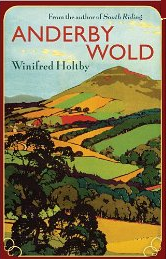
Cover for Anderby WoldMary Robson is a young married woman who has been working for years to save her family farm, Anderby Wold. She even married John, her much older husband, whose hard work has kept it going these past years. She is a managing woman who thinks it is her duty to oversee the welfare of the village, making herself disliked by many. Because of her preoccupations, she seems much older than she actually is.

One day she encounters David Rossiter, a young radical journalist who disagrees with everything Mary believes in. David is trying to get farm workers interested in unionizing, and Mary becomes unsuitably obsessed with the younger man. The schoolmaster, Coast, becomes involved in the unionization issue expressly to make trouble for Mary, whom he detests.

Anderby Wold is an interesting slice of Yorkshire life in the 1920’s. It reflects the issues of the times, when farmers were facing increased demand for workers’ rights. Another of Winifred Holtby’s consistent themes that appears here is getting on with life after the death of a loved one. This novel is Holtby’s first, and its realistic depictions of village life of the times reflect her background as a journalist.

Day 243: The Pursuit of Love

Cover for The Pursuit of LoveIt’s always fun to re-read Nancy Mitford’s charming and funny autobiographical novel about her youth and young womanhood. Mitford’s alter ego is Linda, a young woman with terrible taste in men, who throws herself from one extreme to another in pursuit of love.

Mitford’s strength is her portrayal of peculiar but lovable characters, all modeled upon her own eccentric family or on figures in society. The novel is narrated by Fanny, a sensible but lonely girl who spends a lot of time with her cousins, the Radletts. Her terrifying Uncle Matthew (modeled on Mitford’s father) loves to hunt his children instead of foxes, a game the children love. Aunt Sadie is unutterably vague, which she probably has to be to live with Uncle Matthew. Uncle David is a cultured hypochondriac. The Bolter, Fanny’s mother, is supposedly a portrayal of Lady Idina Sackville, a famous society woman who kept leaving her husbands and was a member of Kenya’s famous Happy Valley set.

Mitford starts the novel with childhood–the children are hunted, hang out in the linen cupboard fantasizing about running away, and generally run wild–and follows the older girls into young adulthood. The novel finally centers on the story of how Linda first impetuously marries a stuffy banker who bores her silly, then leaves him for a communist who only thinks about his causes, and finally falls into the arms of Fabrice, a French duke who is a world-class womanizer. Characterized by facetious observations of society life and dialogue brimming with zingers, Mitford’s novel is a joy to read.

Just as an aside because I’ve recently read a few posts about cover design, I originally copied into this post the most recent cover of the book, which shows a romantic black and white photo of a debutant holding a bouquet of flowers with a pink banner for the title. I decided to replace it with this older cover (the one on the copy I have), which I think does a much better job of conveying the type of novel it is, much more of a social commentary than a romantic novel.

Day 239: Lucky Jim

Cover for Lucky JimI hate to use the word “hapless” two days in a row, but here goes. Hapless Jim Dixon is an unhappily employed lecturer in history at a “new university” in England. (I believe even that phrase is supposed to be fraught with meaning, but I am not British, so I don’t know what it might be.) Uncertain of whether he’ll be keeping his job in the coming year, he is forced to listen with an attentive air to the endless prosings of his boss Professor Welch and to take on all the tedious chores he is assigned. He vents his frustration through silly pranks and grotesque grimaces when he thinks no one is looking.

He has also gotten himself entangled with Margaret, a manipulative coworker whom he pities because she recently attempted suicide when her fiancé left her.

During a stultifying weekend of amateur theatrics and madrigal singing at the Welch’s, Jim meets the beautiful Christine, the girlfriend of the horrible Bertrand, Welch’s pretentious and belligerant son. Jim is startled to find that perhaps Christine returns his interest.

Amis’ amusing skewering of academic life comes to a climax at Jim’s well-attended lecture on Merrie England. Amis’ novel is known both for being the first “campus novel,” one that takes the point of view of a lecturer rather than a student, and for its down-to-earth, witty writing style, an approach that was unusual at the time. Although it was published in 1954, it holds up pretty well in modern times.

Day 233: The Moviegoer

Cover for The MoviegoerWalker Percy’s classic novel The Moviegoer is a novel about alienation. Binx Bolling is an idle young man living in New Orleans during the late 1950’s. His experiences in the Korean War seem to have cast him adrift, or perhaps he has always been adrift. He spends his time chasing women and going to the movies. He cares for his cultured and prominent family, yet he seems strangely indifferent to them at the same time. He claims to be on a search, but it is not clear what he is searching for–perhaps a purpose, but his search is strangely aimless. Although he has a job as a stockbroker, he doesn’t devote much time or attention to it.

Kate, his cousin, is mentally ill in an undefined way. She and Binx seem to understand each other, and he genuinely cares what happens to her. From drifting for quite awhile in the same waters, the story finally moves forward when Kate insists on coming with Binx to attend a convention in Chicago, where he has an important work assignment.

New Orleans features as a colorful setting, but in some ways the city’s possibilities are neglected. Some of the most interesting scenes are set in a small house over a bayou, where Binx goes to visit his mother and younger siblings.

This is an existentialist novel that is supposedly heavily influenced by the writings of Søren Kierkegaard. Although Jack Kerouac’s On the Road reflects the alienation experienced by some young men following World War II, The Moviegoer shows that this alienation was still felt by young men following the Korean War, ten years later. Essentially, these two novels examine the same themes, only Binx’s explorations are followed in more socially acceptable ways.

I have to admit that these themes don’t personally strike any chords with me. For most of the novel I wasn’t that interested in Binx’s search or in the things that he finds interesting. However, I liked the ending of the book, when he finally accepts responsibility for something.

Day 213: The Monk

I don’t usually have problems with the language of the classics or with appreciating a book that is long out of its time, but I had one with The Monk. Although it is considered a classic gothic novel, published in the height of their popularity in 1796, I found it boring. I imagine that for its day it was very shocking.

Ambrosio is a monk at a Capuchin monastery in Madrid. Although he is considered to be almost a saint, he is full of vanity and lust. He becomes sexually obsessed with a woman who is disguised as a boy in the monastery, and succumbs to temptation. Then his eye lights on a pious virgin. Gradually, he becomes more and more debauched until he is completely given up to depravity.

What irritates me is the narrative, which is repeatedly interrupted by long and boring digressions, apparently to further the gothic flavor. An example is the story of the brave Lorenzo, who battles with bandits in the forests of Germany. The novel is also rabidly anti-Catholic, as almost all the representatives of the church are scheming, power-seeking, or just plain evil. Although the general over-the-top quality of the novel should have appealed to me, I found myself just not interested enough to finish it.

Day 199: South Riding

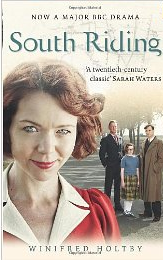
Cover for South RidingI had never heard of Winifred Holtby until I watched the excellent Masterpiece series South Riding. I enjoyed it so much that I picked up several of Holtby’s books. Holtby published 12 novels in the 1920’s and 1930’s, as well as pursuing a successful career as a journalist and nonfiction writer. She is known for regional fiction about Yorkshire and has a prize for regional fiction named after her.

Set post-World War I, South Riding is the story of the conflict between the landed gentry and social progressives in a Yorkshire town. Sarah Burton comes to town as the headmistress of a girl’s school. She has many progressive ideas and wants to improve the school and the quality of education provided to the girls. To accomplish her goals, she asks the town to invest more money in the school.

She immediately runs afoul of Robert Carne, a local landowner. He has very conservative ideas about the town and school, but he also has some heavy concerns. Previously prosperous, he has spent all his money on care for his mentally ill wife. He also has the care of a young daughter who is having her own problems.

Unlike the television series, the novel has a huge sweep and does not concentrate on Sarah, but presents the stories of about fifteen other major characters. It deals with issues like education, poverty, and governmental corruption as well as family relationships. The characters are all carefully delineated so that you feel that you know each one.

The novel is beautifully written, although it gets just a little preachy at the end. Some reviewers have compared Holtby to George Eliot because of her interest in local social issues and her breadth of scope.

Day 183: The Greek Myths

Cover for The Greek MythsThe Greek Myths is classicist and writer Robert Graves’ well respected and unconventional translation and interpretation of a comprehensive collection of Greek myths. Graves explains that rather than interpret the myths psychologically (i.e., Oedipus), which he appears to have some disdain for, it is more useful and accurate to look at them in combination with the findings of archaeology, as a sort of historic record. Graves relates each myth, with all its variants, and then provides sometimes copious notes to explain each facet. He also points out the many similarities among world myths, showing the relationships between Greek myths and those of the Celts, Sumerians, Jews, and others.

It is Graves’ contention that most of the Greek myths with which we are familiar were manipulations and distortions by the Hellenes of the religious beliefs of the people they conquered. There were four migrations of the Hellenes into Greece. After the first two, the patriarchal Hellenes adopted the matriarchal religions of their hosts, but in the last two, the Hellenes forced the existing tribes to follow their beliefs and then consciously distorted their mythologies to reflect this change.

For example, there are many instances where Zeus chases and rapes various nymphs. In the earlier myths, the three-headed goddess in one of her forms would have been chasing the king as part of a ritual ceremony, so the myth has been turned on its head. Similarly, many a Greek hero’s exploits that involve fighting and killing an opponent are a perversion of the ritual whereby the king is “killed” by his tanist–or alternate ruler (“twin” or “son”)–at the end of his reign and then in turn actually kills the tanist to take up his reign again. Grave states, “Like Aeschylus, Euripedes was engaged in religious propaganda.”

The ideas Graves espouses are very interesting and the book is extremely well written. However, the sheer number of names and places and similar incidents can be overwhelming. Some deities or other figures go by six or eight names, for example. And there’s only so much killing and rapine a person can take. I finally bogged down over Heracles, who has more than 100 of the 600+ pages devoted to him (and whose adventures are very similar to those of Gilgamesh). Heracles, I feel, was a thug, and round about his tenth labor, which was particularly rambling, I gave up on him.

My intention in reading this work was to come out with a more coherent idea of the whole of Greek mythology, but ironically, I feel this book is too comprehensive for me to meet that goal–that something simpler would have worked better for me. However, for serious students of mythology, this is probably required and interesting reading.

Day 173: David Copperfield

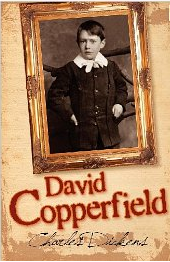
Cover for David CopperfieldBest Book of the Week!

I believe that David Copperfield was the very first book I ever received as a young girl that was not a children’s book. My dad brought it home for me one day when I was sick (beginning my collection of Modern Classics back when they were hardcover), and it transported me to another world.

People have differing opinions about which Charles Dickens book is best. For example, author Nick Hornby blogged that Great Expectations was one of the greatest books ever written. I myself have never fallen under the spell of Great Expectations, though. David Copperfield is my favorite. Tolstoy thought Dickens was the best of all English novelists and considered this book Dickens’s finest work.

David is the narrator of his own story, and he begins it on the night of his birth. David is a posthumous baby, and the novel begins with the first appearance of Aunt Betsey Trotwood, who comes to greet the appearance of her niece and terrifies David’s gentle, foolish mother. When David turns out to be a boy, Aunt Trotwood is mightily offended and departs.

Although David’s early childhood is idyllic, worshipped as he is by his mother and Peggoty the maid, it soon takes a turn for the worse. David’s mother is courted and won by the stern, apparently upright (and ultimately cruel and hypocritical) Mr. Murdstone, and the house is taken over by his cold and fault-finding sister Jane. David is a true innocent with only good intentions, but at every turn he is found to be in the wrong. He is soon shipped off to a typically horrible (if you know Dickens) boarding school.

After a bit of a rocky start, David finds himself made a pet of the popular Steerforth and also befriends Tommy Traddles. However, his mediocre education is interrupted when his mother and baby brother die. Mr. Murdstone sends him to London to lodge with the feckless Micawber family and work in a factory. When the well-meaning but impecunious Micawber is sent to debtor’s prison, David tires of his degrading life and runs off to find the only family he has left, Aunt Betsey Trotwood.

Although Aunt Trotwood is still disappointed that he isn’t a girl, she is kind, and from here, David’s life improves. The story continues with his education, marriage, and young adulthood. It is loaded with some of Dickens’s most delightful characters and a few villainous ones. Alternately turning from comedy to pathos, Dickens expertly drives the story along.

I believe one reason I find David Copperfield so touching is that David’s early life is taken from Dickens’s own. Dickens’s father was sent to debtor’s prison and Dickens went to work in a factory at an early age. This connection translates into a moving experience for the reader.

When innocent and loving David is punished by his stepfather because he is so terrified he can’t recite his lessons or when he is sent off to work in a factory, who remains untouched? When Barkis is willin’ or Mr. Micawber appears on the scene, who doesn’t laugh out loud? When steadfast and valiant Ham dies trying to rescue his rival, who isn’t tearful? When the slimy Uriah Heep finally gets his comeuppance, who isn’t delighted?

If you are not used to reading Victorian literature, you may find the writing old-fashioned, but you will almost certainly be carried along by the story.

Day 126: Dombey and Son

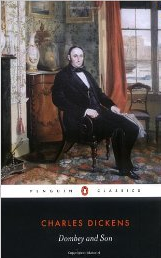
Cover for Dombey and SonI recently re-read Dombey and Son after not having read it in so long that I could not remember its plot. The novel is Charles Dickens’s tale about Paul Dombey, a wealthy, cold, self-important man who cares only about his son, not about his wife or his gentle, loving daughter Florence. His wife dies in childbirth, and his son Paul is weak and often ill, but Paul and Florence have a loving relationship. When Florence is kidnapped as a child, she is rescued by Walter Gay, a young employee of Dombey. Dombey ships him off to Barbados to get him away from Florence, but Walter’s ship is lost and he is presumed drowned.

With Walter gone, Florence has only her brother Paul for her friend. Then Paul dies, and her father even resents Florence for the love his son had for her, which he did not give to his father.

Dombey meets a beautiful widow, Edith Granger. She is a cold, haughty but impoverished woman, and Dombey essentially “buys” her by marrying her. She despises Dombey for his pride and herself for having married him for his money. The only person she is kind to is Florence, which provides more fuel for Dombey’s dislike of his own daughter. His attempts to subdue his wife end in her disgracing him as best she is able by running away to Dijon with Mr. Carker, one of Dombey’s rivals. When Florence attempts to offer sympathy, Dombey strikes her and she leaves the house, friendless and destitute.

Although the novel is not critically accepted as one of Dickens’s major works, it is still enjoyable. It is full of vibrant characters–mostly those of good will but also some villains–and it is gripping to the end. Some critics have noticed a change in the novel that takes place with the death of the young Paul, believing that having the colorless Florence and the unlikable Dombey as the main characters is not enough to carry the story forward. The absence of Walter and his uncle through much of the book is also thought to be a problem. However, the novel has all of the Dickens hallmarks–social commentary, comic absurdity, realism, pathos, and transformation. Dombey and Sons was written before most of Dickens’s real masterpieces like Bleak House or David Copperfield, but it certainly shows the movement from his lighter, shorter works toward the qualities of his more major works.