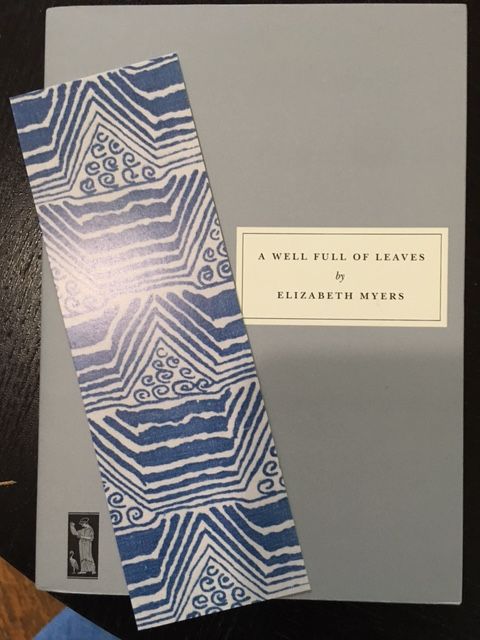
Review 2322: A Well Full of Leaves

Laura is from a poor family, but lack of money isn’t the problem so much as lack of love. Her father earns very little and is often drunk. Her mother constantly complains, offers no affection to her children, and tells them they are ungrateful.

At the opening of the novel, Anda, the oldest at 16, is beautiful but selfish. Robert, at 14, loves reading about history but has been made to quit school for a job as a clerk. Both pick on Steve, the youngest at 11, who deeply feels the lack of affection. Only Laura, who is 12 or 13, seems to care about him, and she has learned to adapt to their circumstances by losing herself in the tiny details of life, to enjoy living. She tries to teach her outlook to Steve, but he just becomes more bitter.

A crisis comes when Steve is 14. Although he is the best student of Greek in school and has a good chance at university, their mother tells him she removed him from school so he can work. This is just meanness, because Anda is leaving home, and Robert and Laura are working, so the household is better off than it ever has been. After a huge family fight, Steve burns all his books.

The novel begins to be about the relationship between Laura and Steve. Steve becomes a famous actor with a very bad reputation. He has many affairs but says he loves only Laura. Once their father dies, Laura goes to live with Steve. The real crisis comes when Laura falls in love.

Although I agree with a lot of Laura’s ideas, Myers expresses them far too often and in a florid writing style that seems to belong to the early Romantics. Sometimes, I had no idea what she was talking about and other times, I didn’t want to think about it enough to figure it out. Parts of the novel are absolutely fraught in tone, especially at the end.

Related Posts

Which Way?

The Old Man’s Birthday

The Other Side of the Bridge

Review 2321: Classics Club Spin Result! Weatherley Parade

Note: the name on this cover image is misspelled. The cover on the book I have looks the same but is spelled correctly.

In Weatherley Parade, Richmal Crompton takes a look at changes in society through the lens of one upper-class family, the Weatherleys. Her novel begins with the return of Arthur Weatherley from the Boer War in 1902 and ends in the midst of World War II in 1940.

The novel is written in vignettes, chapters that take up a few hours, a few days, or a few months. What with children, grandchildren, and other relatives, there are many characters. No one is completely lovable or unlikeable. They are shown with their good points and flaws.

During the years, there are many events—happy and unhappy marriages, separations, a divorce, and deaths. Among these events, there is one treatment of a child that is hard to forgive.

Among some of the characters is Aunt Lilian, a young woman in 1902 of whom her brother Arthur despairs. He can’t understand why she keeps jilting one fiancé after another. She runs with a fast crowd and seems restless and bored. At first, I thought she was just ahead of her time, dissatisfied with traditional women’s roles, but I liked her less as time went on, and she eventually turns to alcoholism.

Arthur’s two children are Clive and Anthea. Clive is a boy who thinks everything should be done properly and by the rules, which doesn’t make him a popular schoolboy or, later, schoolmaster or father, even though his intentions are good. Anthea likes to have people’s attention, which works well when she is the mother of many children but isn’t so successful when they begin leaving the nest.

The novel stops in to visit these characters and their descendants at key periods of their lives. The scope here is broad rather than particular, so we don’t get to know any characters extremely well. I thought the depiction of changing times and attitudes was interesting, but I felt fairly neutral about most of the characters.

Related Posts

Family Roundabout

The Old Man’s Birthday

Greenbanks

Review 2317: William

William Nesbitt is a successful ship builder and owner, and at the beginning of this novel, he is contemplating the successes of his life. The only thing he feels he has missed is some romance in life, his wife Kate being a very practical woman. But he experiences romance vicariously, through his favorite daughter, Lydia, whom he views as a source of light.

Kate Nesbitt is a worrier, and she has a sense of impending doom. She also is extremely conventional and I think old-fashioned, even for the time (1925). For example, she disapproves of her daughter Dora going to visit Lydia in London without her husband. Kate has a sense that something is going to go wrong with what she sees as her family’s happy and content existence.

Of course, she is being almost willfully blind. Their son Walter and his wife Violet are content, but their daughter Dora is increasingly discontented with her husband Herbert. Their daughter Mabel and her husband John are self-righteous, and Mabel likes to complain and pretend they are poor when John’s business is going well. Janet, the youngest, unmarried daughter is silent and unhappy. Later, it becomes obvious that she thinks she’s in love with Oliver, Lydia’s husband.

Then, something bad does happen: Lydia leaves Oliver for Henry Wyatt, a writer. William is still accepting of Lydia, thinking she is trying to live her life honestly, but he begins to see that Kate is more rigid and unaccepting than he realized.

This novel is an insightful and nuanced study of how a crisis can affect a family. Since Young ran off with a married man, it’s interesting to speculate how autobiographical this novel may be. I found the novel deeply interesting, with complex characters.

Related Posts

The Misses Mallett

Chatterton Square

The Curate’s Wife

Review 2315: #ReadingOrwell24: Burmese Days

I picked out Burmese Days to read for Brona’s Reading Orwell event. It may be the only Orwell I read, though, unless one comes up in one of the biannual year reads hosted by Stuck in a Book.

There is nothing politically correct about Burmese Days, published in 1934 and probably set 10 years or so earlier. So, if bigotry bothers you, best stay away. Also, a warning for animal lovers—this book contains the murder of a dog.

John Flory is stationed in North Burma working for a timber concern. He hates most of the English people who live in Burma and spend their nights drinking and complaining about the natives. He wants to talk about books and more intellectual concerns, so his only friend is Dr. Veraswami, an educated Indian. However, when the subject of admitting an Asian to the European Club comes up, Flory doesn’t have the gumption to support the doctor’s admission.

He learns later that this admission is more important than he thinks, because Dr. Veraswami has offended U Po Kyin, a corrupt magistrate who is determined to ruin him. Membership in the club would make the doctor impregnable.

Flory doesn’t want to leave Burma, which he loves, but he is desperately lonely. He decides the only option is to find a woman who loves Burma too and is interested in intellectual discussion.

On the scene comes Elizabeth Lackersteen, a young woman who has been left penniless and has come to Burma to find a husband. Because she came from Paris, Flory immediately imagines her hanging out with artists and thinks he’s met his soulmate. He doesn’t even notice how she hates being among the Burmese and is exactly the type of woman he dislikes.

After Flory take Elizabeth on a hunting expedition, she seems inclined toward him, especially as her uncle has been approaching her inappropriately. But then the dashing Lieutenant Verrall appears, and Mrs. Lackersteen discovers he is an Honourable. In the meantime, U Po Kyin has expanded his efforts to disgrace the doctor to include his friend Flory.

This is a bitter satire against the British Raj with few likable characters and a dark ending. I’m sure it is meticulously observed, even though many of its characters seem like caricatures.

Related Posts

The Glass Palace

The Siege of Krishnapur

The Singapore Grip

Review 2313: Kate Hardy

I usually like D. E. Stevenson’s novels for very light reading, but Kate Hardy seemed all over the place.

Old Quinings is a village that has been left in the past, and the residents like it that way. They are interested to learn, though, that Mr. Morven has sold the Dower House. The new owner is Kate Hardy, a writer of adventure stories who has been yearning to get out of London and away from her selfish sister and spoiled niece.

Kate has bought the Dower House sight unseen, but she loves it as soon as she sees it, even the resident ghost. She meets Mr. Morven early on, but he is careful to visit only rarely because he is old-fashioned and married, although he and his wife live apart.

Kate doesn’t mean to be a recluse even though she needs time to write, and she gets involved in all kinds of things. When she barely knows Mr. Morven, she receives an anonymous letter alleging an improper relationship between them. Another letter goes to Mrs. Morven, who comes back from America hoping her husband wants a divorce. Then Kate arranges to take care of the couple’s nine-year-old daughter Susan, which is an odd offer to a stranger and even odder for the stranger to accept. Susan arrives, but we hardly spend any time with her.

In a gesture that seems sweepingly condescending, Kate also gives a party to welcome back Mrs. Stack’s son Walter from his service in India even though she has just met Mrs. Stack and doesn’t know Walter. There’s a class issue here, not only because of the invitation but because Walter has bettered himself in the service but is stubbornly insisting on keeping his promise to take back his old job and take care of his mother. His old mates are resentful of his getting his job back, although that was promised when he went to war, and his mother and Kate think he could do better.

Then there is the witch plot, which is just silly.

I think there is too much going on in this novel. Maybe the whole thing with the witches was meant to give atmosphere, but it just seemed sort of thrown in, as does the presence of Mr. Morven’s daughter. Also, Kate ends up with two suitors without us having much of a sense of what they are like. I noticed in addition a couple of occasions when Stevenson tells us what people talked about without recounting the dialogue—and the dialogue gives us a better sense of what people are like. Its not very convincing to be told a character’s views are interesting instead of learning what they are or hearing the character say them.

So, I don’t think that this was one of Stevenson’s best.

On the old subject of mistakes in the Furrowed Middlebrow series, which we haven’t encountered in a while, Mrs. Stack is called Mrs. Stark on the back cover of the book, and there is a section after the novel ends that was apparently written by Stevenson but in my copy appears to be missing pages, because it has no heading and starts in the middle of a sentence.

Related Posts

The Baker’s Daughter

The Blue Sapphire

Vittoria Cottage

Review 2309: The Curate’s Wife

When I reviewed E. H. Young’s Jenny Wren, I remarked that I preferred Jenny’s sister Dahlia to Jenny. So, I was delighted to find that The Curate’s Wife is about Dahlia (although Jenny’s romantic fate is also involved).

Dahlia has married the curate, Cecil Sproat, on the basis of a friendship in which she feels she can say anything. But very soon, she finds that’s not true when it applies to religion, which has not formed part of her upbringing and which she finds silly. For his part, Cecil is rigid and has been unthinking in his religious beliefs. There is also the problem that Cecil is in love with Dahlia, but the reverse is not true.

Another issue is created by Mrs. Doubleday, the wife of Rector Doubleday, Cecil’s boss. She is an unpleasant woman who already dislikes Cecil and takes a strong dislike to Dahlia. She makes it her business to listen to gossip about the girls’ mother’s inferior social standing and her affair during the war. Their mother foolishly married farmer Thomas Grimshaw at the end of Jenny Wren, hoping that would remove a bar to Jenny’s marriage with Cyril Merriman, but that only made the situation more hopeless. Jenny has gone off to live with Mr. Cumming’s sisters and father and learn about the antique business.

Dahlia begins to feel as if she missed out. After school, she was first isolated on the farm and now is living with a dedicated man doing good works. She has never even been to a party or enjoyed other types of amusements. She begins to fancy herself in love with Simon Tothill, a young man she met at a theater rehearsal.

Just as Dahlia and Cecil are beginning to understand each other, Jenny arrives without warning. She has left the Cummings and expects to live with Dahlia and Cecil. Although Dahlia is happy to see Jenny, she begins to realize just how selfish her sister can be. For his part, Cecil is a little jealous of how close the sisters are.

Dahlia’s problems with Cecil have an interesting parallel in the relationship between the Doubledays. Mr. Doubleday is easy going and tries to avoid trouble but is afraid of his ill-natured wife. Their son is returning after three years of service in Africa, and Mrs. Doubleday wants him all to herself. But she soon makes a mistake in a remark that frees Mr. Doubleday from trying to please her.

This novel takes a complex look at new marriage and the lack of preparation people have for its problems. I didn’t like Jenny any better, but I have been impressed by how far below the surface Young’s novels go.

Related Posts

Jenny Wren

The Misses Mallett

Chatterton Square

Review 2308: One Afternoon

One afternoon Anna Goodhart, a widow in her mid-thirties with three daughters, runs into Charlie, a young actor whom she met years ago at some event of her husband’s. He invites her to a party. She agrees to go but almost backs out. However, she goes and they soon begin an affair. Although she doesn’t expect it to last, she is wild with joy and makes no secret of their relationship.

This is the story about a woman who begins to rebuild her own life after her husband’s death, to realize things about her marriage, and to identify what she wants her life to be. Although attitudes had begun to change for women in 1974 when this book was published, it reads like a much more modern novel. I was surprised how the people in Anna’s life, with a couple of exceptions, take her affair and her subsequent decisions.

This is a lovely book filled with mostly kind people. It explores memory and how it tangles with reality as well as the complexities of love.

Related Posts

Four Letters of Love

The Transit of Venus

The Women’s Room

Review 2305: The Fawn

The Fawn is an unusual novel, narrated as it is by Eszter, who through the entire novel is speaking to another person. Eventually, we understand this is her lover, whose identity is not confirmed until the last half of the book.

The novel moves among scenes from the present and the past, sometimes with no transition, so that I was briefly confused about the when. Eszter grows up very poor. Her parents are from more prosperous roots, her father’s perhaps aristocratic, but his family has thrown them off. Her father is a lawyer but he takes few cases. He is more interested in horticulture and in fact is ailing for most of her life. So, her mother teaches endless piano lessons to support them, and Eszter earns money by tutoring other students and sometimes by stealing. Her life is made harder by her parents’ sufficiency for each other. She feels that they pay no attention to her.

Although Eszter becomes a famous actress with a good income and a nice flat in Budapest, she never forgets or forgives the slights of her childhood. In particular, she hates Angéla, a schoolmate who is beautiful and kind, but whose way is made easy by everyone because she is rich and beautiful. Her bad grades are corrected by the school after visits from her parents. Eszter is happy to see her family leave town after it is disgraced, but Angéla re-emerges after the war, married to the man who becomes Eszter’s lover.

Eszter is a complex character, not likable but someone who still keeps our sympathy. This novel explores the complexity of human relationships. Eszter laments that no one has ever loved her for herself, but she has turned herself into a chameleon—a famous actress who so submerges herself in her roles that on the street no one recognizes her. The Party members refuse to believe her true story when she submits her CV for approval to work at the theater, so she has to reinvent her life to make herself into a reformed aristocrat. Her lover loves her but doesn’t understand her at all.

I found this novel a little difficult at first because it just seemed to be rambling, but the narrative is compelling. Once I really got going, I just wanted to see how it ended.

Related Posts

Iza’s Ballad

Abigail

Nightwood

Review 2303: Alice

Margaret admires her best friend, Alice, even from their days at school. She thinks Alice is beautiful and elegant and envies her her siblings. However, Alice’s sister Sonia disillusions Alice early by leaving home with a man and turning up at school to demand Alice give her her monthly allowance.

As the two naïve and protected girls emerge into womanhood, Margaret comes to understand that Alice is afraid of life and has no confidence in its success. After Sonia steals the boy that’s been courting Alice, she tries to commit suicide and then incautiously marries Cassius, the man who saves her, when she hardly knows him.

Although the marriage is clearly ill-advised, to Margaret Alice lives a much more exciting life than her own. Still, Margaret notices how suggestible Alice is to those giving bad advice, even people she used to avoid.

Although this novel, about young women in the upper echelons of society, works as a social satire, it also has a serious message about what happens to unprepared young women thrown into society, especially in the years between the wars, when mores where changing.

Related Posts

Sally on the Rocks

Beneath the Visiting Moon

Love in a Cold Climate

Review 2296: Lament for Julia

I tried to read Lament for Julia several times, but I just couldn’t do it. Taubes’s father was a psychoanalyst who believed writing is a disease and her husband disapproved of it for religious reasons, so it’s no wonder it’s quite bizarre.

Lament for Julia is a novella that takes up more than half of the NYRB edition. It is narrated by a disembodied spirit that seems to be part of and not part of a girl named Julia Klopps. Since Taubes believed that each person is a multiplicity of selves, I took it more as another self. Nothing much seemed to be happening in the novella except Julia growing up and the second self obsessing about her, but I didn’t really find any of it interesting. The writing is beautiful, and the second self’s obsessions are akin to those of Humbert Humbert in Lolita. But while I found that novel fascinating, I found the novella too sexualized, too perverse, too Freudian, and too interested in dreams for my taste.

I tried reading some of the short stories, but “The Patient,” about a mental patient who lacks an identity, is told by her psychotherapist that her name is Judy Kopitz, and we seemed to be in for a rehash of Lament for Julia.

The next one was “The Sharks,” about a boy who keeps dreaming he is being eaten by sharks. (Julia also dreams of being eaten.) Nope, couldn’t do it.

I received this book from the publishers in exchange for a free and fair review.

Related Posts

Dangerous Ages

Murmur

Umbrella