Review 2684: Wolfe Island

For quite a while, I wasn’t sure whether Wolfe Island is a contemporary novel or a dystopian one set in the near future. Eventually, it became clear that it is dystopian. It was published in 2019, but we are so much nearer now to its reality that it’s scary.

Kitty Hawke has lived on Wolfe Island in Chesapeake Bay almost all her life. It was once thriving, the home of watermen and their families and summer tourists. Now, with the rising waters, she is the only person left. She is an artist who makes sculptures out of found objects, and her only company is her wolf-dog Girl. All the houses on the island but hers are ruins.

Kitty tried to live off the island when she married Hart, but away from the marshes she couldn’t create, and she felt like an outsider. Once her daughter Claudie was a teenager, she left her family to return to the island, causing a break with Claudie.

During a storm, some people arrive on the island, three teenagers—two boys and a girl—and a little girl. Kitty recognizes the teenage girl as one who asked her questions when a school field trip came to the island. It turns out, she is Kitty’s granddaughter Cat, whom Kitty has never met. With her are her boyfriend Josh and Luis, a Hispanic young man, and his little sister Alejandra. Cat explains that she and Josh illegally drive people north, but they need to lie low for a while.

Luis and Alejandra are illegal aliens. Their father disappeared and their mother has been arrested. They are trying to find their mother, in a climate where ordinary citizens are challenging people to produce their papers and men are running around shooting anyone who looks foreign. Rising waters have ruined the soil of many farms, places are abandoned, and people are flocking north.

The young people move into a nearby house, and they stay there for several months while Cat is pregnant and eventually has the baby. But soon afterward, it becomes clear that someone has found them.

This is a really engaging and occasionally exciting novel. I’m having to eat my words about being sick of dystopian novels, as two of the best novels I read lately are dystopian, and this is one of them.
Related Posts

Prophet Song

Greenwood

Salt Creek

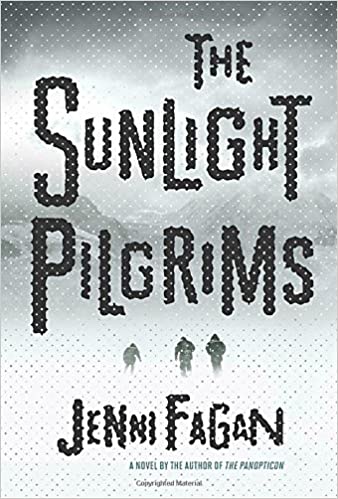
Review 1812: The Sunlight Pilgrims

Dylan MacRae has had a tough few months. Both his mother and grandmother have died, and he has been unable to save the family business, a small art cinema in London. That’s not all, because the melting of the polar icecaps is causing a new Ice Age, and the upcoming winter is forecast to be brutal.

Dylan has discovered that his mother purchased a small caravan in Scotland off the books before she died, so that he would have a place to live. On the eve before the cinema and his flat above it are repossessed, Dylan packs a suitcase containing a few things as well as the ashes of his mother and grandmother and takes a bus to the Clachen Fells in the Highlands of Scotland.

Upon his arrival, Dylan falls in love at first sight with Constance, another resident of the caravan park. She is an independent survivalist with a teenage trans daughter named Stella and two lovers. Temperatures continue to fall.

Dystopian novels aren’t usually my thing, but I became so involved in the lives of Dylan, Constance, and Stella that I enjoyed this novel of life doing its best to prevail in brutal conditions. Fagan has a talent for creating appealing characters. This is another winner from the author of The Panopticon.

The Panopticon

Greenwood

The Year of the Flood

Review 1370: Unsheltered

Unusual for Barbara Kingsolver, Unsheltered is a dual time-frame novel, changing centuries every other chapter. The setting is the same, though, the odd town of Vineland, New Jersey.

In the present time, Willa’s family has discovered that the house she inherited in Vineland is no asset. Both she and her husband, Iano, have recently lost their jobs through no fault of their own. Willa’s magazine failed, and so did the college in West Virginia where Iano was tenured. When he finally got hired in an inferior level for a one-year position, the inherited house nearby had seemed like a godsend. But now she has found that it is falling down, with part of the old house not even on a foundation, and too expensive to fix.

To make matters worse, they are the only people in the family who offered to take in Iano’s ornery dying father. Their daughter, Tig, has also unexpectedly returned from a year in Cuba. Finally, their son Zeke’s partner has committed suicide, leaving him in an apartment he can’t afford with a baby son. Willa and Iano offer him a place to stay, but what he wants is to leave his son with them.

In mid-19th century Vineland, Thatcher Greenwood has moved his new bride, Rose, back into the house she grew up in. They are also living with her mother, Aurelia, and young sister, Polly. Thatcher is delighted with his wife but is soon to find that they don’t share the same values. His position as a science teacher pays very little, but Rose and her mother continue to demand elegancies that belong to their former life, before Rose’s father went broke.

Next door, Thatcher meets Mary Treat. Rose knows her as the poor woman who was deserted by her husband, but Thatcher learns that she is a scientist, whose correspondents include Charles Darwin.

Vineland was founded as a sort of utopia by Captain Landis, but Thatcher begins to see the cracks in that utopia. One of them is his employer, who will not allow him to teach anything more than rote memorization and hates most recent scientific theories, particularly Darwin’s.

Both of these main characters are concerned with keeping shelter over their families’ heads, but while Kingsolver links the stories through Willa’s growing interest in Mary Treat, she is also able to draw many parallels between the two times. The present uncertainty in the poor economy of the Eastern Seaboard she compares to the uncertainty in the lives of Vineland’s population, of workers promised much by a man who can repossess their property if they fail. An unmistakable political figure in the present day, nicknamed by Willa The Bullhorn, bears a metaphorical resemblance to Landis, who is essentially a conman. The main characters’ housing insecurity stands for the insecurity of the entire population as a result of climate change and the death of the American dream. Kingsolver has lots to talk about.

I’m not so sure how much I liked the dual narrative. I was far more interested in the present-time story than I was in the older one. Kingsolver seemed to want to write about Mary Treat, but Treat features more as an important secondary character. And I have to say that some of Willa’s discussions with her daughter and her ruminations about those discussions border on the didactic (which we know has been a fault of Kingsolver in some other books).

Still, it is great to have another book out by Kingsolver. She can be hit or miss, but I have very fond memories of some of her books.

Related Posts

The Lacuna

The Weight of Ink

Maddaddam

Day 1050: Golden Age

Cover for Golden AgeGolden Age is the last book in Jane Smiley’s Last Hundred Years trilogy. It begins in 1987 and finishes a couple of years into a slightly dystopian future.

The Langdon family tree has expanded since the first book. Now, the original Langdon children are in their 60’s and 70’s. One has died of cancer, and by the end of the novel, only one of them is still living.

By necessity, this novel concentrates more on some of the Langdon descendants than others. Frank and Andy’s sons Richard and Michael are continuing to clash. Richard forges a political career by being a compromiser, while Michael makes it big on Wall Street and subsequently misappropriates funds from several member of his family. Joe’s son Jesse continues to struggle with the farm while both of his sons go to war. Claire finally finds happiness with Carl. Felicity becomes an environmental activist, while Janet spends most of her time with horses. Henry and Andy are also important characters.

Like the other novels, Golden Age covers most of the important events in its time period, the past 30 years—recessions, wars, 9/11, climate change, and fiscal crimes. Guthrie goes to Iraq. A family member is killed on 9/11. Michael is a major criminal on Wall Street.

Although I still felt some distance from the characters because there were so many and because the narration skips around from one to another so often, I couldn’t help but be caught up by the sheer volume and breadth of the trilogy. I wasn’t sure what I thought about the projection into the future of a country largely devoid of rain and mounting in chaos. Smiley, of course, couldn’t predict our current peculiar election results, which shows up the problems with this type of predictive writing in a largely realistic novel. Some aspects of her last chapters remind me a bit of Margaret Atwood’s Maddaddam series.

Related Posts

Some Luck

Early Warning

Maddaddam