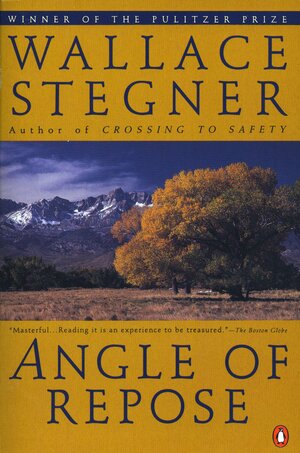
Review 2555: Angle of Repose

Again, when I finished reading this book, which was supposed to be for my A Century of Books project, I found the year already occupied. I have been using Goodreads and often Wikipedia to find books for each year, but Goodreads seems particularly inaccurate. I suspect that what happened here was that it listed the novel for, say, 1981, where I still have a hole (as of this writing in February), because of a 10-year anniversary reprint. I often check the dates if they seem suspicious, but this one didn’t. It’s especially bad now because it took eight days to read, and I am way behind on my reading. I only have a few more books to go, but from now on, I’m double-checking the publication date before I start reading.

Lyman Ward, a former academic just in his 50s, has contracted a bone disease that has frozen his neck so that he can’t turn it, confined him to a wheelchair, and resulted in the amputation of one of his legs. He is almost completely helpless, so his son wants to move him into care, but he stubbornly remains in his grandparents’ home in Grass Valley, California, being taken care of by Ada, a local woman.

His wife, Ellen, left him abruptly for his surgeon when he was helpless in the hospital. Although her partner died soon after and she has shown signs of wanting to return, he stubbornly refuses to see her.

Lyman can read, though, and do other sedentary activities. He was raised by his grandparents, and his grandmother was in her time a famous illustrator and writer, Susan Burling Ward. He has come across newspaper clippings and letters she wrote to her best friend, so he decides to write a biography of her, partly to answer questions for himself about events in his family he doesn’t understand.

Angle of Repose combines Lymon’s current experience and thoughts as he does this work with the events in the biography he is writing. The historical arc of the novel predominates, so much so that I occasionally wondered why Lyman’s story was there at all. However, by the end I understood how his grandparents’ history informs his own.

It’s a mismatch. Susan Barling as a young woman is from Upstate New York, a gifted artist just beginning to become known. She yearns for a life of culture. Her best friend, Augusta, comes from a prominent, cultured New York City family, and as young women, Susan and Augusta make a threesome of friends with Thomas Hudson, a poet and editor who goes on to become famous himself. She meets Oliver Ward, a young mining engineer, when she is very young. Unlike her other friends, he is taciturn and maybe too respectful of them all. He goes away on a job in the West for five years.

Thomas, sensitive, intelligent, and delicate, is Susan’s idea of a perfect man. He picks Augusta, though, and Oliver returns around the same time. Despite her friends’ misgivings, Susan decides to marry Oliver. Her idea is that Oliver can get some experience in the West and then move back East to live a more cultured life. She doesn’t seem to realize that to do his work, he must be in the West, and he is suited for that life.

As far as his career is concerned, Oliver seems too prone to consult Susan’s convenience, and she has unrealistic ideas. He turns down some opportunities because they don’t seem suitable to Susan. He takes a short-term job and they live apart. (She is too genteel for these rough mining camps.) She finally joins him near a mining town named New Almaden, southeast of San Jose. He has taken a house away from town, which anyway she removes herself from, as she does everywhere they live, thinking herself too good for the company. As Lyman says, his grandmother is a snob. Here she begins a pattern of not joining into society and their life but enduring it.

The couple doesn’t thrive financially. At this time, there are lots of qualified engineers available and most of them aren’t as fussy about where they’ll go. Susan’s work writing articles about the West and illustrating other writers’ work is helping support them, despite Oliver’s dislike of the situation and Susan’s complaints about it. They move to Leadville, Colorado, which although it is primitive, allows her to open her home to some intelligent visitors and have lively, informed discussions, which she loves. But the Leadville mine eventually grinds to a halt because of a lawsuit brought by would-be claim jumpers.

The couple goes to Mexico, which Susan loves, but the mine doesn’t prove promising. Their projects gain and then lose funding, and so on.

Susan writes to Augusta constantly, but Augusta never acknowledges Oliver as a fit husband. I fear that much of Susan’s growing disappointment has to do with wanting to justify her choice to her friends.

In the novel’s current time (the late 1960s and early 70s), Lyman expresses some irritating views on the times and young people. I wasn’t sure whether they were Stegner’s own views or more delineation of Lyman’s character, but Lyman eventually forms a sort of friendship with a young woman who acts as his secretary for a time.

This is ultimately a fascinating and absorbing story, but this time through (I apparently read it in the mists of time but didn’t remember anything about it) I kept getting distracted from it. I’m not sure why. I think, though, that it deserved more attention from me. Although I was bothered by Lyman seeming to blame all his grandparents’ problems on his grandmother (and after unfortunate events, his grandfather’s intransigence), the novel is considered Stegner’s masterpiece and won him the Pulitzer.

Related Posts

Obscure Destinies

The Town

North Woods

Review 1313: Obscure Destinies

Cover for Obscure DestiniesObscure Destinies is a collection of three longish stories by Willa Cather. They are all character studies of people living in small prairie towns. I distinctly felt that the stories were based on people Cather knew during her days in Nebraska, even though one story is set in Colorado.

“Neighbor Rosicky” is about a farmer, an old Czech man whose doctor tells him at the beginning of the story that he must stop all hard work. He has a heart condition.

Rosicky has not prospered as well as some of his neighbors, but he is a kind man who enjoys life. He has an affectionate relationship with his family, but he is afraid that his oldest son, Rudolph, and Rudolph’s wife, Polly, will become discontented with the difficult life of farming and move away to the city. Rosicky has lived in London and New York and felt that he was never free until he owned his own land.

“Old Mrs. Harris” is about a woman who lives with her daughter’s family. Mrs. Rosen, her neighbor, thinks she is mistreated. Her room is a passageway in the house, and any treats intended for Mrs. Harris are either resented or appropriated by her daughter, Mrs. Templeton.

Mrs. Harris is from the South, where it was apparently commonplace to spoil young women, and where some older woman usually ran the household behind the scenes. But here she has no help besides a hired girl, and Mr. Templeton’s career has not been successful.

Young Vicky has an opportunity for a scholarship, and she has been encouraged to study by the Rosens. But the Templetons see no reason why she should go to college. Only Mrs. Harris understands.

“Two Friends” is about the friendship between two prominent businessmen in town, Mr. Dillon and Mr. Trueman. The narrator as a child loves playing at their feet each evening as they discuss Mr. Dillon’s tenant farmers, the history of the area, and other interesting topics. However, the friendship eventually founders over politics.

These stories are interesting and insightful character sketches. “Neighbor Rosicky” even brought tears to my eyes. I believe I’ve enjoyed these stories more than I have some of Cather’s novels, which is unusual for me.

Related Posts

My Mortal Enemy

The Optimist’s Daughter

Lila

Day 1112: Brook Evans

Cover for Brook EvansSusan Glaspell’s novel Brook Evans shares some themes with her more famous Fidelity, but she makes an interesting inversion in the plot. Still, the ultimate message is the same as in her earlier novel.

Brook Evans’s story begins with that of her mother, Naomi Kellogg, in 1888. Naomi has been secretly seeing Joe Copeland since his mother objected to their keeping company. They plan to be married in the fall, after the harvest.

But Joe is killed in a farming accident. Seeing no alternative but disgrace, as she is pregnant, Naomi reluctantly marries her other suitor, Caleb Evans, and leaves her beloved Illinois home for Colorado.

Nineteen years later, Brook Evans wants to go to a dance with Tony Ross. Not only does her father, Caleb, not believe in dancing, being religiously strict, but Tony is a Catholic and part Native American. Naomi sees Brook’s relationship with Tony as an echo of hers with Joe, and she is determined not to sacrifice her daughter’s life to worries about what others may think. Unfortunately, the disagreement with Caleb brings out the truth of Brook’s parentage, with unforeseen results.

In Fidelity, the heroine’s decision to grasp life by running away with her married lover blights her life. In Brook Evans it is the instinct to conform with societal norms that is blighting. Still, the ultimate message of both books is to follow your heart. Although I wasn’t so fond of Brook’s ultimate choice (or the perceived alternative) I found this novel thoughtful and so touching that at times I was in tears. Glaspell’s characters show several sides throughout the novel, so that at times you change your mind about them. This novel is another thought-provoking read from Glaspell.

Related Posts

Fidelity

Greenbanks

Someone at a Distance

Day 1055: Benediction

Cover for BenedictionBest Book of the Week!
Goodreads has Benediction listed as Plainsong #3, which makes me wonder what that means. The first two novels in the series, Plainsong and Eventide, were very closely related, but this one not so much. All three of them are set in Holt, an imaginary town in Eastern Colorado, but then again, all of his novels are set there. Yet, these three novels all have titles related to religious services and song.

Dad Lewis is dying. That’s the central focus of the novel. But this novel even more than the others provides a picture of small-town life by looking at the neighbors and others in touch with Dad during his last weeks.

Dad is loved by his wife Mary and daughter Lorraine, but his son Frank has long since disappeared from their lives. When Frank was a young man, Dad was not understanding at all about his homosexuality, and that conflict eventually resulted in a complete break.

Dad is also perhaps not being fair to his long-time employees. When he was 22, his boss gave him an opportunity to buy the hardware store, and he has owned it ever since. Now he wants a reluctant Lorraine to take it over instead of extending the same opportunity to his two employees.

There are other things Dad frets over and even hallucinates about, but the novel isn’t just about Dad. The Lewis’s next-door neighbor Berta May has taken in her granddaughter Alice after her daughter’s death. Lorraine lost her daughter years ago, and she and retired schoolteacher Alene take Alice under their wings.

Reverend Lyle has been sent to Holt after a problem in Denver. His wife and son John Wesley are unhappy in Holt, and soon Lyle begins expressing opinions that leave some of the town in an uproar.

This novel is written in Haruf’s lovely spare prose. In theme and plot, it seems more diffuse than his other novels, but it is profound and moving.

Related Posts

Our Souls at Night

Gilead

Pastoral

Day 849: Our Souls at Night

Cover for Our Souls at NightBest Book of the Week!
Since this is my post before Valentine’s Day, I’m trying to observe the day with a book about love. Kent Haruf, who passed away in 2014, was a great stylist. His prose is unbelievably spare, his tales about ordinary small-town people in eastern Colorado. When it was my turn to make a book club selection for the anniversary of his death, I picked Our Souls at Night, his last book.

Louis Waters is a lonely widower in Holt, the town where most of Haruf’s books are set. One day his neighbor Addie Moore stops by with a proposal. She would like Louis to come over and sleep with her at night, sleep and talk. She misses this intimacy since her husband died. He decides to agree.

Although Louis and Addie are not having a romantic relationship, at least not at first, that’s what the town thinks. Instead, they are simply lying together and talking over their lives. We learn, for example, that once Louis fell in love with another woman and briefly left his wife for her. Everyone in the town knows this, but Louis explains to Addie how he felt and why he returned to his wife.

Addie’s son Gene is having marital problems, so he asks Addie to take his young son Jamie for the summer. Soon Jamie grows to care for Louis, who adopts a dog for the boy to play with.

This is a quiet novel about loneliness, friendship, and love. Haruf said it has its roots in the conversations he had at night with his wife. Our Souls at Night is a lovely novel.

Related Posts

Black River

Major Pettigrew’s Last Stand

Beautiful Ruins

Day 527: The Possibilities

Cover for The PossibilitiesAfter her son Cully’s death in an avalanche near their home in Breckenridge, Colorado, Sarah St. John is having difficulties. She has returned to work as a host of a local TV show but finds it hard to raise the enthusiasm needed. She is angry at the loss of her son, who had only just graduated from college, and is upset with herself for nagging him about his recent aimlessness. She is suffering from grief and a loss of identity.

Then she begins discovering facts about Cully that she didn’t know. She finds paraphernalia for selling pot in his room, which jolts her. A young woman named Kit comes to see her, pretending to want a snow-shoveling job, but she is really Cully’s girlfriend. Sarah had never even heard of her before.

Sarah’s family and friends are planning to attend a second memorial for Cully in Colorado Springs given by his friend Morgan. Sarah is dreading it, as she does not know how to deal with the sympathy or attention. Feeling the need to discuss the drug discovery, she asks Cully’s father Billy, whom she never married, to come see her the day before the memorial.

This novel is a wise and heart-warming, sometimes humorous examination of grief and of life’s surprises. As in The Descendants, a disjointed and somewhat alienated family becomes closer and gathers new members after experiencing grief and making hard decisions.

http://www.netgalley.comI found myself liking all the characters. Sarah is handling her feelings poorly but is sympathetically human. Her father Lyle is a retired public relations executive for one of the resorts. He is not doing retirement very well, giving his ex-coworkers unsolicited advice and buying too many gadgets on QVC. He moved in temporarily with Sarah and Cully and somehow never left, but Sarah likes him being there. Billy is calm and supportive, quietly dealing with his own grief. Sarah’s friend Suzanne, in the midst of a divorce, is at once annoying, interfering, and caring.

I will soon be reviewing The Descendants, but in The Possibilities I find another satisfying and touching novel by Hemmings.

Day 498: The Hour I First Believed

Cover for The Hour I First BelievedThe Hour I First Believed is described on its jacket as an exploration of faith, and as such I didn’t think it would be very interesting to me. But it is really more about a man’s struggle to face the problems of his life and his own demons. It is an extremely interesting and affecting work.

Caelum Quirk is not always a likable protagonist. He has anger issues—went after his third wife’s lover with a wrench—can be withdrawn and drink too much, says the wrong thing quite often, and earned my personal disregard at the beginning of the novel by referring to two different women as a ballbuster and a nutcracker. Lamb had to work hard to get my sympathy for his character after that, but he did accomplish that by the end of the novel. Still, whether I liked Caelum or not, I couldn’t tear myself away from his story.

Caelum is trying to salvage his marriage after the wrench incident, so he and his wife Maureen decide to move away from Three Rivers, Connecticut, the town where his family has a lot of history, and get jobs in Colorado. They are settled there and are doing okay, although still having relationship issues, when Caelum is called back to Connecticut because his beloved Aunt Lolly has had a stroke. She dies shortly after he returns, and Maureen is making arrangements to come for the funeral but decides to work one more day at the high school where Caelum teaches English and she is a nurse. Unfortunately, the high school in question is Columbine, and the school day she works is the day two students go on a rampage.

Maureen would normally be out of the area of trouble, but that day she decides to help Velvet Hoon, a troubled drop-out, fill out some papers in the library. Although she is not killed, she hides in a cupboard for hours before she is found, and subsequently suffers from post-traumatic stress disorder that barely allows her to function. She also struggles with an addiction to uppers.

Caelum and Maureen move back to live on Caelum’s family farm, a place for which he has mixed but mostly negative feelings. His father was a drunk of whom he was ashamed. He remembers his grandfather as judgmental and his mother as cold. Only Lolly seemed to care for him.

Troubles are not over for Caelum and Maureen, but I don’t want to reveal more about that. Caelum must also deal with his feelings about his family. His great-great grandmother was an early fighter for abolition and women’s rights, and she was instrumental in establishing the women’s prison down the road from the farm. It had a long history of treating the women with dignity and had a low rate of recidivism until its values were changed by modern tough-on-crime politics. Caelum’s great-great grandmother’s papers are in a spare room of the house. When Caelum is forced by financial circumstances to rent part of the house to a couple evacuated from New Orleans because of Hurricane Katrina, the wife, a women’s studies graduate student, asks if she can examine them. This and other events lead Caelum to several discoveries about his family.

This novel is sprawling, even a bit messy, because it seems to want to deal with everything. It features large events such as Columbine, 9/11, and Katrina, as well as the inequity of the American justice system, PTSD, drug addiction, grief, love, trust, religion, infidelity, and other issues. It is interesting, frustrating, and ultimately worth reading.