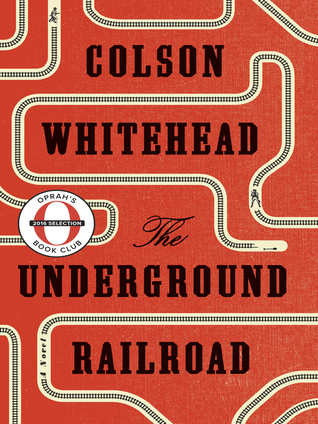
Review 2144: The Underground Railroad

Cora is a slave on a brutal Georgia plantation. When a new slave on the plantation, Caesar, tells her he is going to escape and invites her to come, she at first refuses. But later her master’s brother inherits the plantation and sets his eye on her, so she and Caesar escape using a branch of the underground railroad.

Up to this point the book is grim and realistic, but Whitehead makes his underground railroad an actual train, destination unknown, and here the novel departs from reality so that Whitehead can make points about the evils of slavery and racism in all its incarnations.

Caesar and Cora arrive in what seems to be a utopian South Carolina, where the state has decided to educate and train slaves who have been freed. But there’s a deeper, darker subtext to the plan.

Determined to capture Cora is Ridgeway, an infamous slave-catcher. Cora’s mother Mabel disappeared when Cora was a girl, never to be seen again, and he took it as a personal failing. So, he’s determined to catch Cora, and he eventually turns up in South Carolina.

I have to admit I have problems sometimes with magical realism, and the combination of a real train and a South Carolina that never existed ground me to a halt. However, as Cora’s adventures continued, eventually I was charmed again and found the novel a powerful work of imagination.
Related Posts

Washington Black

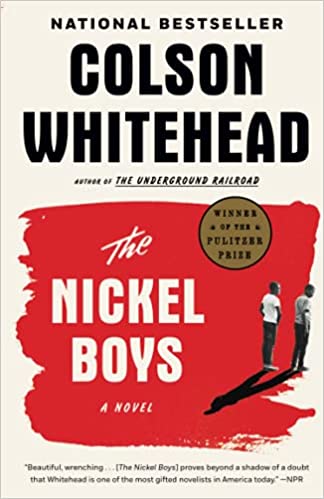
The Nickel Boys

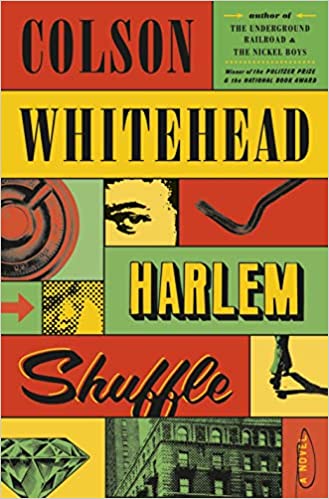
Harlem Shuffle

Review 1890: Harlem Shuffle

Colson Whitehead is certainly a story teller. In Harlem Shuffle, he tells the story of Ray Carney, whom he describes as “only slightly bent when it comes to being crooked.” Carney’s father broke knees for a living, and Carney hated him, so Carney has earned a degree in business and has worked hard to keep his furniture store going. He only occasionally deals in suspect merchandise.

However, Carney’s cousin Freddie, who grew up like a brother, is the type of guy who is always up to something and it never turns out well. In the first section of the book, Freddie is planning a heist with some guys, and when they need a fence, he suggests Carney. Carney knows this is way above his head, so he says no. He is tipped off that Freddie is in trouble when he gets a call from some men working for Chink Montague, a notorious criminal, looking for something that belongs to Chink. It turns out Freddie has not conveyed Carney’s refusal to the gang, and soon Carney finds himself in possession of a large emerald necklace that is part of the robbery of a hotel vault.

This novel is set in late 50’s and 60’s Harlem, and vividly depicts the events of this period at the beginning of the Civil Rights movement. Whitehead is clever about earning the readers’ sympathy for Carney despite his misdeeds. He makes it clear how difficult it was during this time for an African-American who starts with nothing to make a success of himself. Aside from Freddie’s plots, Carney has to deal with the slights of his in-laws, who think their daughter married beneath herself, as well as paying off both the thugs and the police, being cheated by supposedly respectable businessmen, and so on. Another absorbing novel by Whitehead.

Related Posts

The Nickel Boys

Jack

Meridian

Review 1845: The Nickel Boys

The Prologue of The Nickel Boys is chilling in and of itself. The novel is based on investigations into the Dozier School for Boys in Florida, which turned up evidence of mistreatment, torture, and even murder of young boys.

Set mostly in the early 60s, the novel follows Elwood Curtis, a black boy who has been taught to do what is right and who has been inspired by the speeches of Martin Luther King, Jr. His attitude seems to be working. He is doing well in high school, he has a job with a good boss, and his presence at some demonstrations for equality has earned him an invitation to take college courses.

He is on his way to college for the first night of classes when he accepts a ride from a stranger. Next thing he knows, the car has been pulled over as stolen and he’s been sentenced to the Nickel Academy for Boys.

On his second day, still trying to make sense of things, Elwood steps in to stop some bullying and ends up being beaten senseless by the Director. He spends some time in the infirmary, where the doctor only prescribes aspirin no matter what the problem is.

When he gets out, Elwood is befriended by Turner, who tries to show him how to get by. Turner gets him on Community Service detail, where Elwood observes all the food for the school being sold to restaurants, boys being sent to homes of the board members to do yard work and painting, and other signs of graft and corruption. Elwood writes them all down.

This novel is a searing record of the recent racial history of our country as well as being a story of friendship. It’s a powerful book. It makes me wonder why I haven’t read any Whitehead before.

Related Posts

NW

The Cold Millions

The Goldfinch