
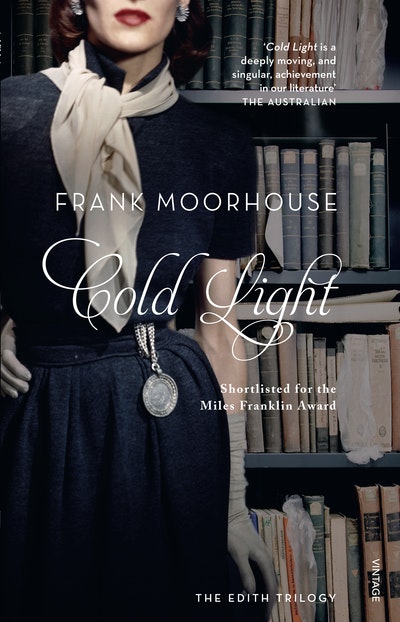
In this third book of Moorhouse’s Edith trilogy, the League of Nations having closed and Edith’s hopes of getting a job with the United Nations dashed, Edith has decided to move back to Australia, thinking that Canberra will “snap her up.” (I was surprised that she thought this after her last job hunt in Australia.) Her husband Ambrose has managed to get a position with the British but is not happy to be there, and Edith has been back for months without any job offers. Her lack of an official title at the League, its spectacular failure, and sexism seem to be getting in her way.
Then her brother Frederick, who disappeared from the family 20 years ago, makes himself known to her. He is an organizer for the Communist party, a true believer. Talk is building up about banning the party in Australia, and in the U. S., Senator McCarthy is building power around this issue, so Edith isn’t sure what to do about Frederick and his girlfriend Janice.
Edith learns that the Canberra government isn’t hiring married women, but she eventually gets a temporary position organizing a conference about the design of the city. When the opportunity comes, she and Ambrose have just decided to move back to Europe and she thinks the job is beneath her, but by the end of the interview, she is sucked in. Of course, she uses this position to shoehorn herself into more opportunity.
I have been ambivalent about this series. At times, it is really interesting, while at other times it dwells too long on the details of some subject. For, continuing on with the theme of Edith being involved in world events of her time, there is a great deal of discussion of Communism from both sides as well as the ramifications of passing a law against it. (Edith has a long discussion with her old mentor, John Latham, a supreme court judge, who she believes voted wrongly on the issue, and it turns tedious.) The novel also deals with uranium and nuclear bombs vs. nuclear energy, as Edith makes herself an expert on uranium.

My other problem is that Edith has always seemed unconvincing to me as a woman. She is a bold and impulsive woman, true, but some of the things she does and the way she thinks don’t seem like the actions and thoughts of any woman I can imagine.
On a related issue, I was kind of fascinated by the cross-dressing aspect of her relationship to Ambrose and the emphasis on it—because there is no such emphasis on any of her other husbands. Robert is around for a millisecond, and she rarely mentions Richard after she marries him except in terms of his kids—not until she decides to leave him, at which point suddenly a chapter is devoted to their relationship.
Thinking about what Moorhouse chooses to talk about and what he ignores brought me to this conclusion. Authors often invest themselves in their characters by imagining that they are their main character (or some other). For a long time, I thought Moorhouse saw himself as Ambrose, but I finally decided that either he saw himself as both Ambrose and Edith herself or perhaps simply as Edith.

 What? Me Read?