
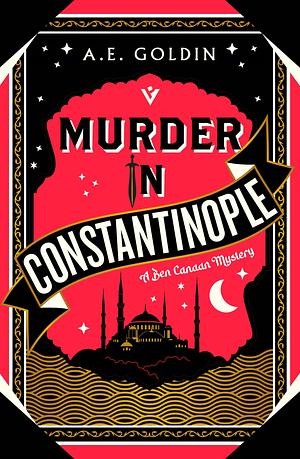
If you want a historical novel that reflects careful research and knowledge of the period, this isn’t it. If you want a novel with a believable plot, this isn’t it. If you want an old-fashioned adventure story, this might be closer.
In 1854 London, Ben Canaan is a Jewish tailor’s son on his way to becoming a nogoodnik. He was a scholar who wanted an academic career, but his father took him out of school to work in the family shop. On the day we meet him, he takes some clothes he is supposed to be delivering, and he and his friends wear them to an elite ball, where he pretends to be a Duke’s son. But he is discovered by the Duke’s son, and in the resulting struggle, a gun he is carrying goes off. He becomes a wanted man.
Before that, though, he helped his father measure Lord Palmerston for a suit. In his pocket, he found a photograph with a familiar face—his lover, who he believed dead, in front of Hagia Sofia in Constantinople with a cryptic message beneath. Since he has to leave town anyway, he persuades the criminal kingpin he does errands for to send him to Constantinople. He departs on a military ship on its way to the Crimean War, serving as a common sailor.
I had immediate problems with historical accuracy when he sashays up to a beautiful girl at the ball and introduces himself under his assumed name, then asks her to dance and she does. At this time, she wouldn’t have spoken or danced with him without an introduction. And where, exactly, is he supposed to have carried on his affair with his lover? He’s a very young man, basically just jerked out of college.
I have to tell myself just to judge the novel on its own terms, as an adventure. In that respect, it certainly shows some flights of fancy with its brash, very young man managing to work his way into the upper echelons of society and get involved in political intrigue.
I was very interested to find that in 19th century Turkey, almost everyone speaks English, including Kurdish street urchins and women who live in the Sultan’s harem. (You can see I’m being facetious here.)
The dialogue is supposed to be witty, but I found it cumbersome.
Judged purely as an adventure story, I still found it a bit meh.
 What? Me Read?