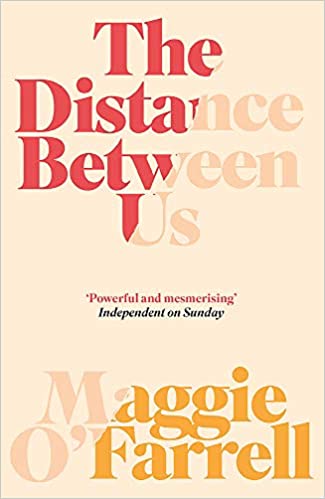
Review 1633: The Distance Between Us

Jake, a Hong Kong Brit who has never been to Europe, is out with friends on Chinese New Year when they are caught in a crush. His girlfriend Melanie’s best friend is killed, and Melanie is gravely injured. Doctors say she will not live, so when she asks him to marry him, he reluctantly agrees even though he has only known her for four months. Of course, she does not die. The next thing he knows, he is in England staying at her parents’ house, and her mother is planning a formal ceremony for them. Having always wanted to find out about his Scottish father, he leaves for Scotland.

Stella’s too close relationship with her sister Nina is one she has to escape from sometimes. The roots of this lie in a horrible incident years ago. On one of her escapes, she takes a job at a hotel in Scotland.

This novel travels back and forth to relate incidents in both Jake and Stella’s lives and in the lives of their parents and grandparents. O’Farrell has a way with making you care about her characters as well as a gift for lyrical prose. This is another great book for her, and thus for her readers.

Related Posts

After You’d Gone

This Must Be the Place

Instructions for a Heatwave

Review 1632: Memories of the Future

When reading Hustvedt, I am always aware of an intelligence far greater than mine as well as a quality of being frighteningly well read. I especially noticed these attributes in Memories of the Future, an apparently autobiographical novel.

In the novel, the narrator, S. H., has found her old diaries from when she was a young adult and moved to New York City to spend a year writing a novel. She breaks up the story to reflect on her thoughts and actions of the time, provide a few updates on her present life working on this novel and visiting her elderly mother, present portions of the novel she was writing back then, and even take on a sort of third persona, the Introspective Detective.

S. H., who acquires the nickname Minnesota, is thrilled to move into her tiny, dark studio apartment, because she is starting a new life. Next door, her neighbor, Lucy Brite, has intriguing dialogues with herself that S. H. begins eavesdropping on, trying to figure out what she’s talking about, as it seems to involve violence.

Minnesota is given her nickname by her new friend, Whitney, who attends the same types of poetry readings and lectures, and soon Minnesota is part of a lively group of young people. She is already running out of money, however, and has some dark times ahead of her.

Hustvedt muses on some interesting topics, such as the nature of memory and the effects of aging, but most of her anger centers around women’s learning of acceptance. In an incident that turns out badly, she asks her younger self why she was more concerned with politeness and going along than with her instinct to resist what was happening. As in the wonderful The Blazing World, she tells the real story of a woman whose work is claimed by a man, Baroness Elsa Von Freytag-Loringhoven, an artist and poet whose sculpture was claimed and attributed to Marcel Duchamp after her death.

I found this novel more difficult and not as engaging as the other two I have read, but still, she is always inspiring and fascinating. I just wish I understood more of her allusions and philosophical meanderings.

Related Posts

The Blazing World

The Enchantment of Lily Dahl

The Wife

Review 1629: The Guest List

A wild Irish island seems the perfect place for the wedding of Jules and Will. The only building on it is an old mansion that has been fabulously restored and is just big enough for the wedding party and the hosts, Aoife and Freddie. The high-society guests will be boated in the day of the wedding.

The bride and groom seem to be a golden couple. They are both physically attractive, and Jules runs a fashion magazine while Will is a rising star in television. However, someone in the wedding party is a sociopath who has ruined many lives, and future victims are on the guest list.

The novel begins in a tumultuous storm during the wedding reception when a waitress thinks she sees a body outside. From there it flashes back to the points of view of several characters beginning the day before the wedding. And the plot thickens.

I recently read Foley’s The Hunting Party and thought it was excellent. So, I was happy to read The Guest List. At first, though, it seemed awfully familiar—a remote island instead of a remote forest, the same kind of upper crusty characters. However, I was soon sucked in, because Foley is great with a suspenseful plot.

I did have one caveat. If there are several narrators in a book, they should not only have different concerns, which these characters do, but they should sound like different people. I don’t think Foley is quite so successful at that.

Related Posts

The Hunting Party

Strangers at the Gate

In a Dark, Dark Wood

Review 1626: The Overstory

Best of Ten!
When I read Richard Powers’ Orfeo a while back, I remember thinking he was quite a bit more intelligent than I am, perhaps a little intimidatingly so, yet I enjoyed his book. Reading The Overstory hasn’t changed my impression of that, except that it blew me away.

The novel is about trees. When am I ever going to write that sentence again? The metaphor for its structure that I’ve seen used is that it’s like the rings around a tree as you go inward, but that’s not the metaphor Powers actually uses. He starts in a section called “Roots” and works his way up the tree.

That doesn’t sound very interesting, but it is. He starts with a group of characters who have all formed an interest in trees. Nick Hoel’s ancestor planted some chestnuts on their farm in Iowa, and his father began a giant project of photographing the last one standing every month for years so that you could see its growth if you used the photos like a flip book. Nick, an artist, has re-created these photos as drawings. Mimi Ma’s father Winston brought with him from China an ancient scroll about trees and took his family out to enjoy the national parks. Adam Appich is a budding natural scientist until judges in a science fair think he cheated and he ends up in psychology. Still, his father planted a different tree for each of his children. Douglas Pavlicek is saved by a tree when his plane crashes in Vietnam, and so on. These lives are described as fables on the cover of the book, but the characters felt authentic, which they seldom do in fables.

In the next section, “Trunk,” Powers begins to intertwine the lives of these characters with each other and with the issue of what is happening to the trees in our world and what the consequences will be. Along the way, Powers tells us all kinds of interesting and astonishing things about trees.

The novel takes place between about the 50’s and 60’s to the present, but the meat of it is in the 70’s or 80’s when there was a lot of activism around the protection of our forests. Some characters’ stories begin earlier with their parents or ancestors.

But the novel is really about the trees, and as Powers’ sections go up the tree, the view becomes a little more abstract, while not losing sight of the human characters. I had a few issues with it. The role of Neelay Mehta, a boy of Indian descent who becomes a master computer programmer, doesn’t really fit well into the story. I understand his role but find it unconvincing. Finally, the last section is so abstract, it’s a bit above my head, although I enjoy Powers’ tendency to present readers with lots of ideas.

Overall, though, I was just entranced by this novel, so much so that I fear for our species. If anything is going to make you pay attention to climate change, it’s this book. Now that I live in a state where clear cutting is going on all around me, not just in the national and state forests but by the purchasers of practically every plot of land, who think nothing of devastating their lots for the money, I have been more struck by what we are doing to our forests. This is an incredible novel. I read it for my Booker Prize project, and it won the Pulitzer.

Related Posts

Orfeo

The Sunken Cathedral

Oryx and Crake

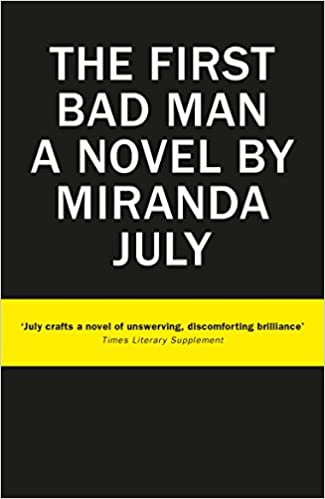
Review 1624: The First Bad Man

The First Bad Man reminds me of Eleanor Oliphant is Completely Fine except on steroids, because while Eleanor is one eccentric character, all of the characters in The First Bad Man are eccentric. I read this novel for my James Tait Black project.

Cheryl Glickman is a bit out of touch with normal human behavior. She is a manager at Open Palm, a martial arts/exercise company, but she has been directed to work from home and is only allowed to come to work one day a week. She has long been in love with Phillip Bettelheim, a much older man who is on the company’s board, and she consults a chromotherapist to treat her Globus hystericus simply because Phillip recommended him and so she can report back to him about it.

When she gets up enough nerve to show some interest in him (she tells him “When in doubt, give a shout”), he responds by asking her whether she thinks it is okay for an older man to be interested in a much younger woman. Of course, Cheryl takes this question as an interest in herself, when he is really in love with a 16-year-old schoolgirl. He continues to update her on the progress of the relationship, using explicit language.

As if this weren’t enough, the owners of the business, who routinely help themselves to supplies and the employees’ food when they come in, force her to let their daughter Clee stay with her until she gets a job. Clee is surly and unresponsive and then physically abusive when Cheryl tries to set her eccentric limits.

Cheryl herself is positive and upbeat most of the time, although she has arranged her house so that it doesn’t get dirty during occasional depressions simply by having almost no possessions. But Cheryl finds a way to respond to Clee that is unusual but ends up lightening the atmosphere.

Cheryl has some surprises for herself in this bizarre but touching novel. I liked it very much.

Related Posts

Eleanor Oliphant Is Completely Fine

Where’d You Go, Bernadette?

This Is Your Life, Harriet Chance!

Review 1622: Literary Wives! Every Note Played

Today is another review for the Literary Wives blogging club, in which we discuss the depiction of wives in fiction. If you have read the book, please participate by leaving comments on any of our blogs.

We’re sorry to lose Cynthia, who is discontinuing her blog.

Be sure to read the reviews and comments of the other wives!

Eva of Paperback Princess
Lynn of Smoke and Mirrors
Naomi of Consumed By Ink

* * *

Lisa Genova has certainly identified her niche, which is, with her knowledge of neuroscience, to write a compelling story that also allows readers to understand what it is like to suffer from a neurological disease. In this novel, the disease is ALS.

After a difficult divorce, Karina and Richard have had little to do with each other. Both are harboring a great deal of anger and resentment.

Richard, a world-class pianist, has put his career ahead of his marriage and family. However, he has been diagnosed with ALS and is becoming less able to care for himself.

Karina has avoided the friends the two had as a couple, but she finally attends an event and feels she is being blamed for the breakup. It is there she learns about Richard’s condition. She goes to see him, but the visit is toxic.

Eventually, though, she visits him again, only to find that even with home health care, he needs help, round-the-clock care. He broke with his family years ago, so he has no one. Karina arranges for him to move in with her.

Although at times I felt that some of the descriptions of the illness or the treatment were a little too detailed, I was ultimately very touched by this novel. Genova gives herself a tougher job this time by making the patient a less likable character, but she handles the situation insightfully.

What does this book say about wives or about the experience of being a wife?
This is a novel that saves some of its insights into Karina’s character for the end. We know that both Karina and Richard are angry with each other, but it is much clearer why Karina is angry than why Richard is until well into the novel, so I don’t see how I can discuss this without spoilers.

The immediate causes of the breakup of their marriage seem to be Richard’s serial infidelities and his neglect of Karina and daughter Grace over a period of years. However, as the novel progresses, we learn of Karina’s contribution to the failure of their marriage. First, she changed from classical piano, in which she was more gifted than Richard, to jazz piano, partly because she loved jazz but partly so as to not compete with Richard. She made a place for herself playing in clubs in New York, but then Richard took a position in Boston without consulting her, and there was no jazz scene in Boston.

Literary Wives logo

Passive aggressively, Karina made excuses for herself not to try to continue her career—pregnancy, motherhood, resentment of Richard—and then more resentment as he began neglecting them and womanizing. Finally, there is the aggressive act of making sure she can’t conceive while pretending to try to conceive.

What makes the novel more than a litany of marriage complaints is how the situation causes both characters to understand the other, to acknowledge their own faults and trespasses, and to forgive.

Related Posts

Still Alice

The Dutch House

The Blazing World

Review 1620: Beatlebone

Judging by the description, Beatlebone is a novel I never would have picked up if not for my James Tait Black project. Often, these projects I’m pursuing have led me to discover wonderful books that I never would have thought to read, but this is not always the case.

Further, I think that reviewers sometimes get jaded, which causes them to give a book rave reviews just because it is different. Certainly, the newspaper and magazine reviewers raved about this one.

The premise is that John Lennon, in 1978, decides, in an attempt to renew himself, to visit an island he bought off the west coast of Ireland. He doesn’t want to be followed by the paparazzi, however, and he can’t remember exactly where his island is. He ends up being taken around by a man named Cornelius O’Grady, who hides him at his farm, takes him to pubs, and so on. During this time, Lennon has what are described on the jacket as surreal experiences.

The novel was lauded for its writing, and the writing is good, but it is full of Joycean monologues that sometimes go on for pages. One Goodreads reviewer mentioned that a novel needs more than good writing, and I’m with him there. I’m not one to say about a novel that nothing much happens in it if something else keeps my attention, but nothing much happens here, and what does happen, I didn’t have much interest in.

Several newspaper reviews mention Barry’s daring act of inserting himself into the novel. This act consists of inserting about 20 pages into the back end of the novel that would normally go in an Afterword. I found this section simply interrupted what little forward movement there was, as did a five-page rant at the end. The whole thing struck me as well-written fanboy fantasy.

Related Posts

The Story of My Teeth

Beautiful Ruins

The Sea

Review 1615: Swimming Lessons

Best of Ten!
I was interested in reading Swimming Lessons when it came out, but I never actually got hold of a copy. Then I read Fuller’s next novel, Bitter Orange, and liked it so much that I had to read Swimming Lessons.

Gil Colman, a famous writer who hasn’t written anything for years, is now elderly and dying of cancer. He has discovered letters from Ingrid, his wife who was presumed drowned years ago, tucked away in his thousands of books, many of which were removed from his house by his daughter Nan and sold to a bookstore. He is in the bookstore, having discovered one of the notes, when he thinks he sees Ingrid out in the street. Rushing after her, he gets injured.

That is the setup of the novel. From there, chapters alternate between the letters telling the story of their marriage from Ingrid’s point of view and Gil’s daughter Flora’s point of view as she returns home because her father is in the hospital. She tries to learn more about Ingrid, who she believes is alive. Although the sections about the current time and Flora’s struggles are interesting, most enthralling are Ingrid’s letters to her husband, describing a marriage in which, as a naïve girl thirty years Gil’s junior, she falls into a life she does not want, of marriage and children, to a husband who is serially unfaithful, and who, in a way, co-opts her past.

This is a fascinating and haunting story about the secrets of a marriage.

Related Posts

Bitter Orange

The Wife

The World’s Wife

Review 1611: Flights

Olga Tokarczuk’s Drive Your Plow over the Bones of the Dead was unusual, but Flights is in another category altogether. It is an attempt to escape the boundaries of the conventional, linear novel.

It is written in snippets. Some of them are stories, some little vignettes or descriptions, some philosophical discursions, some lectures. Some of the snippets are observations from the narrator, an unnamed Polish woman who likes to be constantly traveling, often to visit museums of curiosities, particularly those that show the workings of the human body. Others are stories about people she meets on her journeys or just stories about people. Some of the threads recur in the novel; most do not.

Anchoring all this is the theme of movement. Most of the stories are about people on their way somewhere else, occasionally to another stage of being.

This novel was widely acclaimed by reviewers and won the Man International Prize. How it will strike ordinary readers is hard to guess. It’s not easy. I found parts of it interesting and other parts, particularly the lectures on travel psychology, which I doubt anyone would ever listen to, incomprehensible, as if someone were reading from a dense professional manual.

Related Posts

Drive Your Plow over the Bones of the Dead

Outline

Ducks, Newburyport

Review 1583: The Northern Lights

I so much enjoyed Howard Norman’s My Darling Detective that I made a note to myself to read more by him. I finally chose The Northern Lights because of its setting.

In the 1950’s, Noah Krainik lives with his family on an isolated lake in northern Manitoba. His father Anthony is a geographer who is mapping the far reaches of Manitoba and Saskatchewan, so he leaves Noah, his mother Mina, and his cousin Charlotte alone for months at a time. He blames his work, but there are some events that don’t add up. For example, while out working he somehow ended up in Halifax and arranged for Charlotte to live with them after her parents were killed in a factory collapse. Halifax is a long way from either Manitoba or Saskatchewan.

Every summer, beginning when he is nine, Noah takes the mail plane to Quill, 90 miles away, to live with his best friend Pelly and Pelly’s aunt and uncle, Nettie and Sam. There he experiences the richer life of a village of Cree Indians, trappers, and others who prefer this wilderness life that smacks of a much earlier time period. The novel begins, though, in 1959, when 14-year-old Noah learns of Pelly’s death.

This evocative novel explores the life in the wilderness and what happens when Anthony’s desertion provokes a move out of the wilderness to Toronto. There, Mina gets a job at the Northern Lights movie theater, where she first met Anthony.

This is a novel full of interesting, colorful characters, and I greatly enjoyed it. I especially liked the portion set in remote Manitoba.

Related Posts

My Darling Detective

A Place Called Winter

Pastoral