Review 1473: A Long Way from Home

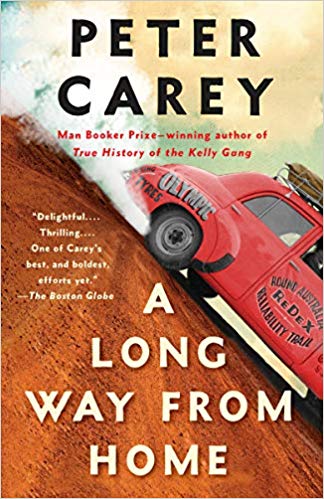
A Long Way from Home is almost like two different novels, starting out as a light-hearted romp and finishing with the Australian treatment of its indigenous inhabitants. It is set in 1954 Australia, all over it.

Irene Bobs and her husband Titch are tiny people with a great will to succeed, but they are hampered by the activities of Dangerous Dan Bobs, Titch’s father, who seems to be working against them. When Titch, who is the best car salesman in Southeastern Australia, wants to open his own Ford dealership, Dan prevents it using his influence with his cronies at Ford. Having opened a junk yard, Dan continually drops off expensive objects at Titch’s and then charges him for them.

Irene always vigorously supports Titch against Dan, so when Dan scuppers the Ford dealership, she has already arranged something with GMC. Then, the two get the idea to compete with one of their cars in the Redex Reliability Trial, a grueling test of a car’s endurance on horrendous roads all around Australia. Irene and Titch will be drivers, and their neighbor, Willie Bachhuber, will navigate. Of course, Dan decides to compete against them.

Willie is a recently fired schoolteacher. He is also a competitor on a quiz show and a fugitive, who left his wife after she had a black baby and is wanted for child support. His quiz show work, after a long run, ends when his infatuation with his competitor interferes with his thought processes. He is a great reader of maps, however.

The novel starts out bright and energetic, with vibrant and quirky first-person narration by Irene alternated with that of Willie. It takes a darker turn, though, after an accident with Dan. Soon, Willie is separated from his companions in far Western Australia.

I was really taken with this book, especially at its zippy and vivacious start. I liked the characters, and I thought the ending covers important history about aboriginal abuse. However, these comments don’t convey how the novel zips along in its own quirky way.

I read this book for my Walter Scott prize project.

Related Posts

Parrot and Olivier in America

Jack Maggs

Salt Creek

Review 1472: Daisy Jones & The Six

Daisy Jones & The Six, about the rise and demise of a 70’s rock band, is written like the script for a documentary. I got the impression at first that it was trying to accomplish something like Jennifer Egan’s amazing A Visit from the Goon Squad.

In the beginning of the novel, we see the separate starts of Daisy Jones and of the band that became The Six. Daisy, a neglected 14-year-old, begins as a rock and roll groupie, while the band works its way up through the usual dances and bars. When they are each beginning to get a little attention, a record executive thinks it would be a great idea if they record a song together. They are a hit. The only problem is that Daisy and the band’s lead singer, Billy Dunne, don’t seem to like each other.

This novel does a pretty good job of depicting the drug- and sex-fueled 70’s rock scene, but I felt it was about 100 pages too long. It also signals where it is going a little too early. The format has its problems. It makes the reader separate from the book even while amusingly showing how different people’s versions of the same event can be.

Taylor Jenkins Reid seems to have ambitions to write more than chick lit, but this novel is essentially chick lit.

Related Posts

A Visit from the Goon Squad

The Flamethrowers

The New Sweet Style


Review 1468: Swimming Home

I didn’t know what to make of Swimming Home because the situation was unbelievable to me. First, there is some timeline confusion because of a short scene dated July 1994 in which Kitty Finch is driving dangerously through the Alpes-Maritimes at midnight with a man. The scene seems threatening, and you get a sense of dread.

Then, the main action of the novel begins with no timeframe, so that you don’t know if the preceding scene comes before or after it or even what year we’re in until there are references later on.

Joe Jacobs, a poet and serial philanderer, has rented for the summer a villa in the Alpes-Maritimes with his wife Isabel, a war correspondent, his young daughter Nina, and another couple. They come home to find a naked woman in the pool, looking dead. She is not dead, she is Kitty Finch, a beautiful but clearly disturbed woman. She makes an unconvincing explanation that the owner lets her stay there sometimes off-season and she got her dates mixed up. It is not off-season, however.

Do they show her off the property? No, they do not. They invite her to stay in the extra room. In particular, Isabel invites her, which gives rise to wondering for the rest of the book.

In fact, it shortly comes out that Kitty knew Joe Jacobs was staying there and wants him to read her poem, “Swimming Home,” which is about suicide. It is clear all the way that the novel is working toward death, but the ending is surprising.

I read the novel for my Booker Prize project, and I’m still wondering about it.

Related Posts

Hot Milk

Siracusa

Days of Awe

Review 1463: This Must Be the Place

Daniel Sullivan is about to leave Ireland for a business trip when he catches a segment of a radio broadcast more than 20 years old. He hears the voice of Nicola Janks, his old girlfriend. When he learns she died in 1986, the year he last saw her, he becomes obsessed with finding out what happened to her, fearing he was responsible for her death.

Unfortunately, he is unable to explain this concern to his wife, Claudette. Instead, she hears from his family about his erratic behavior. He is supposed to visit his 90-year-old father in Brooklyn but stays only a few minutes before abruptly leaving to visit his children from his first marriage.

These are the first events in a series that will change his life. But O’Farrell is interested in more than these events. In chapters ranging back and forth over 30 years and switching point of view among the characters, she tells about the lives of many of them, of Claudette, the reclusive ex-movie star; of Daniel; of Daniel’s children and Claudette’s children; of Daniel’s mother; even of some of the novel’s secondary characters.

I came late to O’Farrell and so far have only read two books by her, but I’ve enjoyed them immensely. She catches you with her complex plots but keeps you with her characterizations.

Related Posts

After You’d Gone

Where’d You Go, Bernadette

Mercy Snow

Review 1458: Winter

The beginning of Winter was so bizarre that I wasn’t sure I was going to finish it. Sophia is an older woman living in a large home in Cornwall. She has begun to hallucinate a child’s head that floats in the air and interacts with her.

Art, Sophia’s son, has split from his girlfirend, Charlotte, and she is now posting tweets on his Twitter account that are causing problems for him. Art is supposed to take Charlotte to his mother’s house for Christmas. Unable to explain what happened, he hires a girl named Lux to pretend to be Charlotte.

When Art and Lux arrive at Sophia’s house, they find it barely furnished, with no beds in the extra bedrooms and no food in the refrigerator. Sophia seems vague and much too thin. At Lex’s insistence, Art summons his Aunt Iris, even though Iris and Sophia haven’t spoken in years.

As I said, this novel started in such a way that I wasn’t sure I would like it. It is quirky, certainly, but it grew on me. Things that seem inexplicable are explained, in a way. As usual with Smith, there is a strong focus on art and ideas. Smith is always interesting and inventive.

Related Posts

Autumn

How to Be Both

Look at Me

Review 1454: Milkman

Best of Ten!
Middle sister, the unnamed narrator in a novel where no one has a name, has a stalker. Actually, she has two. She lives in the 1970s in an unnamed city that is clearly Belfast, and at 18 she has no way to explain what is happening to her and no one to tell, anyway. The man she’s worried about is known as the Milkman, rumored to be a powerful renouncer-of-the-state. This stalking begins with him driving up next to her and offering her a ride. She knows not to get into his car.

That is all it takes for rumors to begin flying about that middle sister is having an affair with the Milkman. Eldest sister, egged on by her husband, who has been letching after middle sister since she was 11, arrives to berate her for this supposed affair with a middle-aged, married man.

But middle sister’s strategy for keeping safe in a dangerous world is to tell nothing about herself. That, and her mother’s constant queries about why she isn’t married yet, have caused her to keep secret her real relationship with maybe-boyfriend. It is the maybe part of this relationship that decides her not to tell maybe-boyfriend about the stalking either, when it progresses to the Milkman joining her while running and making clear that he knows every aspect of her life.

She does finally tell her Ma the truth, but her Ma is too busy upbraiding her for bringing shame upon the family with the affair and calls her a liar. So, middle sister is left to cope with her fears alone.

This sounds like a grim tale, and at some times it is, but it is told exuberantly, in a torrent of words, ideas, stories, asides, and circumlocutions. To give you an idea, about page 80 middle sister steps into an area called the ten-minute zone because it takes ten minutes to cross it. She describes the ten-minute zone and an explosion within it, then she goes into what she calls “the provenance of the eeriness of the ten-minute area” from which she relates a discussion with Ma about her asking weird questions, tells about her father’s history of depression and her Ma’s “hierarchy of suffering,” discusses her bafflement in “shiny people,” those who go around looking happy, finds the head of a dead cat and decides to bury it, compares cats and dogs and tells about an incident where the state killed all the neighborhood dogs, has another encounter with the Milkman and then with one real milkman, and so on until page 139, when she steps out of the ten-minute area. I would include an excerpt, but a short one would seem nonsensical and a long one would be, well, long.

Above all, the novel is funny, dazzling, gleeming. I was absolutely entranced by it. It is about more than middle sister and her adventures, it is about the effects on society of everyday terror, paranoia, gossip, constant attention to the behavior of your neighbors. This is a stunning novel that won the Booker Prize. It deserves it.

Related Posts

History of the Rain

After You’d Gone

Tell the Wolves I’m Home

Review 1413: The People in the Trees

Best of Ten!
When everyone was reading The People in the Trees a few years ago, I didn’t think it sounded like something I’d be interested in. Then I finally read Yanagihara’s fabulous A Little Life. That made me pick up this book when I saw it again.

The novel begins with documents written by Ronald Kubodera, a coworker and acolyte of Dr. Norton Perina, a renowned scientist who won the Nobel Prize and now has been imprisoned for child molesting. Kubodera convinces Perina to write his memoir, telling his side of the story.

Just out of medical school, Perina is wondering what to do with himself. He has no intention of becoming a medical doctor, and his graduate school lab work he finds boring. He has managed to offend his laboratory boss, so he is surprised when the man recommends him for a position accompanying Paul Tallent, an anthropologist, to a remote Micronesian island.

Perina’s prize-winning work is based on what he observes on that island. Tallent takes him to the U’Ivu U’ivu Islands, an archipelago of three islands. One of them, Ivu’ ivu, is forbidden, but there are rumors of a strange animal-like people on that island. Tallent hopes to discover an unknown tribe.

The first people they discover are in a state of extreme senility, some almost totally dehumanized. When they find the village, these other people are much like other U’Ivu islanders, only there are no older people in the village.

Perina’s discovery is to figure out that the people of Ivu’ ivu can live almost eternally after eating the meat of the opa’ ivu’ eke turtle, found only on Ivu’ ivu. The downside is that something in the meat also causes increased senility. The older islanders remain physically fit but eventually lose speech and all semblance of humanity.

Perina breaks a taboo to capture an opa’ ivu’ eke turtle and smuggle it out of the country for study. He also takes with him some of the elders, whom he calls dreamers.

This novel is about the abuse of power and what it can lead to. Perina is not a sympathetic character, although he states justifications for his own actions. His view is that any scientist would have taken the turtle even though his action results in the death of a guide whom he likes. Removing the dreamers from their familiar surroundings to a lab increases their decreptitude, but Perina seems to feel no remorse or even responsibility. He is more concerned with the inevitable destruction of the lifestyle on the islands once he publishes his paper.

This is a fascinating character study of a man so driven by ambition and his own needs that he doesn’t even notice the results of his actions. Even the structure of the novel speaks to this theme of power, for Kubodera’s footnotes abound, and he cuts out an important passage from the original manuscript, included at the end of the book. Kubodera’s comment is that it shouldn’t matter. He himself is such a hero worshipper that he’s ready to excuse Perina anything. Perina attempts to tell the truth about his life, but he is so self-deluded that he becomes an untrustworthy narrator.

Yanogihara has blown me away with another terrific novel.

Related Posts

A Little Life

State of Wonder

Euphoria

Review 1402: Literary Wives! Happenstance

Today is another review for the Literary Wives blogging club, in which we discuss the depiction of wives in fiction. If you have read the book, please participate by leaving comments on any of our blogs. Be sure to read the reviews and comments of the other wives!

Eva of Paperback Princess
Lynn of Smoke and Mirrors
Naomi of Consumed By Ink

* * *

Happenstance is really two novels, back to back, upside down from each other, about a marriage. Depending upon which way you pick up the book, you get either the husband’s or wife’s point of view first. I just happened to read the husband’s story first.

Jack Bowman is a historian who lives a life of the expected. Every Friday he has lunch with his childhood friend Bernie at the same restaurant, where they discuss this week’s philosophical question. He works at the same institute where he was hired straight out of college more than twenty years ago. He still loves his wife, Brenda, and has always been faithful. He is skeptical of, in 1978, new political and social movements. He has been working on the same book for three years, sort of. He attends periodic parties with neighbors he dislikes.

The events of one week make him begin evaluating his life. First, he finds out that an old flame may be publishing a book on the same topic as the one he has been dilatorily writing. Second, his wife is leaving town for five days to attend a crafts conference. Finally, his friend Bernie arrives on his doorstep after separating from his wife.

Jack wonders if he wants to finish his book. He isn’t really interested in the topic, which was suggested by his boss. Further, he wonders whether his work in his comfortable, stress-free environment serves any purpose.

For her part, Brenda began making quilts several years ago and has begun attracting attention because of them. She tends to be placid and self-deprecating, but before she took up quilting she sometimes found herself angry about her life.

At the conference, she finds friendly people who are interested in conversations about things that interest her. Moreover, because of an embarrassing incident, she befriends a metallurgist attending another conference at the same hotel. Soon, she can tell she may have to decide whether to have an affair.

I couldn’t decide what my reaction was to this book. On the one hand, characters are examining their lives through the lens of mundane events. On the other hand, I feel that the portrait of the marriage was more realistic than usual because of this, showing a couple doing ordinary things. I thought that approach was braver than a depiction of horrid secrets coming out. On the other hand, especially the conversations seemed ordinary and not very interesting. As a side note, I am interested whether reading the book the other way around would make any difference.

What does this book say about wives or about the experience of being a wife?

What stands out for me about this marriage is that Brenda, open and ready for change, ultimately decides to stick with her old life. Jack, on the other hand, previously so resistant to change, seems to decide that some changes might be good.

Literary Wives logoAs to her role as a wife, Brenda entered marriage with naïvete and not much thought at a time when it was expected. Twenty years later, she isn’t sure she made the right decision, or rather, she thinks maybe she missed something. Her quilt making, however, has given her a sense of purpose and creativity. She doesn’t seem to resent that she must be a wife, mother, and housewife before being a creative person, even though that topic is raised in one of her conference sessions. Still, she is tempted toward change.

It’s interesting to me that in this time of a growing awareness of feminism (this book was published in 1980), Brenda doesn’t seem to be very aware of it or interested in the ideas the movement has spawned.

I am glad, although Jack doesn’t necessarily understand Brenda, that the book didn’t follow the cliché of the husband being unsupportive of his wife’s activities.

Related Posts

The Wife

The Awakening

A Separation

Review 1382: The Sport of Kings

To paraphrase Sophia Brownrigg, a reviewer from The Guardian, The Sport of Kings is about horse racing like Moby Dick is about whales. It is ambitious—attempting to tell the history of Kentucky through that of two families—one white, wealthy, elitist, and bigotted, the other black, poor, and beleagered. It is sometimes magnificent in its prose and sometimes overblown. It is Southern Gothic, focussing on the ramifications of slavery and bigotry.

Henry Forge is the only son of a proud Kentucky family. As a youngster, he was brutalized by his father and lectured about his place in history. We have some sympathy with him until, in his teens, he commits an unforgivable act.

He rebels against his father by turning the family corn plantation into a horse farm, but the nut doesn’t fall far from the tree. When his wife leaves him, his daughter is nine. He takes his daughter out of school and teaches her himself, all his lessons revolving around horses and breeding and including much out-of-date or just plain incorrect information. He is as elitist as his father—and worse.

Henrietta grows up with a talent for working with horses and a keen, cold intelligence. She also likes to pick up men for sex. Then she meets Allmon Shaughnessy, the new African-American groom, fresh from a prison program for working with horses.

Up to that point, the novel seems mostly a multigenerational saga, occasionally discoursing on geology, genetics, or history in the interludes. But after that it becomes wildly overblown at times, reminding me of the characteristics of Moby Dick that I disliked.

Like one other reader on Goodreads, every time I picked up this novel I wanted it to end. It is about deeply unpleasant characters; the least at fault—Allmon—whines his way through the novel. Its long asides are often irritating. It is sometimes beautiful and very dark, but it is often annoying.

Last year I read an essay—I can’t remember who wrote it—complaining about what I call “books only men like,” usually the ones that win awards. (I read this one for my James Tait Black prize project.) This essay commented that because a certain type of book gets attention and wins awards, now some women are beginning to write like men, using All the Birds, Singing as an example. I did not agree with the writer’s example but couldn’t help thinking of this essay while I read this novel.

Related Posts

Mother of Pearl

Wise Blood

Horse Heaven

Review 1380: Literary Wives! Ties

Today is another review for the Literary Wives blogging club, in which we discuss the depiction of wives in fiction. If you have read the book, please participate by leaving comments on any of our blogs. Be sure to read the reviews and comments of the other wives!

We are sorry that Emily of The Bookshelf of Emily J. has left our group because of her many commitments. We’re going to miss her!

Eva of Paperback Princess
Lynn of Smoke and Mirrors
Naomi of Consumed By Ink

* * *

Ties is a very short novel divided into three parts. It is about a marriage, but moreso, it is about how a period of infidelity in that marriage affects everyone in this small family. Part I consists of letters written by the wife, Vanda, after her husband leaves her. Part II is narrated by the husband 40 years after they reconcile. Part III is from the point of view of their two children.

Initially, I was sympathetic to Vanda. After all, her husband leaves her with almost no warning and then neglects her and her children for several years, refusing to discuss their situation and too busy being happy with his girlfriend. His explanations for the affair are laden with sophism. Where did this idea come from, repeated twice, that it’s bad to resist impulses? It’s the 70’s, but come on. However, Vanda’s tone in the letters is too insistent, too strident.

An old man, Aldo is forced to revisit this period in their lives after a break-in. Cleaning up, he finds Vanda’s letters and reads them again. He sees his old affair with Lidia as a bid for freedom that was defeated out of guilt. After he and his wife reunited, she used his unhappiness to beat him and make him submissive. Worse, from the children’s point of view, she removed his role of father from the family.

This book was obviously written by a man.

Throughout the book are themes of boxes or being boxed in versus freedom and themes of cheating or being cheated.

What does this book say about wives or about the experience of being a wife?

We understand that Vanda and Aldo were happy and content for some years, although for a few years before the breakup, they were less so. But in this book we only see Vanda as a shrew. Of course, there is reason for her to be unhappy when her husband leaves her and the children with nothing and then avoids them for years. Still, she carries her reactions to an extreme, especially after they reunite.

For his part, Aldo seems to see her and their children as a trap. Interesting, how some men seem to forget they actually participated in having children. Once he has left them, he prefers to think only of Lidia. Later in life, he’s been downtrodden for so long, yet he sees Lidia once a year and secretly keeps photos of her in a box.

Jhumpa Lahiri, in her introduction, says the novel is about creating and destroying. To me, it is just about destroying. Aldo was happy with Lidia but didn’t have the courage to stay with her. At the same time, he destroyed what seemed to be a happy marriage with Vanda in the worst possible way, by deserting his family. When he comes back out of guilt, the two of them create an even worse mess.