Day 1284: Hot Milk

Cover for Hot MilkSofia is an anthropology graduate student who has given up her job and her room in a storage cupboard to care for her mother, Rose, as she seeks medical help at a clinic in Spain. Rose has a myriad of symptoms, but no one has been able to diagnose a problem. Mostly, she is concerned about her legs. She can’t walk, at least when she doesn’t want to. She can’t feel anything, except when she does. She complains constantly, and nothing is ever right.

Sofia is unhappy with her life—her unfinished dissertation, her job as a barrista, the cubbyhole she lives in, her subservience to her mother. Her father left them when she was five and despite being wealthy, seems to feel no responsibility for them, even in the days when they could barely afford to eat. He has made a religious conversion and now has a young wife and baby daughter.

Sofia is dabbling in an affair with a German girl, Ingrid, from Berlin, but they seem to be at cross purposes.

This novel is intelligent and sometimes almost hallucinogenic as it explores Sofia’s attempts to wake up and take responsibility for herself. At times, I found it a little confusing and its incidents unlikely but mostly I was engaged in Sofia’s journey.

This is another book I read for my Man Booker Prize project.

Related Posts

History of Wolves

A Spool of Blue Thread

A Tale for the Time Being

Day 1283: The Husband’s Secret

Cover for The Husband's SecretCecilia Fitzpatrick is a super organized woman who volunteers for things and executes them perfectly all the while keeping an immaculate house, running a Tupperware business, and caring for her husband and children. One day, she accidentally finds an envelope addressed to herself from her husband, John Paul, to be opened in the event of his death. She asks her husband about it, and he gives her an unsatisfying answer and asks her not to open it.

Tess O’Leary thinks her marriage to Will is a happy one. She does, that is, until Will and her best friend and cousin, Felicity, come to tell her they are in love.

Rachel Crowley has been depressed ever since the death of her daughter, Janey, as a teenager. Only since the birth of her grandson has Rachel been happy. But now, her son and daughter-in-law are planning to move away to New York.

The lives of all these people are going to change with the revelation of John Paul’s secret.

I just gave this novel three stars on Goodreads but not because I wasn’t deeply involved in it. Rather, Moriarty presents us with some situations that aren’t easily resolved, but some of the choices she makes to resolve them make me uncomfortable. There is sort of a cruel quid pro quo that feels like it minimizes the acts of some of the characters. Further, it is put across in a jarringly flippant tone.

Related Posts

What Alice Forgot

Truly Madly Guilty

Big Little Lies

Day 1268: Literary Wives! An American Marriage

Cover for An American MarriageToday is another review for the Literary Wives blogging club, in which we discuss the depiction of wives in fiction. If you have read the book, please participate by leaving comments on any of our blogs. Be sure to read the reviews and comments of the other wives!

Emily of The Bookshelf of Emily J.
Eva of Paperback Princess
Lynn of Smoke and Mirrors
Naomi of Consumed By Ink

Celestial and Roy are a young African-American couple on their way up to a life of success. Married only a year and a half, they have traveled from Atlanta to Roy’s childhood home in small-town Louisiana to visit Roy’s parents. After an argument earlier in the evening, they are yanked out of bed in their motel room, and Roy is accused of raping a woman whom he earlier assisted with her things.

Although innocent, Roy is found guilty and sentenced to 12 years in jail. The jail sentence is more of a MacGuffin in this novel, though. The bulk of the novel is about what happens to their marriage after his incarceration.

It’s hard for me to evaluate this novel. On the one hand, it’s certainly topical and about an important issue, but this novel is really not about the injustice.

So, to look at it as I would any other novel, I have to say that I didn’t buy these characters or their interactions. I didn’t like Roy, and although I felt sorry for him, I liked him less as the novel went on. At first, he’s too much of an operator, and I’m not sure what Celestial sees in him.

The other two important characters, Celestial and Andre, are more enigmatic. Although Celestial has some narrative sections, we don’t really know how she feels about things. She is an artist who makes dolls and gets more involved in her career as the novel progresses. At first, she seems to be a woman who doesn’t take any guff from men, but she takes plenty from Roy in terms of his philandering. Andre has a few sections as narrator, but he seems to have no discernible personality.

I found the letters section particularly annoying. I didn’t ring true for me at all. I didn’t think the characters would write to each other like that or say the things they did.

Most of the way through the novel I felt as if the characters were just being put through their paces for the sake of the plot. This particularly applies to the end, when Roy suddenly gets released from jail for no reason that makes sense or is adequately explained. Again, the MacGuffin. Although I did get involved in the novel, it was almost against my will.

What does this book say about wives or the experience of being a wife?

Since the characters spend most of the novel apart, this is a difficult question to answer. Certainly, their marriage does not seem to have a firm foundation. Although Roy claims they are happy at the beginning of the novel, we don’t really know this from Celestial. We do know that Roy has cheated on her and is minimizing this behavior to himself, but we don’t know how she feels about it.

Spoilers ahead . . .
Literary Wives logoWhen Roy gets out of jail, his behavior is beyond belief. First, he has sex with the first woman he sees, but then he returns to Atlanta expecting to resume his marriage even though he hasn’t heard from Celestial in two years. The climactic scene where he demands another chance and her reaction to it just seems ridiculously over the top, and I couldn’t believe it when she agrees. The characters’ whole relationship just doesn’t ring true. One thing I can say is that for Roy, being a wife seems to be more like being a possession.  For Celestial, again, I’m not sure what she gets out of marriage.

Related Posts

First Love

The Headmaster’s Wife

On Beauty

Day 1260: The Finkler Question

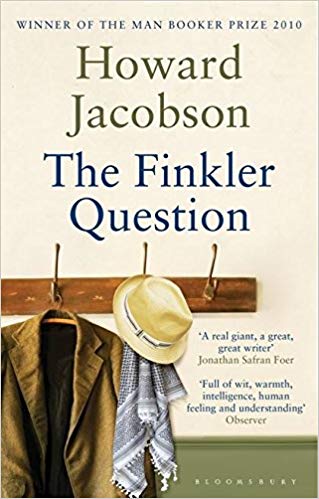
Cover for The Finkler QuestionHaving read Howard Jacobson’s J for my Booker Prize project, I was not looking forward to reading The Finkler Question for the same project. Since it won the award in 2010, I was hoping to like it better. I found it, however, very difficult to stay interested in.

Julian Treslove, the main character, is always expecting loss. He imagines himself holding the women he loves as they lie dying. I found him unbelievable and cartoonish.

Treslove has a long friendship with Libor, his former professor, and Finkler, an old school friend. Both of them are Jewish and recent widowers. Treslove, naturally lugubrious, has been hanging out with them while they grieve and argue endlessly about Jewishness and Israel.

I mean endlessly.

Treslove tends to make generalizations about Jewish traits and calls Jews “Finklers.” I ask you, who would do that?

Then one night on the way home from Libor’s house, Treslove gets mugged by a woman who says something to him that might be “You Jew.” After Treslove endlessly examines this event, I mean endlessly, he decides maybe he’s actually Jewish. He hopes he’s Jewish.

It doesn’t help that Jacobson tells this story using the same jokey, ironic tone that drove me crazy in J. I know that there are people who convert, but Treslove is such a ridiculous person I feel he’s there to be ridiculed.

Yet, I briefly became interested in him after he buckles down to become Jewish and meets a woman who seems suited to him. I could not say the same for Finkler, who belongs to ASHamed, Jews who are ashamed of the behavior of Israel.

I assume Jacobson is mocking the different characters and their ideas about Judaism, but no one in this book feels like a real person but Treslove’s girlfriend, Hephzibah. This novel really bugged me. I see it as the type of literary novel honored by the male publishing elite that no one actually likes.

Related Posts

J

The Fixer

The New Sweet Style

Day 1259: Closed Doors

Cover for Closed DoorsBest of Five!
I loved The Death of Bees, so recently I looked to see if Lisa O’Donnell had written anything else. Closed Doors did not disappoint.

The action of the novel, set in the 1980’s, begins when eleven-year-old Michael Murray’s mother comes home with cuts and bruises on her face. She says she’s been assaulted by a flasher and fell. Mike’s Da urges her to go to the police, but his Ma is worried about the vicious gossip in their small island community off the coast of Scotland. She makes the family promise to keep her secret (which, we sense, is worse than a flasher), but the neighbors all assume that Michael’s Da beat her up.

The ramifications of the lie continue with strained relationships with the neighbors. Then, another woman is assaulted. Now, Michael’s Ma is afraid she won’t be believed because she waited so long to talk. In the meantime, she suffers from anxiety and fear of being touched or looked at.

Michael’s voice is absolutely convincing as a naive boy who doesn’t quite understand what’s going on. This book is sometimes harrowing, but it is also touching and funny. Another great book for O’Donnell.

Related Posts

The Death of Bees

Pigeon English

Mountains of the Moon

Day 1250: Pigeon English

Cover for Pigeon EnglishBest of Five!
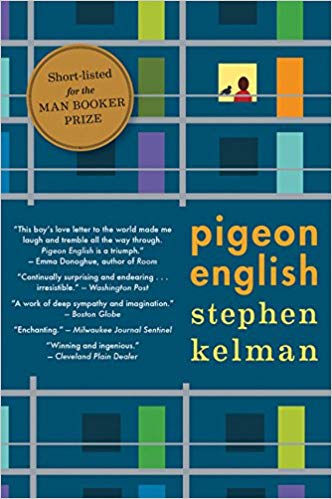
Once again, I’ve been charmed by the unique voice of the narrator of Pigeon English, Harri Opuku, an eleven-year-old boy from Ghana living in a rough area of London. Harri is such an eleven-year-old boy, fascinated by bodily functions but still repelled by the realities of sex, exuberant, funny in a crass boy way, strong in family feelings and the joy of life. He has a hilarious command of English and is liable to comment “Everyone agrees” just when he comes out with the most ridiculous bits of misinformation.

The big news in the neighborhood is the stabbing death of an older boy. Harri and his friends are fascinated by this crime, and one of their games is to investigate it, picking up fingerprints with cellophane tape and watching people for signs of guilt. This situation is one to which the readers know the answer but the boys do not.

Harri is also flirting with the idea of joining the Dell Farm Crew, a local gang that seems to have lots of advantages. But his essential niceness makes him fail the gang’s tests.

This novel makes you laugh while creating a growing sense of dread. For Harri’s world is violent, and he seems singularly unprepared for it.

The only part of the book that didn’t completely work for me was the role of the pigeon, a bird Harri decides is his, who makes occasional comments that are much too sophisticated for Harri (or a pigeon, obviously). The pigeon acts as an omniscient narrator or perhaps more like a Greek chorus.

This was another book I read for my Man Booker Prize project.

Related Posts

The Death of Bees

Mountains of the Moon

White Oleander


Day 1248: Literary Wives! First Love

Cover for First LoveToday is another review for the Literary Wives blogging club, in which we discuss the depiction of wives in fiction. If you have read the book, please participate by leaving comments on any of our blogs. Be sure to read the reviews and comments of the other wives!

Emily of The Bookshelf of Emily J.
Eva of Paperback Princess
Lynn of Smoke and Mirrors
Naomi of Consumed By Ink

There is no conventional plot arc in Gwendoline Riley’s First Love, which was shortlisted for the James Tait Black Fiction Prize. Among other things, it shows scenes from a dysfunctional marriage between a writer, Neve, and her husband, Edwyn. It also provides some insight into Neve’s upbringing—her bullying father and her detached mother, whose smile Neve describes as baring her teeth.

What does the title mean, though? We see no evolution of a relationship, only a few scenes of tenderness, but mostly shattering scenes of badgering and bullying from her misogynistic husband. Neve continually reminds herself that her older husband is ill and must feel terrible, but he treats her shamefully.

We see almost more of her previous relationship in her early 20’s with Michael, an American musician. He breaks up with her over a trivial incident and then returning, years later, entices her into a declaration of her feelings only to drop her again. Is this her actual first love? Because she sure doesn’t seem to love her husband. Are we to understand that her damaging first love destroyed her self-esteem to the extent that she puts up with this husband? I don’t know. Just some points to consider.

I’m not sure how much I liked this novel. It certainly provides insight into a classic abusive relationship, but there seems to be no end to this dire situation.

What does this book say about wives or about the experience of being a wife?

Literary Wives logoNeve seems to be drawn to manipulative, cruel men. Although there is some affection in her marriage, it seems to be dependent upon her completely submerging herself to his needs and demands. Edwyn is verbally abusive and on one occasion, physically abusive. The novel blurb describes them as an unsuited couple, but I can’t imagine anyone getting along with this man. Pity and fear seem to be the only things keeping Neve in her marriage. I think this is one of the worst marriages we have studied in this club.

Neve’s role in this marriage seems to be to cater to her husband’s every whim and make no demands. When she tries to reason with him out of his abusive ideas, her arguments are thrown back at her as bitchery and whining. Instead, she fares a little better if she holds her tongue. It is difficult to understand what Neve gets from this relationship.

Related Posts

Stay With Me

The Happy Marriage

The Headmaster’s Wife

Day 1247: The Return of John McNab

Cover for The Return of John McNabAndrew Greig seems to like to base his novels on Scottish texts, legends, or history, and The Return of John McNab is no exception. This novel is a reworking of a classic novel by John Buchan, John McNab.

I am not familiar with this novel, but I got the idea right away. In the original, three men announce they are going to go poaching, that is, catch a salmon, shoot a grouse, and shoot a stag on three different estates and deliver the game to the grounds of the estate. (I know this isn’t the proper Brit terminology. I’m using “estate” in its American meaning of a large property owned by a wealthy person.) This wager is meant as a protest against the ownership and use of large portions of land in the Highlands for only a few wealthy people. These men call themselves John McNab.

Neil Lindores proposes to do the same thing, aided by his friends Murray Hamilton and Alasdair Sutherland. He does not count, however, on attracting the attention of Kirsty Fowler, a local journalist.

With plenty of close calls, the adventure begins, but the men’s final target is Balmoral. The Prince of Wales is in residence, and the security people are apt to believe that the well-publicized challenge is a threat hidden within a stunt.

This novel is an earlier book by Greig. It is entertaining enough, but it does not feature the brilliance of some of his later works. It’s strictly an adventure/romance novel.

Related Posts

Fair Helen

When They Lay Bare

Waverly


Day 1243: Dear Thief

Cover for Dear ThiefBest of Five
Dear Thief is one of the first books I read specifically for my James Tait Black Prize project, and it is an unusual one. The entire novel consists of a letter that we suspect will never be sent to its recipient.

The unnamed narrator addresses her letter to her friend Nina, whom she has not seen for 18 years. Although not exactly plotless, the novel is concerned with the narrator’s memories of their friendship, imaginings about how Nina is living now, and thoughts about the events that destroyed their friendship and broke up the narrator’s marriage.

Beautifully written, sometimes stunning, the novel is a meditation on memory and on the need for connection. It is an examination of the complexities of relationship, for the narrator both wishes to see Nina again and hopes she will destroy herself.

The focus of the novel is of course on Nina, or Butterfly, as she was named by the narrator’s son when he was small. Harvey makes readers understand Nina’s allure, a beautiful, scarily intelligent woman who seems to be on a path of self-destruction.

Related Posts

Suzanne

Juggling

Amsterdam

Day 1240: The New Sweet Style

Cover for The New Sweet StyleI’ve had The New Sweet Style on my reading list for a long time now, ever since reading a glowing review. I’ve also heard Aksyonov referred to as one of the best contemporary Russian writers. (We’re being flexible with our definition of contemporary here, since this book was written in 1998.)

Sasha Korbach is a dissident theatre performer in Soviet Russia who is kicked out of the country in 1982. Famous in Europe, he comes to the United States expecting a rousing reception. However, because of a mistake about the date of his arrival, he ends up subsisting with a group of underemployed Russian immigrants. A move to Los Angeles results in an even greater comedown in the world.

Then Sasha falls in love with Nora Mansour, the daughter of a wealthy fourth cousin. Sasha scrambles to earn enough money to continue his bicoastal affair.

Told in a jokey, ironic tone, this story seems as if it’s supposed to be funny. Maybe something got lost in translation, because I didn’t find it funny at all. For some reason, we’re meant to have sympathy for this character, who seems to have no personality at all but just lets himself be helplessly battered by the plot. Even upon his first arrival, he makes no effort to contact anyone in the American theater scene and sneaks out of a performance of his own work, and he won’t accept help from his wealthy relatives. At one point, he prefers to become a drug dealer. The plot veers from the realistic to the absurdist. There is a description of his theater act that makes it sound manic and ridiculous rather than amazing, as it is received. There’s nothing really to grab onto with no sense of character, no interest in the protagonist’s adventures, just a lot of pointless mockery.

For some reason, the tone of the novel reminds me of Nabokov, with lots of literary allusions but without his breath-taking prose. Instead, the English is sometimes awkward and often sexist. Sadly, I have to report that I did not finish this novel, although I read more than half of it. It just wasn’t interesting enough to me to finish it.

Related Posts

Look at the Harlequins!

Speak, Memory

The Possessed: Adventures with Russian Books and the People Who Read Them