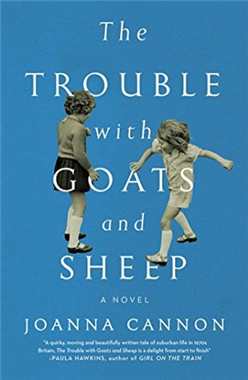
Day 963: The Trouble with Goats and Sheep

Cover for The Trouble with Goats and SheepMrs. Creasy has disappeared, and the neighborhood is worried. Ten-year-old Gracie and her best friend Tilly decide that if they find God, he will help them find Mrs. Creasy. The neighbors are concerned because nine years ago, some of them did a horrible thing. People talk to Mrs. Creasy, and they are afraid she has found out.

Walter Bishop is the neighborhood outcast. The neighbors have wanted to drive Walter out of the neighborhood since they decided he did something wrong. As the novel alternates between following Gracie and the other neighbors, we finally learn what happened nine years before.

link to NetgalleyAlthough I was interested enough in this novel to finish it, I had some problems with it. The first was with the portions that Gracie narrates in first person. Some of these sections do not sound like a ten-year-old. Although at times the two girls are convincingly naive, sometimes Gracie shows a sense of irony that a ten-year-old wouldn’t have. I have taught college level, and trust me, even most college freshmen don’t understand irony. There is an interesting discussion of the problems of using child narrators in this issue of Tea or Books? I also found it unlikely that Gracie, who comes from a family that is not at all religious, would suddenly decide that God is the answer.

I felt at times that I was being clubbed over the head with the novel’s message and at other times manipulated, as the characters’ secrets are revealed. I like the idea behind this novel, about what happens when a man is persecuted because he is a little odd, but I had some problems with its execution. So, this one is a maybe for me.

Related Posts

The Death of Bees

Swamplandia!

We Need New Names

Day 954: Americanah

Cover for AmericanahIfemelu has decided to return to Nigeria after living in the United States for 13 years. She has just finished a fellowship at Princeton and broken up with her American boyfriend, Blaine. In preparation for leaving, she also winds down her popular blog about race in America. While she is getting her hair braided, she thinks about her journey to this point.

Ifemelu grows up in a Nigeria where, for the young, the only hope seems to be to leave the country. Her father has been out of work for years because he was too proud to call his boss “Mam.” A few fat cats, like the general supporting Ifemelu’s Aunty Uju, are unbelievably rich, but there is no opportunity ahead of them for the young middle class. Most of them dream about leaving the country.

In high school Ifemelu falls in love with Obinze, who dreams of going to the States. The two enroll in a college in Nigeria where Obinze’s mother is a professor. But the dorm’s lavatories aren’t working and the professors haven’t been paid in months. Eventually, they go on strike, and Ifemelu must return home to Lagos. When she hears Ifemelu is at loose ends, Aunty Uju, who is now living in New Jersey, suggests that Ifemelu move there to go to school and help her care for her son.

In New Jersey Ifemelu begins struggling to find work, for her scholarship only pays 75% of her expenses. It is in this time period that she does something that separates her from Obinze. She stops taking his calls or responding to him.

Obinze has his own problems. His lack of opportunity in Nigeria eventually brings him to England as an illegal immigrant. There he struggles along with menial jobs, giving kick-backs to work under other men’s names. He is about to marry a woman for citizenship when he is deported.

Much of the novel is about the difficult immigrant experiences of the two main characters (although we spend much more time with Ifemelu) and Ifemelu’s experiences of race problems in the United States. Ifemelu’s observations on her blog provide an interesting, sort of third-party, perspective. With all of the recent police shootings of unarmed black men that have happened lately, this is a  topic that is on everyone’s minds.

I went back and forth on how much I liked this novel. In Ifemelu, Adiche creates a good, strong voice and a believable, likable character. I was not so enamored of the love affair at the center of the novel. The coming of age section at the beginning of the book I found trite and a little tedious, but that is only about 60 pages long. However, the moral decisions at the end are more troubling, or in fact, that there is absolutely no thought about them, that’s what troubles me. I found very interesting, though, Ifemelu’s reaction to the changed Nigeria when she comes home.

Related Posts

We Need New Names

Unaccustomed Earth

Little Bee

Day 952: My Brilliant Friend

Cover for My Brilliant FriendI think my reaction to My Brilliant Friend must be affected by all the hype it has received. That is, I put off reading it because I am often disappointed by novels that are wildly popular. Nothing can live up to the hype, and this novel doesn’t either, but it almost does. It is merciless in its clear-eyed look at the relationship between two frenemies.

The novel begins in the present, where Elena Greco looks back at her relationship with Lila Cerullo. Elena and Lila know each other from childhood. They are neighbors in a rough, poor neighborhood on the outskirts of post-war Naples. From the beginning they are wary, competitive friends. Elena admires Lila’s courage and in school grows to admire her fearless intelligence. But, as the second best in class, Elena finds herself competing with Lila and disliking her secondary position.

Both Lila and Elena are encouraged by their teacher, Maestra Oliviero, but when Lila’s parents won’t allow her to take the exam to enter the equivalent of middle school (I guess) because she has to work, Maestra Oliviero spurns Lila. She continues to study on her own for a while, even helping Elena with her Latin, but eventually, as she gets older, she avoids discussing Elena’s studies as it is too painful. Elena for her part finds herself increasingly isolated from most of her community, because there is no one with whom she can discuss the ideas she is interested in. Only Lila is capable of understanding them, and she begins avoiding these subjects.

Something else Lila and Elena would like to avoid are the Solara brothers, whose father is part of the Camorra crime syndicate. When Elena is a young teenager, the boys attempt to drag her into their car, but Lila stops them by pulling a knife. This action apparently endears her to Marcello Solara, who begins hanging around Lila’s house with the cooperation of her parents.

I can only guess that the effect of this series builds as the reader continues on with it. Certainly, the novel has a climactic ending that makes me wonder what’s coming next.

I felt that the emotions Elena expressed during the novel were immature, but then I had to keep reminding myself that the girls are only 16 at the end of the novel. Elena seems to be totally oblivious of how painful it must be for Lila to hear about her intellectual achievements, and Elena still continues to try to compete with her. Although Lila seems abrupt and dismissive at times, at other times she lets Elena know how she appreciates her.

Related Posts

The Shoemaker’s Wife

Empire Girls

Juggling

Day 947: Owl Song at Dawn

Cover for Owl Song at DawnWhen I first started reading Owl Song at Dawn, I was afraid it was going to be one of those quirky, feel-good novels that I’m coming to dislike. Fortunately, it turned out to have more depth than that.

Maeve is a woman in her eighties who owns the Sea View Lodge, a lodging house in a small seaside town in the south of England. Her policy has been to welcome guests with disabilities, and she provides a full-time residence for Stephanie, a young woman with Down Syndrome. Dot, the mother of Steph’s best friend Len, who also has Down Syndrome, is working with a social worker to arrange a home there for Len, because Dot is dying. A potential problem, at least for the authorities, is caused because Steph and Len consider themselves boyfriend and girlfriend.

Maeve’s memories are sent back to her adolescence and young adulthood by the arrival of Vince Roper, who has come to patch up their differences. Vince was her good friend when she was young. With her twin sister, Edie, who had severe disabilities, they made a threesome until Maeve began dating Frank. Then a series of tragedies culminated in Frank leaving Maeve at the altar. Maeve has always blamed this on Vince and has never understood why Frank left her.

This story is told nonsequentially with interjections by Edie, who is always with Maeve in spirit.

link to NetgalleyAlthough I felt there were some points where Maeve was inordinately obtuse and on the other hand where problems were cleared up too easily, I ultimately found this novel touching. The reasons that Maeve was angry with Vince for so long are flimsy, though, and she has brooded over them for so long that you’d think she would have figured out the truth, which is obvious, long ago. Her own perception that she has been shutting herself off from others for years is laughable, given her living situation.

These are small, niggling faults, though. Overall, I enjoyed this novel. It is touching without going too far, and it does a great job of showing us the loving personalities of its disabled characters. On the other hand, I see that it is on the long list for the Not the Booker Prize (for which you can vote this week from this link). I’m not sure how books get on this list, but I don’t really think this is a prize-winning novel. My favorite book on that list (although I have not read many of them) is Rush, Oh! by Shirley Barrett, which I will be reviewing in the next couple of weeks.

Related Posts

Relativity

The House We Grew Up In

We Are Not Ourselves

Day 942: Siracusa

Cover for SiracusaNews flash! The Man Booker long list was announced today, and I have actually reviewed one of the books!

* * *

Siracusa is a sometimes shocking story about a disastrous vacation in Italy. Two couples, linked by a friendship between the husband of one and the wife of the other, vacation together with one couple’s pre-teen daughter. The trip this year has been planned by Taylor except for a detour to Siracusa, Sicily, planned by Lizzie. The story alternates among the points of view of the four adults.

Lizzie’s voice seems the most reliable, but all of the adults are unreliable narrators for one reason or another. Lizzie, a writer, is deluded. She is in love with her husband Michael and does not know he is unfaithful. Michael, a formerly famous playwright who has been working on the same novel for years, is a liar who likes power games. He has been cheating on Lizzie with a waitress named Kathy.

Finn is a restaurant owner who smokes too much and is serially unfaithful. His wife Taylor is snobbish and shallow, and she is so overprotective of their 10-year-old daughter Snow that she talks for her. At some point, Taylor begins making a play for Michael, whom both she and Snow adore.

At Siracusa, a tragic chain of events begin when Kathy appears as a surprise for Michael and begins trying to maneuver him out of his marriage. It isn’t until then that Michael realizes he wants to stay with Lizzie.

link to NetgalleyThis novel is complex and interesting, with a shocking conclusion. I was rather freaked out by one of the characters from early in the novel, and my impressions turned out to be right. From starting out to be a fairly mundane story of relationships, this novel works up quite a bit of suspense.

Related Posts

Fates and Furies

The Happy Marriage

Gone Girl

Day 938: What Alice Forgot

Cover for What Alice ForgotAlice Love wakes up from an accident thinking she is 29, pregnant with her first child, and madly in love with her husband Nick. But she is actually 39, the mother of three children, and separated from Nick. It takes her a while to understand she is ten years older, much thinner, and quite a bit harder and more driven than she remembers.

Alice escapes from the hospital by simply lying to the doctors. But somehow, she must piece together her life from the allusions of other people and her own feelings of occasional discomfort. How can she get along with her three unknown children? What happened between her and Nick? Why are she and her sister Elizabeth on the outs? And who the heck is Gina?

I thoroughly enjoyed this novel, mostly because of its characterizations. Alice in her 29-year-old reincarnation is guileless and likable, and Nick in her memories is also endearing. Alice’s children seem like real kids, adorable one minute and infuriating the next.

I didn’t like as much the sections written by Elizabeth to her therapist or by Frannie to her long-dead fiancé, but their stories add more depth to the novel. Since the focus was so much on Alice, there probably wasn’t another way to fit that information in.

All in all, this is another highly enjoyable novel from Moriarty. Toward the end, I was afraid she was going to take an easy path, but she did not.

Related Posts

Big Little Lies

The Lace Reader

Before I Go to Sleep

Day 932: Black Swan Green

Cover for Black Swan GreenJason Taylor is thirteen years old in 1982, the beginning of Black Swan Green. He is somewhat of a misfit, obviously bright and interested in poetry, a stutterer, but he spends most of his time hiding his true self to be more acceptable to his schoolmates. Still, acceptance is fleeting. One year he is on the margins of popularity; the next, he’s a pariah.

His parents have some problems he doesn’t understand. His older sister Julia can’t wait to leave home for university. The economic climate is grim in the wake of Thatcherism.

Black Swan Green seems to Jason to be the most boring village imaginable. Still, he manages to have some adventures, visiting a strange old lady in the depths of the woods, taking poetry lessons from Madame Eva von Outryve de Crommelynck, literally dropping in on Gypsies, all the while trying to avoid the popular bullies in his class.

Although I sometimes wondered where this novel was going (and for a while wondered if any time travelers were going to appear), it eventually got there. More importantly, it features a distinctive voice of a bright, funny, sometimes naive boy. It has a unique notion of character that to me makes the novel stand out.

Related Posts

The Bone Clocks

Slade House

The Brief, Wondrous Life of Oscar Wao

Day 930: Early Warning

Cover for Early WarningEarly Warning is the second in Jane Smiley’s Last Hundred Years trilogy. It continues the story of the Langdon family, picking up in the 1950’s and ending in 1985.

The family, which began with a couple and their children and the occasional appearance of other relatives, expands during this period to grandchildren and eventually their children. As you can imagine, by 1985 we are dealing with many characters.

This is one of my criticisms of the novel. With so many characters, we don’t spend very much time with any, which creates distance from the novel. I already felt this with the first book, and this feeling increases for the second.

But is the purpose of this novel to follow the characters or the main events during these times? It seems to be the second, as we look at the ennui of suburban housewives in the 50’s, the Cold War, the Vietnam War and its associated protests, the counterculture and Jonestown, to name a few. Smiley manages to have at least one family member involved in each of these events or movements, which is quite an accomplishment for one family from Iowa.

Of the Langdon children whose families are the focus of this novel, Frank concentrates most of his attention on business and sexual escapades, while his wife Andie struggles with a feeling of pointlessness and self-absorption. Neither of them pays much attention to their children, except that Frank puposefully fosters competition between his two twin boys, Richie and Michael. All of his children suffer from this upbringing, and the boys are at times truly scary.

Joe is the only Langdon to stay on the farm, and although he was one of my favorite characters in the first book, we don’t see much of him in this one. He and Lois have had some lucky breaks, and the farm is in better financial shape than their neighbors’, but decisions of the Reagan administration make small farms a tough business.

Lillian and Arthur raise a rowdy and happy family in Washington, D.C. But Arthur’s job with the CIA brings him under terrific pressure, and a tragic loss creates ramifications for years. This family has more than its fair share of sorrows.

Claire eventually marries a doctor and settles down in Iowa. But she has selected her husband almost in competition with a friend and eventually regrets her choice.

The novel is saved somewhat at the very end by a touching event linked to the presence of a character who isn’t explained until the end, one who appears in the middle of the book and at intervals throughout. At first I found the introduction of this character confusing, but I figured he had to be a family member, so then it wasn’t too hard to guess who he is.

I will read the final book, but I fear that the distance I feel from the story will only increase.

Related Posts

Some Luck

A Thousand Acres

The All-True Travels and Adventures of Lidie Newton


Day 928: The View from Castle Rock

Cover for The View from Castle RockThe View from Castle Rock is an earlier Munro collection of short stories than Family Furnishings, which I previously reviewed. Since Family Furnishings is an anthology of Munro’s stories over the course of her career, I had already read several of the stories in The View from Castle Rock.

All of these stories have to do with the history of Munro’s family. In “No Advantages,” she has traveled to the area of Scotland where the Laidlaws came from. This story incorporates excerpts from other writings and quotes the epitaphs of some of her ancestors. It explains their hard life and the kinds of people her 18th century ancestors were.

In “The View from Castle Rock” Munro relates a family legend about how their drunken great-great-great grandfather James Laidlaw took his son Andrew up onto Castle Rock in Edinburgh to view America, probably as a joke, since they were looking at Fife. Although he talks of emigration throughout his life, he is unhappy when some of his sons finally take him and their families to America. This story is about their voyage and the fates of some of the family on board.

Other stories are more recent. “Hired Girl” is about a summer when Munro worked as a hired girl at a beach house on an island. For that summer, she had to learn that her employers did not consider her an equal. This was a tough lesson, as her mother especially had always had some pretensions of superiority even though they were poor.

In “Home” she revisits home after living away for some years. Her father has remarried after her mother’s death, and her old house has changed almost completely.

Cover for The View from Castle RockThe stories in this collection are powerful, relating the hard life of her family farming and raising fur, their close-mouthed quality, pride, and stubbornness. She is courageous in her ability to look at everything with honesty, even her own foibles.

One comment I have to make is on the cover of my Vintage International edition, shown here. It has absolutely nothing to do with the contents of the book and gives an entirely misleading idea of the stories. The only story that even faintly is about a beach is “Hired Girl,” and the girl is not exactly lying around in the sand. Sometimes I wonder what publishers are thinking. The cover that I used at top is much better.

Related Posts

Family Furnishings

Olive Kitteridge

The Empty Family


Day 922: The Vegetarian

Cover for The VegetarianThe Vegetarian is an unusual, transgressive work, full of disturbing images and violent scenes. When I first began reading it, I wondered how seriously we were supposed to take it as a work of realism. My answer was, not at all.

The novella is divided into three parts, each written from the point of view of a different character. The first is Mr. Cheong, the self-centered, repellent husband of Yeong-hye. He has already alienated us by describing his wife in insulting terms, even when remembering when he chose to marry her.

He tells us the story of what happens when Yeong-hye decides to stop eating meat. Her only explanation is “I had a dream.” But we get short glimpses into Yeong-hye’s thoughts, and they describe a disturbing vision that keeps recurring. This section climaxes in a shocking scene during a family party.

The next section is from the point of view of Yeong-hye’s brother-in-law, an artist. He has his own visions and compulsions.

The final section is from the point of view of In-hye, Yeong-hye’s older sister. In-hye tries to understand her sister’s condition in terms of the hardships of her childhood, when she was abused by their father.

As Yeong-hye decides to embrace her inner plant, bending to her obsessions, the novella becomes more divorced from reality. The three main characters all are gripped by their own visions.

link to NetgalleyThe description of this novel on Goodreads calls it “an allegorical novel about modern day South Korea.” I would agree that it is allegorical (not my favorite genre), but that it’s actually about life in modern South Korea, not so much. It is set there, but it don’t think we’re supposed to see its events as representative of life in South Korea. The review in the New York Times points to the danger of “a focus on the ethnographic and sociological” and attributing much to differences in culture. If you believe this, you’ll think Koreans have very odd attitudes toward vegetarianism. I pondered this when reading, but decided that the behavior of the characters in some scenes was too extreme to be taken at face value.

Did I like The Vegetarian? Not so much, but it made me think.

Related Posts

The Narrow Road to the Deep North

The Orphan Master’s Son

The Blazing World