Day 565: Olive Kitteridge

Cover for Olive KitteridgeThis collection of linked short stories lucidly illuminates the contradictions that make up the human condition. The link that binds the stories together is Olive Kitteridge, a retired schoolteacher in small-town Maine.

Olive is plain-spoken and gruff. Some people are afraid of her, but she can show sudden compassion and insight.

In “The Pharmacy,” Olive’s gentle husband Henry falls in love with his young pharmacy assistant without ever making his feelings known. In “A Little Burst,” Olive steals some of her daughter-in-law’s clothes during the wedding at the house the Kitteridges built for their son. She has overheard Suzanne saying nasty things about her. In “Tulips,” after Henry has a heart attack, Olive reflects upon their pain that their son Christopher moved away to California with his wife, and even after divorcing did not return or invite them to visit.

In other stories, Olive is less important or simply a presence. A timely conversation with her seems to keep a young man named Kevin from attempting suicide in “Incoming Tide.” In another story, the Kitteridges stroll to the restaurant through the bar where Angie plays the piano every night and thinks about the man she loved.

With neighbors and strangers, Olive says exactly the right thing in a difficult moment, and with her loved ones exactly the wrong thing. Many of the stories are sad but ultimately touching. Strout uses an unusual structure to create the sense of a lovely and affecting novel.

Day 562: We Are All Completely Beside Ourselves

Cover for We Are Completely Beside OurselvesBest Book of the Week!
Reading Karen Joy Fowler’s fluffy The Jane Austen Book Club made me willing to try a novel that did not sound appealing on the surface. But my experience with Fowler’s previous books in no way prepared me for the profound and moving We Are Completely Beside Ourselves.

Rosemary Cooke starts her story in the middle, when she is at college and has just been arrested for a small release of her inner “monkey girl.” Rosemary has worked hard to hide her past from her new friends at college. The daughter of a behavioral scientist, Rosemary was raised with a chimpanzee Fern as her sister until she was five years old. Then Fern was abruptly removed from the household when Rosemary was away visiting her grandparents. Rosemary’s beloved brother Lowell was angry with the entire family from then on and disappeared completely during his senior year of high school.

Since then, Rosemary’s family has been broken. Her mother had a breakdown from which she never entirely recovered, and her father is remote and alcoholic. Rosemary herself has never felt as if she fits in, after years of being teased by her classmates as the “monkey girl.” Although she seldom stopped talking as a child, now she rarely says anything.  Then Lowell comes to see her, and she has a chance to recover her own history.

Although this novel is written in a light and lively tone, it eventually brought tears to my eyes. It explores such subjects as reconciliation with oneself and others, human relationships and responsibilities toward other species, and the complexities of issues surrounding scientific experiments with animals. It is odd and unusual and incredibly intelligent.

Day 553: White Oleander

Cover for White OleanderBest Book of the Week!
This reading of White Oleander is my second, for my book club, although I have not reviewed it before now. I believe I appreciated the novel even more on the re-read.

Astrid Magnussen nearly worships her poet mother Ingrid. At twelve years old, Astrid has already lived an unusual vagabond life with her mother. Now the two have settled for awhile in the dry heat of Los Angeles, reeking of creosote with the forests bursting into flame.

Ingrid, herself stunningly beautiful, believes that nothing is important but beauty. She tells Astrid stories of ruthless Viking ancestors who take what they want, for she sees weakness in Astrid and wants to root it out. She is clearly a narcissist. For pleasure, she brings home beautiful young men and then unceremoniously discards them. She keeps Astrid up all night looking at the stars. Although Astrid fears Ingrid will one day leave her, she is smart enough to realize that with her mother everything is always about Ingrid herself.

Then Ingrid falls in love with Barry, an ordinary man. For once, Astrid feels a little secure, as if she has a father. But when Barry dumps Ingrid for a younger woman, Ingrid becomes insane with rage and does something terrible. She ends up in prison, and Astrid is abandoned to the foster care system.

This novel is sometimes beautiful. The beginning dealing with the relationship between the two and their earlier lives is poetically told. Other times it is brutally powerful, as Astrid is torn from her precisely kept home and thrown into a series of horrendous foster homes. Even more heartbreaking is what happens when she finally finds a loving one.

White Oleander is original and gorgeously written, about the search for love and a safe harbor, about betrayal, madness, self-absorption, and self-discovery. The lovely but poisonous white oleander is a symbol for Ingrid’s motherhood, as Astrid finally realizes she will always ache for her mother’s love and never have what she wants.

Day 547: Signed Confessions

Cover for Signed ConfessionsI confess to only having read about half of the stories in Signed Confessions, which was not to my taste. The main characters in the first few stories are all unlikable men who have committed acts for which they desire forgiveness.

After his gay son’s suicide, an implacable attorney regrets how he treated his boy. He remembers an earlier time when as a young boy, he was cruel to a bereaved schoolmate and found how that cruelty gave him power. Another man deserts his family and then spends his time making up stories to tell in support groups.

These two stories are written in a virile style that seems like an imitation of writers like Philip Roth and Norman Mailer. The third comes from another genre—that of dark Jewish comedy. A Jewish man who plagiarizes insults ala Don Rickles to be funny is suddenly gripped with remorse and tries to beg forgiveness of some of his victims. I will admit that the results are a bit humorous.

Walker ties the first few stories together by giving a character in one story some characteristic that you can recognize and then bringing him in as an unnamed character in another story. In one case, the attorney of the first story throws legal terms into regular conversation, as does a member of a support group in the second story. My problem was that I couldn’t imagine a lawyer actually talking that way, especially one who was son of a lawyer. It seems more likely the behavior of someone who has taken one or two law courses.

In general, the stories are written in uninspired prose and show no signs of subtlety. The fourth story, “Ode to Billy Jeff,” is a little more thoughtful than the others. Nevertheless, I chose not to finish the collection.

A disclaimer here: I received this book from from the author in exchange for an honest review.

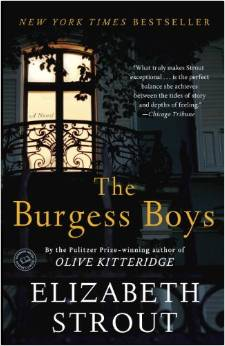
Day 542: The Burgess Boys

Cover for The Burgess BoysBest Book of the Week!
I had an unusual reaction to The Burgess Boys. Part of the way through, I was interested in how it would come out but at the same time wondered if I was liking it. By the end of the novel, though, I found it extremely satisfying.

The novel is about the clearly dysfunctional Burgess family, from a small town in Maine. When the three Burgess children were small, their father was killed in a freakish accident, run over by his own car rolling down the hilly driveway. All three kids were inside the car, and four-year-old Bob was behind the wheel when their mother came out to find their father dead. Mild-mannered Bob has carried this burden all his life, dealing with ridicule from his brother Jim and dislike from his twin sister Susan.

Jim and Bob long ago left Maine for New York City. But they are called back by a distraught Susan. Her son Zach has committed the inexplicable act of throwing a pig’s head into a mosque during Ramadan. Although Susan shows a good deal of ignorance about the local Somali population, the family cannot comprehend Zach’s action. He is a quiet misfit teenager, confused and pathetic, who has no friends. Unhappy especially since his father left for Sweden, he nevertheless does not seem to be angry or have any strong feelings at all except for being plainly terrified by the trouble he is in. He has a reason for his actions that is generally clueless, but it takes awhile for the family to discover it.

A former hotshot lawyer in Maine and famous for having won a high-profile case, Jim is the person Susan is relying on. Zach goes in to the police station to confess to the crime, and it seems as if the case will be handled quietly, but the civil liberties groups get involved and soon there is an uproar. When Jim’s grandstanding at a political event does more harm than good, Zach is charged with a hate crime.

As Jim takes charge while Bob tries to calm and comfort, the dynamics within the family emerge. At the same time, we learn a little about the terrified, disoriented Somali community. During the initial hearings, shopkeeper Abdikarim glimpses the true Zach and tries to help him.

As for the characters, I heartily disliked the person that everyone else admires. I think Strout intended that, and part of my satisfaction with the novel is about how that turns out.

Strout’s rich, detailed exposition is matched by her empathy for all her characters. Although I disliked some of them, they are complex and deeply human. This apparently simple story wisely examines the dynamics of guilt, family tensions, social isolation, and blind political correctness.

Life in the small Maine town seems gray and dismal at first, brightened only by the fall foliage and the hues of Somali garments. Jim and Bob have fled, and Susan and Zach are unhappy. There is little employment or hope for the residents. By the end of the novel, everyone has a little more hope.


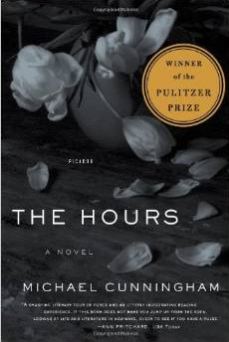
Day 539: The Hours

Cover for The HoursBest Book of the Week!
One of our Pandora channels repeatedly plays Philip Glass’s music from the movie soundtrack of The Hours. So, as soon as I began reading it, the intricate notes of the score became a mental accompaniment to the novel. That is, I got an ear worm.

I came to the novel with the slight disadvantage of being unfamiliar with Mrs. Dalloway, having been traumatized by To the Lighthouse in a college English class. But you don’t have to be familiar with it to appreciate this lovely, cleverly constructed novel, an homage to Woolf’s own.

The novel begins with Virginia Woolf’s suicide. But later it returns to 20 years before, when she is writing Mrs. Dalloway.

First, though, we meet a middle-aged woman, Clarissa Vaughn, whose best friend calls her Mrs. Dalloway. Like her namesake, Clarissa is eagerly going out into a crisp, clear morning to buy flowers for her party. This is New York, though, in the late 1990’s, and Clarissa’s party is for her dearest friend Richard, a poet who is dying of AIDS. He has recently been chosen to receive a prestigious prize for poetry, and the ceremony is that night.

Back in 1920’s Richmond, England, Virginia Woolf is trying to decide the plot of Mrs. Dalloway. Someone will die, she thinks, but will it be Mrs. Dalloway herself? Woolf also copes with her own fears about her mental state, her yearning to return to living in London, and a visit from her sister Vanessa Bell.

In 1950’s Los Angeles, Laura Brown struggles with being a suburban housewife and mother. Although she loves her husband and small son, she feels unsuited to this life.

Cunningham presents us with three stories, and a theme of threes recurs. Woolf has bouts of mental illness, Richard suffers from dementia caused by his illness, and Laura is struggling with depression. The jellyfish shapes and voices of Woolf’s migraine visions appear in Richard’s episodes of dementia. And Laura briefly sees a grayish jellyfish cloud floating over her son’s head. A forbidden kiss and the color mustard feature in more than one story. And other links that I will not name are more intrinsic to the plot. The three stories are so cleverly interwoven, we’re not sure if the events of one cause the events of the other.

This is a novel of astonishing beauty, cleverly constructed and entertaining. I’m going to find a copy of Mrs. Dalloway.

Day 537: The Jane Austen Book Club

Cover for The Jane Austen Book ClubI am sometimes rather contrary about bestsellers. I assume that I’m not going to like them and avoid reading them. This attitude isn’t entirely irrational as I am familiar with the writing of many consistently bestselling authors that I do not like at all. The idea behind The Jane Austen Book Club also seemed like something I wouldn’t enjoy, as I am a little tired of all the Jane Austen spin-offs and other hoopla (although never tired of Austen herself). So, it wasn’t until I picked up the book at a used book sale that I decided to try it.

I found the novel extremely light reading but enjoyable and sometimes witty. Of course, it is about a book club of Austen lovers who get together to read all of Austen. Only one member is male, and Grigg is also the only one who has never read Austen.

The novel does not have much of a plot. There are some romances and a banquet. That’s about it. As in Austen novels, it is more about the characters and their relationships.

Jocelyn, the founder of the club, is a dog breeder in her 50’s who likes to arrange things and make matches. Sylvia is her best friend from high school whose husband Daniel recently left her for a younger woman. Allegra is a strong, adventurous lesbian. She isn’t so much an Austen fan but is in the club because she’s Sylvia’s daughter. Bernadette, a kind older woman with a colorful past, talks a lot and repeats herself. Prudie, the married French teacher, annoys everyone by speaking French during the club meetings. Grigg is a little more of an enigma, a science fiction reader in his 40’s who just moved to town.

Each section of the novel focuses on a book club meeting and tells us more about the character who hosts the meeting. Throughout the novel, quotes from Austen and other sources appear appropriately, or maybe with an angle we need to figure out. Strikingly, the novel is narrated in the second person plural, apparently by the entire book club, and in omniscient viewpoint.

I found myself liking the characters and drawn into their dramas. Early on, we feel Grigg is interested in one of the women, but I don’t think we’re supposed to guess which one. I thought it was obvious.

If you are looking for some light, amusing reading with just a hint of romance, you may enjoy this novel. I did.

Day 533: The Descendants

Cover for The DescendantsIf you have seen the movie The Descendants, the book will not provide you with very many surprises. But that is looking at things the wrong way around. Perhaps the novel provides a stronger sense of betrayal and even more sympathy with the characters.

He may live in balmy Hawaii, but Matt King is struggling. His wife Joanie is in a coma after a boat-racing accident. He has been the type of father who is always working; now he is becoming conscious of his deficiencies as a parent. He finds his ten-year-old daughter Scottie harming herself. Then he learns that the reason his wife sent his teenage daughter Alex away to boarding school was because she discovered drugs in her room.

Added to all this turmoil is a decision he must soon make about his family’s property. A trust is being wound up and prime real estate could be sold. Some cousins want the most money while others favor a local developer. With the majority vote, Matt has the power to decide what the family will do with the land.

After Matt picks up Alex from boarding school, she explains a big blowup she had with her mother over Christmas. Alex had discovered Joanie was having an affair.

Joanie’s doctors decide that she is brain dead, so Matt begins gathering her friends and family to say goodbye. Learning from friends that Joanie had planned to leave him for her lover, Matt decides he should notify him too.

It is in trying to identify and contact this man that Matt discovers Joanie’s affair was a much bigger betrayal than he thought. He is also brought to consider what he owes to his Hawaiian ancestors, from whom his family inherited their property.

Although narrated in a light style that is sometimes funny, The Descendants deals with such issues as grief, anger, death, and infidelity. It is surprisingly affecting, and you feel you know and like Matt, his daughters, and their friend Sid. Most of the characters are well-meaning people who are trying to do the right thing. I enjoyed this novel.

Day 530: Literary Wives! The Crane Wife

Cover for The Crane WifeToday is another Literary Wives review, where the wives explore the depiction of wives in contemporary fiction. Please be sure to check out the reviews of all the Literary Wives.

Also, you can join in by adding comments on any of our pages or on our Facebook page!

***

George is awakened in the middle of the night by a strange cry. When he looks out the window, he is astonished to see a wounded crane in his garden. He removes an arrow from the crane’s wing, and the crane flies away.

The next day he is doodling at work when he gets the urge to cut up an old book. He makes a paper crane. When a woman named Kumiko arrives at the shop, she takes away his crane and unites it with a tile of feathers she has made, creating a wonderful sculpture.

Women have always left George, deeming him to be too nice. Kumiko, though, quickly becomes his lover and promises to be his wife.

George’s daughter Amanda is feeling lonely. Because of her anger and acerbic wit, she has never kept her friends. It is beginning to look like her friendship with coworkers Rachel and Mei is going south. She loves her ex-husband Henri, but her anger drove him away. Only her four-year-old son JP and her father seem to stay.

The stories of these characters are periodically interrupted by a fable about the love/hate relationship between a goddess and a volcano. Eventually, these two threads intersect, overlaying the everyday story with mythic and magical overtones.

I was much more interested in the everyday story of George, Amanda, and Kumiko than I was in the mythic elements, which at times seemed to be trying too hard to be profound. The everyday story was touching and sometimes funny, the character Mehmet being particularly amusing.

What does this book say about wives or the experience of being a wife? In what way does this woman define “wife”—or in what way is she defined by “wife”?

There are two wives in the story. One is Amanda, who loves Henri. But her self-hatred is so strong that she feels something must be wrong with Henri for him to love her back. So, she fights with him until he leaves her. Eventually, she has to settle for being his friend.

Although she and George never actually marry, the other wife is Kumiko, the crane wife. She is a self-sacrificing figure. To stay with George and make their works of art, she tears the feathers from her own body. In her mythic self, though, she offers forgiveness at a terrible price, by ripping out a person’s heart and blinding him, then turning him to stone.

Is Ness saying that we’re only forgiven if we are blind, heartless, and turned to stone? Or are we only free of pain in that condition? Ness’ vision of love, that it is greedy, angry, or self-sacrificing, is a strange one. The goddess’s love is harrowing while Kumiko’s makes her give up everything. All of these ideas seem at once confused and simplistic. Literary Wives logo

I think Ness is saying more about love than about being a wife—that true love is more self-denying than greedy. George becomes obsessed with learning everything he can about Kumiko instead of accepting what she can give—and that leads to unhappiness.

But my question is, is either view of love a true one? Is it healthy or even right to be so self-denying that you literally mutilate yourself for love?

Day 529: The Interestings

Cover for The InterestingsIt took me awhile to get interested in The Interestings. (I just had to say that.) Reading it was ultimately worth it, but I found the novel difficult to get into, beginning as it does with a situation and characters to which I do not relate.

Jules Jacobson is an awkward teenager when she arrives at a summer camp for the arts during the mid-1970’s. The campers are mostly rich New Yorkers. She is not rich, but received a scholarship for the camp after her father’s death. Jules feels inferior to these kids, but she is unexpectedly adopted by a small group who call themselves the Interestings.

Ethan Figman is an unattractive but kind boy. He spends most of his time at the camp learning animation and drawing. Jonah Bay is the beautiful but elusive son of a famous folk singer. Cathy Kiplinger is a talented dancer. Ash and Goodman Wolf are a wealthy, attractive sister and brother. It is not clear what Goodman does at camp besides flirt with girls, but Ash is studying drama.

Jules is entranced by her friendship with these people, so much so that her relationship with them becomes a preoccupation of her life. She is particularly attracted to the Wolf family, and Ash becomes her best friend. Ethan early on makes overtures to her of a different nature, but she is not attracted to him.

The novel follows Jules’ relationship with her friends over a period of forty years. It particularly focuses on Ash and Ethan, who marry and become extremely successful.

For Jules, the Interestings glow with a special aura long after most of them have not lived up to their promise. Wolitzer’s intent is to examine issues such as how much value to place on a constant striving for success and its link with the need to feel special. She also examines the life of art—how far do you go for art before giving up? After having little success, Jules abandons her own desire to be a comic actor. She also goes through a long period of envy for Ash and Ethan while she and her “ordinary” husband Dennis struggle financially.

My problem with this novel is that I don’t understand the attraction the group, and particularly the Wolfs, have for Jules. In truth, she seems dazzled by the wealth and privilege of this family, even if she doesn’t realize it. Ash is a nice enough person, although somewhat vaguely depicted. But somehow these fascinating Wolfs manage to raise a self-absorbed, uncaring son and a daughter who is too eager to please her family. Early on, Goodman is accused of a serious crime. The way his family handles this problem is very telling, as is the fact that they never seem to consider he might be guilty.

Wolitzer sometimes tells us other things I personally feel the novel does not demonstrate, for example, how witty Jules is. I saw very little evidence of wit in the dialogue, and when I did, it usually came from Ethan. Maybe the novel would have been more compelling if we could feel the attraction of the Interestings ourselves or hear the sparkling wit. Or has Wolitzer planned for us to remain detached, to see through everyone from the first?

This novel provides many ideas to ponder. After I stuck with it, I got interested in what happened to the characters, but I didn’t  love it.