Day 527: The Possibilities

Cover for The PossibilitiesAfter her son Cully’s death in an avalanche near their home in Breckenridge, Colorado, Sarah St. John is having difficulties. She has returned to work as a host of a local TV show but finds it hard to raise the enthusiasm needed. She is angry at the loss of her son, who had only just graduated from college, and is upset with herself for nagging him about his recent aimlessness. She is suffering from grief and a loss of identity.

Then she begins discovering facts about Cully that she didn’t know. She finds paraphernalia for selling pot in his room, which jolts her. A young woman named Kit comes to see her, pretending to want a snow-shoveling job, but she is really Cully’s girlfriend. Sarah had never even heard of her before.

Sarah’s family and friends are planning to attend a second memorial for Cully in Colorado Springs given by his friend Morgan. Sarah is dreading it, as she does not know how to deal with the sympathy or attention. Feeling the need to discuss the drug discovery, she asks Cully’s father Billy, whom she never married, to come see her the day before the memorial.

This novel is a wise and heart-warming, sometimes humorous examination of grief and of life’s surprises. As in The Descendants, a disjointed and somewhat alienated family becomes closer and gathers new members after experiencing grief and making hard decisions.

http://www.netgalley.comI found myself liking all the characters. Sarah is handling her feelings poorly but is sympathetically human. Her father Lyle is a retired public relations executive for one of the resorts. He is not doing retirement very well, giving his ex-coworkers unsolicited advice and buying too many gadgets on QVC. He moved in temporarily with Sarah and Cully and somehow never left, but Sarah likes him being there. Billy is calm and supportive, quietly dealing with his own grief. Sarah’s friend Suzanne, in the midst of a divorce, is at once annoying, interfering, and caring.

I will soon be reviewing The Descendants, but in The Possibilities I find another satisfying and touching novel by Hemmings.

Day 519: Northanger Abbey

Cover for Northanger AbbeyNorthanger Abbey seems to be the Austen novel people like least. Perhaps this is because Catherine Morland is an ordinary girl, naive and not overly bright, so the opportunity for witty conversation is lost. But Austen has some fun with the fad for Gothic novels at the time. One of young Catherine’s misadventures results from her dreaming up a lurid past for her new friends’ family, her imagination influenced by her choice of reading. Austen also creates some broadly comic characters in the greedy and crass Isabella and John Thorpe.

When I learned that Val McDermid was attempting an update, I was intrigued, because McDermid is better known for her chilling thrillers. She places her updated version of the novel in Edinburgh during the festival. This could have been an inspired choice if she had made more use of the setting.

Cat Morland is attending the festival as the guest of her neighbors, the wealthy Allens. She meets Bella Thorpe, who befriends her because she likes Cat’s brother James (although this is not of course obvious to Cat). Bella’s brother John in turn begins pursuing Cat. Cat, though, is already interested in Henry Tilney, son of General Tilney, the owner of Northanger Abbey.

Much of the plot of Austen’s original book rides on the Thorpes’ assumption that Catherine is the Allens’ heir. McDermid implies a similar motive for their friendliness.

McDermid has not changed the plot of Austen’s novel in any major respect, except for the reason why General Tilney throws Cat out of the house in the middle of the night. In that instance, she chooses to pursue a theme that has been cropping up a lot in her later fiction, and the choice is unfortunate. She has set us up to expect something else, and the motive she chooses doesn’t fit in well with anything that has already happened. It is clear that General Tilney is unusually friendly with Cat because he thinks she is wealthy, so to alter the reason for this dramatic scene at the last moment throws us off.

Although the novel seems promising at first, with some witty observations about the festival attendees, we soon fall into the banalities of conversation and texts between vapid young women. Cat just loves vampire fiction and actually believes vampires might exist. You can see where this might lead in terms of the original novel, if McDermid had given it a bit of a twist. I am sick of vampire fiction, but I was almost hoping one would appear in the darkness of an Edinburgh street.

http://www.netgalley.comCat and the Tilney siblings are likable, but Cat doesn’t capture my sympathy as much in her current guise. Again, I’ll stick with Austen.

Just as a side note, those wily internet marketers must have noticed my searches for Northanger Abbey, because I got an email about the Complete Northanger Horrid Novel Collection. This collection includes all of the gothic novels referred to in Austen’s novel. All mine on my iPad for a mere $.99! Well, why not? I’ll be reporting back later.


Day 517: The Empty Family

Cover for The Empty FamilyIn this collection of short stories, Colm Toíbín writes empathetically about the human condition. People remember how they have loved, their desire, their loneliness.

In the only historical fiction story, “Silence,” Lady Gregory tells Henry James a tale over dinner. Even though her story is not true, it encapsulates a kind of truth about her relationship with her lover during her marriage to her much older husband.

In “The Empty Family,” a man returns to a seaside village in Ireland after years of absence in California. He meets some old friends and considers his former life in that town and the life he just left.

In my favorite story, “Two Women,” an elderly Irish set dresser remembers her affair with the only man she ever loved. One day on the set where she is working, she meets his widow, the woman who married him after they parted.

In “One Minus One,” a man returns home to be with his dying mother. He is full of regret and longing because she never cared much for him.

These stories are precisely written, sad, and evocative.

Day 511: The Storied Life of A. J. Fikry

Cover for The Storied Life of A. J. FikryI dislike publicity that compares books by new authors to established, popular books, because the comparison is so often misleading. I’ve seen The Storied Life of A. J. Fikry compared to The Guernsey Literary and Potato Peel Society. The similarities are a certain lightness of tone, the presence of book clubs, and the setting on an island. Otherwise, there is no comparison between the novels. I should add that I didn’t have much of an opinion of “Guernsey.” I like this novel much better, but the comparison almost made me decide not to try it.

A. J. Fikry is a recently widowed bookstore owner when the novel begins. He is normally somewhat of a curmudgeon, but he is also having difficulty coping with his wife Nic’s death. The book actually begins with Amelia Loman, the new account manager for Knightley Press, who has made the trip from the mainland to meet with him. He has forgotten their appointment and refuses to discuss any of the books on the winter list.

Aside from his wife’s death, things are not going well for A. J. He is drinking too much. Without Nic around he’s doing a poor job of managing the store. Then one night when he forgets to lock up his only rare book because he’s been drinking, it is stolen. He had planned to use the book as his nest egg after he drove the book store out of business, but the police can find no trace of it.

After A. J.’s book is stolen, he decides there is no point in locking up the store. When he comes back from a run, he finds a toddler in his store with a note from the child’s mother saying she wants Maya to be raised around books. It is the beginning of the weekend, so A. J. agrees to take care of Maya until social services can come out to the island on Monday. You may guess that by the end of the weekend, he does not want to give the little girl up and his life is changed.

Zevin writes in a breezy third person. Partly because of the style, this novel seems to be the type that will be full of quirky characters, but it isn’t really, just nice ones who seem realistic.

Each chapter begins with a commentary on a short story, which A. J. has written for Maya. Zevin also inserts the occasional literary allusion or joke. One playful element is the reuse of names from works of literature. In a more extended joke, Amelia disappears from the book for quite awhile after the first chapter, so that when A. J. says this

You know the kind of book I’m talking about, right? The kind of hotshot literary fiction that, like, follows some unimportant supporting character for a bit so it looks all Faulkneresque and expansive.

we think the book is being self-referential. But Amelia returns and becomes an important character.

http://www.netgalley.comI liked this novel. It deals playfully with literature if that appeals to you, but I just plain liked the characters. The novel is occasionally amusing and ultimately touching. It is both intelligently written and light in touch.

Day 509: Mountains of the Moon

Cover for Mountains of the MoonBest Book of the Week!
It will be difficult for me to put into words how unusual Mountains of the Moon is. The novel is about a woman’s act of creating herself despite a past that is nearly crippling, but its unusual quality is primarily in the style of narration.

At the beginning of the novel, Louise Adler is 31 and newly out of prison. She is doing what she can to make a fresh start, fixing up her dreary apartment, trying to find any kind of job.

The story shifts to when Lulu is a little girl. Brought up with her grandfather’s stories of the Mountains of the Moon, she pretends she is a Masai warrior, dressed in a bright strip of cloth and holding her spear on a perch high above the neighborhood.

Her home life is difficult. She loves her older brother Pip, but he is sent away to live with his father because of “disloyalty” to his mother. Her verbally abusive mother keeps her out of school and makes her stay up all night listening to her talk. Her physically abusive father is often away with his other family. When Baby Grady arrives, he is left to Lulu’s care much of the time, but she adores him.

This portrait of the imaginative little Lulu is charming, but fear always lurks around the edges of her world. We know something goes wrong for her, but Kay spins the story out by interleaving it with the present one. A third story line returns to when Louise is 21 and learning to deal blackjack at a casino. At that time, she becomes fatefully involved with a girl named Gwen and her friends.

Louise is a woman of many names and identities. As a child she plays gleefully with language, gobbling up new words but only saying parts of the ones she knows. As an adult she finally begins trying to make sense of herself as a person.

This novel is sometimes brutal and harrowing, other times endearing. Its narrative style reminds me a bit of that of The Bone People.We like Louise/Lulu and we want her to succeed, but there are secrets in store. This story is one of an unforgettable character.

Day 507: My Wish List

Cover for My Wish ListMy Wish List is very popular in France and was just recently released in English. It is narrated by Jocelyne, a middle-aged woman who is feeling she missed something in life when the novel begins. She runs a fabric store and keeps a blog about sewing and knitting that is gaining a large audience. Still, she feels unsatisfied with her life and with her husband Jo, who has not always been kind to her.

Then Jocelyne wins more than $18 million Euros in the lottery. She is cautious about her money, not sure what to do about it or how it will change her life. Although she begins making lists about how she could spend the money, she hides the check in a shoe in her closet and doesn’t tell anyone she has won it.

Although I supposed this novel would be light and fluffy, it is more thoughtful than that. It is not in any way deep, but it does examine the question of whether money can buy happiness. Its outcome is unexpected.

http://www.netgalley.comIn the novel we get to know Jocelyne and to like her. The other characters are more sketchily drawn. Delacourt writes in the present tense, which can be a poor choice but in this case lends it a jaunty flavor even when the mood is somewhat somber. I found this novel mildly enjoyable.

Day 506: The Bastard of Istanbul

Cover for The Bastard of IstanbulTwo 19-year-old girls are the focus of The Bastard of Istanbul, which is full of colorful characters. First, though, we meet Zeliha Kazancı, twenty years before most of the action of the novel. She is notable on the streets of Istanbul during the 80’s for her miniskirts and incredibly high heels, her colorful outfits and jangly jewelry. She is defiant of convention, and bitingly invents rules of prudence for Istanbulite women as she makes her way to have an abortion. But fate intervenes.

In Arizona, Zeliha’s brother Mustafa is a student when he meets an American woman and her baby in the supermarket. Rose is newly divorced from an Armenian American, and she thinks nothing would enrage her husband’s family more than her dating a Turk.

Nineteen years later, Armanoush Tchakhmakhchian loves her father’s Armenian family, but because her parents have been at loggerheads her entire life, she does not feel totally at home on the Armenian side. She decides to visit her stepfather Mustafa’s family in Istanbul so that she can see the house her Armenian grandmother used to live in before they had to flee and try to learn more about her heritage.

In Istanbul, Asya Kazancı is even more of a rebel than her mother Zeliha. She is an angry girl who hates being a bastard and thinks of herself as a nihilist. She hangs out with a group of rather effete intellectuals at the Café Kundera. She is not pleased to learn her four aunties expect her to act as a hostess to her uncle Mustafa’s American stepdaughter.

Eccentric women dominate the Kazancı household. Asya’s great-grandmother Petite-Ma is suffering from Alzheimer’s. Her grandmother Gűlsűm is a bitter woman who spoiled her son Mustafa rotten only to have him go to America and never return. Her oldest auntie Banu is the only observant Muslim in the house, but she also is a soothsayer, who learns the future from two djinnis that sit on her shoulders. Cevriya is a rather didactic schoolteacher, and Feride toys with different types of mental illness. Zeliha, whom Asya also calls auntie, is as colorful as ever and owns a tattoo parlor.

Shafak writes in a light-hearted style that mixes in folk tales, superstitions, and family legends and is often comic. Yet it deals with some serious subjects, one being modern Turkish identity and another the Armenian diaspora. Armanoush finds when she arrives that most of the people she meets have never heard of this latter subject that has her American-Armenian friends so angry. The subject matter is an odd contrast with the light tone, for Armanoush’s visit brings old family secrets out into the open, and they are dark ones.

This novel is well written and interesting, but I can’t decide how much I like it. I feel that the narrative style somehow keeps the reader aloof from the characters so that they remain unknowable. Still, the novel gives glimpses into life in a fascinating country and informs us on historical events of which many people still are unaware. And it includes a recipe.


Day 503: Tomorrow There Will Be Apricots

Cover for Tomorrow There Will Be ApricotsBest Book of the Week!
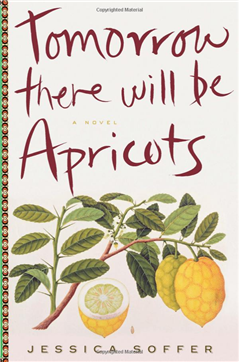
Tomorrow There Will Be Apricots is a brilliant, touching novel about the complexity of human relationships and the longing for love and acceptance. It is also a mouthwatering novel centered around food and the love of cooking. (I have no idea, though, why lemons are on the cover instead of apricots.)

Lorca is a teenage girl who yearns for love and affection from her mother Nancy. Nancy is a noted chef who remains emotionally aloof, so Lorca tries to please her by cooking food that she likes. The two live in a small New York apartment with Nancy’s sister Lou, who seems jealous of any attention Lorca gets from Nancy.

Lorca cuts herself for release, because something feels better than nothing. When she is caught doing it at school, she is expelled for a week. Instead of getting Lorca help, her mother informs her she is sending her away to boarding school.

One night Lorca overhears Nancy tell Lou that the best food she ever ate was masgouf at a restaurant that has since closed. Lorca believes that if she can learn to cook that dish for her mother, she won’t be sent away. So, she begins trying to find out about the restaurant with the help of her friend Blot.

Victoria narrates the novel in alternate chapters with Lorca. She is an old Jewish woman who fled Iraq with her husband Joseph when they were young. The two used to own and run the restaurant, which they closed when Joseph became ill. He dies early in the novel.

Victoria is full of regret, because she was so afraid that Joseph would love their child more than her that she insisted upon giving up their daughter for adoption when they were young and refused to have another child. Now she feels she deprived Joseph of part of his life and wants above all things to find their daughter. When she first sees Lorca, she is sure she is her granddaughter, and Lorca, whose mother was adopted, soon believes Victoria is her grandmother.

Whether this is magical thinking or not you can find out by reading the novel. It is ripe with the flavors and scents of the Middle East. This novel will touch you. It will also make you want to run out and eat some Middle Eastern food. Oh, and the recipe for masgouf is included.

Day 498: The Hour I First Believed

Cover for The Hour I First BelievedThe Hour I First Believed is described on its jacket as an exploration of faith, and as such I didn’t think it would be very interesting to me. But it is really more about a man’s struggle to face the problems of his life and his own demons. It is an extremely interesting and affecting work.

Caelum Quirk is not always a likable protagonist. He has anger issues—went after his third wife’s lover with a wrench—can be withdrawn and drink too much, says the wrong thing quite often, and earned my personal disregard at the beginning of the novel by referring to two different women as a ballbuster and a nutcracker. Lamb had to work hard to get my sympathy for his character after that, but he did accomplish that by the end of the novel. Still, whether I liked Caelum or not, I couldn’t tear myself away from his story.

Caelum is trying to salvage his marriage after the wrench incident, so he and his wife Maureen decide to move away from Three Rivers, Connecticut, the town where his family has a lot of history, and get jobs in Colorado. They are settled there and are doing okay, although still having relationship issues, when Caelum is called back to Connecticut because his beloved Aunt Lolly has had a stroke. She dies shortly after he returns, and Maureen is making arrangements to come for the funeral but decides to work one more day at the high school where Caelum teaches English and she is a nurse. Unfortunately, the high school in question is Columbine, and the school day she works is the day two students go on a rampage.

Maureen would normally be out of the area of trouble, but that day she decides to help Velvet Hoon, a troubled drop-out, fill out some papers in the library. Although she is not killed, she hides in a cupboard for hours before she is found, and subsequently suffers from post-traumatic stress disorder that barely allows her to function. She also struggles with an addiction to uppers.

Caelum and Maureen move back to live on Caelum’s family farm, a place for which he has mixed but mostly negative feelings. His father was a drunk of whom he was ashamed. He remembers his grandfather as judgmental and his mother as cold. Only Lolly seemed to care for him.

Troubles are not over for Caelum and Maureen, but I don’t want to reveal more about that. Caelum must also deal with his feelings about his family. His great-great grandmother was an early fighter for abolition and women’s rights, and she was instrumental in establishing the women’s prison down the road from the farm. It had a long history of treating the women with dignity and had a low rate of recidivism until its values were changed by modern tough-on-crime politics. Caelum’s great-great grandmother’s papers are in a spare room of the house. When Caelum is forced by financial circumstances to rent part of the house to a couple evacuated from New Orleans because of Hurricane Katrina, the wife, a women’s studies graduate student, asks if she can examine them. This and other events lead Caelum to several discoveries about his family.

This novel is sprawling, even a bit messy, because it seems to want to deal with everything. It features large events such as Columbine, 9/11, and Katrina, as well as the inequity of the American justice system, PTSD, drug addiction, grief, love, trust, religion, infidelity, and other issues. It is interesting, frustrating, and ultimately worth reading.

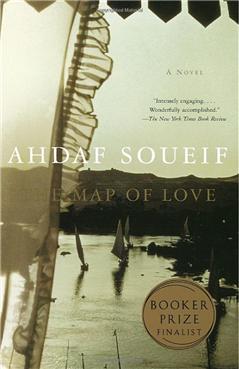
Day 482: The Map of Love

Cover for The Map of LoveBest Book of the Week!
The Map of Love is an absorbing novel to read now, just after the Arab Spring and during the troubled times that have continued on. It is a love story certainly, its title tells you that, but it also explores the roots of the political turmoil in present-day Egypt and some of the other countries that used to be a part of the Ottoman Empire.

The novel follows the course of two cross-cultural love affairs 90 years apart. In 1900 Anna Winterbourne travels to Egypt in an attempt to overcome her grief. She is the widow of a man who recently served in the Soudan, and even though their marriage was not a happy one, she is sorrowful that she could not help him overcome his despair at participating in an unjust war. Almost accidentally, she meets Sharif al-Barroudi, a Cairo lawyer and activist, and falls in love with him.

Anna’s diary and letters are discovered by her great-granddaughter, Isabel Cabot. Isabel herself has fallen in love with ‘Omar al-Ghamwari, a famous Egyptian-American orchestra conductor who is rumored to work with the Palestinians. ‘Omar feels that their age difference is too great for a relationship, but he suggests that Isabel take her find to his sister Aman in Cairo so that she might help Isabel translate some of the materials.

Aman becomes absorbed in reading Anna’s diaries and letters and realizes very soon that she and Isabel are related, for Anna’s beloved sister-in-law Layla is Aman’s own grandmother. With Layla’s diaries of the same time period, she begins to reconstruct Anna’s story and that of Egypt’s history during a turbulent period. Aman has returned from life abroad to live in Cairo in another turbulent time.

Anna’s courtship is fraught with difficulties, but once she and Sharif are married, she is caught up in his work for Egyptian independence from the Ottoman Empire and from British oversight. As the years go by, his efforts extend to attempts to keep Palestinian land, once owned by his family and by his neighbors and occupied by hundreds of thousands of Muslims, from being bought up by Zionists who would expel them.

The blurb for this novel stresses the similarities between the two love stories, and there are many points of similarity, but the focus of the story in the current time is more with Aman than with Isabel and ‘Omar. Aman is at first at loose ends in Cairo, but she becomes involved with trying to help the fellaheen who occupy her family’s land, as they are treated unjustly by a corrupt and paranoid government. I was frankly more interested in Aman and in Anna and Sharif than I was in Isabel and ‘Omar, who are much less present in the novel.

For me, not very politically aware in regard to problems in this part of the world, this was a fascinating and revealing reading experience. It points up the complex history of the area from a point of view we westerners seldom hear. It is affectingly told in the context of a great love affair between two lovingly created characters. The characters of the two sisters, Layla and Aman, are also vivid. This novel is beautifully written and evokes for us a vibrant culture.