Day 442: Housekeeping

Cover for HousekeepingBest Book of the Week!

A few years ago I was reading about a nonfiction work called A Jury of Her Peers, which discusses the routine misogyny in the American publishing and academic communities that has resulted in the neglect of works of countless American women writers. This book accomplishes the astounding task of tracing the careers of every significant American woman writer through the twentieth century, including not just the literary writers but even many popular genre writers.

On the Amazon page for the book, the author, Elaine Showalter, includes a great list: Top Ten Books by American Women Writers You Haven’t Read (But Should). My book club read several selections from that list and thoroughly enjoyed all of them. I still have not read them all, but I just recently finished Housekeeping.

First, let me warn about the blurb on the book cover, which makes this novel sound like a cheerful story about an eccentric family. It is not like that at all. The picture on the cover will give you a better idea of the novel.

Ruth and her younger sister Lucille are young girls who have repeatedly been abandoned. As children, they were left on their grandmother’s porch in the cold, remote town of Fingerbone, Idaho, by their mother, who went off to commit suicide by driving off a cliff into the huge glacial lake next to the town. This lake is the scene of another family tragedy, the place where their grandfather, a railroad worker, died when his train plunged off the bridge on the way back from Spokane.

The little girls are raised by their grandmother, a stiff, strict woman who forgets, on the rare occasions when she hugs them, that she has pins and needles stashed in a cloth in her bosom. When she dies, her maiden sisters-in-law take her place, a couple of timid, incompetent great-aunts who feel unequal to the task of raising two growing girls.

Lily and Nona find and summon the girls’ Aunt Sylvia, who was estranged from her mother for years. As soon as Sylvie arrives, the two old ladies skedaddle back to their comfortable room in the Hartwick Hotel in Spokane. Sylvie stays, but the girls are always afraid she will leave. Everything about her seems transient. She keeps a $20 bill pinned inside her lapel and never takes off her coat. She finds old friends in the railroad yard and in box cars and sometimes sleeps outside.

Ruth and Lucille have been inseparable, but soon Ruth feels her sister drifting away, as Lucille makes friends at school and becomes more aware of some salient facts: how unusual their household is and how the townspeople have begun viewing their living environment. Instead of acceding to Lucille’s perfunctory request to let Lucille make her more presentable, tall ungainly Ruth seems to grow more feral. As Lucille turns away from Sylvie and Ruth, Ruth is forced to depend even more on Sylvie.

Water is a persistent image in this disturbing novel. The lake, the scene of their family tragedies, is always there, cold, deep, and mysterious. Many of the girls’ illicit adventures involve exploring this lake. The town floods every year. The landscape is dripping and the road to town muddy. In the early days of Sylvie’s residence with the girls, she buys them cheap sequined ballet slippers to wear to town through the mud.

Every word in this novel is carefully chosen, every sentence exquisite. We can track Ruth’s growing eccentricity and unusual mind by the increasing oddness of her metaphors as she narrates the novel. Housekeeping is a stunning portrait of loss, longing, and fear of abandonment.

Day 438: In the Lake of the Woods

Cover for In the Lake of the WoodsBest Book of the Week!

In the Lake of the Woods is a mystery, but not in the traditional sense. It is also a harrowing look at one man’s tormented psyche after the trauma of war.

It is September 1986. John Wade and his wife Kathy have retreated to a remote cabin on Lake of the Woods in far northern Minnesota after John sustained a brutal defeat in a state senatorial campaign. Wade had been beating his opponent handily until information about Wade’s past surfaced, or perhaps it was only rumor.

One day Kathy disappears. Thinking she is just out for a hike, Wade does nothing for awhile, waiting for her to return. Late that night he goes into the village for help.

This all seems fairly straightforward, but O’Brien periodically presents us with a story about what actually happened, only the story is different each time. As O’Brien reveals more, we learn that Wade was behaving oddly the night before Kathy disappeared–or did she disappear that night? Is she lost, did she leave on her own, did something happen to her? We learn that Wade has taught himself to forget anything he doesn’t want to think about–as if it never happened.

O’Brien shows us the psychological makeup of a man who has undergone a great deal of trauma–whose father committed suicide when he was ten, who spent his boyhood in the basement teaching himself magic tricks, who served in Vietnam. But he is also a man who periodically spies on his wife, who calls himself the Sorceror, who makes of himself a master manipulator, who has horrible nightmares.

O’Brien alternates chapters about the search with those that explore Wade’s past. He also includes chapters of excerpts from interviews of those involved and from other sources as diverse as books on psychology, biographies of politicians, and records of military massacres, such as the Battle of Little Bighorn and My Lai.

This novel is absolutely riveting, written in spare and beautiful prose, disturbing and powerful. It is not so much a mystery as a novel about mystery–why we find it fascinating and what we can never know, a single human soul.

Day 432: The Orphan Master’s Son

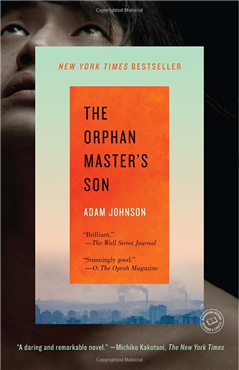
Cover for The Orphan Master's SonBest Book of the Week!

I can tell before I even start that this is going to be one of those times where I have difficulty conveying just how good this novel is. It is going to sound dreary and painful, but it is a wonderful, wonderful novel.

For a long while I avoided this book, afraid that the subject matter would be too cold or too harrowing. However, it has earned so many honors that I felt I finally had to read it. It is harrowing, but it is so very human, and touching, and inspiring.

Pak Jun Do (note the purposeful echoing of our clichéd unknown man, John Doe) is the only boy with a father who was raised in an orphanage in North Korea, the orphan master’s son, or so he believes. Of course, many of the orphans actually have parents, who dropped them off because they couldn’t or wouldn’t feed them during the time of the great famine. The orphans, including Jun Do, are shamelessly put to hard labor deep in the mines, where our hero learns a skill that will come in handy, to get around in the dark.

Later, he is assigned to a kidnapping team, sneaking into Japan to abduct unwary Japanese citizens. You can see him quietly processing his opinions about this activity. From this position, he is sent to language school and ends up on a fishing vessel spying on radio transmissions from other countries and vessels, including, significantly, those of a young American woman who is rowing around the world with a partner. Jun Do begins showing himself to be observant, resourceful, and ethical in his own way.

Jun Do has had a difficult start in life in an environment that seems almost totally arbitrary, and as he experiences one event after another, he begins to develop in unexpected directions and to look at his environment with a skeptical and aware eye. After an encounter with an American ship, Jun Do and his shipmates fabricate a ridiculous lie to save themselves and their families. This lie inadvertently results in Jun Do being declared a national hero. From there his life begins a series of remarkable transformations.

I am feeling my inadequacies here, because I am not conveying at all how wrapped up I became in Jun Do’s story. It is told in many voices, including the daily loudspeaker broadcast of propaganda (which is frequently ridiculous) and the “biography” put together by a state inquisitor. Some of the events are difficult to read about, some frankly absurd, as when the Dear Leader Kim Jung Il decides to entertain some American dignitaries with synchronized fork lift demonstrations.

The novel tells a story of hope, mixed in with the grim reality and sheer ludicrousness of what seems to be a fully realized vision of North Korean existence, where people live in terror of innocently making some terrible error. The book tells this story with power, with pathos, with sly humor, and with irony.

This book is really, really great.

Day 431: Butterfly Winter

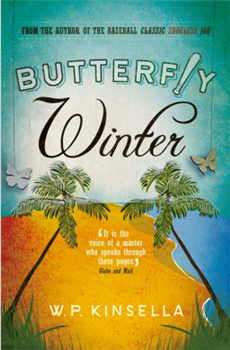
Cover for Butterfly WinterI have to start right out by saying that Butterfly Winter was a poor choice for me. W. P. Kinsella is beloved by many, and I know that people are excited that this is his first novel in fifteen years. However, I should have known better than to select a book by the “master of magical realism,” as one reviewer put it, because I have a problem with magical realism. It is a very tough sell for me. I have to be fully bought into the realism before I can accept the magic. In the case of this novel, though, I don’t even think it can be called magical realism, because the realism was left out.

This novel is about baseball. That shouldn’t be a problem, although I am not a sports fan. I was willing to be wooed by The Art of Fielding into at least grasping that it can be pretty fantastic. But Kinsella doesn’t try to convince us of that. He just posits that it is wonderful and magical and obviously thinks everyone should agree with him.

I think I could have dealt with either of these two issues, but the first chapter of this novel, where the Gringo Journalist is trying to interview the Wizard, and the Wizard refuses to answer his questions but goes off on a bunch of tangents, is the most annoying piece of writing I have ever read. The novel picks up a little in the second chapter when it changes to a narrative style and picks up again every time it returns to that style, but unfortunately the irritating voice from the first chapter is the novel’s primary narrator. The tone of the novel is arch, to me a little forced, and the humor unsubtle.

http://www.netgalley.comNow to the story. Julio and Esteban Pimenthal are twins who play baseball in their mother’s womb (a wince-inducing image). One of them is born with cleats on, and the other with a baseball glove. (I think it is safe to say that only a man would have thought of that.) They are inhabitants of Courteguay, a fictional country wedged between Haiti and the Dominican Republic where magic is commonplace. (Silly me, when I read “magical Caribbean island” in the blurb, I was thinking scenery and beauty.) When Julio and Esteban are ten years old, they travel to the United States to play pro ball. But first we hear about the Wizard and how he came to the island in the late 19th century and introduced baseball to it.

I have to admit, I did not finish this book. I’m sure that many will think it delightful, but I found the narrative style too annoying to continue. This novel was the wrong one for me to choose to become acquainted with Kinsella.

Day 429: The Dark Rose

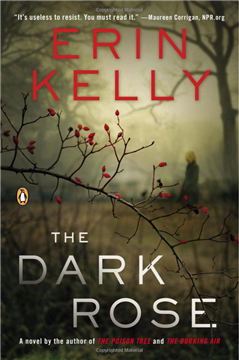
Cover for The Dark RoseThe Dark Rose is the story of how the lives of two troubled people intersect, with unfortunate results.

Louisa has had a secret for 20 years that changed her life. In flashbacks to 1989, she meets Adam, a singer and bassist in a local rock band, and falls immediately in love. For the first time, she is not the one in charge of her own love life, and he is in turn attentive and evasive, loving and impatient. Louisa is eaten up by jealousy, especially when his band mates make jokes about his relationships with other women. No good comes of this situation.

In the present time, 19-year-old Paul has been forced to testify against his friend Daniel. They have a long-standing friendship that Paul has been wanting to escape. As boys Daniel protected Paul from bullies while Paul kept others from finding out that Daniel was illiterate. But Daniel’s father is a criminal, and Daniel has begun involving Paul in illegal activities just as Paul is trying to begin a new life at university.

While he awaits Daniel’s trial, Paul is sent out of the area for his own protection to help with a project restoring a Tudor garden to its former glory. On site he meets Louisa, the head gardener, who is struck by Paul’s resemblance to her long lost love.

Kelly does a good job of keeping up the suspense, telling the interleaved stories of the young Louisa from 20 years before and of Paul’s more recent history. Although you become aware that each story involves some horrendous event, she spins out her tale so that events are revealed toward the end of the novel. Still, all is not over.

I found The Dark Rose less satisfying than The Poison Tree, Kelly’s debut. Paul and Louisa are definitely more flawed and less likable than the previous book’s heroine. Still, we want to find out what happens to them.

Erin Kelly has been likened to Gillian Flynn or Tana French. I am always skeptical of such comparisons (“If you like so-and-so, you’ll love . . .”), and I prefer the work of Flynn and French. However, Kelly does have a comparable dark sensibility. I just think Flynn and French are better at getting you to sympathize with their main characters, even though they are invariably flawed (except for Gone Girl, that is, where no characters are sympathetic).

A warning about this book if you shop in used book stores. I bought it a second time by accident because the British edition is under a different title, The Sick Rose.

Day 420: NW

Cover for NWI’m not sure what I think about NW. In reading a few reviews, I almost wish I had come to Zadie Smith first through one of her more traditional novels, as NW is almost a deconstruction of form.

NW is the postal code of an area of northwest London where Smith’s characters were brought up and reside. They were all raised in the same housing project, a group of towers that dominates the area of the impoverished and ethnically mixed Kilburn. In each section of the novel, we follow a different character.

Leah Hanwell has escaped the projects but lives within sight of them in a nicer neighborhood. She is of Irish and English heritage, married to Michel, who is half Algerian, half Guadaloupan. Her best friend Natalie Blake is first generation English of Caribbean origin. It seems that for every character in this novel, ethnic heritage is a mixed bag and not a way to find an identity.

Leah has come to resent Natalie, who has been the most successful of their acquaintances. Leah misses their former closeness and feels they now have little in common, especially since Natalie had children. The issue of children is a stressful one for Leah, who has been secretly taking birth control pills while her husband thinks they are trying to conceive. The only absolute and pure love Leah has to bestow goes to her dog Olive.

Leah is home alone when a woman comes to her door claiming to have an emergency. When the woman recognizes Leah as a former resident of the same building in the projects, all pretence of an emergency seems to disappear as they exchange information about common acquaintances. Even so, Leah impulsively hands over a fairly large sum of money. Afterwards, she vacillates between sympathy for this woman–a drug addict on the con–and a resentment that she’s been cheated. Telling Michel about it sets up a situation that ends badly.

In the second section of the book, Felix starts out his day of running a few errands in a cheerful mood. He is going to visit his father, say goodbye to an old girlfriend, perhaps buy a car. He is happy in his life. He has kicked a drug habit, is in love with his girlfriend, has a good job, and wants to lead a more productive life. We don’t anticipate what happens to Felix.

The bulk of the novel belongs to Natalie, who has remade her life, including changing her name from Keisha. She is a lawyer married to a day trader, with two children. She lives in a beautiful house in an upscale neighborhood. She is outwardly a confident, take-charge woman, but inwardly much more tentative. As one of her friends says, she’s been telling everyone all their lives that she is different from them. Yet surely, her impulse is more to fit in.

Natalie and her husband Frank pretend to be a loving couple, but when they are not out in public they spend little time with each other. Natalie doesn’t enjoy her children, either. Of all the characters, including a homeless drug addict named Nathan that Leah and Natalie had crushes on when they were all kids, she seems the most discontented. In one way, she has erased her former life. In another, she drags it along with her. All she enjoys is her work.

The novel is presented in a fragmented way. Conversations begin in the middle and sentences are cut off. Issues remain unresolved. Dialogue and descriptions are vivid but gritty, such as when Leah and Natalie push a stroller through a trash-lined neighborhood to find an ancient church in the middle of a traffic circle, its tombstones covered in graffiti. Smith’s novel is ambitious, an urban slice of several lives.

A little side note. The paperback copy of this novel has a typo on the back cover where it calls a character by the wrong name. I kept waiting for that character to appear until I figured out what was going on. That’s a pretty big mistake. Just sayin’.

Day 416: The Lowland

Cover for The LowlandBest Book of the Week!
Today we have a treat–one of the novels that made the short list for this year’s Booker Prize.

As boys in Calcutta, brothers Subhash and Udayan Mitra are inseparable, even though their personalities are so different. Udayan, the younger boy, is bold, reckless, and charismatic. Subhash is quiet and responsible.

As they reach college age, Subhash dedicates himself to his studies while Udayan becomes involved with the Naxalites, an obscure radical leftist group that takes its name from solidarity with the poor farmers of Naxalbari who rose up against their landlords in 1967. Subhash, who is apolitical, stays away from these activities and soon goes to Rhode Island to attend graduate school.

Subhash is called back to India because Udayan is dead. He returns to a home of grief, where his parents hardly speak to him or move from their balcony overlooking the street, where his mother goes out periodically to tend the small stone marker in the Lowland, a marshland where the boys had played and where the police shot Udayan in custody.

Subhash’s parents do not speak to his brother’s wife Gauri, and soon he understands that they hope to drive her away and take custody of her unborn child. So, Subhash offers to marry her and bring her back to the States so that he can care for her and the child. Gauri agrees.

Although Lahiri chooses to begin her novel in turbulent times, both in India and the United States, where demonstrations against Vietnam are taking place, her characters seem distanced from this activity, even though their lives are irrevocably changed by what happened in India. Incidents are described, but at a level that seems far removed from their reality. Only at the very end of the novel do we understand Udayan’s viewpoint, and it is just of the last few moments of his life.

I don’t know if this is a criticism, though. This novel is not so much about these political activities as about Udayan’s actions and their results, about the emotions that arise from them. The novel is about the complexities of grief and how they evoke other emotions–anger, isolation, inertia. As Maureen Corrigan remarks in her review of Unaccustomed Earth, “All that lushness electrifyingly evokes the void.” In The Lowland, we’re not so much faced with lushness as a marshy wasteland. This wasteland is in itself a metaphor. In the monsoon season it is one marsh, but when it becomes drier, it is separated into two ponds, just as Subhash and Udayan, and later Subhash and Gauri, are together and separate, each failing to comprehend the other.

Finally, the novel is about betrayal. Spanning more than 50 years and four generations, this novel, apparently broad in scope, is actually more concerned with private and personal tragedies. It evokes an atmosphere that is at once poignant and arid.

Day 413: Doll Bones

doll-bonesI just realized I had inadvertently reviewed a slew of historical novels in a row, so here’s something contemporary.

I really appreciate a children’s book that has as much to offer an adult as a child. I’m thinking of those books of Frances Hodgson Burnett, Philip Pullman, J. K. Rowling, or Robert Louis Stevenson as examples. Doll Bones doesn’t actually fit into that category, but I’m sure that tweens and younger kids will enjoy it.

Zach Barlow is growing up. He’s put on enough height this year to join the middle school basketball team. What he still enjoys most, though, are the games he plays with his best friends Alice Magnaye and Poppy Bell, where they use dolls and action figures to act out elaborate stories. However, they never touch one doll belonging to Poppy’s mom that they call the Queen, an old porcelain doll that seems very creepy.

Zach’s dad left him and his mother for a few years, but now he has returned to them and is still trying to figure out how to be with them. One afternoon Zach comes home thinking about what will happen next to Pirate William, only to find his dad has thrown away all his toys and dolls. Zach is too upset even to explain to Alice and Poppy why he won’t play anymore. The two girls are devastated.

One night the girls come to see him. Poppy explains she’s had a ghost visitor who says her ashes are inside the Queen. The ghost girl has asked them to bury her ashes in her grave in East Liverpool, Ohio. Poppy believes the ghost and wants to go on a quest to return the bones, which are in the bag that makes the doll’s body. So, despite their fears of getting into major trouble, the kids get on a bus in the middle of the night to travel from Pennsylvania to Ohio.

Of course, on this trip they run into difficulties, including getting scared off the bus part way and having to make their way on foot or any other way they can find through a landscape of urban blight. On the way, some adults creepily seem to believe there are four of them. Eventually, they solve the mystery of who the girl is and what happened to her. As they meet these difficulties they grow up a little and figure out better how to handle their changing relationships.

I think kids will relate to the problems of Zach, Alice, and Poppy. I also think they’ll like the spookiness of the story. Doll Bones falls among the more innocent of contemporary books for tweens and younger teens, with a few chills but no violence or bad language. It would make a good story for any kid from ages eight or nine to, say, twelve or thirteen.

Day 404: Swamplandia!

Cover for SwamplandiaBest Book of the Week!

Swamplandia! is the third book I’ve read in the past few months that has a strong young female voice (with Tell the Wolves I’m Home and Where’d You Go, Bernadette). All of them were very good.

Before I start, though, a comment on the cover for the hardcover copy of the book, which is not the one I read or the one shown here. I was not really clear about whether this book is considered appropriate for young adults or not (probably), but the hardcopy cover makes Swamplandia! look like a children’s book, showing a very young girl piggyback on a character who looks somewhat like the Mad Hatter, both watching an alligator. Let me warn you that Swamplandia! is definitely not for young children.

Thirteen-year-old Ava Bigtree and her family live on an island in a hokey-sounding amusement park in the Florida Everglades called Swamplandia! There, they dress up as Native Americans (their grandfather, who founded the park, was a German-American farmer from Ohio) and breed and wrestle alligators. Ava’s mother Hilola was the main attraction until she became ill with cancer and eventually died.

Since then the family has tried to cope with its grief while also attempting to save the floundering park. Homeschooled and with little contact with the mainland, the Bigtree kids have been raised in a sort of dream land. They all possess a thorough and subversive knowledge of the history of Florida and of its flora and fauna but not many skills for dealing with the outside world. Kiwi spends almost all his time reading, Osceola believes she has a ghost lover, and Ava is aiming to become a world-famous alligator wrestler.

When tourists stop arriving on the ferry, Chief Bigtree, the children’s father, makes one of his mainland journeys to raise money to save the park, but not before Kiwi apparently abandons them to get a job with the park’s competitor, The World of Darkness. Sixteen-year-old Osceola and Ava are left alone on the island until Osceola floats away on an old barge to join her lover.

Frantic to save Osceola, young Ava joins up with a mysterious man named the Bird Man, who claims to know his way into hell, which is where Ava assumes she must go to bring Osceola back from her ghost lover. As our apprehension grows, we follow Ava’s journey while periodically cutting over to observe Kiwi’s serio-comic adventures at the hell-themed World of Darkness.

Russell creates a lush world in Swamplandia! and a compelling narrator in the innocent/wise Ava. The language of the novel is gorgeous, its heroine engaging. You will find yourself immersed in a damp world bursting with life, and you won’t want to leave it until you know what happens to Ava.

Day 399: Beautiful Ruins

Cover for Beautiful RuinsAt times I wasn’t sure how much I liked this novel, whether it wasn’t going to wrap its many threads into too neat a package. It does wrap things up, but ultimately in a satisfying way.

The novel begins in 1962, when Pasquale Tursi is a young man. He dreams of turning his very small Italian seaside village into a tourist attraction, so he is futilely trying to create a beach on a small strip of waterfront when a boat pulls in. It is carrying Dee Moray, an American actress who has been working on the troubled set of the movie Cleopatra. She has fallen ill and has come to Porto Vergogna to wait for her lover at Pasquale’s hotel, the Hotel Adequate View. Pasquale is immediately smitten.

In present-day Los Angeles, Claire Silver is contemplating leaving what she thought was her dream job, as chief development assistant for the legendary film producer Michael Deane. Claire’s vision for the job had been that she would help develop many exciting projects, but unfortunately for her, Deane hadn’t produced a hit in years until Hookbook, a TV “reality” show, like Facebook for dating. Since then, she has spent her time listening to pitches for sleazy reality programs.

This day might be her last Wild Pitch Wednesday, when anyone who can get an appointment can pitch her an idea. If she takes the new job she’s been offered, she’ll return to film archiving–for the Church of Scientology.

Shane Wheeler is on his way from Portland, Oregon, to present an idea at Wild Pitch Wednesday. A failed novelist, he has decided to trying pitching an idea for a movie about the Donner Party. On the way into the building, he encounters Pasquale, who has come all the way from Italy to try to find Dee Moray. Pasquale’s only lead is an ancient business card he got from Michael Deane, who was an assistant on the movie at the time, taking care of problems such as those posed by the scandalous affair between Elizabeth Taylor and Richard Burton. Shane, Claire, and Michael Deane soon find themselves involved in helping Pasquale find Dee.

These are only a few of the characters we encounter as the story moves backwards and forwards in time, moves from person to person in point of view, and takes us from rural Italy to Rome to the inner circles of Hollywood to the Fringe Festival of Edinburgh to an amateur theatre performance in Idaho. On the way we are entertained by wry observations on the Hollywood film business and the music business, and the straight narrative style is carried forward by partial movie scripts, acts from plays, pitches, pseudo-pitches, a chapter from a novel, and some brief notes.

At times knowing, at times amusing, at times sweet, Beautiful Ruins is an engaging postmodern love story and commentary on the entertainment industry.