Day 316: The Keep

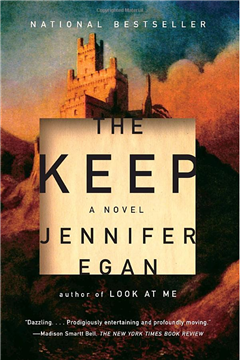
Cover for The KeepI only recently discovered the pleasures of reading Jennifer Egan when I read Look At Me last year. The Keep is another of her very interesting novels. Her most well-known novel, which I have on my list to read, is A Visit from the Goon Squad, which won the National Book Critics Circle Award.

Danny is an aging hipster who has long occupied the edges of power looking for a way to get some for himself. He is on his way to Europe to take up an invitation extended by his cousin Howard to help develop an ancient castle into a hotel.

Danny is anxious about accepting this position because of his guilt and paranoia over a horrible childhood event, when his older cousin talked Danny into abandoning Howard in a deep cave. However, Howard’s invitation comes at a time when Danny urgently needs to get out of New York, so he goes.

After an unsettling arrival at the half-renovated castle, which contains opulence and filth within rooms of each other, Danny meets an almost unrecognizable Howard, his wife Ann and their two young children, his second-in-command and best friend Mick, and other assorted workers. Living in the keep of the castle is a mysterious old baroness who thinks she still owns the castle. A creepy feature of the property is a dark, reeking pool that may be haunted by two twins who drowned in it.

Back in the states, Ray, a prison inmate, is taking a writing class and begins reading aloud his story about a guy named Danny who journeys to Europe to help his cousin develop a castle into a hotel. Discovering the connection between the two stories, and a third one involving the writing class teacher, is part of the pleasure of reading this deeply involving novel. Egan moves the narrative back and forth in time to tell these two parallel stories, keeping the reader’s interest with consummate skill.

Day 315: Beyond Black

Cover for Beyond BlackI have liked almost everything I have read by Hilary Mantel but could not finish Beyond Black. It is supposed to be extremely black humor, which I usually enjoy, and the idea is certainly an entertaining one, but somehow I felt it went too far, at least for me.

Alison is a medium who travels the rounds of the psychic “fayres.” She actually does see and hear the dead. Alison meets Colette, an event planner, who she hires as her personal assistant. Soon, the two women are sharing a house in a suburban wasteland, where apparently all hell breaks loose. (I did not get this far in the novel.)

Mantel’s skewering of the “fayres” is amusing. Another clever idea in the novel is that the dead are a bunch of seedy characters obsessed with trivial things, just as are many people in life. However, after awhile the sheer bulk of the trivialities becomes overwhelming.

Alison’s spirit guide, Morris, instead of being the traditional Indian chief or swami, is the ghost of an actual hoodlum Alison knew when she was young. I could deal with the spirits constantly talking about minutia, but Morris was incredibly repulsive and disgusting. With the mundanity going over the top combined with my disgust at Morris, I stopped reading.

Day 312: Castle

Cover for CastleEven from the first moments of reading the unusual Castle, the novel seems to be about more than is on the surface. That notion turns out to be the case.

Eric Loesch returns to the town where he grew up and buys a large piece of property outside of town. Then he starts fixing up the farm house. He almost immediately becomes fixated on a large rock on the property and eventually finds the ruins of a castle behind it.

This activity seems all very straightforward, but something more is going on, we’re sure. Loesch is an unusual man, as demonstrated throughout by his thoughts and actions. His reactions to seemingly ordinary conversational gambits seem extreme. His emphasis on privacy seems excessive. We also feel, although we don’t know why, that he may have a military background.

Castle is a novel that unfolds slowly but keeps your attention throughout. It becomes clear that there are painful incidents in Loesch’s past, but the novel takes its time getting to them, and Loesch seems to be in denial about some of them.

The writing is skillful, particularly in delineating Loesch’s character through his behavior. In fact, I don’t know when I’ve understood the personality of such an unusual character so particularly before without the author actually telling me about it.

The revelations at the end of the novel are not, for the most part, foreseeable, although I could eventually predict at least one important plot point. All-in-all, Castle is a disquieting, dark tale.

Day 306: The Cat’s Table

Cover for The Cat's TableIn the early 1950’s, the 11-year old Michael Ondaatje set sail from his home in Sri Lanka for England to meet his mother and go to school. The Cat’s Table is a fictionalized tale of this journey, he tells us.

On board the Oronsay, Michael (nicknamed Mynah) becomes friends with two other boys–Cassius, a wild, rebellious boy from his school, and Ramadhin, gentle and contemplative, with a bad heart. Also on board is Michael’s cousin Emily, a 17-year-old beauty with whom he is close.

Although Michael’s father has arranged for an acquaintance to look after him, she is in first class and only summons him occasionally during the voyage. Michael and his two friends are assigned to the “cat’s table” with the most insignificant passengers on board–a tailor who never speaks; Mr. Mazappa, a jazz musician who admits he is “on the skids”; Miss Lasqueti, a seemingly colorless spinster; Mr. Fonseka, a literature teacher from Colombo; and Mr. Daniels, a botanist who is transporting an entire garden in the hold of the ship. Other important characters are a deaf Singhalese girl named Asuntha whom Emily befriends and a mysterious prisoner who is brought above board late each night and provides fuel for the boys’ imaginations. Michael and his friends find that no one is paying attention to them, so they run wild all over the ship.

At first this narrative proceeds more or less sequentially in a series of vignettes telling of different passengers or events. Later, the narration branches out, moving forward in time to later periods and incidents in Michael’s life related to the people he knew on the ship, and then back again. Toward the middle of the novel I felt confused, as if the narrative would never resolve itself into a coherent story.

But it does. Events on board the ship affect the future lives of several of the passengers, particularly those of Michael and Emily. In getting to that place, we experience the sights and sounds of this exotic and evocative passage across the Indian Ocean and the Arabian Sea, up the Suez Canal, and into the Mediterranean.

The novel is beautifully written, with the vignettes working together in the same way that Michael describes a series of paintings by Cassius, which he sees in a gallery years later. At first the paintings seem abstract, but if he looks at them from the right distance, he sees they perfectly depict the events of a particular night in their voyage together. The vignettes, like fragments seemingly disconnected and abstracted, slowly come together to show us a coherent whole, of Michael’s understanding of the events of the voyage, of his reinterpretation of those events later in life, of how they affect his life and those of others.

Day 301: 1Q84

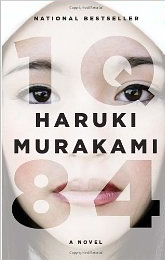
Cover for 1Q841Q84 is an extremely unusual novel. I notice that the blurbs about it don’t reveal much about the plot, but I have chosen to describe the incidents in the beginning of the book because I found it difficult to decide whether to read it (I prefer book covers that give some indication of the plot or subject matter instead of just quotes) and probably wouldn’t have were it not for all the buzz.

1Q84 was originally published in Japan as three books, so it is very long. It is sort of a combination of a fantasy novel, a romance, and a mystery, but it is not by any means a genre novel.

In 1984 Tokyo, Aomame is on her way to an important meeting with a client when traffic becomes gridlocked on an elevated expressway. The taxi driver, who has Janáček’s Sinfonietta playing on the radio (which Aomame is surprised that she can recognize), tells her that there is an emergency staircase nearby that will allow her to exit the expressway and catch the train. He mysteriously reminds her that there is only one reality. Aomame climbs down the stairway–and enters a world on a slightly different track from her own.

Aomame is a physical therapist who works occasionally as an assassin, murdering men who have repeatedly abused women. Her appointment is with a victim, whom she murders. When she emerges from his hotel, she notices there are two moons in the sky and realizes she has entered a slightly different world, which she decides to name 1Q84.

In a parallel story also set in 1984 Tokyo, Tengo is a part-time math instructor who wants to be a writer and happens to like Janáček’s Sinfonietta. He is approached by Komatsu, a publishing company editor who is familiar with his work, to rewrite a novel that has been submitted to a competition. The story is unusual and imaginative, he says, but poorly written, and Komatsu believes that with help it can become a sensation. This suggestion is highly unethical for a submission to a literary competition, and Tengo is reluctant, but once he begins working with the material, he can’t resist it.

Tengo finds that the novel, named The Air Chrysalis, was written by a teenage girl named Fuka-Eri, who is a fugitive from an idealistic commune that has become a secretive religious sect. The novel is about Little People who weave a chrysalis out of the air and live in a world with two moons. Fuka-Eri tells Tengo that the Little People exist.

I was driven to finish the first book to try to figure out the connection between the stories of Aomame and Tengo. There are many echoes between the two stories, but the two characters seem to be living in different worlds, as tracked by the number of moons.

In the second book, the connections become clearer. By the third, I was reading to see if Aomame and Tengo are finally able to meet and emerge from danger.

Reviews of this novel are mixed, and I find that I feel the same way. I have seen 1Q84 compared to Ulysses, which is absurd, and on the other end of the spectrum, completely dissed. Certainly, Murakami has written a story that compels you to finish, but I found the mystery of the Little People to be lacking any internal logic and even a bit silly. I also have a sneaking suspicion that if The Air Chrysalis was really published, it would not be a publishing sensation but more likely a publishing joke. And don’t get me started on Cat Town.

Moreover, although Tengo as a character seems attractive and convincing, I found Aomame much less likely. To mention one detail, yes, many women are unsatisfied with their own appearance, including their breast size, but they don’t think about it constantly. After about the twentieth mention of Aomame’s breasts, this repetition becomes tiresome.

Tengo also has an obsessive memory of his mother’s breasts. In fact, the sexual context of the novel is definitely peculiar, with lots of odd descriptions of pubic hair and references to intimate body parts. The physical focus is just one facet of Murakami’s use of repetition as a thematic technique.

My prediction is that if you choose to read this novel you will want to finish it, but you may find parts of it absurd.

Day 295: The Gathering

Cover for The GatheringA large family in Ireland is gathering together for the wake of their brother, Liam, who drowned. Veronica Hegarty, his sister, travels to London to collect the body and keep vigil with it.

This novel follows her consciousness as she thinks about her relationships with her own husband and the rest of her family and considers why her brother’s life turned out the way it did. She describes Liam as a “terrible messer,” who was an alcoholic and finally put stones into his pockets and walked into the sea.

She also remembers her grandmother Ada, and imagines scenes involving her grandmother’s relationship to Veronica’s grandfather and to another man when she was a young woman. Veronica muses about life growing up in her grandparents’ house and the connection with her brother’s secrets and troubles. She feels guilty that she did not help him and that no one sympathized with him when he was alive.

This novel is angry, heavy, and sometimes repels the reader. By page 55, I felt that the narrator was inordinately concerned with the mechanics of men’s penises. Still, it is an evocative story about a woman’s grief and her struggle to understand her brother.

Day 286: Await Your Reply

Cover for Await Your ReplyLucinda Rosenfeld with the New York Times was stuck by this novel’s bleakness. I was more struck with its cleverness. In fact, I think I’ll have a hard time conveying what an incredible novel it is.

At first, it seems to be a set of three stories about people who are not connected, but the connections begin to occur to you as you read it. Although the novel plays with time by relating incidents out of order, you eventually understand how the characters and the incidents are related.

Ryan is traveling to the hospital with his severed hand in an ice bucket. He has been holed up in a remote cabin in Michigan with his father Jay, but a violent incident has just occurred. Later, we learn that Ryan was a student at Northwestern University until he was contacted by Jay, who told him he was his real father–that the parents who raised him actually were his aunt and uncle. Ryan, feeling his life is a sham, has abandoned his school and parents and gone to work with his father as an identity thief.

Lucy has run off with her high school science teacher George, who has promised her they are going to make a lot of money. Lucy has been dying to leave her hick life in a hick Ohio town, as she sees it. She is dismayed, however, when they arrive in Nebraska at an abandoned motel shaped like a lighthouse near a dried-up reservoir and take up residence in a creepy old house the description of which reminds me of the one behind the Bates Motel.

Miles has been searching for his twin brother Hayden for ten years. After a period of extreme mental illness in high school, Hayden disappeared. Miles has never been sure whether his brother’s condition was real or faked, because Miles and his brother used to spend a lot of their time creating elaborate fantasies. Now, every once in awhile, his life working in a mail-order magic store is interrupted by a paranoid and semi-coherent letter from Hayden offering Miles clues of his whereabouts, which sends him off in pursuit. Each time he arrives late, after his brother has left the area, and finds that his brother has been using a different name, working a different job. Now Miles is driving to the farthest reaches of Canada to try to find Hayden.

The novel is constructed like a puzzle, providing the pieces, but jumbled up, and building a sense of suspense and dread. You become completely absorbed in reconstructing the events and connecting the stories. You begin to wonder what has happened to some of the characters, who seem to have disappeared.

My only small problem with the novel is a key incident, where a character is lured to Africa by the classic Nigerian Letter scam, which offers a huge amount of money for helping a stranger get a larger sum out of the country. This scam is well known on the Internet, and I in fact ran into it in letter form about 20 years ago. I have always been incredulous that anyone would fall for it, although I realize that people still do. But the character who falls for it in this novel is one who has long used the Internet for identity theft. It seems as if he would be likely to know of the scam, even though his character is one who seems compelled to believe in the fictions he has created.

This novel is about identity and its relationship to death. Various characters take on different identities throughout the book. In doing so, they come to view their old selves as dead. It is almost as though Chaon views identity and selfhood as being entirely fluid–or perhaps his message is that this is a change wrought by our uses of the Internet.

Day 281: Gilead

Cover for GileadBest Book of the Week!
Gilead is the novel that precedes Marilynne Robinson’s Home, although it is set in the same time frame and covers some of the same territory. This novel won the Pulitzer Prize for fiction.

John Ames is an elderly Congregationalist minister in 1956 who believes he is dying. He has a much younger wife and young son, a surprising blessing in his old age. The novel is in the form of a diary addressed to his son in the expectation that he will not live long enough to personally pass on his family history and advice.

Ames lives in Gilead, a small Iowa town on the prairie near the border with Kansas. The town was founded by abolitionists during the Free State wars in Kansas as a refuge for slaves and fighters the likes of John Brown. Ames’ grandfather, also a minister of the warrior-for-God ilk, had visions of God and once preached a sermon in a bloody shirt with a gun in his belt. With that upbringing, his son was naturally a pacifist, who left the church for awhile after that sermon to worship with the Quakers. One of Ames’ most powerful memories is of the journey he made with his father to Kansas, in terrible conditions, to retrieve the body of his grandfather, who had returned there.

Although Gilead is certainly about the history of the town–the wars, the Depression, the Dust Bowl years–it is more about the relationship between fathers and sons, both from the secular and religious points of view. Not only does it explore the relationships within Ames’ own family, but it also looks at that between Ames and the son of his best friend the Presbyterian minister–Ames’ surrogate son–John Ames Boughton.

The story of John Ames Boughton is the one more thoroughly explored in the sequel Home, although interestingly enough, Gilead tells Boughton’s story more explicitly, while Home, narrated by Boughton’s sister Glory, only hints at some of the facts.

The novel, a celebration of life and faith, is beautifully written and full of ideas to ponder. That being said, as I do not particularly have a religious background or bent, I did not fully understand some of the narrator’s ideas and preoccupations. I found Home, although told from the point of view of the same goodness and piety, a more accessible novel than Gilead.

Day 276: The Best of Friends

Cover for The Best of FriendsJoanna Trollope writes contemporary novels about real people with realistic problems who live in small British towns and villages. It is one pleasure of reading her that she seldom presents you with a trite ending with all the loose ends tied in a pretty package.

Gina Sitchell and Laurence Wood have been friends since school but were never romantically involved. Their relationship was one that Hilary made sure she understood before agreeing to marry Laurence. Around the time of their marriage, Gina came home to Whittingbourne from living in France and soon married Fergus Bedford, an antiques dealer, and Gina and Hilary became fast friends. Now, twenty years later, Laurence and Hilary run a thriving hotel in the historical Bee House and have three boys. Gina and Fergus live with their only daughter Sophy in a home that Fergus has lovingly restored.

The marriage dynamic of Gina and Fergus has always been to argue, loudly and often. To Gina, nothing has changed, so perhaps that is why she is so shocked and overcome when Fergus coldly informs her that he is leaving her, has indeed been waiting for Sophy to get older before he did so. Then he takes exactly half of the furniture and goes.

Gina is so devastated that she imposes herself on Laurence and Hilary, leaving 16-year-old Sophy in limbo between her own, now unfamiliar home and her grandmother Vi’s tiny apartment. Sophy, who adores her father, is heartbroken and furious.

Between the diverse tasks of managing the hotel and raising three teenage boys and the burden of Gina’s presence, Hilary, first sympathetic, grows tired of the toll Gina’s drama is taking on her household. When Laurence isn’t working as the hotel chef, he seems to be spending all his time comforting Gina. Little does Hilary suspect that her own family life will soon be disrupted by Laurence’s discovery that he loves Gina.

Trollope creates fully realized characters in the two couples but also in their children, and in Vi and her aged suitor. Not all of them are likeable, but they are all convincingly human. I felt sorry for Gina at first, but my sympathy was soon evaporated by her self-centeredness and willingness to wreak havoc with her friend’s family. Fergus seems almost heartless at first, but we soon grow to understand him a little better. None of Trollope’s characters are bad, just people with ordinary complicated personalities who see things from their own points of view.

Trollope creates a story that you want to see resolved but never takes shortcuts to provide a typical happy ending, in fact seldom invents plots for which there could be one. Her novels are for adults, and they deftly explore the complexities and confusions of being human.

Day 267: Black & White

Cover for Black & WhiteI had an ambivalent reaction to Dani Shapiro’s Black & White. By coincidence, while I was reading it, I read an article about adult survivors of child abuse that helped me focus on what was bothering me about the themes and conclusion of this novel. I’ll talk about that later.

Clara Brodeur has not seen her mother since she left home at the age of 18. She is a seemingly ordinary housewife with a nine-year-old daughter, but she has a secret. Her mother is Ruth Dunne, a world-famous photographer who made Clara’s childhood miserable by documenting it with evocative, nude photos.

Clara’s life is interrupted by a phone call from her older sister Robin telling her that their mother is dying, and she can’t cope anymore. Despite herself, Clara finds herself in New York City, where she is forced to face her feelings about her mother.

The strength of this novel is its finely observed descriptions, especially of Clara’s memories of the photo shoots–both from the point of view of a young child and then overlaid with adult awareness. Shapiro accomplishes the difficult task of explaining only with words both how striking Ruth’s photos must be and why they are disturbing. Clara feels that she has had her life stripped bare for the entire world and her relationship with her mother destroyed because of Ruth’s obsessions.

Of course, the novel evokes questions about art and its importance, whether the creation of an object of art justifies Ruth’s treatment of Clara, the impact of abuse upon the family, and so on. Perhaps I should warn now about spoilers, although I will try not to reveal too much.

Emily Yoffe’s article in Slate deals with how there is often a societal pressure put upon adult survivors of child abuse to reconcile with their abusers  and bring them back into their lives as the abusers get older. She points out the possible destructiveness of this expectation as well as the possibility of more harm to the original victim, or as she puts it better, “the potential psychological cost of reconnecting.”

One of my problems with this book is that it buys wholeheartedly into this assumption that reconciling with and forgiving one’s abuser is automatically healing for the abused, with a much too indulgent and simple-minded conclusion. Robin has been telling Clara “it’s not about you,” and suddenly she realizes that is true. But it is about Clara. Moreover, when Clara asks why her mother didn’t stop, her husband answers “Because she couldn’t.” I’m sure that is true, and Ruth’s form of abuse is admittedly different than sexual or physical abuse, but if you ask a sex offender why he or she doesn’t stop, you’re going to get the same answer.

Shapiro’s novel provides too facile an answer to her heroine’s problems and then wraps everything up in a pretty package. Not a satisfying or particularly realistic ending to a novel of promise.