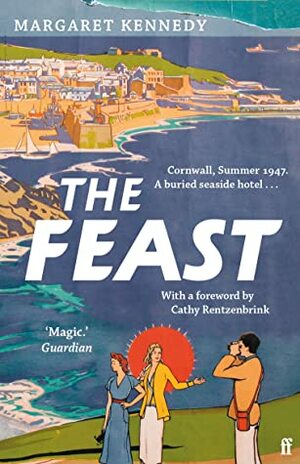
Review 2543: The Feast

At the beginning of The Feast, we’re informed that a cliff came down near a resort town in Cornwall, obliterating a bay and a hotel beneath the cliff. Some of the people from the hotel survived.

With that information in hand, Kennedy begins the novel a week before the cataclysm. So, she cleverly sets out a source for some suspense while the readers form an opinion about which people they hope will survive.

The small hotel is owned by the Siddal family, run somewhat incompetently by Mrs. Siddal. Mr. Siddal is an educated man who has done nothing for years. They have three grown sons, the oldest of whom, Gerry, is the most helpful and least appreciated.

Other characters do almost nothing, too. Miss Ellis is supposed to be the housekeeper, but she does nothing but spread vicious gossip and order the maid around. A character who acts like an invalid is Lady Gifford. The Giffords have adopted three children, but Lord Gifford works all the time and Lady Gifford spends all her time in bed. She seems to dislike her mischievous daughter Hebe.

Mrs. Cove has three young daughters who yearn to give a feast like one they’ve read about in books. In reality, they have very little. Their mother is so stingy that she sells any candy they’re given, saying it is to buy children’s books. But they have no books. Blanche, the oldest, has problems with back pain but has never seen a doctor.

Two women are abused by their male relatives. Evangeline is at first so shy that she can barely utter a sentence. But her father, a Canon, accuses her of chasing after men and berates everyone else. At the beginning of the novel, they have been tossed out of another hotel because he is so obnoxious.

For his part, Mr. Paley seems to be holding something against his wife, but she doesn’t know what it is. Instead of talking to her about it, he bullies her.

These are a few of the characters, which also include a lady author who likes to take on younger male writers as protégés, her chauffeur being one. And there is Nancibel, the housemaid who does most of the work in the hotel . . . and others.

Despite pending fate, I enjoyed this novel very much. It shows a lot of insight into human nature. I have only read one other book by Kennedy, but I enjoyed it as well.

Related Posts

Troy Chimneys

A Wreath of Roses

Grand Hotel

Review 2299: The Salt Path

The Salt Path is Raynor Winn’s memoir of walking with her husband the 600+-mile Salt Path from Wales around the tip of Cornwall and back to Devon. This may not sound extraordinary or appealing to everyone, but the circumstances that initiated the walk were difficult.

It must have been the worst few days of their lives to date. For years, Raynor Winn and her husband Moth had been fighting a lawsuit that, through no fault of their own, threatened their home and livelihood. They went to court having found a document that proved they owed nothing, but because they didn’t follow the proper procedures, they were not allowed to admit it as evidence. They lost the farm they built up from nothing and were homeless.

As if that weren’t enough, a few days later some pain Moth had in his arm for years was diagnosed as a terminal illness that would result in the degeneration of his muscles and end with him choking to death.

The Winn’s reaction to these circumstances was unusual. With a very small income and almost no ready cash, they decided to walk the Salt Path. And although Raynor wanted to walk it the easy way, from the southeast westward, because the best guidebook went the other way, they went that way.

This book is compulsively readable, as the couple deal with grief, bad weather, physical problems, lack of food and water, poor equipment, difficulty finding camp sites, and general bad treatment of the homeless. It is vividly written and although I tripped over some misplaced modifiers, impels you along with them on their journey.

Related Posts

Notes from a Small Island

Vanishing Cornwall

Wild

Review 1854: The Weather at Tregulla

Una Beaumont (again, the publishers got the name wrong on the cover) is 19 and very much still a sulky teenager. She finds her home in a small Cornish village to be absolutely boring. Her father, Captain Beaumont, had promised her that she could live in London and study to be an actress. However, her mother has unexpectedly died and her money was entailed, so the Captain can no longer afford to send Una. Even her distraught father notices that she is more upset by this than by her mother’s death.

The weather in Tregulla is tumultuous, at least in regard to several love affairs. Una meets Terrence Willows, an artist leasing a cottage in the neighborhood, and his sister Emmeline. Terrence is a bit of a bounder, but Una immediately falls in love with him. Emmeline has the kind of looks admired by Una’s friend Barnabas, and she has in fact moved to the area in hopes of getting him to marry her, even though she hadn’t met him before. She is tired of the chaotic existence of her brother and his friends, but when she thinks of Barnabas, she always thinks of his parents’ estate first. Barnabas, although believing he is cautious, is smitten. Finally, his brother Hugo is in love with Una.

At first, I didn’t think I was going to like this novel as well as I did others by Gibbons. I didn’t like Una, and the novel has several more unlikable characters. However, Gibbons is a great storyteller and satirist, and her characters are believably written. Further, some of them improve, particularly Una.

Related Posts

The Woods in Winter

Nightingale Wood

A Pink Front Door

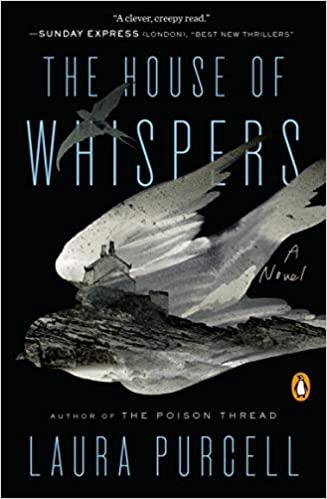
Review 1851: The House of Whispers

Hester Why travels to the Cornish coast to take up a position as a lady’s maid. Right away, we know something is wrong, because Hester is traveling under an assumed name and is drinking. When she arrives at Morvoren House, it seems a strange household. The mistress, Louise Pinecroft, is a frail woman who hardly speaks and refuses to leave a drawing room full of china, even though the room is freezing. Aside from an adopted daughter who, although adult, is treated like a child, there are only servants, including Creeda, a disturbing woman who is obsessed with fairies.

Forty years earlier, Louise Pinecroft and her father arrive at Morvoren House. Dr. Pinecroft has purchased the house because it sits above some caves on a beach. He has a theory that clean, damp sea air could cure consumptives, so he has arranged for some consumptive convicts to live in huts built in the caves below the house. Neither Louise nor her father is thinking very clearly, because their entire family recently died of consumption, after which Dr. Pinecroft lost all his patients because he couldn’t save his family.

This gothic novel is set in two unnamed periods, most likely in the 19th century. It is about two women whose need to be needed basically shipwrecks their lives. It is fairly creepy, although I thought the ending was kind of all over the place. Still, Purcell knows how to write a page-turner.

Related Posts

The Poison Thread

The Silent Companions

The Shape of Darkness

Review 1846: Classics Club Spin Book! The Dead Secret

The latest Classics Club Spin ended up with The Dead Secret as the book I should read. It is Wilkie Collins’ first full-length novel but unfortunately not his best.

Mrs. Treverton is on her deathbed at Porthgenna Tower, but she has a secret. She wants to disclose it to her husband but can’t bring herself to do it. So, she forces her maid, Sarah Leeson, to write it down. She makes Sarah promise not to destroy the confession or remove it from the house, but she dies before she can make her promise to give it to her husband. So, Sarah hides it in a ruined wing of the house and then flees.

Fifteen or sixteen years later, Mrs. Treverton’s daughter Rosamond is a young wife. She and her blind husband, Leonard Frankland, are on their way to Cornwall to take up residence at Porthgenna Tower, where Rosamond has not lived since she was five. They intend to renovate the house, including the ruined north wing, but they have had to stop their journey because Rosamond has gone into premature labor.

The local doctor, in seeking a nurse for the new mother and son, consults a householder only to have her housekeeper, Mrs. Jazeph, unexpectedly volunteer to do it herself. However, Mrs. Jazeph’s odd behavior that evening causes her to be dismissed. Before leaving, she tells Rosamond to stay out of the Myrtle Room.

With a ruined old mansion on the coast of Cornwall that is possibly haunted and a secret too awful to tell, this novel promises to be all that a sensation novel should be. However, Collins is clearly learning here, for this novel is dripping with sentimentality and soppiness. Moreover, the behavior of the maid (it’s not hard to guess who she is) is so exaggerated that I could hardly stand to read about her at times. Collins took Dickens for his model, and Rosamond is a typical type for Dickens—sweet, a little foolish at times, loving, needing the guidance of her morally correct husband. Without having spent enough time with Sarah for us to care much for her—in fact, at times her behavior is extremely irritating—he spends too long a time with a supposedly heart-rending scene.

The secret isn’t very hard to guess, nor are the events of the plot difficult to predict. This isn’t a terrible novel, but Collins has written better ones.

Related Posts

The Haunted Hotel

Hide and Seek

The Moonstone

Review 1766: China Court

Old Mrs. Quin dies, leaving her beloved house, China Court, dilapidated from lack of money and her even more beloved garden tended only in a few places. Her descendants gather, assuming the house and contents will have to be sold to pay for the taxes and the leftover money divided. Among them is Tracy, her only grandchild, who loved the house as a child but was taken away by her mother to lead a wandering existence. Mrs. Quin’s children are indignant about the presence of Peter St. Omer, who abandoned an aimless life four years ago to work the estate farm at Mrs. Quin’s encouragement.

When the will is read, there is a surprise for all, as Mrs. Quin has left the house to Tracy and the farm to Peter with an unusual proviso. But can they find the money to save the properties?

China Court was the novel I chose to read for Rumer Godden Week, hosted by Brona at This Reading Life. With a great deal of fluidity, it tells the story of the lives of several generations of Quins in their home of China Court. It moves back and forth among generations, the shifts triggered by an object or a smell, as it tells what happened to the family—the smart girl denied an education because of her sex, the wife madly in love whose husband was unfaithful at the first opportunity, the girl in love with one brother who married another.

Godden does this skillfully, inserting the seeds of the stories into the first chapter so that readers want to find out about them. She structures the novel by dividing it up like a book of hours, beginning each chapter with a description of the page of that hour from a specific book. I was perplexed about the reason for this device, but all is eventually made clear.

Godden uses a similar technique in A Fugue in Time (written in 1945) but less successfully there, I think. In this novel I became very involved in the stories of some of the characters and the fate of the house. Godden has perfected this approach to fiction by the time she published this book in 1961.

A Fugue in Time

The Lady and the Unicorn

A Harp in Lowndes Square

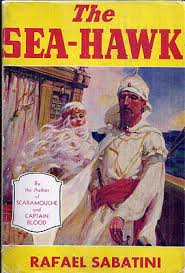
Review 1687: The Sea-Hawk

Sir Oliver Tressilian is in a good place. As one of Elizabeth I’s privateers, he has made a fortune and gained the Queen’s favor. He is also engaged to marry the woman he loves, Rosamund Godolphin, or at least she has promised herself to him. When he calls on her brother Peter to ask for her hand, though, Peter refuses it, determined to keep up the feud begun between their parents. Indeed, he is insulting to the proud Sir Tressilian, so much so that Oliver would have killed him had he not promised Rosamund he would not.

Peter’s refusal seems of little moment to Oliver, because Rosamund will soon be of age. When Oliver’s brother Lionel returns home, however, he has fought with Peter without witnesses and killed him. Oliver promises to protect him but later learns that the wounded Lionel left a trail of blood to his door and everyone thinks Oliver murdered Peter. When Oliver tries to speak to Rosamund, she refuses to hear him. He is able to prove he is innocent to a magistrate and a minister because he has no wounds, but Rosamund will not listen.

Lionel becomes frightened that Oliver will tell the truth, so he arranges with a shady sea captain, Jasper Leigh, to kidnap Oliver and sell him into slavery. Jasper Leigh actually intends to let Oliver buy himself back, but their ship is taken by Spain and both Oliver and Jasper end up as galley slaves.

When next we meet him, Oliver is named Sakr El-Bahr, the Sea-Hawk, for his famous acts of piracy. He has adopted Islam and is a chief of Asad-ed-Din, Basha of Algiers. He learns that his brother and Sir John Killigrew have had him declared dead and Lionel has taken over his property and his former fiancée. Upon hearing this, Sir Oliver sends a messenger to Rosamund with the proof of his innocence in her brother’s death, but she throws it unread into the fire. Oliver is overcome with anger against both Lionel and Rosamund. How will it end?

I thought this was a very interesting swashbuckler, mainly because both the hero and heroine have more dimensions than in the usual adventure tale. There are times when both of them behave very badly, and I especially disliked Rosamund for much of the book because she was so quick to distrust Oliver. However she is also more brave and self-possessed than the majority of adventure story heroines. They get into some seriously exciting situations.

This is my last book from my second Classics Club list, which I have finished a couple of weeks late, so I’ll be publishing another list tomorrow.

Related Posts

The Lovers of Yvonne

Blood & Sand

Treasure Island

Review 1647: The 1936 Club! Jamaica Inn

When Mary Yellan’s mother is dying, she makes Mary promise to go live with her Aunt Patience in Bodmin. However, Aunt Patience’s reply to her letter after her mother’s death tells her that she no longer lives in Bodmin. Her uncle is the landlord of Jamaica Inn out on the moors.

When Mary tells the coach driver her destination, he advises her to stay in Bodmin. Jamaica Inn is a place of ill repute. Mary feels, though, that she must keep her promise to her mother.

She finds Jamaica Inn a ramshackle, brooding inn with no customers. Patience, her mother’s sister, has changed from a vivacious, pretty woman to a terrified drudge. Her uncle, Joss Merlyn, is an overbearing bully with signs of being a habitual drunk.

Days after arriving at the inn, Mary must help serve the most disreputable bunch of men she has ever seen. Later, Joss advises her to stay in her room with her covers over her head. But she looks out the window and sees evidence of smuggling.

But the secrets of Jamaica Inn go far beyond smuggling. Mary looks for a way to safely remove herself and her aunt. In the meantime, she meets and is attracted to Joss’s younger brother, Jem.

It’s been many years since I read this novel, which I reread for the 1936 Club. I found it to be a truly exciting thriller.

Related Posts

Rebecca

Castle D’Or

I’ll Never Be Young Again

Review 1466: Vanishing Cornwall

Over the years, I have read most of the novels written by Daphne du Maurier, but when I made up my current Classics Club list, I came across this work of nonfiction. It’s the book I read for the most recent Classics Club Spin.

Vanishing Cornwall is a little hard to describe. Du Maurier made her principal residence in Cornwall for many years, and I guess I would call this book an appreciation.

She starts out by traveling around the area with her son to take photographs from each of the Hundreds of Cornwall. So, the book is in small part a travel book. But as it progresses from region to region, aside from lyrical descriptions and photos of the scenery, du Maurier includes stories from history and folk lore. Toward the end of the book, she switches to chapters on specific topics, like fishing or free-trading, associated with Cornwall.

She ends with a conservation message, at the time a concern to preserve the area’s beauty while finding some way to help support the locals. I have never been to Cornwall, but I would imagine that some of what she has to say is out of date now, as it was even between 1967, when the book was first published, and 1980, the date of my edition, which switched out the original black and white photos for colored ones and added an epilogue. She does tend to romanticize some subjects, and her assertions such as the one that King Arthur did actually exist are a little more in doubt now.

Related Posts

Castle Dor

The Scottish Highlands

Le Morte d’Arthur

Review 1458: Winter

The beginning of Winter was so bizarre that I wasn’t sure I was going to finish it. Sophia is an older woman living in a large home in Cornwall. She has begun to hallucinate a child’s head that floats in the air and interacts with her.

Art, Sophia’s son, has split from his girlfirend, Charlotte, and she is now posting tweets on his Twitter account that are causing problems for him. Art is supposed to take Charlotte to his mother’s house for Christmas. Unable to explain what happened, he hires a girl named Lux to pretend to be Charlotte.

When Art and Lux arrive at Sophia’s house, they find it barely furnished, with no beds in the extra bedrooms and no food in the refrigerator. Sophia seems vague and much too thin. At Lex’s insistence, Art summons his Aunt Iris, even though Iris and Sophia haven’t spoken in years.

As I said, this novel started in such a way that I wasn’t sure I would like it. It is quirky, certainly, but it grew on me. Things that seem inexplicable are explained, in a way. As usual with Smith, there is a strong focus on art and ideas. Smith is always interesting and inventive.

Related Posts

Autumn

How to Be Both

Look at Me