Day 638: The Singing Sands

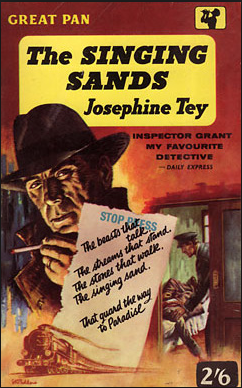
Cover for The Singing SandsEvery once in awhile, I like to read a classic mystery, and I have only read a few by Josephine Tey. Tey’s novels acted as a bridge between the Golden Age of mysteries and the modern mystery, when the genre moved toward more realism.

The overworked Inspector Grant is on his way to a holiday in Scotland and is concerned because he has developed a debilitating claustrophobia. Upon leaving the train at Euston station, he comes across a porter trying to rouse an apparently inebriated passenger. Grant sees right away that the man is dead. When he examines the body, he drops some of his own papers, and while picking them up, accidentally removes the dead man’s newspaper.

Relaxing at his cousin’s house in the Highlands and preparing to go fishing, Grant checks the paper the next day to see what it says about the dead man. His face has stuck in Grant’s mind. He finds that the man has been identified as a Frenchman named Charles Martin. He has already discovered the man’s newspaper, with some verse scratched on it referring to animals that talk, streams that stand, stones that walk, and singing sand. He recognizes the man’s handwriting as the unformed style learned by British schoolboys, and he can’t imagine that the dead man was French. So, he decides to look into the death a bit more.

Except for The Daughter of Time, Tey’s most well-known book, I have only read a couple of Tey’s one-off novels, not her Inspector Grant mysteries. After reading this one, I think I’ll look for more. Inspector Grant is interesting and likable, as are the relatives he visits. The mystery is involving without being so overcomplicated as to be unlikely, as Golden Age mysteries often are. When Grant travels to the island of Claddagh (referred to as Cladda in the novel) in search of the singing sands, we also get to explore a new landscape.
Day 625: Another Time, Another Life

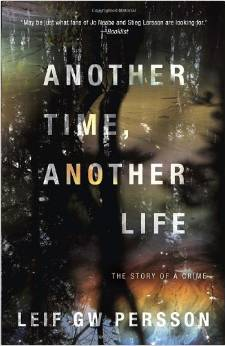
Cover for Another Time, Another LifeAnother Time, Another Life is the second book in a trilogy of complex political police procedurals by Leif GW Persson. I reviewed the first book last spring.

At first, it is difficult to see the connection between the two books, but eventually some of the names and events from the previous book re-emerge. Another Time, Another Life begins with two crimes 14 years apart. Like Between Summer’s Longing and Winter’s End, one of the crimes is based on an actual event, in this case the bombing of the West German embassy in Stockholm in 1975 by German terrorists. Although the Swedish authorities are certain that the Germans must have had help from Swedish citizens, the case is wound up fairly quickly without any indication of who those Swedes might be.

Inspector Bo Jarnebring was on the scene right after the bombing, and 14 years later he is the first to respond to a call for help. A little old lady has overheard an argument in a neighboring apartment and called to report that someone is attacking her neighbor. When Jarnebring and his partner Anna Holt arrive, they find Kjell Göran Eriksson stabbed to death in his living room.

Eriksson turns out to be an unpopular man—no one at his workplace liked him and he had only two friends, both of whom have not seen him in awhile and have alibis. Bäckström, the inspector in charge of the investigation, gets it into his head that the crime involves homosexuality, based solely on there being no evidence that Eriksson had a girlfriend. He has no compunction in using illegal means to make the facts fit his idea of the crime. Jarnebring and Holt are suspicious of the amount of money in Eriksson’s bank account, not justified by his salary or his background. But Bäckström won’t let them pursue their leads, and no suspect is ever identified.

Ten years later, Lars Johansson has just taken a job as head of the Swedish Security Police when he finds some puzzling information in his files. The names of four Swedes suspected of helping the German terrorists in 1975 were redacted from a file, but then two were reinstated. Both men are dead, and one of them was Kjell Göran Eriksson. The other was one of his two friends. This discovery leads Johansson back to his friend Jarnebring and to an official reopening of the Eriksson case and an unofficial reopening of the embassy bombing case.

Having read the first book in this series, I was not surprised to find the case becoming very complex, with important political ramifications. Persson’s work is reminiscent of some of John Le Carré’s political thrillers, although not as exciting and probably not as well written (hard to tell with a translation). The novels are intended more as complex procedurals, though, than thrillers, and they succeed in keeping my attention. As with the first book, Persson seems to delight in depicting incompetence and idiocy in the police and government. Jarnebring and Johansson’s teams are capable and intelligent, though, and for once we meet detectives who are happy with their wives.

Day 619: The Long Way Home

Cover for The Long Way HomeAfter the traumatic ending to How the Light Gets In, Inspector Armande Gamache and his wife Reine-Marie have retired comfortably to the lovely village of Three Pines. Gamache feels none of the restlessness experienced by retired cops in other crime series, so he is not really pleased when Clara Morrow comes to him, reluctantly, with a problem.

Clara’s difficulties with her husband Peter have been growing throughout the series. The two are both artists, and their relationship was fine as long as he was the more acclaimed. But of late, Clara has gained a reputation that has surpassed Peter’s, and he has been jealous and unsupportive.

A year ago Clara asked him to leave. But she made a date with him to come back in exactly a year to see where their relationship lay. That date has come and gone, and Clara has no idea where he is. She wants Gamache to find him.

Gamache finds it easy enough to trace Peter’s movements to Paris and Venice and then, oddly, Scotland through his credit card use. They find he returned to Toronto a few months ago and then disappeared.

With Clara leading, Gamache, his son-in-law Jean-Guy, and Clara’s friend Myrna set off to find Peter, eventually ending up in a remote village at the mouth of the St. Lawrence. In their quest, they encounter a tale of madness and revenge.

This novel makes an interesting start to a new life for the series. I’m not sure how successfully it will continue, as there have been more murders per capita in Three Pines than just about anywhere. But perhaps basing the series in this small village rather than continually returning there to deal with crimes will work better, because the crimes can take place elsewhere and readers can still visit this peaceful village. I have already enjoyed some of the other novels that were set elsewhere in Canada, usually in gorgeous or interesting locations.

Day 612: The 19th Wife

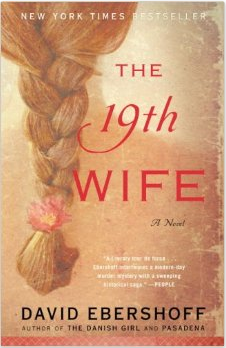
Cover for The 19th WifeBest Book of the Week!
The 19th Wife is actually two interleaved novels, one as interesting as the other. The novel that begins the book is a modern mystery. The novel that dominates the book, however, is historical, about Ann Elizabeth Young, Brigham Young’s 19th wife, whose lectures after she left the Latter-Day Saints were partially responsible for ending the authorized practice of polygamy within the church.

In the modern story, Jordan Scott is a young man who grew up with the Firsts, a fundamentalist Mormon group that still practices polygamy. At the age of 14, Jordan was booted out on his own because he held his stepsister Queenie’s hand. Jordan’s intentions were not amorous, because he is gay, but he realizes that the young men are ejected from the group so that the old men can keep the young girls for themselves.

Jordan is living in California when he reads that his father has been murdered and his mother, Becky Lynn, arrested for it. As his mother is a complete believer who actually dumped him out on the highway herself those years ago, he does not believe she murdered his father. The evidence against her is that another wife saw her coming from their husband’s room looking upset. Jordan’s father was texting someone just before he was killed and remarked that his 19th wife was at the door. That wife is Becky Lynn.

While Jordan tries to find out what happened that night, we read the story of Ann Elizabeth Young, a woman born into the Church of Latter Day Saints but who has always been clear on the evils of the practice of polygamy. This story is told through fictional excerpts from her autobiography, newspaper clippings, statements by Brigham Young, and other documents.

Ann Elizabeth begins with the story of how her own parents, once devoted to each other, were forced into polygamy by Brigham Young, and what pain it caused her mother every time her husband took another wife. This pain was amplified by the hypocritical ruling that the first wife had to accept all future wives into the household before further marriages could take place. Ann Elizabeth’s own first marriage is also marred by threats of polygamy, which her husband uses to manipulate her despite having promised before marriage not to practice it.

Well written and convincingly characterized, this novel is absolutely engrossing. Although I found the modern mystery interesting in its insights into fundamentalist Mormonism as currently practiced, I found the story of Ann Elizabeth’s life even more compelling. Ever since reading Jon Krakauer’s Under the Banner of Heaven, I have been fascinated by this subject.

Day 610: How the Light Gets In

Cover for How the Light Gets InI didn’t realize I had never reviewed this book, even though I finished it almost exactly a year ago, until I started to post a review of its sequel. So, you’ll have to forgive me. I’m working from memory.

This novel serves as a culmination of an ongoing plot from the very first of the series. Inspector Gamache’s enemies in law enforcement have gutted his department and alienated the loyalty of his friend and lieutenant Jean-Guy Beauvoir through encouraging his drug addiction. Now they are planning to destroy Gamache.

In the meantime, Myrna Landers has summoned him to the picturesque village of Three Pines to look for a friend who has disappeared, Constance Pineault. Myrna is cagey about the true identity of the friend, but eventually Gamache finds out that she is very famous, the last surviving sister of a set of quintuplets. Gamache and his department are also dealing with a possible terrorist threat. All of this action takes place over a snowy Christmas.

The end of How the Light Gets In is extremely dramatic, but it left me wondering if the novel was intended as the end of the series. (Hint: I wondered this at the time, but notice that I referred to a sequel.) As always, it is complexly plotted and colorful in detail.

Every time Penny describes Three Pines, I want to go see it. Also, Penny’s books continue to win my award for the most beautiful covers, ever.

Day 599: Kind of Cruel

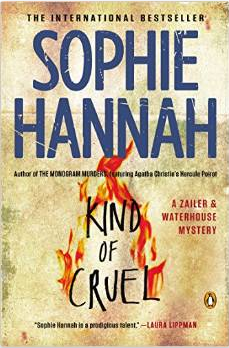
Cover for Kind of CruelWhen Amber Hewerdine decides to consult a hypnotherapist for her insomnia, something unexpected happens. She blurts out a phrase that is puzzling her because she has seen it somewhere and doesn’t know what it means, “Kind, Cruel, Kind of Cruel.” Then she realizes she saw it written on a pad that one of the other clients was writing on in her car before her session.

She knows she has seen it before that. When she asks the woman if she can see it, the other woman denies having it on her pad. So, after the woman goes in to consult with the therapist, Amber gets into her car to look at the pad.

What Amber doesn’t realize is that the phrase is a clue in a murder. Detective Constable Charlie Zailer is the other client, and even though she is not on the case, she has been mulling over the phrase. But it was impossible for Amber to have seen the entire phrase on Charlie’s pad, because she had only written “Kind, Cruel” before Amber interrupted her.

The case where the phrase was discovered was the bludgeoning death of Katherine Allen in her own home, now being investigated by Charlie’s husband Simon Waterhouse. Amber didn’t know Katherine. She believes the phrase is somehow linked to a Christmas event several years before, when her sister-in-law Jo and her family disappeared for two days after inviting the entire extended family to stay at a house they had leased. Amber thinks maybe she saw the phrase in a locked room in that house. No one ever spoke about why part of the family disappeared, and Amber has always been curious.

Amber’s insomnia started after her best friend was killed in a fire. After the fire, Amber and her husband Luke took in her friend’s two daughters. Amber loves the girls but hasn’t slept much since the fire.

Sophie Hannah writes compelling psychological thrillers. Amber’s narrative is interrupted by that of Waterhouse, the detective whom Amber agrees to speak to, as well as that of Ginny Saxon, the therapist. Hannah’s plots are complicated and always interesting to unravel.

Day 589: Broken Monsters

Cover for Broken MonstersIn the wreck of the city of Detroit, Detective Gabi Versado is investigating the bizarre murder of a young African-American boy. His torso is found glued to the body of a deer. Gabi is so involved in the case that she doesn’t realize her teenage daughter Layla and Layla’s best friend Cas are attempting to entrap a child molester.

Jonno is a failed writer who moves to Detroit and is soon posting video blogs about the wild art scene. He just happens to be on the scene to videotape the discovery of another weird murder.

Clayton is an artist whose work has recently shifted. A few people have been stunned by the strange beauty of his animal fusion statues. An art promoter wants him to exhibit at a massive art party where the artists are assembling themed shows in a group of abandoned houses.

Beukes steadily builds tension in a novel that juxtaposes the ruins of the city with themes about abuse of the Internet. Those who are fans of her stunning debut, The Shining Girls, will not be surprised by the additional twist the plot takes.

http://www.netgalley.comIf I have any criticism, and it is a very small one, it is that the South African author, who has set both of her novels in the urban ruins of large cities in the U.S., occasionally gets her American idioms wrong.

Day 584: The Shining Girls

Cover for The Shining GirlsBest Book of the Week!
The Shining Girls is a clever, clever novel, a hybrid of a fantasy novel and a crime thriller. I read rave reviews of it, and it deserves them.

Harper has just killed a man in a Chicago Hooverville in 1931. He is being pursued in the freezing cold when he murders a blind woman for her coat. Inside the pocket he finds a house key, and somehow he knows the way to the house. It is a boarded up old wreck on the outside, but inside it is warm and comfortable, even prosperous looking. When Harper goes into an upstairs room, he finds souvenirs and girls’ names written on the wall. He understands that the house wants him to kill these girls. When he goes back outside, he finds himself in another time.

In 1993, Kirby Mazrachi interviews for an internship at the Chicago Sun-Times. She has asked to work with Dan Velasquez, a former crime writer who now covers sports. Her goal is to find the man who attacked her and nearly killed her in 1989. She believes he is a serial killer, and she is planning to use the paper’s resources to find more of his murders.

As Kirby continues her investigation, finding evidence that doesn’t make sense, Harper tracks down his shining girls one by one, visiting them when they are young and then going back for them as adults, over a time period of 60 years. He takes something from each one and gives it to the next.

This novel is completely absorbing, well written, and suspenseful. It is also haunting and unusual, with everything cleverly linked up. In the larger context, it explores the issues of fate and free will, but as entertainment, it keeps you pinned to your seat.


Day 582: The Secret Place

Cover for The Secret PlaceDetective Stephen Moran has been stuck on the Cold Case squad ever since he made his move to claim responsibility for a solved case in Tana French’s last book, Broken Harbor. But when Holly Mackey comes to see him, he thinks he’s found his opportunity to join the Murder squad.

A witness in a previous case, Holly is now 16 and attending St. Kilda’s, a private girl’s school where Chris Harper, who attended a nearby boy’s school, was found dead the year before on the grounds. It is so far an unsolved case, and Holly has information about it.

Holly explains that the school has a bulletin board called the Secret Place, where the girls can post anonymous messages. The school thinks this board is preferable to allowing the girls to use a social media site. That morning Holly found a message that said, “I know who killed him.” As she is a cop’s daughter, she removed it carefully with gloves and put it in a plastic bag to bring to Moran.

Moran takes the note to Antoinette Conway, the lead on the Harper case, hoping she’ll allow him to work with her. She has not had a lead in the case for awhile and is eager to follow it up. Once the two detectives begin looking into it, they find their suspects for posting the note and for being the murderer limited to two groups of four girls—one Holly’s group of close friends and the other a bunch of mean girls lead by a girl named Joanne.

Although this is not my favorite of French’s novels, she writes a strong, atmospheric mystery. I believe she is the premier writer of contemporary Irish crime fiction, and her work in many ways reminds me of that of Gillian Flynn. I like that her books are not series, yet they are linked by a minor character in one novel being the major character of another.

http://www.netgalley.comIn The Secret Place, French evokes an eerie atmosphere in the grounds of this posh girl’s school. This novel creates a fascinating psychological portrait of these two groups of teenage girls.

Day 578: Tethered

Cover for TetheredBest Book of the Week!
Clara Marsh has been wounded by life. She is a mortician who spends her days preparing bodies for burial, caring for them tenderly and tucking a symbolic bouquet of flowers into the coffin of each. But she herself is isolated, afraid to look people in the eye, unable to touch. Her frame is skeletal, her scalp scarred from pulling out her own hair. The only people who seem to care for her are her boss and his wife, Linus and Alma Bartholomew.

One day Clara finds a little girl in the funeral home named Trecie, who says she has been visiting Linus. When Clara asks Linus about the girl, he asks Clara to help her. Soon after, at the scene of a death, Clara finds evidence that Trecie is the victim of child pornographers. When she tells Detective Mike Sullivan that she knows Trecie, he asks her to call him when she sees Trecie again. But Trecie gets away from them.

Mike believes there is a connection between the pornographers and the death of Precious Doe, an unidentified child found murdered after being badly beaten three years before. Soon it begins to look as if he may be right. Unfortunately, a fragile friendship between Clara and Mike is threatened when Mike begins to believe that Trecie doesn’t exist.

Although this novel is framed within a mystery, its soul is within the persona of Clara and her story. Tethered is precisely and beautifully written and absolutely haunting. I was transfixed by it.