Day 570: Murder in Pigalle

Cover for Murder in PigalleParis during the sticky summer of 1998 is in chaos because of the impending World Cup. Private detective Aimée Leduc is in her office worrying about paying her taxes when her 13-year-old neighbor Zazie comes to see her. Zazie explains that some girls her age, including her friend Melanie, were raped, and that she has a lead on the rapist.

Aimée promises to meet with Zazie about it later that day, all the while planning to warn Zazie’s mother Virginie about her daughter’s sleuthing activities. But Aimée doesn’t make it to Virginie’s until that evening, and by then Zazie is already an hour late coming home. A visit to the friend Zazie said she was seeing turns up another crime scene—Zazie’s friend Sylvaine has just been raped. All of these girls were home alone.

Aimée is convinced that Zazie somehow found the rapist and he took her. But the police think Zazie is a teenage runaway.

In what at first appears to be a side plot, a parolee named Zacharíe is being forced to commit a crime. His client has kidnapped Zacharie’s daughter Mary Jo to keep him from abandoning the job. With Mary Jo was a little friend, Zazie.

Aimée doggedly pursues her investigation despite her condition—she is six months pregnant. Helping her are her partner René and their cyber expert Saj.

I had heard good things about this series but wasn’t really impressed. Although Black may have developed the main characters in earlier books, she certainly doesn’t do much with them here. The book races from action to action, leaving a lot of loose ends untied or ignored. Right from the beginning, Aimée has some photos Zazie tells her were taken using her friend’s telephoto lens. Yet no one follows up by trying to figure out who the friend is. When they eventually find out it is Mary Jo, Aimée spends no effort on finding the girl, just making a few feeble efforts to contact her parents.

Another example—later in the novel, Aimée kills a man in self-defense, then she and another person flee the scene. Yet we never hear about the dead man again.

These omissions all go to my feeling that Aimée’s world is not fully realized. Paris is not much of a presence in the novel, even though Black mentions various locations. We hear, for example, about the dangers of Pigalle, but we don’t really learn what it is like. We don’t really get a flavor of Aimée’s world.

Day 505: The Red Road

Cover for The Red RoadIt is 1997. Young Rose Wilson is waiting for her pimp Sammie one night when Pinkie Brown, a young man she knows, asks her to hide a knife for him. Although she has had a crush on him, she suddenly understands he is attempting to use her. She tries to push him away and ends up accidentally stabbing him to death. Terrified about what Sammie will do to her, she attempts to hide from him that she is covered in blood as they drive away from the area. But he finally sees the blood, so she attacks him in panic, killing him. Then she realizes she has nowhere to go and no way to hide her crime, so she sits in the car and waits for the police.

In the present time, Detective Inspector Alex Morrow is set to testify against Michael Brown. He was found guilty years ago of the murder of his older brother Pinkie. Now he is up on weapons charges, as caches of guns with his fingerprints on them were found buried in his back yard. But Alex soon learns something puzzling. Brown’s fingerprints were found at the scene of a murder that happened three days before in an abandoned building on the Red Road, when Brown was in custody. Although Alex is inclined to believe this is some ploy by Brown’s defense, Anton Atholl, she can’t figure out what they have to gain from it. In any case, court is dismissed because of news of the death of another defense attorney, Julius McMillan.

Back in the past, it is Julius McMillan who saves Rose. After Rose admits everything she did, he figures out a way for her to serve minimal time for Sammie’s death, as long as no one connects her to the killing of Pinkie Brown. To save her, he is forced to make a deal with some powerful but unscrupulous men.

Alex’s investigation is taking some unexpected detours, and eventually she figures out that there was a conspiracy to pin Pinkie’s murder on Michael years ago. Michael’s fingerprints were switched for those of the real murderer, who has just killed again. Although Alex begins to realize she will be up against some powerful people, she just can’t let something like that go.

Denise Mina’s mysteries are set in a gritty Glasgow. Alex is an abrasive and stubborn heroine whose career keeps being dead-ended because she insists on going up against corrupt politicians and police. The novels are smart and interesting, with convincingly drawn characters.

Day 501: Waiting for Wednesday

Cover for Waiting for WednesdayThe writing duo Nicci French has come out with another powerful Frieda Klein mystery with Waiting for Wednesday. Although it deals mostly with another case, there is still the threat of a serial killer from the first book in the background.

DCI Karlsson and his team are trying to solve the murder of Ruth Lennox, a housewife whose face was smashed by a heavy object. Although her death appears to be part of an interrupted robbery, when the police find the thief, he has an alibi for the actual time of the murder. Soon Karlsson and his team find evidence that Ruth was leading a secret life.

Frieda is recovering from injuries incurred at the end of Tuesday’s Gone, and she is on leave from her practice. Her absence from the case does not prevent another psychoanalyst who is working with the police, Hal Bradshaw, from seeing her as a threat and attempting to professionally humiliate her.

Bradshaw has set a trap for Frieda and some other analysts he dislikes by sending in graduate students for consultation who pretend to have sociopathic thoughts and ask for treatment. Frieda immediately realizes her subject is pretending and sends him away, but something he says captures her attention and she begins trying to track down the source of the story. In doing so, she meets Jim Feary, a retired journalist who is sure he has happened upon traces of a serial killer. When Frieda takes Jim and his evidence to see Karlsson, though, Karlsson believes that her judgment is impaired because she is still traumatized by her experiences and that Jim is a nutcase.

http://www.netgalley.comFrench presents a complex set of mysteries in this novel, which is really gripping and ultimately suspenseful. While Frieda flounders with too much going on in her usually quiet life to allow her to make her recovery, Karlsson, Yvette, and Riley struggle with a case that gets more and more complicated. Even if you can figure out a piece of one puzzle, as I did, there is still a lot more going on in this intelligent mystery novel.


Day 495: Just One Evil Act

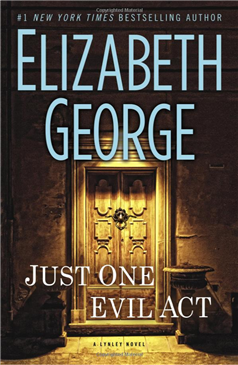
Cover for Just One Evil ActI can chart my changing attitude toward Elizabeth George’s Inspector Lynley mystery/thrillers simply by how I treat the new books. I used to get them as soon as they were available and read them immediately. This one I had for a couple of months before reading it. They are still page turners, don’t misunderstand me, but George has put her characters, and fans, through a lot.

George is not a proponent of the idea of keeping her characters’ private lives out of her mystery novels—very much the opposite. At first their absorbing lives made these novels stand out. But by now she has put Lynley through a brother accused of murder, a fiancée marrying his best friend, a seemingly hopeless romance, a murdered wife, and an ill-judged affair with his alcoholic boss. Heretofore, Sergeant Barbara Havers, although sometimes rebellious and unruly, has been a rock of good judgment, often better at finding the criminal than Lynley is. So, now it’s her turn to go off the deep end.

At the end of the previous novel, Believing the Lie, Barbara’s neighbor Taymullah Azhar had his sweet young daughter Hadiyyah kidnapped by the girl’s mother Angelina, who returned to Azhar pretending a reconciliation in order to get an opportunity to take the child. The situation is complicated because the parents never married and Azhar’s name is not on Hadiyyah’s birth certification, so for now he has no legal right to her (although, if that is so, since Angelina abandoned them, British law must be really weird). In addition, he has no idea where they have gone.

The Met can’t apparently help him, so Barbara takes Azhar to a private investigator, Dwayne Doughty, and they hire him to find Angelina and Hadiyyah. Eventually, though, Doughty reports back that there is no trace of the two to be found.

The tables turn quickly, though, when Angelina returns with her lover Lorenzo Mura, claiming that Hadiyyah has been kidnapped from them, so Azhar must have taken her. When it appears that Azhar is just as alarmed as Angelina and that he has an alibi for the time of the kidnapping, they all return to Lucca, Italy, where Angelina and Mura have been living. Inspector Lynley is assigned to go along as liaison between the parents and the Italian police. Isabelle Ardery, the boss, refuses to let Barbara come along.

Barbara absolutely refuses to believe that Azhar has had anything to do with the kidnapping. She has already given information to a tabloid journalist to create enough furor in Britain about the kidnapping for someone to be assigned to the case, and that liaison with Mitchell Corsico is not only a breach of trust but a major source of drama—and irritation—for the rest of the novel. The novel ends with Corsico assuming Barbara is in his debt. I certainly hope George doesn’t plan to pursue that subplot, because I found it to be too far over the top, with the journalist demanding more disclosures about every 15 minutes (an exaggeration, admittedly) and always when Barbara urgently needs to be doing something else.

Unfortunately for Barbara, as she breaks all the rules set by her new boss, John Stewart, to investigate the case from her end, it begins to look as though Azhar did indeed plan the kidnapping and execute it with the help of some of Doughty’s contacts in Italy. We readers actually know where Hadiyyah is, although we don’t know the identity of her kidnapper. But we also soon learn that her kidnapper has died, leaving Lynley and the excellent Italian detective Salvatore Lo Bianco to figure out who he was and where he put the child. Lo Bianco’s efforts are hindered by the actions of his incompetent boss.

In the midst of all this, Angelina dies, and it becomes obvious that she was murdered. Soon, it looks as though Azhar could be implicated in that, too.

My problem with this novel is Barbara’s behavior, as she goes overboard to protect Azhar. First, there are the leaks to Corsico which, after the first one, seem totally unnecessary. Then she begins concealing and attempting to alter evidence. I won’t go on. Even worse is how this trouble is wrapped up at the end of the novel, either by a cheat or a completely unlikely act on the part of Ardery.

You can tell I had a mixed reaction to this novel. On the one hand, it is extremely gripping. On the other hand, especially if you have been following the series and care about Barbara, you occasionally want to throw the book across the room. For the last four or five books, I’ve been wondering whether to quit the series, but I always end up picking up the next one.

Finally, I was upset by how the novel ends for Azhar and Hadiyyah, who for a large part of the series have been two of the most likable characters.

Day 493: Between Summer’s Longing and Winter’s End

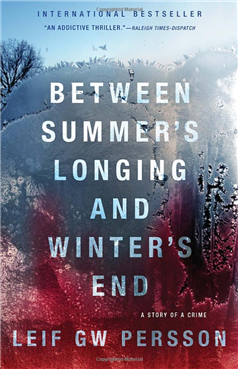
Cover for Between Summer's Longing and Winter's EndBest Book of the Week!
Between Summer’s Longing and Winter’s End is difficult to place in genre because while it is about the investigation of a crime and its repercussions, it is also reminiscent of the more cerebral of John Le Carré’s political thrillers without so much being a thriller as a record of law enforcement incompetence. The novel is crammed with characters who are mostly concerned with pursuing their own agendas, whether it be the chief constable of Sweden with his ridiculous intellectual exercises or a member of the secret police who is more concerned with pursing graft and sexual exploits than doing his job.

The novel is a fictional dissection of the possible scenario behind the true-life assassination of the Swedish prime minister Olof Palme in 1986. It is the first of a trilogy of which only two novels have been published in English, but it stands fairly well on its own.

Between Summer’s Longing begins with an apparent suicide. A man living in a student apartment in Stockholm plunges to his death from his window. The apartment door is locked from the inside, and there does not appear to be any other explanation for the incident, even though the man’s shoe fell shortly after the body, killing the small dog that had just saved his master’s life from the falling body. The dead man is identified as John Krassner, an American journalist.

There are a few odd things about the crime scene, including the unusual message the man apparently left as a suicide note and the lack of a manuscript he had supposedly been writing. Still, everyone appears to be ready to wrap things up when police Superintendent Lars M. Johansson discovers that his own name and address are on a slip of paper inside a hollow heel of the man’s shoe.

In a separate time stream, the novel returns to several months earlier when the Swedish secret police get a tip to keep an eye on John Krassner. Chief Operations Officer Berg is informed by his people that they are having difficulty finding out what Krassner is up to because he seldom leaves his room, which is close by that of several students. He puts police Superintendent Waltin in charge of an operation to lure Krassner out of the house at a time when it will be empty and send an independent operative in to search his apartment. That operation takes place the night Krassner is killed, but Waltin’s operative assures him he was finished and out before the death.

Persson takes us down some labyrinthine trails before finally getting to the assassination and also before we find out exactly what happened to Krassner. In the meantime we encounter espionage agents, secret societies, sexual deviants, drunks, and incompetents, almost all of whom work for the regular or secret police or the government. If there is any hero of the novel, it is Superintendent Johansson, who figures almost everything out.

The novel is gripping and well written except for a couple of murky passages, but I wasn’t sure if I found them murky because of my own lack of understanding of Swedish politics of the 80’s or if they were perhaps even purposefully murky. Persson himself was a whistle blower in the Swedish police, so it should not be a surprise to learn that the novel is cynical, sly, and full of intrigue.

Day 485: Into the Darkest Corner

Cover for Into the Darkest CornerAlthough I can’t say I found this thriller terrifying, it was certainly difficult to put down. First-time novelist Elizabeth Haynes effectively evokes suspense by telling her story in two parallel time periods—the earlier one where we have a good idea of what happens and the present where we do not.

In the present, Catherine Bailey is a terrified woman suffering from OCD and PTSD. Three years before, her abusive boyfriend Lee Brightman nearly killed her. Since he managed to discredit her with her friends before that and she had a breakdown during the trial, his punishment was light. Although Cathy has moved away from London to Lancaster and obsessively performs her security checks, she is certain that he will come for her when he gets out of jail.

Five years earlier, Cathy is a care-free young woman who likes picking up men at bars. She meets Lee, who is mysterious about his work but stunningly handsome. We readers have seen him murder his previous girlfriend at the beginning of the book, though, and Lee is soon manipulating Cathy to try to separate her from her friends.

In response to suggestions from her new neighbor, the post-trauma Cathy finally begins getting help for herself, but she is wise enough to know that there is a difference between an unfounded fear and a real fear. Of her new contacts and medical professionals, only a female police officer seems to understand that she may actually be in danger.

Haynes is good at keeping up the suspense, even for the earlier plot for which we already understand the basic outlines. Awhile back I reviewed Accidents Happen, featuring a heroine in a similar condition facing a similar threat. Into the Darkest Corner seems much more realistic in its portrayal of a person suffering from OCD and depicts its characters’ behavior more believably.

Day 480: Playing with Fire

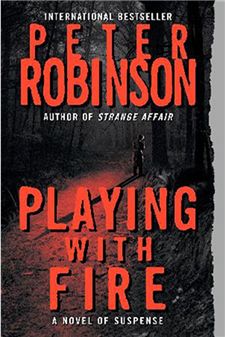
Cover for Playing with FireThis DCI Alan Banks mystery begins with a fire on a couple of canal barges. A squatter named Tina Aspern has been killed on one and an artist named Tom McMahon on the other. Accelerant is present, and it appears that McMahon’s boat was the origin of the fire.

On the scene appears Tina’s boyfriend Mark Siddons, but his alibi that he was with another woman after a fight with Tina checks out. Banks and DI Annie Cabbot and their team are able to discover very little about McMahon except that he has failed as an artist and buys cheap old books from a store owned by Leslie Whitaker.

Soon another fire kills Roland Gardiner in his caravan (mobile home). The police are trying to link the two men, but Gardiner was unemployed and almost a recluse. Tests reveal that both McMahon and Gardiner were drugged before the fires were set.

Annie’s boyfriend Phil Keane, an art expert, suggests that one use for old paper is to employ it in forged artworks. When the police find a fire-proof safe in Gardiner’s caravan containing money and some drawings that seem to be Turners, Banks and Cabbot think they may at least have uncovered a motive. But who could the murderer be? Is it Leslie Whitaker?

Finally, tracing a rented Jeep leads them to a shadowy figure, a man who does not seem to exist. He turns out to be very dangerous indeed.

Playing with Fire is a fast-paced and complicated mystery. Some sixth sense made me guess the killer almost as soon as he appeared, but I don’t think the solution is obvious. If you enjoy an intelligent police procedural, I think you’ll like Robinson’s series. The only other book I have read by him, which was not really part of the series (a more atmospheric novel in which Banks appears but is not part of the story), I enjoyed even more.

Day 478: Mr. Timothy

Cover for Mr. TimothyAlthough not typical holiday fare, Mr. Timothy picks up some of Dickens’ characters about 20 years after A Christmas Carol and has the added similarity of being set at Christmas time. The main character is Timothy Cratchitt, familiar to us as Tiny Tim.

Timothy is depressed and aimless. The patronage of Ebenezer Scrooge, or Uncle N as he is known in this novel, has had the unfortunate effect of making Timothy dissatisfied with his roots while not fitting him for much else. Most of his family has died or moved away, and he is depressed about the death of his father six months before. In despair, he has left his usual haunts and gone to live in a brothel, where he teaches the owner, Mrs. Sharpe, how to read. Although he has some desire to make his own way, he lacks purpose and initiative, still accepting an allowance from Uncle N. He seems to be on his way down in life.

Timothy goes out dragging the river for bodies one night with his friend Captain Gully, and they pull out a young girl. She has an odd brand on her back, like a G with eyes. Timothy realizes he has seen this brand before, on another girl the police were examining as he went by, who was found dead in an alley.

Timothy has several times spotted another young girl around the city and tried to approach her, but she has always run away. With the help of a street urchin named Colin, he finally tracks her down. Philomela is Italian and has had something traumatic happen to her of which she will not speak. When Timothy tries to take her home to safety, two different parties attempt to remove her from his custody on the street. A charity worker insists she will take Philomela to a home, and a mysterious man in a coach tries to kidnap her. Philomela and Timothy get away, but now Timothy is determined to find out what is going on.

This novel is a slow starter and fairly depressing at the beginning. Although it is feasible to theorize that Scrooge’s help could result in such unhappiness (ala Great Expectations), I wasn’t sure I wanted to think of the original story in these terms. However, the novel successfully invokes a Dickensian atmosphere, including the comic characters and character names, and it picks up its pace as Timothy gets involved in the mystery. After the first 50 pages or so, I was involved and trying to figure out the mystery, which is as entangled as any Dickens effort.

Day 465: Betrayal

Cover for BetrayalA quick note before I start my review. Be sure to check back on Monday, February 3, for the Literary Wives reviews of The Inquisitor’s Wife by Jeanne Kalogridis. We encourage anyone who has read the book to add their comments on any of our blogs. We also have a new Literary Wives Facebook page where you can comment or add a link to your own review.

Now, to the book.

Eva suspects her husband Henrik might be having an affair, so she sets herself to find out. Meanwhile, in a nearby hospital, Jonas is caring for his girlfriend Anna, who is in a coma.

It is not too long before Eva discovers Henrik is having an affair with Linda, their child’s daycare teacher. Feeling at once enraged and rejected, she goes out one night to see if men still find her attractive. She meets Jonas and spends the night with him.

Of course, Jonas is a psychopath who drowned Anna when she rejected him. This is not a spoiler, as it is revealed at the beginning of the novel. Now he decides he’s in love with Eva and begins stalking her.

All of the characters in this novel are fairly despicable. Eva is contemptuous of her husband, who lets her take care of everything. Instead of being devastated to find he’s having an affair, she immediately begins looking for revenge. Henrik is spineless, and his lover Linda turns out to be a bitch. Jason has lots of strange character traits, but I doubt that someone suffering as strongly from OCD as he is at times could at other times be free of it or be functional enough to also be a very clever stalker.

The inner thoughts of Eva and Jason, the two narrators, are related in abrupt, harsh sentences, which also characterize all of the dialogue. The characters are all one-dimensional.

In order to be fully engaged in the suspense, I think we need to feel some sympathy for Eva, but we just don’t. Perhaps if the plot hadn’t resorted almost immediately to nastiness, we would have. All in all, I wasn’t that impressed with this novel.

Day 462: The Return of Captain John Emmett

Cover for The Return of Captain John EmmettThe Return of Captain John Emmett is the first of Elizabeth Speller’s Laurence Bertram mysteries set just after World War I. I previously reviewed the second in the series, The Strange Fate of Kitty Easton.

Laurence Bertram has felt himself at a loss since the war ended. He is haunted by his memories of the war and also by guilt at his lack of grief over the deaths of his wife Louise and baby son, whom he never saw. Ostensibly writing a book about church architecture, he is finding it difficult to work. So, it is with a bit of relief that he responds to a letter from Mary Emmett, the sister of an old school friend John Emmett, in which she asks him to come visit her.

Laurence has fond memories of some school leave visits with the Emmetts after his parents died but feels Mary has misunderstood the depth of his friendship with John, whom he has not seen in years. Of course, he has heard of John’s death, an apparent suicide. Mary explains that John had been staying in a rest home because of mental disturbance following the war. Since he seemed to be improving, she and her mother cannot understand why he committed suicide. She asks John to find out what he can about John’s motives.

Laurence feels uncomfortable but agrees to look into it because he has always been attracted to Mary. With the help of his friend Charles Carfax, who gets his detective skills from reading Agatha Christie books, Laurence investigates the rest home and anything he can find out about John’s state of mind before his death. Included in John’s curious scraps of paper and photos is a list of the beneficiaries of his will, some of whom cannot be identified or located, and some photos from the war.

Laurence comes to believe that John’s death has something to do with his war experience, possibly with an execution over which he was forced to preside. And it seems John may not have committed suicide after all.

Speller takes her time with these mysteries. The settings are beautifully described and the period effectively evoked. A true sense of depth of character emerges. Even though I was about 100 pages ahead of Laurence, not in identifying the perpetrator but in realizing the motive, I enjoyed every bit of this novel.

In the last few months, I have read several historical mysteries where the author did little with the time or place, simply using the historical events to frame the plot. Thankfully, Speller has taken more care with this interesting period of history.