Day 460: March Violets

Cover for March VioletsThe blurb on Philip Kerr’s collection of three noir mysteries, Berlin Noir, compares him to John Le Carré and Alan Furst. I wouldn’t say that is an apt comparison. For one thing, the other two are writing in a different genre. For another, they are better writers. Still, if you like noir, March Violets has its own qualities.

This novel is the first in a series featuring private detective Bernie Gunther. It bears many of the hallmarks of a typical noir mystery. Its main character is a smart, wise-cracking tough guy who used to be a cop. It features beatings, untrustworthy dames, thugs, and murder. What makes it stand out is its setting in 1936 Berlin.

Bernie is hired by millionaire industrialist Hermann Six to find a family heirloom necklace. It was stolen from the safe of his daughter Grete and her husband Paul Pfarr when the two were brutally murdered in their beds and their bodies burned. Herr Six explicitly instructs Bernie not to look into their deaths but to find the necklace and return it to him. Of course, Bernie begins looking into everything.

Using credentials as a representative of an insurance company investigating the fire, Bernie soon finds out that Pfarr was a member of the SS, with a mission from Himmler to seek out corruption in the labor movement. That mission made him a lot of enemies. He also had some kind of friction with Herr Six, who is rumored to have ties to organized crime. In addition, there were unexplained problems in the Pfarr’s marriage.

Typical of noir fiction, the plot becomes very involved. The setting is convincingly evoked, especially the constant threat of violence for ordinary citizens under the Nazis. Bernie specializes in missing persons, and the novel makes clear that hundreds of people go missing from Berlin daily.

Since I am more familiar with classic noir, the novel occasionally struck me as too coarse, but that didn’t bother me as much as other uses of language. First, idioms with which I am unfamiliar are used constantly. Perhaps they are period German idioms, but they often seem clumsy and inapt, which idiomatic  language seldom does. Also clumsy and inapt are Kerr’s many metaphors, for example:

The butler cruised smoothly into the room like a rubber wheel on a waxed floor and, smelling faintly of sweat and something spicy, he served the coffee, the water and his master’s brandy with the blank look of a man who changes his earplugs six times a day.

Perhaps this style of writing is meant as a send-up of traditional noir style, but it is certainly overblown and irritating. (To be entirely dated in my references, it sometimes reminds me of the passages read by Jeff Goldblum’s character in the old TV series Ten Speed and Brown Shoe, but those were explicitly tongue in cheek, and I’m not as sure about Kerr’s writing style.) Although at one point I considered putting the novel aside, I finally decided to continue, and found the book moderately entertaining.

Day 454: Ripley Under Ground

Cover for Ripley Under GroundIn the second novel of Highsmith’s Ripley series, Tom Ripley seems much more of a bumbler than in The Talented Mr. Ripley and the plot unnecessarily convoluted. In the first book, Highsmith succeeded in making us care about Ripley’s fate almost despite ourselves, but in Ripley Under Ground, Ripley’s troubles seem to be caused by hubris.

Ripley is living in France in his beautiful house with his wealthy wife Heloise at the beginning of the novel. He has done well from the death of Dicky Greenleaf but occasionally finds ways to raise a little extra cash.

One recurring source of money has been some businesses built around the work of a famous artist named Derwatt. The businesses are completely fraudulent, however, because Derwatt has been dead for five years. He committed suicide in Greece, and Buckmaster Gallery was originally opened to sell his paintings as an homage by his friends. His paintings were soon all sold, however, and it was Tom’s idea to “resurrect” him, as a recluse living in Mexico. Derwatt’s devoted friend Bernard Tufts has been painting forgeries ever since, to be sold by the gallery with a small token going to Ripley.

Gallery owner Jeff Constant contacts Ripley in a panic. Thomas Murchison, the American owner of a Derwatt, thinks his painting is a fake, and he is coming to the next Derwatt opening to speak to the gallery owners. In an attempt to bamboozle Murchison, who is planning on meeting with an art expert, Tom masquerades as Derwatt at the opening and assures Murchison that the painting in question is his. Murchison has some theory about the use of color in the painting, though, and is unconvinced, even ridiculously suggesting that Derwatt may not remember his own painting.

As himself, Tom meets Murchison in the lobby of his hotel and invites him to France to see his own Derwatts. Tom’s intention is simply to try to convince Murchison he is wrong about the painting, but of course he ends up having to murder him.

This starts us on a complicated series of events, where Tom buries the body then digs it up, confesses his murder to no less than four people, travels all over Europe looking for an errant Bernard, and is, of course, the number one suspect in Murchison’s disappearance. If this isn’t enough, while Tom is trying to cope with all these problems, people continually arrive on his doorstep and the phone rings at every inopportune moment. Ripley’s return is not an unqualified success from my point of view, as everything is over-complicated and the pace of the novel is too frenetic.

Day 448: The Tiger in the Smoke

Cover for The Tiger in the SmokeI have only read one other Albert Campion novel, and that was so long ago that all I can remember is not having much of a sense of Campion. I can say the same thing after reading this novel, although it has other qualities. Perhaps one can only get an understanding of Campion through reading the series.

In this post-World War II novel, we get a feel for the effect of the war on London. The wealthier households no longer have servants, shoddy neighborhoods have sprung up near where service men used to gather, the ruins of bombed buildings are everywhere, as are groups of unemployed veterans. To this setting Allingham adds the further atmosphere of a heavy fog that persists over the course of the novel. This fog is vividly described and is almost a character in the novel.

Meg Elginbrodde, a young war widow, has recently announced her betrothal to Geoffrey Levett, a wealthy businessman. Beginning directly after the announcement, however, Meg receives poor-quality street photographs of someone who looks like her husband, Martin Elginbrodde, supposedly blown to bits during a battle. No message has arrived explaining these photos, and when we meet the engaged couple, Geoffrey is dropping Meg off for a rendezvous that Campion has arranged as a trap for the culprit.

Meg is to walk into the train station to meet the man, where Campion and the police will capture him. However, when Meg sees the man at a distance, his resemblance to Martin is so strong that she shouts his name and runs toward him, startling him away. Campion eventually captures him, and Meg is embarrassed and puzzled to find that close up, the man doesn’t look like Martin at all. He turns out to be a low-level criminal named Duds Morrison.

Campion and Detective Charlie Luke are fairly confident that someone hired Duds for the impersonation, but what was it meant to accomplish? Duds isn’t talking; in fact, he seems terrified, and rightly so. Within an hour of his release, he is found stabbed to death in an alley.

Campion notices one thing that helped Meg mistake Duds for her husband. He is wearing Martin’s distinctive coat. When Campion repairs to the unusual household of old Canon Avril, Meg’s father and Campion’s uncle, to investigate, he finds the coat was recently in the house. How could it have fallen into the imposter’s hands?

Soon the police find a connection between this case and the escape from jail of a very dangerous man, who calls himself John Havoc. Havoc murdered an eminent physician to escape and subsequently killed three people trying to break into the law office that handled Martin Elginbrodde’s estate. He did not escape, though, early enough to have killed Duds.

In the meantime, Geoffrey Levett is missing.

The plot of this novel, like many of those from the Golden Age of Detective Fiction, is absurd. However, the novel is notable for its strong and vivid characterizations—of one of fiction’s first sociopaths as well as of the many unusual and delightful characters living in Canon Avril’s house. Campion himself remains a quiet character instead of being a presence such as Lord Peter Wimsey or any of Christie’s detectives.

Day 444: Murder at Mansfield Park

Cover for Murder at Mansfield ParkIt’s hard to explain my fascination with the books of Lynn Shepherd, even to myself, when she repeatedly skewers the books and some of the characters I love with her dark reinterpretations.

The cover of Murder at Mansfield Park quotes the literary critic Lionel Trilling: “Nobody, I believe, has ever found it possible to like the heroine of Mansfield Park.” Apparently, Shepherd shares his views.

That heroine, of course, is Fanny Price, and I have to admit I do like her in the original novel, even though she is not my favorite Austen heroine. Shepherd had to jump through some hoops in her recasting of Fanny, however, to get her to be really unlikable.

In Shepherd’s novel, instead of Fanny Price being the despised, impoverished orphan living with wealthier relatives, Shepherd transforms her into a spoiled heiress, whom the Bertrams and the dreadful Mrs. Norris treat better than their own children. Fanny’s marriage with her cousin Edmund Norris has long been planned, at least by Mrs. Norris.

Mary Crawford in the original novel was the worldly socialite whose lax views eventually shocked Edmund into dropping her, but in Murder at Mansfield Park, she is the heroine. Her brother has been hired to redesign the grounds of Mansfield Park. In this novel, she has switched positions with Fanny Price in that she and her brother have little money, and Mrs. Norris treats them with disdain.

Fanny shows little desire to wed the introverted Edmund and finds entertainment in filching suitors from her cousin Maria Bertram and being nasty to everyone. I would not usually give away an event that occurs well into the novel, but the blurb makes no secret that Fanny is eventually found murdered after going missing for some weeks. Suspects abound. Charles Maddox, Shepherd’s sleuth, arrives to solve the crime.

I don’t think I enjoyed this reimagining of Austen’s novel as much as I have some of Shepherd’s others, even though she is amazingly adept at recreating Austen’s writing style. I think my reaction is because she probably could have achieved a similar effect, more subtly, without changing so many aspects of the original story.

I don’t mean to imply, however, that I didn’t enjoy the novel. Shepherd has made a very interesting career for herself by putting a dark spin on classic novels, and it is always entertaining to read her. She is a wonderful writer, and she gets the period details and style of dialogue correct. I think my favorite of hers, however, is still her chilling rewrite of Bleak House.

Day 441: The Talented Mr. Ripley

Cover for The Talented Mr. RipleyThe first Ripley novel, The Talented Mr. Ripley, is a re-read for me after I recently bought a set of three Ripley novels. If you are familiar with Tom Ripley only through the terrific movie starring Matt Damon, prepare to find the original Ripley a lot less likeable.

We first meet young Tom Ripley just eking out an existence in New York, but he is already engaged in a con—inept because he can’t even collect the proceeds of his mail fraud. Nevertheless, when a middle-aged man seems to be tailing him one night, he is afraid it is the police.

The man turns out to be a wealthy businessman named Herbert Greenleaf. He has been trying to get his son Dickie to come home from Italy and take up his responsibilities, but Dickie has shown no interest in returning. Apparently, some of Mr. Greenleaf’s friends have misunderstood the depth of Tom’s friendship with Dickie, whom he has only met once or twice, and have recommended he send Tom to Italy to try to convince Dickie to come home. Tom sees in this project a free trip to Europe, getting out of New York at a very good time, but he also intends to do his best for Mr. Greenleaf.

Tom is a man with a troubled past and a will to succeed with the right people. Except for his fastidiousness, he seems almost a blank slate, so eager to please that he constantly lies about himself, his work, his education. He wants to be liked but finds people shying away from him after awhile. He is a talented mimic. Tellingly, he only feels guilty when he tells the truth about himself.

Tom travels out to the small seaside village of Mongibello to find Dickie, who does not remember him. In an attempt to ingratiate himself, Tom confesses why he is there and how much Dickie’s father is paying him. Dickie is amused by this and invites him to stay, encouraging Tom to spend the money from Dickie’s father on the two of them even though Dickie has plenty of his own money.

Tom becomes enamored—it is unclear whether of Dickie or Dickie’s lifestyle—for Dickie is free to go wherever he wants, and his only serious endeavor is to try to paint, which he does badly. Dickie’s close friend Marge Sherwood poses a problem to their friendship, though. She is immediately jealous and suspicious of Tom, telling Dickie he is probably gay. Since Tom’s sadistic aunt, who raised him, used to taunt him with being a sissy, Tom has sought to deny this, even to himself.

None of these characters is particularly likable. Dickie is a spoiled rich kid who uses Tom but believes himself used, who thinks only of himself, and strings Marge along so he’ll have some company in the long winter months. Marge, although seen only through Tom’s eyes, is clinging and jealous. Tom is, of course, Tom, whom we only begin to understand slowly.

The situation is ripe for disaster, and Tom eventually commits a much more serious crime than mail fraud. This event happens only a third of the way through the book, and the fascination of the novel is in watching how Tom Ripley hides his crime, how he manages to profit by it, and what he is forced to do to avoid suspicion. He is surprised to find within himself an ability to coldly and analytically carry through his crimes with little notice—actually commit them almost without planning—although he is somewhat bumbling when it comes to the cover-up.

But Ripley learns, and we watch with fascination as he slowly develops his inner sociopath. This is an absolutely spellbinding novel by an author who was depicted in a recent biography as a sociopath herself. Another goal for my personal reading—pick up that biography!

Day 438: In the Lake of the Woods

Cover for In the Lake of the WoodsBest Book of the Week!

In the Lake of the Woods is a mystery, but not in the traditional sense. It is also a harrowing look at one man’s tormented psyche after the trauma of war.

It is September 1986. John Wade and his wife Kathy have retreated to a remote cabin on Lake of the Woods in far northern Minnesota after John sustained a brutal defeat in a state senatorial campaign. Wade had been beating his opponent handily until information about Wade’s past surfaced, or perhaps it was only rumor.

One day Kathy disappears. Thinking she is just out for a hike, Wade does nothing for awhile, waiting for her to return. Late that night he goes into the village for help.

This all seems fairly straightforward, but O’Brien periodically presents us with a story about what actually happened, only the story is different each time. As O’Brien reveals more, we learn that Wade was behaving oddly the night before Kathy disappeared–or did she disappear that night? Is she lost, did she leave on her own, did something happen to her? We learn that Wade has taught himself to forget anything he doesn’t want to think about–as if it never happened.

O’Brien shows us the psychological makeup of a man who has undergone a great deal of trauma–whose father committed suicide when he was ten, who spent his boyhood in the basement teaching himself magic tricks, who served in Vietnam. But he is also a man who periodically spies on his wife, who calls himself the Sorceror, who makes of himself a master manipulator, who has horrible nightmares.

O’Brien alternates chapters about the search with those that explore Wade’s past. He also includes chapters of excerpts from interviews of those involved and from other sources as diverse as books on psychology, biographies of politicians, and records of military massacres, such as the Battle of Little Bighorn and My Lai.

This novel is absolutely riveting, written in spare and beautiful prose, disturbing and powerful. It is not so much a mystery as a novel about mystery–why we find it fascinating and what we can never know, a single human soul.

Day 435: Literary Wives: The Wife, the Maid, and the Mistress

Cover for The Wife, the Maid, and the MistressToday is another Literary Wives posting, where along with several other bloggers, I post reviews of the same book with the theme of “wives.” For more information, see my Literary Wives page.

The famous disappearance of Judge Crater, who like Jimmy Hoffa was never heard from again, certainly has potential for a noirish whodunnit. I just wasn’t that satisfied with Ariel Lawhon’s version of the story.

For one thing, although the plot has all the elements of a noir mystery, the writing style doesn’t reflect the cold crispness and snappy dialogue I expect from noir. It is merely pedestrian.

At the beginning of the novel, Judge Crater’s wife Stella meets Jude Simon, the detective who was on the case, years later in 1969 to give him a confession. Then we return in time to 1930. The bulk of the novels flits restlessly between different days and times around and before this period, returning occasionally to 1969 to Stella and Jude’s meeting.

This time shifting was one of my problems with the novel. I do not remember dates readily, and it was difficult for me to keep my place in time. Possibly a fault that will be cleared up in the published book (I was reading an advanced reading copy) is the problem of the dates at the beginning of sections, which sometimes are there to signal a change in time and sometimes are not. The first time the time changed with no indication, I thought it was a mistake, but then it happened several more times.

In addition, a few scenes that return to an earlier time have no apparent purpose. Perhaps they are intended to establish something about the Craters’ relationship, but I find them unnecessary to the story. The example that comes to mind is a dinner scene where the judge tells Stella where he wants her to shop from then on.

For the plot, the judge disappears at the beginning of the book. His mistress Ritzi is hiding in the room when he is taken, so it is no surprise to find out who took him. His wife Stella and their maid Maria also have some guilty knowledge. Maria sees her husband Jude plant some money in the house after the judge’s disappearance, and Stella removes money from the house and all their assets from the bank before reporting the judge as missing.

Overall, I found the novel mildly entertaining. It does manage a surprise at the end, which I didn’t expect because the novel seemed otherwise predictable. I also think more could have been done to make the time period and the setting more evocative.

Now to our questions for Literary Wives.

What does this book say about wives or the experience of being a wife?

There are two prominent wives in the novel–Stella and Maria. The judge sees his wife’s role as being an ornament and an asset on his way to the top, and Stella seems to have agreed to take this role, although she obviously has lost her respect for him over time. There are some references to happier times, but we frankly can’t see that he has any redeeming qualities. Stella’s only other concern seems to be to make sure she has money after the judge’s disappearance.

Maria’s relationship is more loving. She seems to see her role as to protect and support her husband and to try to become a mother. However, we don’t really see very much of Jude and Maria together, and Jude seems to be preoccupied with his difficulties at work.

In what way does this woman define “wife” or is defined by “wife”?

Except for one central act, which I don’t want to give away, both women are essentially defined by their roles as wives, which are fairly stereotypical for the time. Stella is the society wife. Maria is the religious little woman. This defining act tells us there is more to both of them, but we don’t really understand these women very well as people, and this act is only revealed at the end of the novel, giving us no opportunity to view them in another way. I think Ritzi is the most fully developed character, and although she is actually a wife as well, that part of her character isn’t really explored.

Be sure to view the posts of the other “wives,” as follows. An interview with Ariel Lawhon is posted on Audra’s blog, Unabridged Chick.

Ariel of One Little Library
Audra of Unabridged Chick
Carolyn of Rosemary and Reading Glasses
Cecilia of Only You
Emily of The Bookshelf of Emily J.
Lynn of Smoke and Mirrors

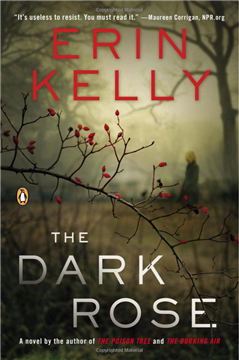
Day 429: The Dark Rose

Cover for The Dark RoseThe Dark Rose is the story of how the lives of two troubled people intersect, with unfortunate results.

Louisa has had a secret for 20 years that changed her life. In flashbacks to 1989, she meets Adam, a singer and bassist in a local rock band, and falls immediately in love. For the first time, she is not the one in charge of her own love life, and he is in turn attentive and evasive, loving and impatient. Louisa is eaten up by jealousy, especially when his band mates make jokes about his relationships with other women. No good comes of this situation.

In the present time, 19-year-old Paul has been forced to testify against his friend Daniel. They have a long-standing friendship that Paul has been wanting to escape. As boys Daniel protected Paul from bullies while Paul kept others from finding out that Daniel was illiterate. But Daniel’s father is a criminal, and Daniel has begun involving Paul in illegal activities just as Paul is trying to begin a new life at university.

While he awaits Daniel’s trial, Paul is sent out of the area for his own protection to help with a project restoring a Tudor garden to its former glory. On site he meets Louisa, the head gardener, who is struck by Paul’s resemblance to her long lost love.

Kelly does a good job of keeping up the suspense, telling the interleaved stories of the young Louisa from 20 years before and of Paul’s more recent history. Although you become aware that each story involves some horrendous event, she spins out her tale so that events are revealed toward the end of the novel. Still, all is not over.

I found The Dark Rose less satisfying than The Poison Tree, Kelly’s debut. Paul and Louisa are definitely more flawed and less likable than the previous book’s heroine. Still, we want to find out what happens to them.

Erin Kelly has been likened to Gillian Flynn or Tana French. I am always skeptical of such comparisons (“If you like so-and-so, you’ll love . . .”), and I prefer the work of Flynn and French. However, Kelly does have a comparable dark sensibility. I just think Flynn and French are better at getting you to sympathize with their main characters, even though they are invariably flawed (except for Gone Girl, that is, where no characters are sympathetic).

A warning about this book if you shop in used book stores. I bought it a second time by accident because the British edition is under a different title, The Sick Rose.

Day 423: Accidents Happen

Cover for Accidents HappenKate Parker has lived the last five years in fear, not of something specific but of harm to herself or her son Jack. She believes she is cursed. First, her parents were killed in a freak accident on the night of her wedding, and then a few years later her beloved husband Hugo was viciously murdered by a gang of men who were trying to steal his car.

Since then, Kate has been obsessed with numbers, the odds of this or that happening that could hurt her or her son. She has gotten so fearful that her in-laws are threatening to sue for custody of her son, claiming she is harming his mental well-being.

Kate is not just being paranoid, though. Fairly early on, we learn that someone is regularly breaking into her house from the student rooming house that shares a wall.

Kate meets Jago Martin, a professor at Edinburg University who is visiting at Oxford. He has written a book that fascinates her on the statistics of events. Once he finds out her problem, he begins a series of unorthodox experiments with her to try to draw her out of her fears. Soon, she seems to be improving, and she is becoming attracted to Jago.

This novel does a fairly good job of building suspense. However, I feel the whole “treatment” idea to be unlikely, first that Kate would agree to do some of the experiments–actually any of them given how she was behaving before–and second that they would help her improve so quickly. There are other plot points I find unlikely, but I can’t discuss them without giving too much away. Let me just say that although the motivation for some actions may not be completely absurd, the chosen target makes no sense at all. Finally, after a villain comes into the open, given the time and effort expended on the tortuous plot, the manner of resolution seems too easy. With these mysterious comments, I will leave you to decide for yourself whether to read the book!

Day 419: The Bones of Paris

Cover for The Bones of ParisHappy Halloween! I tried to select a book that was appropriate for the occasion, although I didn’t have a ghost story lined up.

Laurie R. King’s series about Mary Russell and Sherlock Holmes is very popular, but I prefer her Kate Martinelli series or, even better, some of her dark psychological stand-alone novels. Folly is my favorite. With The Bones of Paris, she brings some of that darker sensibility to what looks like the beginning of a new mystery series.

Harris Stuyvesant is an ex-FBI agent who has been scraping a living in Europe by taking private investigation work. Among the hordes of American expatriates in 1929 Paris, he is searching for a young woman, Pip Crosby, whose relatives have not heard from her in months. A cause for possible embarrassment or worse is that Harris met Pip in Nice the year before and had a brief fling with her. Ever since a disastrous incident that ended his career and cost him his fiancée, he has been living an aimless and bohemian existence.

Two of Harris’ first stops in his search for Pip are Pip’s flatmate, Nancy Berger, and the Paris Missing Persons Bureau. Nancy seems to have a hangover but is actually suffering the effects of travel. She just returned from an archaeological dig in Greece and has not seen Pip for months. Harris finds the police officer, Doucet, concerned about what may be a series of killings.

Harris’ attentions soon narrow on three men connected with the art world whose names keep surfacing in connection with Pip and who all have a fascination with the macabre. The artist Man Ray‘s photographs of Pip focus on a gruesome scar from an accident in her youth. Count Dominic de Charmentier is a wealthy patron of the arts who owns a theatre that alternates grotesque and frightening scenes with comic ones. He also hosts parties that feature macabre decorations and terrifying staged events. Didi Moreau is a creepy, disturbing artist who makes displays of found objects, including human bones. Pip has a few of these displays in her room, as well as some of Man Ray’s photographs. When Harris begins investigating these men more closely, he finds to his alarm that his ex-fiancée, Sarah Grey, is working as de Charmentier’s assistant.

King evokes the time and place with mastery, introducing us to a dissolute café culture populated with famous figures such as Cole Porter and Josephine Baker. She also cleverly raises the creep factor by interjecting short chapters about the bones that underlie parts of Paris, foreboding snippets of conversation, and other indications that something monstrous is going on behind the scenes of glittering nightlife.