Day 412: Stone’s Fall

Cover for Stone's FallBest Book of the Week!
Ever since Iain Pears wrote the stunning An Instance of the Fingerpost, I have been waiting for him to come out with something that could match it for complexity and interest. He has finally achieved this with Stone’s Fall.

Did he fall or was he pushed? might be the question journalist Matthew Braddock is asked to answer when Elizabeth Stone hires him after her husband falls to his death from his office window. Instead, she asks him to find the child John Stone mentioned in his will. Stone’s estate is tied up during the search for this unknown heir, but Elizabeth says she has no ulterior motives except a sincere wish to follow her husband’s wishes. As Stone was an extremely wealthy but private arms manufacturer and the only person who could understand the complex structure of his inter-related companies, many are concerned in his affairs, even the British government.

Completely infatuated with the older woman and feeling wholly unqualified to find the child, Braddock instead concentrates on investigating the last days of Stone’s life and the state of his corporations. In doing so, he finds evidence that Stone’s net worth was not nearly as large as everyone thinks. He also has questions about the involvement of Henry Cort, a mysterious figure believed to work for the Foreign Office. Braddock relates the tale of what he discovered quite some time after his 1909 investigation, in 1953 after Elizabeth Stone’s funeral.

Braddock’s story does not answer many questions even though he believes he has found some facts, but after his narrative, he includes a manuscript sent to him by Henry Cort. Cort takes his own story back further, to events in Paris of 1890, when he befriends Elizabeth after having known her years before.

The final section of the novel takes us to Venice in 1867, when as a young man John Stone meets Cort’s parents and the man who invented the torpedo that began Stone’s empire. It is in this final section of the novel that we begin to understand the answers to the mysteries of John Stone’s life and death.

This series of narratives is like a set of nested gift boxes–as we unwrap each one, we learn more and go deeper into the story, finally beginning to understand the mysterious Stone. The novel is impeccably plotted and beautifully written–a great reading experience for those who appreciate a mystery that is not formulaic.
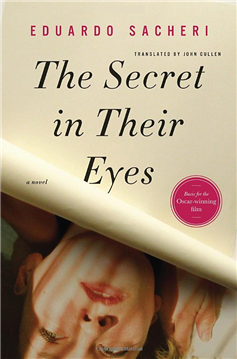

Day 409: The Secret in Their Eyes

Cover for The Secret in Their EyesBest Book of the Week!
I picked up this novel because I saw the excellent Oscar-winning movie from a few years ago. It had been long enough that, even though the movie stayed fairly close to the book, I didn’t remember some of the key plot points. The movie emphasized the crime-solving aspects of the novel, which is more about political corruption, Argentina’s violent history, and finally, a love story.

Written as a novel within a novel, the story spans more than 30 years. Benjamín Chaparro has retired after a long career as deputy clerk in an examining magistrate’s court, the court responsible for carrying on criminal investigations. As he wants to find something to occupy himself in his retirement, he decides to write about a case he worked on 30 years before, the ramifications of which seriously affected his life.

In this case from the 1970’s, a beautiful young woman, Liliana Colotto, has been found raped and murdered in her apartment. Although it is not a customary part of his duties, Chaparro’s judge sends him to the crime scene to observe the investigation. He is struck by the woman’s beauty and also by how the police are trampling all over the crime scene to get a look at her.

Her husband, Ricardo Morales, is in the clear, because a neighbor saw a man come to the woman’s door after her husband left for work. The investigation takes a false start when the other deputy clerk in Chaparro’s office decides that two workmen in the apartment building did it and has a confession beaten out of them. Chaparro figures out what is going on very quickly and files a complaint against the clerk, Pedro Romano. This incident has far-reaching effects on both the case and Chaparro’s life.

After this false start, the case goes nowhere. Chaparro has been meeting with Ricardo Morales periodically to keep him informed, but the investigators have been unable to find any clues to the identity of the mysterious man. The case is about to be closed when Morales shows Chaparro some snapshots of his wife, and Chaparro is able to discern the secret in the eyes of one man–that he was in love with Liliana Colotto and angry at her marriage. Chaparro sees the secret because he has his own–he has been in love with his married coworker, Irene Hornos, for years, since he first saw her. It is not revealing too much to say that Chaparro and Morales soon identify this man as Isidoro Gómez, because as I said, the focus is not on the solution of the crime but on the aftermath.

Several years go by before Gómez can be found. With the clever help of his friend and coworker Pablo Sandoval, Chaparro is able to get Gómez to confess to the murder, even though they have no evidence against him except the fact that he was late for work for the only time on the day of the murder. This should have been the end of the case, but because of corruption, political influence, and state-sponsored terrorism, the case and its ramifications follow Chaparro and Morales for more than 20 years.

The present-day story is concerned with the difficulties of writing and of Chaparro’s heart-yearning over Irene, who is now a judge. He has never spoken to her about his feelings, even though he left his first wife when he realized he loved Irene. He has been using his book as an excuse to meet with her to discuss it and the case.

This novel is wonderfully well written and absorbing. The conscientious, upright, deprecating Chaparro makes wry and cynical observations about the workings of the judicial system. The novel suspensefully shows how a state-sponsored reign of terror can affect the lives of even very ordinary citizens who are just trying to live their lives and how it can create injustice even in a case that has nothing to do with politics. The Secret in Their Eyes provides a fascinating look at a time in Argentina that many of us know little about.

Day 405: The Child’s Child

Cover for the Child's ChildEven though The Child’s Child is a relatively short novel, it seems to take a long time to get to the payoff. Although Barbara Vine’s novels are more character studies than thrillers, they always involve a certain amount of suspense.

This book uses a novel-within-a-novel structure, with the exterior novel taking place in 2011 while the interior one begins in 1929. The themes of unwed motherhood and homosexuality and the extent to which both are stigmatized are the same in both stories.

Grace Easton is a graduate student working on a thesis about the portrayal of unwed mothers in literature. She and her brother Andrew have inherited a house and impulsively decide to share it instead of selling it. However, they have not discussed issues such as how to deal with prospective mates, and soon enough Andrew, who is gay, has brought home James, a writer. Grace and James do not get on, and she begins to feel uncomfortable in her own home.

One evening Andrew and James witness a brutal crime against a gay friend, about which they will be called upon to testify. James is extremely upset by this event, and his reaction leads to unforeseen complications.

Grace has promised to read the manuscript (the interior novel) written by an acquaintance’s father with a view to telling the acquaintance whether it is publishable. She has been avoiding reading it while she works on her thesis but finally begins. We are led to understand that, while presented as a novel, it is actually a true story of the writer’s relative.

In the interior novel, Maud Goodwin becomes pregnant at fifteen and is immediately rebuffed by her family, with the exception of her brother John. John has recently taken a new job in a different county, and his solution to his sister’s problem is to set up housekeeping with her, the two of them posing as husband and wife to avoid her shame. John is homosexual, which of course was illegal in those days, and has vowed to remain celibate, so he knows he will never marry.

The interior novel takes up the bulk of the book, which I found unfortunate. I thought John was in some ways foolish, and Maud becomes a bitter, ungrateful woman. My immediate thought, even as John was deciding what to do, was that Maud’s situation could just as effectively and more sensibly have been taken care of by her posing as a widow and sharing a house with her brother.

Sadly, John lacks judgment in where he bestows his affections, and when he chooses a partner he basically seals his fate. I had some sympathy for John, but he exits the novel fairly early on, and I grew to dislike Maud more and more.

It isn’t until the narrative returns to the present time that I feel the novel regains its focus and finally provides some payoff, and the long-anticipated suspense. In addition, sadly, the themes of the novel seem labored and obvious, to the point where the author has characters voicing them instead of letting the reader figure them out. If you want to try Barbara Vine, the name Ruth Rendell uses for her psychological suspense novels, I suggest instead A Dark-Adapted Eye, which is one of my favorites.

Day 402: Dust and Shadow

Cover for Dust and ShadowIn Dust and Shadow: An Account of the Ripper Killings by Dr. John H. Watson, Lyndsay Faye combines a great deal of research into the Jack the Ripper killings in 1888 with a vast knowledge of Sherlock Holmes literature to offer an entertaining solution to the crimes. The novel begins nearly 50 years after the events, when Dr. Watson places his narrative of the murders into a safety deposit box on the eve of war.

Inspector Lestrade comes to consult Holmes after the second murder, when police begin to realize the two deaths may be linked. Holmes immediately begins pursuing his usual means of detection–inspecting the body and the scenes of the crimes, trying to find out where the victims were last sighted, questioning the victims’ friends–and he very quickly figures out that another murder is related. He even hires an alert young prostitute, Mary Ann Monk, to make her own enquiries and observations after she identifies the body of her friend, Mrs. Nichols. However, he is soon frustrated by his lack of progress. The only lead Holmes has come across is the story of an elusive sailor, being sought by a friend who thinks he may have been involved in the first murder, that of Mrs. Nichols.

Soon Holmes and Watson have something else to worry about, for a member of the press is printing details of the crimes unknown to but a few. He has been alleging that Holmes himself may be the murderer.

Faye’s novel is atmospheric and absorbing. Its greatest accomplishment, though, is in successfully capturing the narrative style of Doctor Watson, making us believe that this could be a Holmes story. Although I was about 100 pages ahead of Holmes in solving the murder (which would never happen in a real Holmes story), I still found the solution ingenious as well as the reason why the crimes are recorded in history as unsolved (when, of course, Holmes solved them). This novel is a very good first effort. I have Faye’s next book awaiting me in my pile.

Day 398: The Strange Fate of Kitty Easton

Cover for The Strange Fate of Kitty EastonIf you prefer a book to leap immediately into action, this is probably not the mystery for you. The second in a series, it starts slowly, with Speller taking the time to develop the setting and characters.

Laurence Bartram is a young man damaged by World War I, during which his wife and child died and he was injured. Laurence is an expert on church architecture, and he is happy to be summoned to the estate of Easton Deadall by his friend, William Bolitho. William wants him to look over  a small but unusual church, for which William is designing and installing a window.

Laurence is soon pulled into the affairs of the Eastons, a family that is haunted by the war, but moreso by the disappearance in 1911 of the young daughter of Digby Easton, the oldest of the three Easton brothers. Digby died during the war, but Kitty still obsesses her mother Lydia, an invalid who sometimes speaks of her as if she is alive.

The middle Easton son, Julian, has been doing his best with the estate, which Laurence finds beautiful but slightly crumbling, while Lydia’s sister Frances takes care of her. Laurence finds the subject of Kitty lurking behind every conversation and wonders if they will discover her body in the course of their renovations. Soon, the third Easton brother, Patrick, returns to Easton Deadall after an absence of years, first at Oxford and then on an archaeological dig in Greece. It becomes obvious that there is tension between him and Julian.

The family decides to make up a party to visit the Empire Exhibition. William, who was left wheelchair bound by the war, does not feel he can handle it, and Lydia is too ill, but the rest of the family goes. The expedition includes Eleanor, William’s wife, and Laurence. They also bring along David, the estate’s man of all work, and the teenage maid Maggie to help care for William and Eleanor’s young son Nicholas. At the exhibition, Maggie and Nicholas go missing, and although the others find Nicholas, Maggie is nowhere to be seen.

Distressed by Maggie’s disappearance, which can’t but echo the earlier one of Kitty, the family begins falling apart and secrets emerge, especially about the charismatic Digby and his relationships to his family and to his troops during the war. A few days after the disastrous outing, Laurence and David are clearing an area in the church to prepare for the installation of William’s window when they discover a trap door in the floor under the altar. When they open it, they find the body of a woman. The police are able to quickly ascertain that the body is of a woman too old to be Maggie, but then, who can it be? Could it even be Kitty, grown up and returned from wherever she has been?

Laurence does not exactly detect so much as look into a few things the others haven’t thought of, and he eventually unearths a tangle of secrets. Although the novel takes awhile to get going, I soon found myself unable to put it down. It slowly and skillfully builds to suspense. I found it well worth my patience.

Day 396: Back to Bologna

Cover for Back to BolognaThe Aurelio Zen series begins as fairly traditional mysteries featuring the bemused Italian detective. Gradually, they become more and more comic. In Back to Bologna, Dibdin presents us with more of a spoof than a mystery novel.

Zen is not feeling his normal self. He is just recovering from a stomach operation, and he is also coping with troubles with his girlfriend, Gemma. She is leaving for Bologna to meet her son when Zen is also recalled to duty and sent to Bologna to solve the murder of a football team owner.

The victim is Lorenzo Curti, a millionaire entrepreneur who was found dead in his Audi, stabbed by a Parmesan cheese knife. Zen actually has little desire to investigate. His main reason for coming to Bologna is to keep an eye on Gemma.

A ridiculous situation is created by a celebrity cook-off between local semiotics professor Edgardo Ugo and the singing TV chef Romano Rinaldi, or Lo Chef. Ugo has suggested in a newspaper article that Lo Chef can’t cook, which has sparked a rivalry and this competition. Gemma gets tickets to the cook-off, and Zen ends up being arrested after Ugo is shot in the wake of the comic event.

Dibdin presents us with a large cast of characters, including a rich student of Ugo’s who is an “ultra” football fan, the student’s illegal immigrant girlfriend “Princess Flavia of Ruritania,” and the worst private detective imaginable. Despite the large number of characters, the solution is not at all difficult to guess. 

Zen does very little detecting as we watch a series of incredible mishaps result in the murderer being delivered right at Zen’s feet. Although I found this novel mildly amusing, my interest in this series has been winding down, and I think this is a good place to stop.

Day 393: The Cuckoo’s Calling

Cover for The Cuckoo's CallingBefore I go on to say some nice things about this mystery, I have to say that the author pulls one big dirty trick to put the readers off the scent. I can’t say what it is because it is too big of a spoiler, but this one thing lessened my enjoyment of what proved to be a very readable mystery. Of course, you probably know by now that this novel was written by J. K. Rowling. I was slightly more interested in figuring out whether—had I not known that—I could have guessed the novel was by a woman (probably) than by Rowling (probably not).

Robin Ellacot is excited to discover that her new temp job is with a detective agency, even when the office proves to be less than impressive and she is almost knocked down the stairs by the detective when she arrives. She is smart, pretty, newly engaged to be married, and always wanted to be a detective.

Cormoran Strike, her new boss, isn’t happy to see her. He has just been dumped by his fiancée, and anyway he can’t afford a secretary. As it is, he has nowhere to live but his inner office.

His luck looks like it may change when he gets a new client, a lawyer named John Bristow from a wealthy family. Bristow’s adopted sister was Lula Landry, a famous supermodel who fell to her death from her apartment balcony several months before. The police have decided her death was a suicide, but John is convinced she was pushed.

Strike, although he really needs the money, is inclined to turn down the job because he thinks the death is a suicide. He is a man with very high principles, a former Royal Military Police officer whose army career ended after he lost a foot in Afghanistan. Something in the “evidence” Bristow has collected makes him decide to take another look, however.

Lula was a manic-depressive, but Bristow claims she was on her meds and under control. Her contacts on the day she died include her on-again, off-again drug-using rock star boyfriend Evan Duffield; her supermodel friend Ciara Porter, who has alibied Evan for the night of the death; the famous designer Guy Somé; and a strange friend from rehab who may be named Raquel.

Neither Lula’s adoptive nor her birth family are stellar human beings. Her mother Lady Yvette is now dying but has been needy and clinging and disapproves of Lula’s search for her real father. Her uncle Tony is nasty. Her birth mother, Marlene Higson, only cares about the money she can make from their association.

The novel is fast moving and interesting, with a complicated plot. Robin shows her value as a bright employee with initiative and is an engaging character. Strike is complex, a tough, wounded guy who is very systematic in keeping records and carrying on his investigation.

I liked this novel and will be happy to read another one. I’m just unhappy about the trick Galbraith played, one that makes little logical sense once you know the identity of the killer, and the Psycho-esque wrap-up used to explain it at the end of the novel.

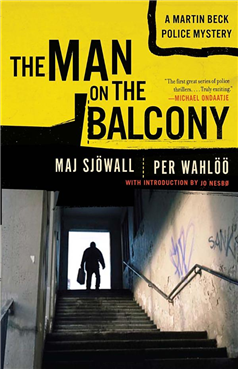
Day 390: The Man on the Balcony

Cover for The Man on the BalconyAlthough it is the third in the Martin Beck series, The Man on the Balcony is considered a breakthrough novel, one of the first realistic police procedurals. Written in 1967, it is based on an actual case from 1963.

The novel begins with a description of a man watching the activity of a Stockholm summer day from his balcony. The scene seems very ordinary, but we know it is important because of the title of the novel. Later, a detective in Martin Beck’s division takes a phone call from a woman who complains that a neighbor is standing all day long watching children from his balcony, but the detective dismisses the woman as a crank. Such activities are obviously not illegal. Although a call like this might send chills down our spines these days, this novel takes place in a more innocent time and place.

The police have actually been working hard on the case of a mugger who attacks people in the parks and robs them. But almost under their noses the body of a nine-year-old girl is found in the park. She has been raped and strangled and her panties stolen. This case becomes the priority, but it is not long before the police suspect that the mugger may very well have seen the murderer in the park.

After a second girl is murdered, Beck realizes he has another potential witness–a three-year-old boy who went off to play with the victim and came back alone. The boy can barely talk, however. Although the book is notable for its realism, this was the only point that I found unrealistic, as usually three-year-olds can speak quite well with some occasional interpretation from their parents.

As Martin and his coworkers doggedly follow every lead and wait impatiently for forensics results, they become more and more stressed and depressed, hoping they can catch a break before the killer strikes again.

These novels are extremely well written. Although the pace is much more leisurely than you would find in an American mystery novel, the novel still builds up a fair amount of suspense. Sjöwall and Wahlöö, the husband and wife writing team, set the standard for this type of mystery to come. Ever since I picked up the first Martin Beck novel, Roseanna, I have been impressed with this series.

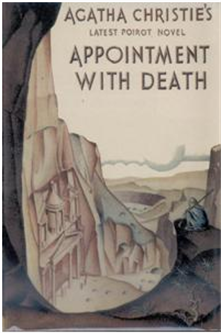
Day 387: Appointment with Death

Cover for Appointment with DeathHercule Poirot is in his hotel room in Jerusalem when he overhears two people discussing a murder. He finds that these two people, Raymond Boynton and his sister Carol, are discussing their stepmother, a sadistic, manipulative, demanding head of a wealthy family. The family is part of the expedition Poirot is taking to Petra.

All of the family are traumatized by their mother’s behavior. Raymond and Carol are eager to escape from their stepmother’s control. Their sister Ginevra is barely attached to reality. Lennox, the oldest son, rarely speaks, and his wife Nadine is threatening to leave him.

Poirot finds the rest of the party in the camp at Petra interesting. Sarah King is a studying psychiatrist who is romantically interested in Raymond, but Raymond does not have the courage to tell his mother. Dr. Gerard is a famous French psychiatrist. Lady Westholme is a well-known politician, and she is accompanied by her friend Miss Pierce.

When Mrs. Boynton dies, the cause is not clear. She was overweight and in poor health. Did she die of natural causes, or was she murdered? If she was murdered, there are plenty of suspects in their party, most of them in her own family. Colonel Carbury, an official assigned to the case who is known to Poirot, asks him to help.

This novel is not one of Christie’s best, even though she continues to deftly draw believable characters. It is marred by some silly psychobabble that was probably popular at the time. Perhaps Christie was trying to reflect then-modern topics of conversation, or perhaps she was writing dialogue that would be typical of the two psychiatrists. In addition, she pulls one of her tricks, making the solution depend upon information that is not possible for the reader to know.

Day 384: Vendetta

Cover for VendettaAurelio Zen is faced with a seemingly insoluble mystery in Vendetta, and the hapless detective falls into the solution, this time literally. Some government ministry officials assign him to the murder of an eccentric billionaire, Oscar Burolo, whose corrupt dealings have made many Italian politicians wealthy. The chief suspect is a friend of one of the politicians. They want Zen to find a murderer–just about anyone except the suspect will do–and if he has to frame someone, that’s fine, too.

The problem is that Burolo was killed on his seemingly impregnable estate in Sardinia, where every room is monitored by video. Burolo’s death is plainly visible on the cameras, but not his murderer.

Before Zen leaves for Sardinia, though, some odd things happen. He thinks someone may have been following him, and someone has been in his house. A criminal he put away has just been released from jail, and a magistrate has been slain, but he sees no connection between these two incidents. It takes awhile, but Zen figures out that someone is stalking him. His growing relationship with his coworker Tania is also complicated by his being forced to go out of town.

On the scene of the crime, Zen finds an odd care-taking couple and learns that the chief suspect was probably not the murderer. Everyone that was on the scene was killed with a shotgun, and no one else appears to have been in that part of the house. Yet, the estate’s safeguards make it next to impossible for someone to have sneaked in from the outside, it appears.

In his bumbling way, Zen remains incorruptible while managing to stumble into a solution of the crime that makes everyone happy. Dibdin’s mysteries always cynically expose corruption in the Italian government. Zen is a somewhat befuddled detective, nattily dressed, and Dibdin takes great pleasure in occasionally covering his impeccable detective with muck. Vendetta is no exception. Zen’s romances and his difficult relationship with his nearly senile mother are important components of the series, which is occasionally funny and furnishes a clever puzzle to work out.