Day 381: Death on Lindisfarne

Cover for Death on LindisfarneI got a free copy of this novel in a giveaway from Goodreads. I was attracted to it because of its setting (I can’t resist novels set on islands), and frankly its cover. Unfortunately, however, I found the mystery to be mediocre at best.

Aidan Davison and his eight-year-old daughter Melangell are on a pilgrimage of sorts. Aidan’s wife died about six months ago, and Aidan is taking Melangell to one of the places she loved best, the island of Lindisfarne off the Northumbrian coast. They are scheduled to attend a course on the history of Lindisfarne given by Reverend Lucy Pargeter.

Lucy is traveling with Peter, a student, and Rachel, a troubled teen who has recently given up drugs. Other attendees are two middle-aged Oxbridge women, a fussy older couple, an evangelist who shows signs of wanting to take over the tour, and his worshipful assistant.

Lindisfarne is a tidal island, which means it can only be accessed by the bridge or across the sands when the tide is out. Aidan and his daughter decide to walk, and on the trek across the sands see on the shore a woman struggling with another person. When they approach the spot, Melangell finds an earring that turns out to belong to Rachel, but they aren’t able to identify her opponent. In any case, Rachel’s subsequent behavior is erratic. Lucy is very concerned about her.

Soon Rachel is found dead, apparently from drowning. The police are inclined to treat the death as a suicide, although the water rescue folks doubt that her body could have drifted to where she was found if she jumped into the water from any height. Soon, though, the autopsy shows she was strangled.

As far as the mystery is concerned, there is a long central section of the book during which no detection is going on, just a lot of speculation. Nothing turns up to point to any of the suspects. In fact, the most suspicious character is involved in an event that could exonerate him. Although it can be frustrating to read a mystery where evidence or suspicion arbitrarily seems to point to everyone, it is even more frustrating to have no evidence at all. When the definitive clue finally arrives, the main characters stupidly miss it, even though it makes the motive and the culprit immediately obvious.

More troublesome, though, is that the entire murder depends on Rachel not telling Lucy something that I couldn’t imagine not being said almost right away. Yes, one sentence at the logical time would have either prevented the murder or made the solution obvious.

But these are problems that only become obvious once the case is solved. Characterization and behavior are problems from the start. The novel is only adequately written, including some poor writing. What bothered me more were all the characters’ exaggerated reactions. Lucy is almost frantic about Rachel from the first scene, when she has just wandered off somewhere–not concerned, frantic. All the characters are constantly starting, stiffening, or being startled. Really, how often does a normal person start? Characters routinely overreact for everything. All this is an artificial attempt to interject drama.

The best I can say for the novel is it made me want to visit Lindisfarne. Sampson obviously had things she wanted to say about its history, however, and the only way she could think of to get them in was through short lectures as part of the course. Besides providing a little color, however, the lectures aren’t really relevant to the story, and repeated verbatim, are far too short to constitute any kind of believable course. I don’t think I’ll be reading more of this series.

Day 377: Gods and Beasts

Cover for Gods and BeastsMartin Pavel is standing behind an old man and a child in the post office waiting to mail Christmas packages when a gunman comes in. The old man pushes the little boy toward Martin and behaves as if he knows the gunman. The gunman forces the old man to assist him in the robbery and then shoots him.

Things are going better for DS Alex Morrow than they have in awhile. She finally admitted her relationship with her criminal half-brother Danny Boyle to her supervisors and has been investigated and cleared of any suspicion of wrong-doing. She also gave birth to twins four months ago and is happy in her marriage. Her habitual anger has stopped simmering below the surface.

Morrow’s team is surprised to find no ties to crime on the part of the victim, Brendan Lyon, a former union organizer. The tattooed Pavel turns out to be a wealthy do-gooder. The police are having a hard time figuring out how Lyon could have known the gunman.

In a parallel story that seems unrelated until the very end of the novel, labor leader Kenny Gallagher, a rock star in politics, can feel the support of his constituency ebbing. His leadership is being challenged, he is being accused of improprieties with a young party member, and his wife wants a divorce.

Alex soon finds that two officers on her team were lured into taking a bribe, and then a third has a sack of cash thrown into his car. As she investigates these incidents, she begins to uncover a web of corruption.

On the home front, she is tentatively exploring normal family relations with Danny. He says he’s retiring from crime, but is he?

I discovered Denise Mina’s gritty crime novels shortly after the publication of her first book. They are unfailingly excellent, with gripping plots, complex characters, and complicated moral dilemmas. Mina’s writing is spare and elegant. You can’t go wrong with her if you have a taste for dark, dramatic crime novels.

Day 374: A Plague of Lies

Cover for A Plague of LiesA Plague of Lies is the third in the mystery series set in 17th century France and featuring Charles du Luc, a master of rhetoric at the Louis le Grand school in Paris.

Charles is dismayed when he is summoned to escort Père Jouvancy to the court at Versailles to present Madame de Maintenon with the gift of a holy relic. Madame is angry with the Jesuits because the King’s confessor, Père la Chaise, convinced the King not to give her the title of Queen, so the gift is an attempt to regain favor. Although Charles disapproves of what he sees as the Sun King’s constant self-glorification, he must escort Père Jouvancy, an old man who is just recovering from an illness that is raging through Paris.

On their way to Versailles, Charles and Jouvancy encounter Lieutenant-Général de la Reynie, head of the Paris police, whom Charles has assisted on occasion. La Reynie asks Charles to keep an eye on the Prince of Conti while he is there and to listen to what is said about him.

Once at court, though, Père Jouvancy has a relapse, and Charles comes close to witnessing the death of a much-disliked man, the Comte de Fleury. Apparently, he too was ill and running for the latrine when he slipped on the wet floor and fell down the stairs. The rumor is that he was writing a scandalous memoir, and poison is immediately mentioned. When the other members of Charles’ party fall ill, there are more rumors of poison, but all the men seem to just have food poisoning.

De Fleury does appear to have been poisoned, however, and Charles observes several people going in and out of his room, including the Duc du Maine, son of the King. Charles finds himself getting embroiled in the problems of the Duc’s sister, Mademoiselle de Rouen, who is soon to be engaged to the son of the King of Poland and is not happy about it. Charles also observes Conti behaving suspiciously. Next, a gardener is found drowned.

The novel presents us with a convoluted plot but also with a fascinating portrait of the court at Versailles. Rock’s knowledge of the period, even of how the places she describes would have appeared at that time, seems convincingly complete. Her novels are always absorbing.

Day 372: A Trick of the Light

Cover for A Trick of the LightThe morning after the village of Three Pines throws a big party to celebrate Clara Morrow’s show at the prestigious Musée d’Art Contemporain in Montreal, the body of a murdered woman is found in Clara’s garden. The body turns out to be that of Clara’s childhood friend Lillian Dyson, whom she has not seen in more than 20 years.

Clara’s friendship with Dyson was broken because Dyson cruelly betrayed her in art school. This puts Clara on the list of suspects. However, as Inspector Gamache’s team investigates Dyson, they find that she has a reputation for doing harm to others by trying to ruin their careers in art, providing a broad field of suspects, especially after a party celebrating an art debut.

On the other hand, Dyson is viewed completely differently by her new circle of acquaintances, which leads Inspector Gamache to wonder if people can really change their natures. Eventually, the police realize that Dyson was on a 12-step program and that she was probably intending to ask forgiveness of one of the people at the party.

On another front, Clara seems to be headed toward trouble in her marriage. Although her husband Peter has been happy with his own moderately successful career in the art field, now that Clara may be proving to be more talented than he is, he is becoming jealous and insecure.

Although this mystery has Penny’s usual hallmarks of beautiful description and insight into people’s characters, I do not like where the plot involving Jean Guy Beauvoir is going. Also, I thought it took the police an awfully long time to figure out about the 12-step program.

Day 370: The Preacher

Cover for The PreacherA little boy on vacation in the fishing village of Fjällbacka goes out early one summer morning and sees the body of a young woman in a crevice called the King’s Cleft. When the police come to remove the body, they discover bones of two more women beneath it. The medical examiner finds that many of the bones were broken, not only in the recent corpse but in the old remains, in exactly the same way.

Eventually, the older bodies are identified as Siv Lantin and Mona Thernblad, two young women who disappeared 25 years before. Although those crimes were never solved, Gabriel Hult reported that he saw his brother Johannes with Siv Lantin the night she disappeared. Johannes later committed suicide, according to his family because he was innocent and couldn’t bear the suspicion.

Patrik Hedström is on vacation with his massively pregnant wife Erica, the main character of Läckberg’s first novel, but he is called back to head this investigation. Soon the situation becomes more urgent, because another young woman who is staying in a local campground with her parents disappears while hitchhiking into town.

Fearing that Johannes Hult is perhaps not actually dead, Patrik has his body exhumed. Johannes is indeed dead, but he was murdered, not a suicide, and semen found on the most recent victim’s body belongs to a close relative of Johannes.

This situation still leaves Patrik with several suspects in the feuding Hult family, all descendents of a leader of an odd religion that believes in faith healing. Gabriel Hult inherited the property of patriarch Ephriam Hult, known as “The Preacher,” leaving Johannes’ sons Stefan and Robert poverty stricken. Gabriel’s son Jacob runs a farm for reforming delinquent teens and continues with his grandfather’s religious work, although he does not have the ability of faith healing that his father and uncle supposedly possessed as boys.

While Patrik stresses over the case, Erica suffers in the oppressive summer heat and tries to cope with holiday guests who descend upon them without notice.

As with Läckberg’s previous novel, The Ice Princess, I liked this book perhaps more than it deserves. Patrik and Erica make attractive, likeable main characters, and the characterizations seem to have more depth in general than I’ve found with other Swedish police procedurals. However, again, Läckberg’s writing seems clumsy at times, particularly the dialogue.

Aside from a confusing typo early in the book where Johannes is referred to as Stefannes, I had a serious problem with the chronology of the mystery. The older crimes took place in 1979 and yet 30ish Patrik and Erica both say they remember them, not that they heard of them. This discussion confused me so much that I actually looked up the original publication date of the book, thinking that it may have come out earlier than I thought, but it was published in 2004. Although I suppose this timing is not impossible, it may have worked better to have an older police officer clue Patrik in to the details of the case.

The police investigation details also seem a little odd. It is hard for me to believe that any police station in Sweden would still have a modem connection. In addition, maybe they do things differently in Sweden, but blood tests for DNA analysis seem excessive. Of course, they are necessary for the plot, which, if that is the only reason they are done, makes them a cheat.

The Ice Princess depended for its plot mostly on Erica poking around where she shouldn’t be, and I think that works better for Läckberg than a police procedural, about which she seems to need to do more research. Nevertheless, despite these criticisms, I still find myself liking these books a lot.

Day 368: Dead Lagoon

Cover for Dead LagoonDead Lagoon is the most atmospheric of the Aurelio Zen mysteries I have read. In the novel, Zen returns to his home town of Venice, ostensibly to look into the “haunting” of the Contessa Zulian, his mother’s old employer, who is convinced that costumed “swamp dwellers” are invading her home. The contessa has long ago been deemed batty because of a tale she has been telling for years about a missing daughter. Although Zen has hitherto been incorruptible, he is actually there to work on the case of a missing wealthy American businessman, being paid under the table by the businessman’s family.

As Zen wanders or boats through the misty winter setting of Venice, visiting places he knew in his youth, he keeps stumbling over “ghosts,” some from his own past, and some actual dead bodies. A fisherman who spotted a ghost on the Isle of the Dead is drowned, then a crooked cop, head of the Venice drug squad, is found smothered in a sewer. In the search for the ghost on the cemetery island, an unexplained skeleton is found.

Zen’s investigation leads to a string of discoveries, of dishonest police, drug smuggling, and ambitious local politicians. His biggest discovery, though, is about his own family, including that nothing is what he thought it was.

I think what makes this Aurelio Zen book stand out is its depiction of Venice. The plot itself is rather disjointed and difficult to explain. Zen is able to solve both cases, but some readers have expressed frustration about the conclusion.

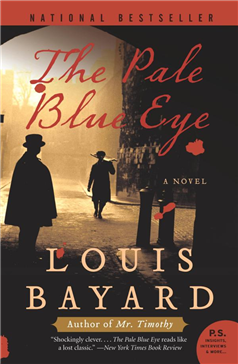
Day 366: The Pale Blue Eye

Cover for The Pale Blue EyeGus Landor, a retired New York police detective, is dying, and he writes the account of his last case in The Pale Blue Eye. Gus is a lonely widower who earlier moved up to the mountains near the Hudson Valley with his wife and daughter to help improve his lungs. But his wife died within a year, and his daughter left him soon after. So, Gus lives as a veritable hermit.

On an October morning in 1830, an officer from West Point fetches him. The body of a cadet named Fry was found hanged the night before, presumably a suicide, but during the night his body was stolen and later he was found with his heart removed. Superintendent Thayer and Commander Hitchcock wish to hire Landor to find who stole the heart. Landor is quick to figure out that Fry did not commit suicide but was murdered. A mysterious message clutched in his hand seems to indicate an assignation.

Landor soon realizes that his investigations on the reservation will be sorely hampered without the assistance of an inside man. So, he asks for the help of an unusual cadet he has met who is not in good favor with the academy–Cadet Edgar Allan Poe.

This is a clever novel with a macabre mystery that would have been completely to Poe’s taste. Just when we think everything is figured out, Bayard presents us with a twist. His portrait of the young Poe, bombastic, ridiculously romantic, and fearfully intelligent, is a great pleasure.

I would only fault the novel for a slow-paced middle section, and only because Landor doesn’t seem to be doing anything. Most of the plot is driven forward by Poe’s reports, which begin to dwell on his infatuation with a lovely young woman, Lea, the daughter of the post doctor, who unfortunately suffers from the “falling sickness,” or epilepsy.

Of course, Landor is doing something–he’s deciphering Fry’s diary–but since he doesn’t relate its revelations, his investigation seems to flag, and he barely seems to look into a second death, with a second missing heart. Otherwise, the novel is well written, with well-developed and interesting characters and a surprising ending.

Day 364: Hell Is Empty

Cover for Hell Is EmptyThis Walt Longmire novel is more like an adventure story than a mystery.

Walt and his deputy Sancho are transporting prisoners to a rendezvous with other county sheriffs and FBI agents. One of the prisoners, a sociopath named Reynaud Shade, has confessed to murdering a boy and burying him in the Bighorn Mountains. During this trip he is supposed to take the feds to the body.

After Walt drops off his prisoners and leaves the meeting, he learns that the prisoners have escaped with the help of accomplices. Finding one sheriff badly injured and a federal officer dead, Walt sends Sancho off for help and goes alone after the convicts and their two hostages into the Bighorn Mountains during a snowstorm.

This Longmire novel is notable for the mysticism that occasionally appears in the books. In this case, Walt again runs into the troubled Vietnam vet Virgil White Buffalo, who assists him in an unusual way.

The Longmire novels are not just whodunnits, but true ensemble pieces that further develop Longmire and the regular characters with each entry in the series. Wyoming is a character, too, and in this case, the mountains during a massive snowstorm make for a grueling environment.

Day 362: Finders Keepers

Cover for Finders KeepersBelinda Bauer returns us to Shipton, the setting on Exmoor of her first two chilling novels. Someone abducts a girl from her father’s car, leaving a note that says “You don’t love her.” At first the police assume the kidnapping is for money or revenge against the girl’s apparently wealthy father, but more abductions follow. The small town, which has been ravaged by serial killers twice, is horrified.

Constable Jonas Holly is still on leave following the murder of his wife Lucy the year before. He will soon be returned to duty, although Inspector Reynolds is skeptical of the help he can provide.

Steven Lamb, almost a victim in the first novel, thinks he knows who murdered Lucy Holly. As more children disappear, he becomes worried about his younger brother Davey, as well he might. Unknown to their mothers, Davey and his pal Shane have been running around the countryside while their families think they are at each other’s houses.

Reynolds and his team are at a loss. They hope the children are alive but can’t figure out where they’re being held, despite having covered the moor with heat-seeking technology from a helicopter.

Bauer’s thrillers keep me on the edge of my seat. Her novels are well written and suspenseful, her characters complex. If you like dark thrillers, you can’t do much better.

Day 360: 4:50 from Paddington

Cover for 4:50 from PaddingtonWhile traveling by train, Miss Marple’s friend Elspeth McGillicuddy witnesses a murder on another train along a parallel track. The police find no trace of a victim, so they are inclined to think Mrs. McGillicuddy imagined the incident. Miss Marple knows her friend, however, and imagination is not her strong suit.

Jane believes the body must have been thrown off the train near an estate called Rutherford Hall. She sends her friend Lucy Eyelesbarrow in as a housekeeper to investigate, and Lucy eventually finds the body, not lying somewhere in the bushes along the track, but hidden away.

The money from the estate will eventually be divided among the grown children of Luther Crackenthorpe, a semi-invalid widower, while the house will go to his eldest surviving son. But does that have anything to do with the murder? All of the children seem to have their secrets. Cedric is a bohemian painter who lives in Ibiza, Harold is an aloof banker, Alfred is engaged in shady business deals, and Emma is a spinster who is in love with Dr. Quimper, Luther’s doctor.

The biggest puzzle is to identify the body. Who is the woman murdered on the train, and why does Lucy find her in a sarcophagus among a bunch of antiques in the stables? Soon Miss Marple is on the scene visiting Lucy at tea time. The solution will soon be divulged, we feel.

Christie is great at drawing convincing characters, and Lucy is one of her most attractive. We wish we could see more of her. 4:50 from Paddington is yet another entertaining mystery from Christie.