Day 359: The Yard

Cover for The YardThe Yard contains elements that should have made it interesting to me, particularly the period, but it didn’t really grab me.

The novel takes place shortly after the failure of Scotland Yard to capture Jack the Ripper, and the police are dispirited, while the public has grown scornful of them. The body of Detective Little turns up in a trunk at Euston Square Station. Detective Inspector Walter Day is put in charge of the investigation to the surprise of everyone, as he is new to the force.

We are not left in ignorance of the identity of Little’s murderer, as he is watching the case from the sidelines. He didn’t intend to murder anyone, but Little discovered his secret. Soon another officer stumbles onto his secret and also must be killed.

Constable Hammersmith is assigned to the case, but he becomes embroiled in another incident. A thief breaking into a house finds the body of a boy stuck in the chimney and stops Hammersmith on the street to tell him about it. Directed by his superiors to concentrate on the more important case of Detective Little’s murder–the death of a chimney sweep’s boy not being considered a crime–Hammersmith continues to search for the sweep on his own time.

Another case is preoccupying Inspector Blacker. Some men have been found murdered with their beards newly shaven. Blacker thinks it is unlikely that two serial killers are loose in London at the same time, but Day and Dr. Kingsley, the coroner who is interested in new forensics research, do not agree.

This first series book sets the stage for all the recurring characters as well as attempts to recreate the chaos of the Yard. I feel it is spread a bit thin. The writing is capable rather than brilliant, although I encountered enough clichés in the first few pages to irritate me. A technique used several times of flashing back to explain something right in the middle of the action seems very disruptive and only serves to stall the flow.

Some unlikely events disturbed me as well. That two police officers would stumble onto the killer’s secret in the space of two days seems completely far-fetched. A minor incident where a family claims to have made a day trip to Birmingham seems equally absurd. I can’t imagine even in these days that a trip from London to Birmingham and back would be something anyone would want to do in one day, but back then the trains were surely slower. Such a trip may have been possible, but that the police officers receiving this information don’t challenge it seems absurd.

Almost despite myself I found myself beginning to like the major characters, but I still don’t think I’ll be picking up the second book anytime soon.

Day 357: The Dying of the Light

Cover for The Dying of the LightThis is going to be a fairly short review, because The Dying of the Light was a book I could not finish. I usually enjoy reading Michael Dibdin’s mysteries and I also like dark tales with a macabre sense of humor, but if that is what this is, it is too much.

Rosemary Travis and Dorothy Davenport are two little old ladies who live in a horrible nursing home run by William Anderson and his sister Letitia Davis. The owners are blatantly torturing the residents.

Rosemary and Dorothy react to this environment by turning it into a game, pretending it is some kind of convoluted mystery plot. When Hilary Bryant dies or George Channing is mauled by Anderson’s Doberman when he tries to escape, they fold this into their plot. But when Dorothy dies the night before her departure from the home, Rosemary finds she has a real mystery to solve.

This plot sounds as if it could be darkly humorous, but it is too sickening for me. One reviewer on Amazon says that Dibdin relies on the shock value, and not much else, to carry the novel. That about says it for me, and it doesn’t work.

Day 355: Deadly Web

Cover for Deadly WebA naked teenage girl is found dead in the grounds of Yoros Castle in Turkey. She has apparently stabbed herself through the heart, but there is evidence of some strange sexual practices. Someone is convincing young people in Istanbul to participate in what they believe are sex orgies, only to murder them. Inspector Mehmet Suleyman draws this conclusion while investigating another incident involving a teenage boy, although one death seems to be a suicide.

Inspector Çetin İkmen has made several visits to a friend, local magician Max Esterhazy, for information about a strange obscene symbol someone has been painting on the walls of religious sites. His investigation seems to indicate some connection with Suleyman’s case. Then Max disappears, and blood is found splattered around his study.

Suleyman is having his own problems. His wife has left him for a visit to Ireland, taking their infant son. His unfaithfulness has broken them up, and he has been exposed to the HIV virus through an affair with a prostitute.

Soon another girl is killed, and Suleyman and Ikmen find links to the city’s goth clubs and possibly to Satanism.

I find Nadel’s mysteries set in Istanbul interesting because they often provide fascinating insights into the city’s subcultures.

Day 352: Junkyard Dogs

Cover for Junkyard DogsI read this novel completely out of order with the others, but then I’ve been reviewing them out of order, too, so I guess that’s irrelevant.

First, old George Stewart, who owns the junkyard in Durant, Wyoming, is dragged behind a Toronado by his granddaughter. Then he is attacked by his neighbor. When Walt finds him in an attempt to investigate the first incident, he is dead, but not from these attacks. Someone has shot him.

Perhaps George’s death has to do with a new housing development next to the junkyard. The developer would like to remove the junkyard from the immediate vicinity of the homes he is building.

In the meantime, Walt is using the investigation of a severed thumb to try to keep his deputy, Santiago Saizarbitoria, who is considering quitting after being shot in the last book. Although Walt already knows that someone has claimed the thumb, he wants to keep Saizarbitoria busy and engaged in the hopes that he will stay.

Walt is also dealing with an eye injury and uncomfortable feelings about his daughter’s upcoming marriage to the brother of his other deputy, Victoria Moretti.

As I have said before, I think Craig Johnson is a great storyteller, and I love the setting of these modern-day western novels. To Junkyard Dogs, Johnson adds a touch of an offbeat sense of humor.

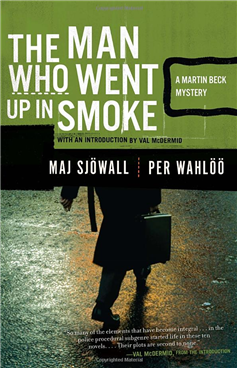
Day 350: The Man Who Went Up in Smoke

Cover for The Man Who Went Up in SmokeAt first, I thought this novel, written in 1966, was a little more dated than Roseanna, by the same authors. However, except for the formality in the characters’ dress, it stopped feeling dated after awhile.

Inspector Martin Beck has been on vacation with his family less than a day when he is called back to take charge of an unusual case. A Swedish journalist named Alf Mattson has been reported missing by his editor. The difficulty is that he disappeared in Budapest. There can be no official investigation because the Hungarian police have not received an official request for assistance, so Beck must travel to Budapest unofficially.

In Budapest Beck is able to retrace Mattson’s movements right up until he disappeared, one day after arriving. He visits a youth hostel where Mattson spent the first night and hears through his colleagues back in Sweden that Mattson claimed to have a girlfriend there. But when Beck finds her, she denies knowing Mattson.

Beck feels himself at a loss. His discussions with the Budapest police have not gone very far. The police can’t conduct a full-blown investigation until Mattson’s visa expires, but they have made some inquiries. It is not until Beck is viciously attacked that he understands he is getting somewhere.

Sjöwall and Wahlöö are known for having reinvented the police procedural, and many of its present-day conventions were first used in their novels. The novels are well written and deal with common people more often than with career criminals or gangsters.

Day 348: A Fatal Grace

Cover for A Fatal GraceIn this second novel of the series, Inspector Gamache is investigating the death of an old bag lady when he is called back to Three Pines to solve the murder of a very unpleasant woman. C C de Poitiers is a minor celebrity who is poison in the village because she treats others so callously. Now she has met an unusual and complicated death, electrocuted while watching a curling game on the day after Christmas.

Gamache has lots of suspects, including the victim’s hen-pecked husband and her daughter, whom she continually heckled about her weight. But as he investigates, he finds that Poitiers was not who she said she was.

In an ongoing plot, Gamache’s career is threatened by an old case where he took down some crooked officers high in the force. He has two new members of his team, local agent Robert Lemieux and agent Yvette Nichol, taken on because he likes to mentor young officers. However, one of them is working for his enemies by helping them sabotage his career.

It is always a pleasure to return to Three Pines, and I like the generous Inspector Gamache. Apparently some readers who were charmed by the picturesque village in the first novel were disenchanted by this sequel, but a mystery series about murders in a small town is bound to affect the atmosphere of the location. My favorite of the series so far is actually the one that took place in Quebec City, and it’s hard to imagine how many more people Penny can kill off in this village, but I still enjoy the series.

Day 346: Behold, Here’s Poison

Cover for Behold Here's PoisonAlthough Georgette Heyer’s Regency romances are some of the best historical fiction around, also entertaining are her few mystery  novels, set in the time period in which they were written (this one in 1936). The only problem with many of them is that the murderer is frequently the only unlikeable character (except the victim, usually) and therefore highly identifiable. However, Heyer’s novels are character driven, and her lifelike and amusing characters are what make them so enjoyable.

There are plenty of characters to dislike in Behold, Here’s Poison. Gregory Matthews is found dead at his country home. His family assumes the death is because of his bad heart, but the police find traces of nicotine poisoning.

Suddenly, all of the surviving Matthews are suspects, including the domineering Aunt Gertrude, hypocritical Zoë Matthews, and malicious nephew Randall. Inspector Hannasyde and Sergeant Hemingway find that one big stumbling block is their difficulty in figuring out how the poison was administered.

The dialog is especially witty in this novel and the characters lively. As always, Heyer is a brilliant writer.

Day 344: Tuesday’s Gone

Cover for Tuesday's GoneTuesday’s Gone is the second mystery/thriller featuring psychotherapist Frieda Klein in a series that is turning out to be quite exciting. A social worker calls on a mentally ill client for a first visit at a grimy, squalid hostel. The client, Michelle Doyce, leads her in to her apartment and introduces her to her guest–a naked man who has been long dead.

The police, embattled with cost-cutting measures, are inclined to close the case even though the victim has not been identified, but DCI Karlsson wants to see what Frieda Klein makes of Michelle, who seems to be talking nonsense. Frieda soon concludes that, rather than having strangled the victim, Michelle suffers from a rare disorder that makes her unable to distinguish the animate from the inanimate and was trying to help him.

When the victim is finally identified, he turns out to be Robert Poole, an apparently charismatic and charming con man and identity thief. He seems to have several potential murderers, but none of them appears to bear him any ill will.

In the meantime, Frieda is slowly beginning to realize that the case from the first book, Blue Monday, is not closed, because the murderer is not dead, as believed. Frieda is sure he is lurking somewhere nearby. She is also involved with troubles with her family and among her friends, as well as the return of her ex-lover Sandy from the US.

Frieda is an interesting character–a loner who likes to walk the streets of London at night and prefers to keep her own counsel yet has several close friendships. The mysteries are involving and complex, and although I figured out who the murderer was before the secret was revealed, it was only a bit earlier. Although the married writing team who calls itself Nicci French builds suspense slowly, the final chapters of the novel are quite thrilling.

Day 342: The Tryst

Cover for The TrystThe Tryst is an odd book by Michael Dibdin, the author of the Aurelio Zen mysteries. Although billed as a crime novel, it takes some time to get around to the crime. In fact, it misleads us into thinking it is one type of novel when it is actually another.

The novel follows the actions of two characters, a homeless boy and the therapist who is trying to figure out why the boy is pretending to be insane. Gary Dunn has come to the psychiatric hospital where Aileen Macklin works as a psychiatrist requesting institutionalization and insisting that someone is trying to kill him.

We find out that Gary, a glue-sniffing boy who lives with a bunch of junkies, has befriended an old man. Although Gary’s mates would like to rob the man, Gary has become involved in the old man’s long, involved story about a former employer who sees a beautiful woman no one else sees. In the story, the employer follows the woman to his death. This story eventually connects the fates of Aileen and Gary.

Ultimately, the novel doesn’t work that well, because it starts out being a crime thriller and turns into more of a gothic novel/ghost story. It is too much one kind of novel to work successfully as the other kind. Although the novel is well written and interesting, it reads almost as if Dibdin started with an idea and changed his mind in midstream. For a better example of a book that combines a crime story with a ghost story, read Johan Theorin’s fantastic The Darkest Room.

Day 341: Nightwoods

Cover of NightwoodsBest Book of the Week!

Charles Frazier sets his novels in backwoods North Carolina. His first novel, Cold Mountain, was set during the Civil War. His second, Thirteen Moons, went further back to the treatment of the Cherokee in the earlier part of the 19th century. Nightwoods, his third, deals with more recent times, a small mountain town in the early 1960’s.

Luce is a troubled young woman with a traumatized past who has taken up a secluded life as a caretaker for an old disused lodge across the lake from town. She is unprepared when a social worker brings her the young twin children of her murdered sister Lily, an almost feral boy and girl who refuse to speak and like to start fires.

Stubblefield is lazing away his life on the coast of Florida when he learns his grandfather has died and left him, aside from a load of debt, the lodge and a road house and a considerable number of acres on the mountain. When he goes to inspect the lodge, he is immediately smitten by the skittish Luce.

Trouble is on the way, which we know from the beginning of the novel. Bud, the husband and murderer of Luce’s sister Lily has been released from prison because of a hung jury. He is on his way to town in search of the money he stole, which he gave to Lily one night when he was drunk and she refused to give back to him. He beat her to death trying to get her to tell him where it is, and now he thinks the children know.

This novel is at times tender, as Luce blindly copes with the two damaged children in the best way she can, instinctively treating them with delicacy and kindness. At the same time, the violent Bud resembles a character from a Carl Hiaasen or Elmore Leonard novel, almost comic at times in his psychopathic ineptitude.

The result is an enthralling novel that is both a love story, not just between its characters but with the beauty of nature, and a thriller with a true feeling of danger. As usual with Frazier, the novel is wonderfully well written, with entrancing descriptions of nature.