Day 204: Unspoken

Cover for UnspokenAs you have probably figured out by now if you have been following this blog, I have spent a lot of time trying mysteries written by Scandinavian authors. Unspoken by Mari Jungstedt is probably one of the less successful of them, although it has an interesting plot.

The novel is set in winter on the island of Gotland. Fourteen-year-old Fanny is missing. She seems to have no friends and only an unstable mother to care about her. She spends most of her time caring for the horses at the local racing stable.

Seemingly unconnected is the murder of an alcoholic photographer named Henry Dahlström. But Dahlström recently won a large sum of money at the race track. Inspector Anders Knutas and his team are investigating both incidents.

As I said, the plot for this novel is interesting, but the writing is so choppy as to be distracting, and the characters seem undefined. In addition, a love affair between Johan Berg, a reporter who gets involved in the investigation, and a married woman seems completely pointless, although I understand this is a continuing relationship from a previous book.

I noticed recently that there is a blog that evaluates book cover art, so I’ll just say this, sort of tongue in cheek. I was struck by how atmospheric the cover to this book was and just wish that half of that atmosphere spilled over into the novel.


Day 198: The Princess of Burundi

Cover for The Princess of BurundiJohn Jonsson, an unemployed welder, small-time crook, and expert on tropical fish, is found tortured and beaten to death at the beginning of The Princess of Burundi by Kjell Eriksson. A deranged man is roaming the town, his behavior escalating in violence. He has attacked one of his former classmates, and Jonsson is another. The attacks seem to be related.

Ann Lindell is on maternity leave while her colleage Ola Haver runs the investigation. But Ann is so interested, she returns from leave to help. Although the police think that the demented man, a victim of bullying years ago in school, is a likely suspect, they cannot find any proof that he is the murderer and begin wondering if they are off base. Does the murder have to do with Jonsson’s school days, the tangled relationships in the Jonsson family, or perhaps the tropical fish?

Although this was the second Ann Lindell mystery I read, I had the same difficulty I reported before in keeping the various police officers straight. However, I am still interested and want to get to know them better. The crime story was complex, and I was unable to tell where the novel was going until the very end.

Day 193: The Drop

Cover for The DropSeveral people asked me recently if I had read any Michael Connelly. I hadn’t, so I read The Drop.

Harry Bosch is a cop who retired and then returned to work on the Open Unsolved unit. He is asked to take over another team’s case when DNA tests on the blood from an old rape and murder show that it comes from a sex offender who was only eight years old at the time.

Harry thinks he has a viable suspect in a man who was briefly the boyfriend of the sex offender’s mother, when he is told to drop the case. A city councilman who has always been his enemy has asked for him to investigate the apparent suicide of his son.

Harry begins to find what looks like corruption in city government, so he must tread carefully. In the course of the case, he also has reason to doubt both his current partner, David Chu, and his previous one, Kiz Rider.

The plot is reasonably interesting if you can get past the choppy writing, tendency to state the obvious, and unconvincing dialog. The problems in Harry’s growing affection for a program director for a rehabilitation center also seem contrived and premature, given the newness of their relationship. After all the raves about Connelly, I found him a disappointment.

Day 191: The Wrong Mother

Cover for The Wrong MotherAgain, Sophie Hannah uses the technique of multiple narrations in the enthralling mystery/thriller The Wrong Mother, featuring Simon Waterhouse.

Sally Thorning is married with two children, and although she is happy, she feels worn out with working and child rearing. When a business trip is cancelled, she lies to her husband so that she can take some time at a spa. There she meets a man named Mark Bretherick and has a brief affair.

A year later she is out shopping when someone pushes her into traffic. When she arrives home, she sees a news report about a woman who apparently killed herself and her child. The woman’s husband is supposed to be Mark Bretherick, but the man on the television is not the man Sally met at the hotel. She does not want to go to the police because she doesn’t want her husband to find out about her fling.

In the meantime, police constable Simon Waterhouse thinks there is something wrong with the diary found for Geraldine Bretherick, in which she writes about how much she hates being a mother.

Although Hannah seems to have a very dark idea of human behavior if you look at the totality of her work, I always enjoy her twisty plots and her grasp of psychological manipulation. Her two recurring characters, Simon and Charlie, are also almost completely disfunctional in their abortive romance and occasionally behave very oddly as police officers. Still, if you like dark mysteries, her books are fun to read.

Day 185: Haunt Me Still

Cover for Haunt Me StillHaunt Me Still (published as The Shakespearean Curse in Britain) is another enjoyable literary mystery by Jennifer Lee Carrell. Shakespearean scholar and theatre director Kate Stanley visits Lady Nairn to discuss a production of Macbeth. Lady Nairn, once a renowned actress, plans a production of the play at the foot of Dunsinane Hill using some props from her own collection and wants Kate to direct.

Once the cast arrives at Lady Nairn’s Scottish castle, though, Kate sees a vision of Lady Nairn’s fifteen-year-old granddaughter Lily being murdered and finds the body of a local woman dead at the scene of what appears to be a pagan sacrifice. Then Lily is kidnapped. The ransom demanded is an earlier version of Macbeth that is reputed to include actual magical ceremonies.

On the romantic side, Kate and Ben Pearl have broken up, but Ben reappears, dating an actress in the play.

This novel is loaded with action, as well as witches, curses, cauldrons, crazed killers, some 16th century history, and an exploration of the myths surrounding the play. In other words, it’s a lot of fun.

Day 180: The Beautiful Mystery

Cover for The Beautiful MysteryHundreds of years ago, a small order of monks travelled across the ocean from Europe to Canada and hid itself in the wilderness of Quebec away from the Inquisition. There they remained hidden until two years before the beginning of The Beautiful Mystery, when an inferior compact disk of stunningly beautiful Gregorian chants appeared and became popular worldwide. Reporters eventually traced the origins of the CD back to the remote monastery of Saint-Gilbert-Entre-les-Loups. Pilgrimages to the monastery began, but no one was admitted. At the beginning of Louise Penny’s latest novel, two men, Chief Inspector Armand Gamache and Jean-Guy Beauvoir, arrive at the monastery and they are admitted. They have been summoned to investigate the murder of the monastery’s prior.

Gamache and Beauvoir soon discover that there is a serious rift among the monks, between the men who agree with the dead prior that the monastery should make another CD so it can pay for badly needed repairs and the men who believe the CD has ruined their peace. But it is much more difficult to determine who murdered the prior, who was also the choir conductor. A critical piece of evidence may be a scrap of paper the prior was clutching when he died, which contains neumes–the precursors to musical notation that indicate the rise and fall of the chants–and nonsense syllables in Latin.

Gamache’s and Beauvoir’s work is interrupted by the arrival of their superior, Superintendent Francoeur, a man who hates Gamache and is determined to destroy him. Soon it becomes obvious that his intent is to drive a wedge between Gamache and Beauvoir.

As always with Penny, the mystery is atmospheric and absorbing. I haven’t been happy lately, though, with the direction she has been taking Beauvoir.

Day 178: Borkmann’s Point

Cover for Borkmann's PointI don’t know what tipped me off about the murderer in Håkan Nesser’s Borkmann’s Point, but I guessed the result early on. I do not think the solution was obvious, though.

Inspector Van Veeteren interrupts his vacation to help find a murderer who has killed two people with an ax in the small coastal town of Kaalbringen. There don’t seem to be any links between the victims except that they recently moved to Kaalbringen, and the police aren’t finding any leads, so Van Veeteren occupies his time playing chess with the retiring police chief. Then, another man is murdered.

Some scenes in this police procedural are written from the murderer’s point of view, a technique that could be hackneyed but works fairly well here. The writing is taut, and the pace, although not rapid, keeps you engaged. I have commented before on the pace of some Swedish police procedurals, thinking it is more realistic than that employed in American mysteries but can flag. I did not have that complaint about this novel, however.

I thought the novel is more involving than some of the Swedish mysteries I have read but not as involving as others. I believe an opportunity was missed, though, in that more could have been done with the setting in a seaside town.

Day 175: Death Angels

Cover for Death AngelsAlthough Death Angels is the fourth of Åke Edwardson’s books to be published in the United States, it is the first book in his Erik Winter series. I felt that this mystery flagged in the middle, although the beginning and ending were interesting.

Young men are murdered in a similar way in Sweden and London, so Erik Winter and his team get together with their London counterparts to solve the crime. When they begin to suspect that the murders may be connected with snuff films, Winter asks a childhood friend with ties to illicit porn for help. A break finally comes when a burglar reports seeing some blood-stained clothing in a house he’s broken into.

As I mentioned before, nothing much seems to happen in the middle of the book. It appears that some of the Scandinavian mystery writers are at pains to show realistically how long it takes to solve some crimes. This objective is a worthy one, but they need to also find a way to build suspense or keep the reader’s interest. The characters of the members of Winter’s team are not well developed, although an attempt is made to show other aspects of their lives. However, I especially disliked the subplot of the young cop with a pregnant wife who gets involved with a stripper.

Day 171: Eye of the Red Tsar

Cover for Eye of the Red TsarI had a strange reaction to Eye of the Red Tsar by Sam Eastland. I felt as if the author had researched the time and place without actually grasping anything about it. The novel is placed in post-revolutionary USSR with flashbacks to pre-revolutionary Russia. Tsar Nicholas II and Stalin are both characters in the book, in their different time periods, but you do not get any feeling that the author understands what kind of people they were or anything about the politics involved. Given my fascination with Russia, this novel would seem to be a great fit for me, but I have nothing but objections to it.

Pekkala, a Finnish soldier, is a prisoner in a labor camp in Siberia at the beginning of the novel. He was Nicholas II’s private investigator before the revolution, when he became known as The Emerald Eye. He remained completely faithful to the Romanovs, so when the family was captured by the Bolsheviks, he was exiled to Siberia. But at the beginning of the novel, he is released because Stalin wants him to find out exactly what happened the night the Tsar and his family were executed. Of course, this question has remained a mystery to the western world until recently, but I did not buy at all that Stalin and his predecessors would not have already known perfectly well what happened to the Romanovs.

My first objection is about how Stalin is characterized. The book takes place partly in 1929, when Stalin is only a few years away from his reign of terror. Yet he is depicted as quiet and thoughtful, not exactly true to the historical consensus. As a kind of extension of that thought, even though the book is about a time and place when everything is politicized, the novel provides no political context for the reader.

Another problem I have is with the narrative style. As Pekkala conducts his investigation, he remembers his past, in order. When I compare Eastland’s technique with that used in The Darkest Room, where characters have fleeting thoughts or disjointed memories that eventually add up to something, this novel seems incomparably clumsy in execution.

Finally (somewhat of a spoiler), I found it completely unbelievable, given the loyalty of the main character to the Romanovs, that he would willingly agree to work for Stalin at the end of the book. I forgive myself for revealing this turn of events, as it is easy to see it coming. Readers are told at the beginning of the book that Stalin is known as the Red Tsar. Obviously, since Pekkala was the Emerald Eye under the Nicholas, he will become the Eye of the Red Tsar under Stalin.

Day 167: City of Shadows

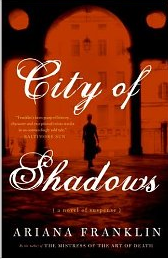
Cover for City of ShadowsAlthough I have read and liked books from Ariana Franklin’s “Mistress of the Art of Death” mystery series, I think that City of Shadows, a stand-alone thriller about a different period, is particularly good. On a side note, I am sorry to hear that Ariana Franklin has died, so we will never learn what her plans were for the characters in her series.

Esther Solomonova is a mysterious scarred woman who works for the phony Russian prince and nightclub owner Nick Potrovskov in 1920’s Berlin. However, the book begins a step before we get to Esther, when a woman is being chased through the streets of Berlin and dives into a canal to get away. Nick hears that this woman, Anna Anderson, is claiming to be Grand Duchess Anastasia of the murdered Romanov family, so he decides to take her under his wing in the hopes of getting a share of the Tsar’s fortune that has been left in England.

Anna is in an asylum, and the inmates claim that every six weeks a man lurks outside, trying to get a chance to murder her. After Nick removes her from the asylum, people begin dying. Only Detective Schmidt pays attention to Esther’s theory that someone is trying to kill Anna, since the only evidence is the testimony of insane people.

Franklin does a convincing job of mixing the true story of Anna Anderson with the completely fictional murder plot. She evokes a real sense of the chaotic, anarchic, starving Berlin in the time in which Hitler is coming to power.