Day 54: Started Early, Took My Dog

Cover for Started EarlyKate Atkinson’s mysteries featuring Jackson Brodie are always complex and carefully plotted. The somewhat hapless Brodie is a “semi-retired” private investigator who usually works in Edinburgh, but Started Early, Took My Dog takes him back to his home town of Leeds in Yorkshire.

Jackson Brodie is trying to locate the family of Hope McMasters, a woman who was adopted in the 1970’s at the age of two. In doing so, he has stumbled upon the story of an old crime–a prostitute was murdered and the child found with her disappeared.

Tracy Waterhouse, a retired detective who works as a security guard at a mall, was originally on that case and always worried about the child. On impulse, Tracy purchases another abused child from a junkie prostitute. When Jackson tries to find her to ask her about the old crime, she thinks he is after her for kidnapping and flees.

Two separate groups of people appear to be chasing Tracy–or maybe Jackson. And what does Tracy’s friend Barry know about the crime? And how is Tillie Squires, an old actress who is going senile, involved in everything? And then there’s the dog.

Atkinson’s mysteries are edgy and well written, as well as humorous. She spends more time on characterization than the usual mystery novel, creating interesting individuals. The novel changes between viewpoint and time to tell the complex, interweaved stories about identity.

Day 52: Winter’s Bone

Cover for Winter's BoneI became interested in reading Winter’s Bone by Daniel Woodrell after seeing the powerful, gritty movie. If anything, the book is grittier and more compelling.

Winter’s Bone is a grim, yet touching, sparsely written tale of a young girl’s attempt to save her home. Ree Dolly is a high school student who has been supporting her mentally ill mother and two younger brothers in an area of the Ozarks that except for some modern-day conveniences doesn’t seem like it could be much different from it was a hundred years ago or more. One day the sheriff arrives to tell her that her father put their house and property up as collateral for his bail, and that if he doesn’t make his court date in a week, the family will lose their home. To Ree, this would mean a loss of all hope.

Ree sets out to find her father, whom she hasn’t seen in several months. Although almost everyone she visits is related to her in some way, most of the men are meth cookers, and her quest among the Ozark hollows is fraught with danger. Some of the women are even scarier than the men. Ree begins to feel that there is some greater mystery–that others know where her father is and aren’t telling. Initially resistant to her efforts, her terrifying Uncle Teardrop finally decides out of family loyalty to help her.

Woodrell’s prose is both lyrical and spare. You are rooting for Ree, her honest, uncorrupted spirit in stark contrast to the endemic criminality of the community.

Day 50: Blacklands

Cover for BlacklandsBest Book of Week 10!

Belinda Bauer was another of my discoveries last year as a new writer of dark, psychologically complex novels. Blacklands is not so much a mystery as a thriller.

Twelve-year-old Steven Lamb’s uncle Billy was murdered as a child by a serial killer, and his grandmother has never gotten over it. Steven’s Nan spends all day looking out the window for her son, whose body was never found. Everyone thinks Billy was murdered by pedophile Arnold Avery, who is serving a life sentence.

Steven decides he will find his uncle’s body and that will fix his family, so he has spent all of his spare time for three years digging up the moor near his house where Avery’s victims were found. Finally he realizes the task is hopeless.

Steven feels that he is so average that he has no talents, so he is pleased when his teacher tells him he writes a good letter. He decides that maybe if he writes to the murderer, Avery will tell him where he buried Uncle Billy.

When Avery realizes that the person who has been writing to him is a boy, he decides that the situation is too delicious and he must escape from prison. Of course, he is successful.

The barren moors of Exmoor are so vividly described that they are almost a character in this chilling, suspenseful novel. At times I wasn’t totally convinced by the depiction of the thinking of the serial killer, but for the most part I was absolutely riveted.

Day 47: Believing the Lie

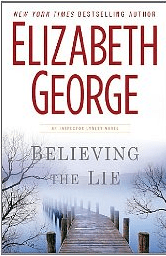
Cover for Believing the LieI have been a fan of Elizabeth George’s Detective Inspector Lynley and Detective Sergeant Havers series ever since I read A Great Deliverance, the first one. However, it seems to have gone astray ever since George killed off Lynley’s wife three or four books ago, and I came close to not picking up this one. With Believing the Lie, however, George is slowly returning to form. (Just as a side note, those of you who think you know the series from Masterpiece Mystery are sadly mistaken. I was thrilled to hear they were doing the series but really upset at how they combined books, changed endings to ones that were less effective, and so on.)

Lynley is asked by Assistant Commissioner (and slimy politician) David Hilliard to do him a favor and investigate whether a wealthy industrialist’s nephew died in an accident or was murdered. Of course, a lot is going on with the Fairclough family below the surface.

Since the investigation is unofficial, Lynley takes along his friends Simon and Deborah St. James, who are recurring characters in the series. Simon St. James is a forensic scientist of some note and Deborah is a world-class photographer. Although the nephew’s death has been ruled an accidental drowning, Simon finds some evidence to suggest otherwise.

In investigating Fairclough’s son Nicholas, Deborah becomes involved with his beautiful Argentinian wife, with whom she feels a sympathetic connection, while Lynley and Simon investigate the rest of the family. As family secrets are revealed, things begin to fall apart.

Meanwhile back at home, Havers gets more involved with her neighbor’s family. She has long cared about the little girl next door, Hadiyyah, and her handsome father Taymullah Azhar. Now Azhar’s estranged partner, Angela Upman, has returned to the family. Barbara wants to dislike her because of the pain she has caused her family, but Angela is nice and helps her improve her professional appearance, as she has been ordered to do by her new boss. However, Barbara thinks that something is going on.

I think what makes George’s books outstanding are her writing skills and her ability to create convincing characters. I have said before that I have dropped many series mystery novels, principally because I get tired of the secondary characters, who keep doing the same things over and over. George does a nice job of developing even the minor characters and making them interesting, instead of just using them as plot devices.

That being said, George seems determined to thrust Lynley into a series of romantic disasters. Maybe she should be following a dictum I have heard attributed to P. D. James that it’s not a good idea to mix the romance and detective genres. In the first book, Lynley was madly in love with Deborah as she was marrying Simon. In the second book, he suddenly realized he loved his old friend Helen. Then he spent several books chasing Helen, whom we all loved, and was happily married for one or two books until she was murdered. Since the last book he has been stupidly pursuing an affair with his alcoholic boss. As I said before, I think killing Helen was a big mistake, and judging from some of the comments on Amazon, others agree.

One more caveat to this book. Deborah is starting to have the secondary character problem I described above. She is so obsessed by her conception problems that she thinks she understands Bernard’s wife based upon finding one copy of a brochure in the house. Because she thinks she knows what’s going on, she ignores all evidence that things may not be as she thinks. This misunderstanding has tragic consequences. Deborah has been obsessing over her inability to have a child since the third or fourth book in a long series. I wish George would have her adopt a child and get it over with.

Day 46: The Winter Thief

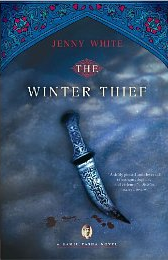
Cover for The Winter ThiefThe Winter Thief is the latest of Jenny White’s mysteries set in late 19th Century Istanbul about the investigations of the honest and hard-working Special Prosecutor Kamil Pasha.

It is a freezing cold, wintery holiday in Istanbul when Vera Arti visits an Armenian publisher to try to convince him to publish The Communist Manifesto in Armenian. Disappointed in her attempts, she doesn’t notice when someone follows her home. When her husband Gabriel returns abruptly to their apartment and tells her they must leave immediately, she argues that she must pack her things. He leaves her to get a carriage for them, but while he is gone, she is taken by the Sultan’s new secret police.

In another part of the city there has been a bank robbery and next door a massive explosion at a café followed by a fire where many people are injured or killed. Kamil Pasha is helping out at the scene when he finds evidence that his brother-in-law Huseiyn might be one of the victims.

Gabriel Arti’s mission is to open a socialist commune in Armenia, and to do that he arranged to purchase a shipment of illegal guns and robbed the bank. His fears for his wife lead him to seek the help of an enigmatic but powerful acquaintance of Kamil Pasha’s who helped him arrange the gun shipment. At the man’s suggestion, Gabriel departs for Trabzon and the commune, leaving the other man to try to find his wife.

Although the Ottoman empire has traditionally been one that tolerates people of different religions and race, tensions are rising. Vahid, a vicious, sadistic, conniving commander of the Sultan’s new secret police has a plot to gain more power by making the Sultan believe that the Armenians are a threat to the empire and then providing himself an opportunity to end the threat. Vahid believes that Huseiyn might have been having an affair with the woman he intended to marry, who died in the fire. In his efforts to find Huseiyn and wreak his vengeance, he runs up against Kamil Pasha and his sister, who is frantically trying to find her husband. The next thing he knows, Kamil Pasha has been framed for the murder of a young Armenian girl.

As we follow the adventures of all those people, as well as Gabriel, the members of the commune, and others, the book begins to feel too disorganized and diffuse. My interest flagged a little. However, the threads of the story all come back together when the Sultan dispatches Kamil Pasha to the wilds of Armenia with a small troop of soldiers to find out whether the new settlement is a band of Armenian revolutionaries or a harmless socialist commune.

Day 44: The Dogs of Riga

Cover for The Dogs of RigaHenning Mankell was my introduction to Swedish crime fiction. I usually enjoy his mysteries, but have not really liked his “more serious” novels. The Dogs of Riga is another of his mysteries featuring Inspector Kurt Wallender.

In a novel set earlier in time than his previous mysteries, Wallender travels to Latvia in the days before the dissolution of the Soviet Union to discover why Major Liepa, a Latvian police inspector who has been working on a case with him, is murdered as soon as he returns home. Wallender is bewildered by the politics and workings of the deeply depressed country. He soon figures out that the person arrested for the murder is innocent.

Wallender responds to the pleas for help by Liepa’s widow, Baipa Liepa, to continue his investigation further than the Latvian officials want him to. He encounters widespread governmental corruption and the realities of living in this grim regime. Readers of Mankell’s books have heard of Baipa Liepa, because she is the woman he loves in books that take place in a later timeframe.

Wallender is his usual depressed self, eating bad food and getting little sleep. The setting of urban Riga, though, is much more dark than Mankell’s usual setting of rural Sweden.

I enjoyed the book, although I thought that Wallender seemed strikingly naive at times. Mankell’s writing is sometimes a little awkward, although it is usually spare and transparent.

Day 40: The Damage Done

Cover for The Damage DoneIn The Damage Done by Hilary Davidson, Lily Moore comes home to New York from Spain when the police call her to tell her that her sister Claudia was found dead in the bathtub on the anniversary of their mother’s suicide. In an effort to support Claudia, but unable to deal with her lifestyle of drug addiction, Lily has been paying the rent on her own apartment so that her sister would have a place to live. Lily hasn’t seen her sister for three months, since she came home to visit a supposedly drug-free Claudia only to find her strung out. Since then, Claudia has not returned any of her calls.

When Lily goes to the morgue to identify the body, she realizes that the dead woman bears only a superficial resemblance to her sister, which makes the circumstances of her death–the supposed suicide on the date of their mother’s suicide–doubly suspicious. Lily realizes that Claudia has been missing for months, and that the other woman has stolen Claudia’s identity. She is determined to find her sister even as the police decide that Claudia is a suspect in the unknown woman’s death.

Davidson has written a capable, fast-moving mystery that keeps your attention. The characters are interesting, and readers will like Lily and her affectionate gay friend Jesse. I guessed one part of the puzzle fairly early in the book, but the solution was more complicated than I thought. The writing could have used another edit, but I don’t think editors actually edit books anymore. Overall, though, the book was enjoyable and fun to read.

Day 37: The Notting Hill Mystery

Cover for Notting Hill MysteryI have always understood that the first mystery novel was The Moonstone by Wilkie Collins, but last year I read an article that said the first mystery novel was actually The Notting Hill Mystery by Charles Felix (pen name for Charles Warren Adams), which was published serially  in 1862 before being published in a book. Even more interestingly, this article made a good case for the actual author being Benjamin Disraeli, the prime minister of England (that is, for Charles Felix being a pen name for a pen name). Well, of course I had to read it.

Two wealthy sisters have a sympathetic connection that makes them each get ill when the other is ill. The stronger sister is stolen away by gypsies at the age of five.

Years later, the other sister marries a wealthy man, and she and her husband fall under the spell of a mesmerist, the sinister Baron R. He has an assistant who develops a mysterious sympathy with the wife. Baron R. figures out the two are sisters and marries his assistant.

Soon, the Baroness is dead, having apparently swallowed a bottle of acid while sleepwalking in her husband’s laboratory. It looks like an accident until the insurance investigator, Ralph Henderson, learns that Baron R. took out several life insurance policies on his wife. As he investigates, he finds there may actually have been three murders.

If you have read many 19th century mysteries, you’ll know they tend to be overcomplicated, and this one is no exception. Also in common with other early mysteries, it has a strong flavor of the gothic.

The story is narrated entirely as depositions, which makes it seem more removed from the reader. Although Wilkie Collins used a similar device in The Moonstone, his character’s depositions teem with personality, and he is much more skillful at revealing prejudices and flaws.

In addition, the mystery is not very mysterious. Within 40 pages, it was perfectly clear where things were headed. However, as a new representative of a genre, I’m certain the story was blood-curdling to Victorian readers, whose only other exposure might have been to short stories by Edgar Allan Poe featuring detective C. August Dupin. It certainly compares at least equally or even favorably with some of the “Golden Age” mysteries I have read (for example, by John Dickson Carr) that concentrate more on timetables than on character development and motives.

Day 35: The End of the Wasp Season

Cover of End of the Wasp Season I have long been a fan of Denise Mina’s gritty mysteries, set in Glasgow. The End of the Wasp Season begins with two seemingly unrelated deaths: in Strathclyde, a crooked ex-millionaire banker named Lars Anderson commits suicide, and a young woman, Sarah Errol, is brutally murdered in a Glasgow suburb. Sarah was home temporarily taking care of her mother’s estate, and the wealthy suburban neighborhood is terrified by the seemingly random attack by hoodlums.

We know from the beginning that Sarah Errol was killed by two boys, but we don’t know exactly what happened or why.

As Detective Inspector Alex Morrow investigates, she runs into an old friend, the murdered woman’s housekeeper. Later Morrow’s friend Kay is accused of stealing from the dead woman’s estate. Kay’s teenaged boys are then arrested for the murder. Alex is convinced that her friend and the boys are innocent and tries to prevent a travesty.

DCI Morrow finds that one of the boys who broke into the home was the son of Lars Anderson, and that he mistakenly believed Sarah was his father’s mistress. As DCI Morrow investigates, she finds out about the boy’s horrible home life. Eventually we are lead to believe that the boys broke into Sarah’s house to scare her, and that the Anderson’s son stood there in horror and watched his companion go berserk. But the evidence is confusing.

I have been impressed by Mina’s work since I read the Garnethill series, her first three books. Her books feature strong women from working class backgrounds and criminal families who are trying to make their way on the right side of the law. Alex herself has a stepbrother who is a crime kingpin, from whom she has been trying to keep her distance.

Day 32: The Girl with the Dragon Tattoo

Cover for The Girl with the Dragon TattooBest Book of Week 7!

Maybe everyone has read The Girl with the Dragon Tattoo by Stieg Larsson. But if you are one of the few who have not, you are missing an exciting thriller.

Editor and writer Mikael Blomkvist has just lost a libel case brought by a billionaire industrialist named Wennerström concerning Blomkvist’s allegations of corruption. Blomkvist has been sentenced to three months in prison. He had carefully checked his facts but then one of his witnesses recanted. In order to separate his magazine, Millenium, from this problem, he resigns.

After he gets out of jail, he is approached for a job by Henrik Vanger, the retired head of Vanger Corporation. Vanger wants Blomkvist to find out what happened to his great-niece Harriet, who disappeared off the family’s private island 36 years earlier during a day when the island was cut off from the mainland by an accident blocking the only bridge. He is afraid that some member of his family murdered her. He yearly receives a pressed flower on his niece’s birthday and believes the killer is expressing remorse through this means.

Although Blomkvist is initially reluctant, he eventually accepts the job and goes to live on the island. When he decides he needs a research assistant, Vanger’s lawyer connects him with Lisbeth Salander, a child-sized woman who dresses in a goth style and has a dragon tattoo.

Salander is a computer genius with a difficult past. When she was a teenager, she was institutionalized and is still under the care of a legal guardian, who controls her money and can have her institutionalized at any time. She is hostile and uncommunicative, and few people have bothered to try to get to know her. After her guardian has a stroke, he is replaced by Nils Bjurman, who uses his position to sexually abuse her.

Bjurman has seriously misjudged Salander, however, and she takes care of this problem in one of the most satisfying scenes of the novel.

As Blomkvist and Salander investigate Harriet Vanger’s disappearance, they begin to believe that they may be on the track of a serial killer. Ultimately, Blomkvist finds himself in grave danger.

With a complex, interesting plot, an engaging hero and formidable heroine, a slew of interesting characters, and a sense of Swedish politics and law, you will lap up this book and go looking for the next one. Larsson was an activist with strong feelings about violence against women, a theme in all of his books.