Day 30: Never End

Cover of Never EndNever End by Åke Edwardson is an interesting police procedural. A young woman is raped in the park during a sweltering summer evening in Gothenburg. What concerns the police even more than the rape is the fact that it took place in the same alcove where a girl of the same age was murdered five years ago. Jeanette, the victim, was also choked with something, perhaps a dog leash, while the murdered girl was strangled with her own belt.

Chief Inspector Erik Winter leads the investigation, and Inspector Handler tries to help while dealing with his ex-wife’s death.

The characters were interesting and the solution was difficult to guess. I have read a couple of Erik Winter books so far, and I still find myself unable to get much of a sense of the personalities of Winter and the other detectives. Edwardson provides some personal information about his detectives: Winter is happily married with a young son, and he is grappling with the idea of how much time his work takes away from his family; he is also battling with nicotine withdrawal. But Edwardson really concentrates on the methods and findings of the investigation. Perhaps as you read through the series, you slowly develop an idea of what the recurring characters are like.

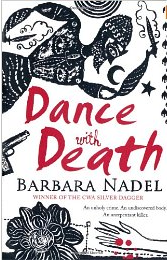
Day 28: Dance with Death

Barbara Nadel’s Turkish mystery novels are interesting because they usually involve one of the many minorities of Istanbul. Dance with Death takes place in the fascinating region of Cappodocia rather than in Istanbul, though. Inspector Çetin İkmen gets a call from his cousin asking him to come to Cappodocia. A body has been found in a cave, and his cousin believes it may be that of a girl with whom he was in love years ago. This girl, who was rambling around the Europe and then Turkey on vacation, simply disappeared, and he thought she had left him.

In the meantime, his colleague Mehmet Süleyman is still in Istanbul trying to catch an attacker of homosexuals.

Nadel’s Turkish mysteries are filled with detail about place and customs that I find irresistable. I almost always guess the killer fairly early, but sometimes this is my test of a mystery. If I still find it interesting even when I guess the solution, then it is worth reading. Dance with Death is full of the color of that mysterious region, and İkmen and Süleyman are sympathetic and interesting characters.

Except for one thing. A theme of men’s unfaithfulness runs through the books. Both Inspector İkmenand Süleyman have been unfaithful, even though they love their wives. I’m not sure if that is meant to indicate something cultural or not.

Day 23: The Dead Lie Down

Cover for The Dead Lie DownBest Book of Week 5!

Sophie Hannah is another writer of dark mysteries who I discovered during the past year. The Dead Lie Down was the first of her books that I read, not the first in the series. Be careful if you buy her books as some of them have two titles, depending upon whether you buy the British or the American version. I have bought two copies of the same book by mistake.

Ruth did something bad in the past but was punished far out of proportion to her crime. She is still trying to recover some confidence and self-esteem when she meets Aidan, a picture framer. The night they get engaged, they make a pact to tell each other everything and forgive each other their secrets, with no questions asked. But Ruth is shocked when Aidan confesses he strangled a woman named Mary Trelease years ago. She is even more confused when she realizes that she has met Mary Trelease and she is alive.

Ruth takes her case to Sergeant Charlie Zailer, a recently disgraced police officer, who dismisses it. At the same time, Aidan confesses to Charlie’s fiancé, DC Simon Waterhouse. After further consideration, both of them decide to investigate further, because they feel a sense of dread.

The Dead Lie Down is a compelling novel with a tangled plot. Sophie Hannah follows a convention in her novels of alternating the narrative between a usually victimized character (in this case Ruth) and the police officers. She indicates this alternation by changing the form of the dates that head each chapter. This confused me at first because for every other chapter she was using the European form of putting the day before the month, and I thought the chapters that took place in early March were actually flashbacks to January and February. Just something to keep in mind when you are reading Hannah.

I have found that Hannah’s novels are deliciously dark and always difficult to figure out, even though by now I know the pattern that someone is being deeply deceived. The trick is to figure out who and how. Her police officers are seriously flawed and have a difficult relationship. A bit of narrative that I have had difficulty following is the story of their romance, which is, however, just incidental to the novels. In other respects the books are stand-alone and do not have to be read in order.

Sophie Hannah is another find for those who like edgy, complex mysteries with a touch of the gothic thriller.

Day 21: The Sweetness at the Bottom of the Pie

Cover for The Sweetness at the Bottom of the PieI don’t know that anyone has invented a more delightful heroine than Flavia de Luce, the eleven-year-old sleuth in Alan Bradley’s funny, charming series. I haven’t read The Sweetness at the Bottom of the Pie in a few years, but for series books I am trying to start with the first one, so I’ll do the best I can.

It is 1950’s Britain, and Flavia is an eccentric in a family full of eccentrics. She spends her time cooking up dangerous chemicals in the laboratory she inherited from a great uncle or riding around on her bicycle, Gladys, looking for trouble. Her father is a reclusive widower who stays locked up in the library with his stamp collection and worries about how to support their ramshackle estate. She engages in all-out warfare with her two older sisters, which includes putting poison ivy extract in Ophelia’s lipstick. Her only ally is the Dogger the gardener, her father’s batman from WW II who suffers from post-traumatic stress disorder.

First, Mrs. Mullet the housekeeper finds a dead bird on the porch with a valuable stamp in its beak. Then a mysterious stranger calls upon her father, and they have an argument. Later Flavia finds the stranger dying in the cucumber patch. When her father is arrested for murder, Flavia decides to investigate. She finds out her father may have been involved in the suicide of a former schoolmaster and the theft of a valuable stamp. As Flavia cycles around the village of Bishop’s Lacey looking for clues and interviewing suspects, she may be putting herself in danger.

If you’re looking for a light mystery with plenty of twists and turns that will make you laugh out loud, look no further than any book featuring Flavia de Luce.

Day Eighteen: Jar City

Cover for Jar CityJar City is a police procedural from the Icelandic writer Arnaldur Indriðason, who has received several awards for his books. Although I found the plot interesting, I have several criticisms of this novel.

Within a few pages, I noticed a choppy, sometimes clumsy writing style. I saw some evidence of a poor translation, but it wasn’t clear whether this was because the translator’s English wasn’t good enough or he was translating too literally. Some idioms seemed dated, and although the translation was British, I think I read enough modern British novels to know which idioms are currently in use. For one of the many examples of what appears to be a simply bad translation, take this perhaps not literal quote (I’m writing it from memory) “the photographer must have had to bend his knees until he was very short.” In English we have a word for that. It’s called “crouching.” But there is also evidence that the writing just isn’t very good, the most noticable being a dream sequence that is one quite dreadful, long sentence.

I was unable to guess whether the poor writing was the fault of the translator or the writer. My guess is it was a combination of both.

Other problems emerge. Although Inspector Erlendur was developed as a character, all the other characters were pretty flat. I got no sense at all of the personalities of his fellow investigators, for example. What is more of a shame, I also got no sense of Iceland as a country or the Icelandic as a people (or even any individual Icelanders), which is one reason I like to read books from other countries.

What fills out the detective himself is some background about his family, his divorce, his struggles with his addicted daughter, his messiness, his sleeplessness or tendency to sleep in his clothes, and his worry about a pain in his chest. These details all seem very familiar to me, but I’m not sure whether Detective Erlendur or Kurt Wallender came first or whether either of the writers knew the other’s work, so I will say no more.

Arnaldur also plays the Christy-an trick of keeping some of the evidence to his detective for awhile. For example, the killer leaves a note on the body of the victim, but we’re not told what it says for some time. If the author was holding out for a dramatic moment, I don’t believe that attempt was successful.

My final criticism is of the detective, who seems notably stupid at times. Making the detective too busy to take care of something on time or just plain dense is a common tactic of some writers, who use it to drive up the suspense, but it just makes me angry. I want my detectives to be smarter than I am. An old woman saw the killer in her yard. When she calls the detective back, does it occur to him that she might have seen him there again? No, he is too busy interrogating someone else to take a second to call her back. In doing so, we would have missed the final scene. I’m sorry, but surely Indriðason could have handled that less clumsily.

All that being said, the plot and mystery were interesting enough to get me to finish the book, although I’m not as sure if I would pick up another one. An old man is found dead in his apartment, his head smashed in by a heavy ashtray and a note on his chest that says (we eventually learn) “I am HIM.” The only other clue is an old photograph found in the back of his desk of the grave of a child.

In investigating the victim’s past, Erlendur finds that he was accused of rape in the 60s but the case was mishandled and the woman did not get justice. The photograph, it turns out, is of the grave of the daughter of the rape victim.

As Erlendur investigates further, he realizes that the victim was a truly repellant creature. He also finds another mystery–one of the victim’s friends disappeared 25 years ago. Erlendur eventually figures it out, and in doing so encounters some interesting twists.

Day Sixteen: Sharp Objects

Cover for Sharp ObjectsI love dark mysteries with an edge. Two of my discoveries from last year  for this type of novel are Gillian Flynn and Belinda Bauer. My book journal for Gillian Flynn’s first book, Sharp Objects, starts out with “What a terrific book!”

Camille Preaker works for a Chicago newspaper, which sends her to her home town of Wind Gap, MO, because a young girl was murdered and another one has disappeared. Camille reluctantly returns to the home town she has avoided for eight years. Institutionalized for self-mutilation as a young girl, she has learned to resist cutting words into her body and now writes them on with a pen. But as she begins investigating her family problems and her disturbed childhood as well as the murder, she awakens her own demons.

Camille’s mother has never paid much attention to her, although she plays the doting mother outside of the home. Camille’s sister Marianne, who was loved by both Camille and her mother, died when she was young. Now Camille has a much younger stepsister, Amma, a 13-year-old who behaves like an angel at home but is a terrible bully outside the home, hanging out with a bunch of mean girls.

As Camille interviews her old friends and acquaintances, her leads all seem to be turning into dead ends, but the reader’s sense of horror grows. Discovering more of the truth about the murder and her own family, she begins spinning out of control and has difficulty resisting the urge to cut herself again.

Flynn’s writing is fast-paced and efficiently builds suspense. This book is a real page-turner.

Day Seven: Bury Your Dead

Cover for Bury Your DeadLast fall I read about the series of mysteries by Louise Penny, some of which have received numerous mystery book awards. They all take place in Quebec and feature Chief Inspector Armand Gamache. Bury Your Dead is not the first in the series, but it is the first one I read, and I wrote the most about it in my book diary. However, if you decide to read these books, you should make a special effort to read them in order, starting with Still Life. I did not, and I was sorry at times, because most of the books are set in the same small, charming village and you can sometimes tell who the murderer of a previous book is just by who is missing from the village in a later book. Also Bury Your Dead in particular reveals the outcome of the previous book, because Inspector Gamache decides that he perhaps did not get it right that time and sends his second to re-investigate.

That being said, I think I liked Bury Your Dead best of all the Penny books I have read, because it partly takes place in the fascinating Quebec City. That is where Inspector Gamache is recovering from a case that turned out horribly, during which he was badly injured.

He discovers a delightful building in the city, the Literary and Historical Society, full of old books and documents about the English population of the city, and he meets some of the historians. Then the body of a French-heritage historian who has been obsessed with finding the missing remains of Samuel de Champlain is found in the society’s basement, and the board of the society asks him to investigate. The board is particularly worried because there has been some strain between the English minority and the French majority in the city, some of it fostered by the dead historian.

In the meantime, Gamache has asked his second, Inspector Jean-Guy Beauvoir, who is also on leave, to return to the small village of Three Pines and find what they missed in the last case, as he is convinced they made a mistake.

While this is all happening, Gamache is haunted by the memories of the young agent who was held captive and died during the incident that injured both Gamache and Beauvoir.

The book skillfully follows both plots and flashbacks to the investigation that went wrong. The characters in this series are well developed and interesting. The plots are tight and the mysteries difficult to figure out. The small village setting could become problematic, because the cast of characters is limited, but so far I have been enjoying the books.

Day Three: The Darkest Room

Cover for The Darkest RoomTie for Best Book of Week 1!

I love dark mysteries, good ghost stories, and books about family secrets. The Darkest Room by Johan Theorin, a Swedish mystery writer, is one of my discoveries from the past year. It is an excellent book, atmospheric, absorbing, part mystery and part ghost story.

Katrine and Joachim move to Öland, a large island off the coast of Sweden, with their two children. Katrine has been living on the island with the children for several months and remodeling their house while Joachim finishes up his teaching job. Katrine lived in an outbuilding of the house as a child with her artist mother.

The house itself is almost a character in this book, and the first few chapters are about its history. It was built to be the home for the families of lighthouse keepers, and two lighthouses are nearby. The walls of the house are actually built from the wood salvaged from a ship wreck, and as with any old house, many people have died there. There are local stories about the house.

Joachim has just arrived to live permanently in the house, but he needs to make one more trip to pick up a load of things from their home in an upscale neighborhood of Stockholm, a home that they had also bought and restored. On his way back to the island, he gets a confused call from the Öland police who tell him that his daughter has drowned off the pier near the house. But when he gets home, he finds it is not his daughter but Katrine who has died. The police told him the wrong name. As he tries to take care of his young children and cope with his grief, Joachim begins to think the house is haunted. And his daughter is having strange dreams about her mother.

In the meantime, a policewoman starts work at the new police post on the island. Her first investigation involves a rash of robberies of summer cottages. Another point of view is of one of the housebreakers, who is becoming dismayed by the growing violence of his partners, who have decided that they will get more by breaking into occupied houses. The atmosphere and our sense of dread builds as Joachim gets a little odder and the housebreakers become more vicious.

And let’s not forget that we don’t actually understand the circumstances of Katrine’s death.

I was especially impressed by Theorin’s skill in revealing important pieces of information naturally throughout the book instead of laying them out at the beginning. For example, early on Joachim has a few stray thoughts about a woman. He feels some guilt about her but we don’t know why or who she is. We find out later, naturally, as Joachim thinks about her, in addition to some other facts that turn out to be important to the plot. This technique doesn’t seem artificial at all, but more organic and reflective of how thoughts and memory actually work.

I’ve read one other book by Theorin, also set on Öland. I can’t wait to read more.

Day Two: The Cold Dish

Cover for The Cold DishMy intention is to review a book a day. Of course, I don’t read a book a day, but I have a book journal, so I am cribbing my reviews from that.

Today’s book is a great mystery set in present-day Wyoming, The Cold Dish by Craig Johnson. I have been loving this series, which is full of interesting characters. The setting is almost a character in itself.

The main character is Walt Longmire, the sheriff of a rural Wyoming county, who is a widower nearing retirement. (I understand that A&E will be broadcasting a series based on these books, called Longmire, sometime this year, something to look forward to.) I often tire of series mysteries, principally because of the secondary characters, who are often one-dimensional. Johnson’s characters seem more like the actual inhabitants of a smallish western town.

In The Cold Dish, Cody Pritchard is shot to death at long range by someone using an unusual rifle. Two years before, he and some other high school boys participated in a brutal rape of a young Cheyenne girl, and he and his co-defendents got off lightly. Despite his abhorrence of their crime, Walt is worried that the other boys may be at risk, so he must try to keep them safe. He is also worried about what his best friend, Henry Standing Bear, might know, since Henry is the girl’s uncle.

The book features a good mystery, some exciting action, characters that you really care about, and perhaps even the ghosts of long-dead Cheyenne warriors (although Walt doesn’t think so).