Day 881: Quiet Neighbors

Cover for Quiet NeighborsBest Book of the Week!
Jude is in trouble, thinking of fleeing the country. But when she gets to the train station, she remembers a kind face, so on an impulse she takes a train to Glasgow. In a nearby village, she walks into Lowland Glen Books. There she is taken under the wing of the owner, Lowell Glen, and sent to his house for an exhausted rest.

Jude’s trouble involves her ex-husband Max, but we don’t learn what it is for a while. She is afraid to read the online articles about whatever happened but just sees that they have thousands of hits. Then she destroys her phone.

Jude is a library cataloger with a bit of a phobia about disorder. She finds the squalor of Lowell’s home disturbing but is pleased when he offers her the attic apartment to live in and a job helping him catalog the books in his store. She is just settling in when another orphan of the storm arrives, a pregnant Irish teenager who announces that she is Lowell’s daughter, a person Lowell didn’t know existed.

Lowell immediately accepts Eddy, but Jude is skeptical. Eddy claims that her mother, Miranda, only told her about Lowell on her death bed, but Jude thinks she is lying about something. She is also upset when Lowell lets her know that Eddy would like her apartment. Lowell has a place for Jude, though, a cottage he owns next to a graveyard.

The cottage is so isolated that Jude is happy to accept it, figuring that no one will find her there. She is also enchanted to find that the cottage once belonged to T. Jolly, someone whose brief reviews in the backs of some of the books in Lowell’s store have delighted her. She starts making a collection of his books, but the notes in the later books in his collection take on a different, more ominous tone.

With Quiet Neighbors, Catriona McPherson moves away from contemporary thrillers back toward the mystery genre. Aside from the question of why Jude is hiding, there is a mystery connected with Lowell’s “summer of love” back in the 80’s that engendered Eddy, a mystery of what Eddy’s mother Miranda told her versus the facts they can determine about the time. And then there is the mystery of T. Jolly’s notes.

link to NetgalleyThere does turn out to be a murderer, and to me that person’s identity was obvious as soon as murder was suspected. But this did not interfere with my enjoyment of the novel. I loved most of the characters and the warm, unusual household that Lowell, Eddy, and Jude begin to build. I loved what McPherson does with two apparently menacing characters. I absolutely loved this novel.
Related Posts

The Child Garden

The Day She Died

Haunt Me Still

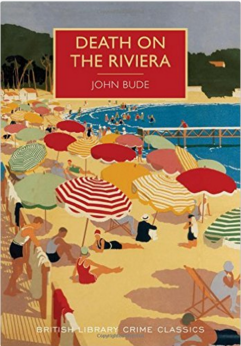
Day 878: Death on the Riviera

Cover for Death on the RivieraDetective-Inspector Meredith and Sergeant Freddy Strang are on an unusual mission. They are following up clues that a British counterfeiter, “Chalky” Cobbett, is operating a counterfeiting ring on the Riviera. Since Meredith has encountered Chalky before, the French police hope the D. I. can help find and identify him. Meredith cautions Strang that they are working undercover, but not before they meet a tourist named Bill Dillon.

Nesta Hedderwick is a rich, middle-aged British woman with a villa in Menton who sometimes patronizes young, handsome men. Currently, she has two living with her in addition to her niece Dilys. Tony Shenton, in Dilys’ opinion, has been sponging off her aunt for far too long. He has no employment and orders the servants around as if they were his. His aunt has even given him a sports car. Even worse, he has invited a girl to stay, Kitty Linden, who is clearly infatuated with him.

Paul Latour is the other man. He keeps odd hours and spends most of his time in his room, painting. But when Dilys goes to an art show, she recognizes some of his work—with someone else’s name on it.

At the show Dilys meets Freddy Strang, who introduces himself as John Smith. Later, he is embarrassed when they run into Bill Dillon, who has come looking for Kitty, and Dilys finds out he is using a false name.

link to NetgalleyThe murder mentioned in this novel doesn’t occur until fully halfway through the book. Instead, we follow the details of the investigation into the counterfeiting ring and Freddy’s romance with Dilys. This atmospheric novel is one of the more enjoyable of these Poisoned Pen class reprints. There isn’t a great deal of characterization, but in general that is common with these older mysteries.

Related Posts

The Singing Sands

Thirteen Guests

Antidote to Venom

Day 872: Elizabeth Is Missing

Cover for Elizabeth Is MIssingBefore I begin my review, here is a little bit of news about the Walter Scott Prize for Historical Fiction. Some of you may know that, along with Helen of She Reads Novels, I am attempting to read all the short-listed novels. Today the short list for 2016 was released. To see the list, check out my Walter Scott project page. I have only read one of the novels, but was disappointed, along with other readers, to see that A God in Ruins, which was on the long list, didn’t make the short list.

* * *

Elizabeth Is Missing is—I won’t disguise it—the third book about Alzheimers I’ve read in the last six months. When the book blurb says Maud is forgetful, that’s putting it mildly. After only a few pages of this novel, I wondered why Maud was living alone.

Maud is an old lady who is having trouble keeping track of just about everything. She writes herself reminder notes but loses them. She makes endless cups of tea and forgets them. Her caregiver comes in every morning and makes her lunch and she has eaten it by 9:30. She remembers occasionally that her friend Elizabeth is missing. Elizabeth doesn’t answer her phone and she isn’t home. But no one pays attention to a dotty old lady.

Of course, we realize fairly quickly that Elizabeth isn’t missing, but Maud has a more important mystery in her life. When she was a young girl just after World War II, her older sister Sukey disappeared, never to be seen again. Although Maud’s short-term memory is inconsistent, there’s nothing wrong with her long-term memory, at least not at first, so the more coherent narrative is the time around Sukey’s disappearance. Maud finds the boundaries between the past and present blurring.

I found this novel extremely painful to read at times, even more so than Still Alice. However, it is certainly compelling although not perhaps as realistic as Still Alice is.

One thing that bothered me, although only a bit, is that Maud clearly has all the information she needs to solve her sister’s disappearance, if only she can make sense of it. But she tried to investigate when she was young, and she had the same information then. That she would finally solve it in her current condition is a bit hard to buy. We’re to understand that she found something before the action of the novel, though. At least, that’s what I think happened, since sometimes the narration from the point of view of a confused old woman is a little opaque.

Related Posts

Still Alice

This Is Your Life, Harriet Chance!

Family Furnishings

Day 863: A Banquet of Consequences

Cover for A Banquet of ConsequencesDetective Sergeant Barbara Havers is in a lot of trouble with Superintendent Ardery since she nearly went off the rails in the previous Detective Lynley novel. So, Ardery is having Inspector Lynley keep her on a short leash. But Lynley thinks the leash is too short, because Barbara is tamping down everything, including her contributions to investigations. Finally, she is contacted about a case that Lynley thinks she can take charge of herself.

But the novel begins three years earlier. William Goldacre has been trying to reconcile with his girlfriend, Lily Foster. William has a condition that causes him to utter nonsense words and profanity when under stress. But Lily’s problem with him is the relationship he has with his family. William and Lily go on a camping trip, but Will commits suicide when he finds Lily reading his journal, and Lily is horrified about what she reads there.

In the present, Barbara encounters Caroline Goldacre, William’s mother, when she attends a talk by feminist Clare Abbott. Clare gives Barbara her card because she is interested in Barbara’s t-shirt, but Caroline, who is Clare’s assistant, takes it upon herself to ask for the card back. Rory Stratham, Clare’s agent and good friend, gives Barbara another card.

A few days later, Rory contacts Barbara to tell her that Clare was found dead in her hotel room. Although the death is considered natural, Rory finds it high suspicious. She also suspects someone, Caroline Goldacre, whose relationship with her employer seemed unusual at best.

When Barbara performs an initial investigation, she finds hotel staff who overheard Caroline and Clare arguing. An autopsy reveals that Clare was poisoned. Before Barbara can tell Rory, Rory herself has been poisoned, although she is not dead. Lynley dispatches Barbara and Sergeant Winston Nkata to Shaftsbury to investigate. Ardery’s orders are for Winston not to let Barbara out of his sight.

The evidence seems to point to Caroline Goldacre until the detectives find out that Clare borrowed Caroline’s toothpaste and that was the source of the poison for both women. But was someone trying to murder Caroline, or is Caroline simply a clever murderer who made it look that way? Caroline herself is manipulative and nasty to just about everyone.

I have been distressed by how melodramatic George’s series has been the past few books, basically since the death of Lynley’s wife. Although the Detective Lynley series is one of the few that has recurring characters who are as interesting as the mysteries, the last few years they have been behaving atypically. This book is the first in a while that seems back on track. The personal plots involve Lynley’s relationship with his current girlfriend and an amusing plan of Dorothea Harriman’s to spiff Barbara up and find her a boyfriend. I very much enjoyed this novel and feel that it is returning to the strong series it was when I first discovered it.

Related Posts

A Great Deliverance

Believing the Lie

Just One Evil Act

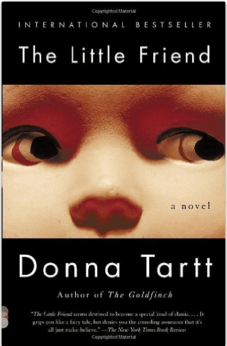
Day 853: The Little Friend

Cover for The Little FriendI didn’t decide to read The Little Friend until recently. That was because I was one of the few people who didn’t like Donna Tartt’s first book, The Secret History. I thought The Goldfinch was wonderful, however, so I decided to give The Little Friend a try.

This novel shows influences from practically every modern southern novel I’ve ever read, a bit of the Comptons from Faulkner, a touch of To Kill a Mockingbird, and lashings of Southern Gothic. The novel’s world is a harsh one, although not as twisted as that of Flannery O’Connor.

The main character is 12-year-old Harriet Dufresnes, a bookworm and misfit in 1970’s Alexandria, Mississippi. She is from a once-wealthy family whose rotting mansion, no longer in the family’s possession, is out in the countryside. Harriet lives in town with her mother Charlotte and sister Allison. But whatever future they might have had was prematurely blighted by the death of Harriet’s brother Robin, at the age of nine, 12 years earlier. Robin was found hanging from the tree at the edge of the yard, and his murder has never been solved. Their household has been made miserable by the ceaseless mourning and lassitude of Harriet’s mother.

Harriet is facing a long, lonely summer when she decides to avenge the death of her brother. She understands from the family’s maid Ida that Robin and Danny Ratliff were bitter enemies, so she decides that Danny, who is now a small-time criminal and meth addict, must be the murderer. She begins stalking him with the help of her best friend, Hely.

The Ratliff family embodies almost cartoonish O’Connor Southern Gothic. Farish, the oldest brother, is a half-crazed and hyperactive meth cooker and dealer. Although he talks about fighting in the Vietnam War, he spent it in a mental institution and is said to have calmed down since he had a head injury. Eugene is a street corner preacher who is inept at preaching. Curtis is a sweet-natured boy of limited mental capacity, and Gam, the boys’ grandmother, relentlessly favors Farish and does her best to undermine the other brothers’ efforts to leave their lives of crime.

Danny is rather a more tragic figure than anything else, but I was more interested in Harriet’s life than in her interactions with the Ratliffs. That situation provides the tension and danger of the plot, but I was sometimes bored by it and other times found it grotesquely funny.

Harriet’s family is the essence of dysfunction. Her mother is almost completely self-obsessed, spending all her time mourning Robin. She neglects her two daughters and stays in her bedroom. Harriet is dependent on Ida for any attention or care in a house that is only held from chaos by Ida’s efforts. Allison, although 16, is timid and milky and almost doesn’t exist as a character.

The other influences on Harriet are her grandmother Edie and her great-aunts. They are really the only points of stability in her life, especially her great-aunt Libby.

By and large, I was impressed by the energetic writing and the imagination of The Little Friend. The parts I don’t admire as much are the forays into an almost clichéd Southern Gothic of the Ratliff brothers. Still, I found it hard to put down this novel.

Related Posts

The Goldfinch

The Optimists’s Daughter

Wise Blood

Day 843: Murder at the Manor

cover for Murder at the ManorMurder at the Manor is another collection of classic mystery short stories published by Poisoned Pen Press. Each of these stories is set at a country manor.

This collection features writers the likes of Arthur Conan Doyle, G. K. Chesterton, Margery Allingham, and Ethel Lina White. Some of the stories are ingenious, and one is an amusing satire of the genre.

The satire was the story that most stood out, “The Murder at the Towers” by E. V. Knox. Just the first sentence gives a sense of it:

Mr. Ponderby-Wilkins was a man so rich, so ugly, so cross, and so old, that even the stupidest reader could not expect him to survive any longer than Chapter 1.”

And he doesn’t. Mr. Ponderby-Wilkins is found hanging from a tree, suspended by a muffler. His guests decide to “go on playing tennis as reverently as possible” until the detective arrives. When the detective, Bletherby Marge, arrives, he is described as a person who is sometimes mistaken for a baboon. The story continues on to turn the genre on its head.

“The Copper Beeches” by Arthur Conan Doyle is the only story I had previously read. Miss Hunter comes to consult Sherlock Holmes about an unusual offer of employment. She has been offered a job as governess at an inflated wage under the condition she bob her hair. Holmes advises her to take the position but promises to come immediately to her assistance if she summons him. She soon does and explains she has been asked to put on a certain blue dress and sit with her back to the window. Holmes immediately realizes he can prevent a crime.

“The Problem of Dead Wood Hall” by Dick Donovan is another early mystery. This case refers to two mysterious deaths, two years apart, of first Mr. Manville Charnworth and then Mr. Tuscan Trankler. Although no cause of death can be determined, both men show signs of having died the same way. Unfortunately, this story is turgidly written, and the method of murder and identity of the killer are easy to guess.

“Gentlemen and Players” by E. W. Hornung is a Raffles mystery. Raffles takes his friend Bunny along on a weekend at a country house, where they have been invited because Raffles is such a good cricket player. Raffles doesn’t usually rob his hosts, but he resents being invited as if he were an entertainer. And old Lady Melrose has such a nice necklace.

“The Well” by W. W. Jacobs is more of a psychological study than a  mystery. Jem Benson is about to be married. He has a cousin, Wilfred Carr, who continually borrows money from him. But this time Wilfred threatens to tell Jem’s fiancée Olive a disreputable secret if he won’t cough up. The two men walk out to the woods near a disused well and only one of them comes back.

“An Unlocked Window” by Ethel Lina White raises a lot of suspense when two nurses are left alone with their patient. A maniac in the neighborhood has been murdering nurses. Nurse Cherry suddenly realizes she left a window unlocked.

link to Netgalley“The Mystery of Horne’s Copse” by Anthony Berkeley is quite entertaining, about Hugh Chappell, who stumbles over the corpse of his cousin Frank late one night on the way home from dining with his fiancée’s family. Only the body isn’t there when he brings the police back, and Frank and his wife are on vacation at Lake Como. This is an odd state of affairs, but then it happens again and again until the last time the body is indeed Frank’s, and Hugh is wanted for murder. In this story, I particularly enjoyed Hugh’s spunky fiancée Sylvia.

All in all, I found the collection mixed in quality but enjoyable. Some of the stories are truly suspenseful, and some present a good puzzle.

Related Posts

Silent Nights

Thirteen Guests

The Hog’s Back Mystery

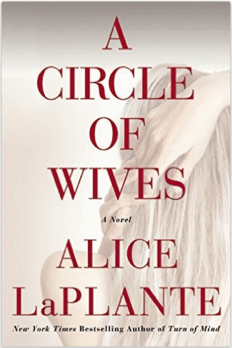
Day 842: Literary Wives! A Circle of Wives

Cover for A Circle of WivesToday is another review for the Literary Wives blogging club, in which we discuss the depiction of wives in modern fiction. Be sure to read the reviews and comments of the other wives! If you have read the book, please participate by leaving comments on any of our blogs.

Ariel of One Little Library
Emily of The Bookshelf of Emily J.
Lynn of Smoke and Mirrors
Naomi of Consumed By Ink

Welcome back, Ariel!

My Review

As a detective for the Palo Alto police department, Samantha Adams does not have to deal with many violent crimes. So, when a prominent plastic surgeon is found dead in a local hotel room, registered under an assumed name, the assumption is that he died of a heart attack. But the medical examiner finds bruising on his body and what seems to be an injection site.

The first interviews around the possible crime seem routine. Dr. John Taylor’s wife Deborah is a commanding and cold presence, but nothing seems out of the ordinary. Then someone leaks shocking information to the police. Dr. Taylor had not one but three wives.

To her surprise, Sam finds that although second wife MJ and third wife Helen are completely unaware of the existence of the other wives, Deborah knows all about them. Love having departed their marriage years before, Deborah has compromised to avoid divorce by allowing John to have other wives.

MJ is a middle-aged hippy who has two grown sons by her first marriage and is close to her brother. She works as an accountant and has had a difficult life. Helen is a successful pediatric oncologist living in L.A., who was happy with a part-time married life while John worked in Palo Alto. The coroner’s opinion being brought in as murder, Sam seems to have a choice among three ready-made suspects.

This novel certainly hooked me in, although it never really answered my questions about the kind of man who would do this. As a mystery, it is also complicated. I was able to figure out how to break one character’s alibi, but the solution was more complex than that.

What does this book say about wives or the experience of being a wife?

If we don’t count Samantha’s relationship with Peter, which she doesn’t admit to even being “committed,” this novel looks at three marriages. For Deborah, her marriage seems to be concerned solely with wealth and prestige. She has pushed John into his career because of its potential for making money, his only insistence being on sticking with reconstructive rather than elective plastic surgery. He has stopped doing the things that used to give him pleasure because of her opinion that he isn’t that good at them and they are a distraction. It is not such a surprise that he would have wanted a divorce but more of a surprise that he didn’t just get one. But Deborah’s will seems to have been stronger than his, he seeming to be one of those men who will do almost anything to have peace in the house.

John’s marriage to MJ is based on his having the upper hand. She is so happy to find him that she meekly accedes to all his rules about their relationship, which she later learns were designed to keep her from learning about his original marriage. She does not call his office and just accepts his odd schedule unquestioned. This marriage of six years was the least clear to me. John and MJ seem to have little in common, and the attraction seems to have to do with MJ being from such a different sphere and not being demanding. MJ herself gave the impression that what held them together wasn’t sex.

Literary Wives logoHelen and John are still in the honeymoon phase of a six-month marriage. Although Helen is a private, self-contained woman, she is in love and happy with John. Because her career is so demanding, she has no problem with a marriage where they see each other only a few times a month. Theirs seems like a marriage of equals, but it obviously isn’t, because he has lied by omission about his previous marriages and another worse lie is to come. The newness and seeming happiness of their relationship makes a discovery about a decision of John’s inexplicable.

What the novel seems to say about marriage in general is that a lot depends upon where the balance of power resides. But I think we only get a very surface look at any of these marriages. This novel doesn’t really deal in subtleties.

Related Posts

The 19th Wife

The Secret Keeper

The Paying Guests

Day 830: The Nature of the Beast

Cover for The Nature of the BeastLaurent Lepage is known in the village of Three Pines as a boy with an active imagination. So, when he runs into the bistro and announces he’s found a big gun in the woods with a monster on it, no one pays attention. Then, the next day he is found dead of an apparent bicycle accident.

Isabel Lacoste and Jean-Guy Beauvoir send in a foresics team that establishes Laurent’s death as an accident. But retired Chief Inspector Armand Gamache has Jean-Guy take another look. The body was positioned incorrectly for the boy to have fallen off the bike while speeding down a hill, as was supposed. Laurent was murdered somewhere else and his body positioned to look like an accident.

While the police search for the site of the murder, Gamache also gets them to look for the gun that no one believed in. The murder site will be located by a search for a stick that Laurent always carried and pretended was a gun.

They find the stick, and next to it is a huge cannon, a missile launcher that is enormous, covered by camoflage, in the woods outside Three Pines. Eventually, the police find out that the gun is the invention of an arms dealer named Gerald Bull, 20 years deceased. His idea was to launch missiles into low Earth orbit to travel thousands of miles to their targets. The gun is completely mechanical, too, so that power outages won’t affect it. This weapon has always been considered a myth, but here it is, with an engraving of the Whore of Babylon on it. The firing pin and the plans are missing, however.

Shortly, three people arrive on the scene. Professor Michael Rosenblatt claims to be an undistinguished physics professor with an interest in arms. He is the person who fills Gamache in on Bull, but Gamache thinks he knows more than he is saying. Mary Fraser and her partner Sean Delorme identify themselves as from the CSIS (Canadian intelligence service), but say they’re just file clerks. Although they look unprepossessing, Gamache fears there is more to them. The goal for all these parties is to locate the firing pin and the plans before various arms merchants find out about the gun.

Another recent incident has disturbed the village. Several of the villagers have been rehearsing a play under the direction of Antoinette Lemaitre. The author of the play has been kept anonymous, but then the actors find out the play was written by John Fleming, a notorious murderer. When the actors learn that Antoinette knew who wrote the play, they all quit.

Once the gun is found, Gamache has an intuition that the two events are connected. But he can find no logical link. And then Antoinette is killed.

The novel is another excellent mystery for Louise Penny. Its characters are interesting as always, even the recurring cast of old friends. There is some action and danger, but the emphasis is on puzzle solving. Although the retired inspector seems to be encountering too many murders for a small town, Penny leaves hints that Gamache may come out of retirement.

Penny tells us in the afterword that the story of the gun is based on true events and that Gerald Bull was a real person.

As a totally gratuitous side-note, I have to say that with this cover, Penny’s series has lost the most beautiful mystery series cover award I bestowed on it some time ago. The cover is okay, but it isn’t gorgeous, like the others in the series.

Related Posts

The Long Way Home

How the Light Gets In

The Beautiful Mystery

Day 821: Broadchurch

Cover for BroadchurchMaybe because I so enjoyed the British TV mystery series Broadchurch, it wasn’t such a great idea to read the book. It’s one thing to read the book a series or movie is based on and another to read one based on the series. However, the novel was written by a good British suspense writer, Erin Kelly, so I thought I’d give it a try.

An 11-year-old boy is found dead on a beach in a small town early one morning. Because his paper route gets him out of the house early, his parents haven’t missed him yet.

On the same morning, Detective Sergeant Ellie Miller returns to work from vacation eager to take over her new job as head of investigations. When she arrives, though, she finds the position has gone to a man, Detective Inspector Alec Hardy. Worse, she soon remembers he was lead in a murder case in Sandbrook that went terribly wrong.

Beth Latimer doesn’t realize that her son Danny is missing until she takes his lunchbox to school, thinking he forgot it. His teacher and school mates haven’t seen him. On the drive home, the traffic to the beach is blocked because of a police investigation. Some instinct makes her stop her car and run to the beach.

While the small town tries to cope with the idea that someone among them has murdered the boy, Ellie Miller and Alec Hardy work the evidence trying to find the killer. Alec is brusque and rude and constantly reminds Ellie that she can’t trust people. Ellie thinks her strength lies in her knowledge of these people, particularly the Latimers, who are her family’s best friends. As the town’s suspicions turn from one person to another, she has to reassess this idea.

A stranger to town is also looking for trouble. Reporter Karen White has Hardy on her radar, after she figures he bungled the Sandbrook case. He didn’t, but the truth takes a while to come out.

Honestly, if you have already seen Broadchurch, this novel doesn’t add anything to it except for more insight into what some of the characters are thinking. The ending has a few extra scenes that only draw it out unnecessarily. The final scene, which I found touching in the series, is a bit too much because it’s from the point of view of the boy’s mother.

However, if you have not seen the series, this book is a perfectly good murder mystery. The characters and situation are interesting, the solution quite a shock.

Related Posts

The Dark Rose

The Poison Tree

A Great Deliverance

Day 813: Dry Bones

Cover for Dry BonesCraig Johnson explains that his latest Walt Longmire mystery is inspired by the Dinosaur Wars, which took place in the 80’s between a rancher, his tribe, and the FBI over dinosaur bones discovered on the rancher’s land. The dinosaur in this story is named Jen, and she is a T. rex found on Danny Lone Elk’s ranch.

But first, Walt is called by Omar Rhoades, who has found a body in a fishing hole on Lone Elk’s ranch. It is Danny Lone Elk’s body, and it appears the old man has drowned. Still, Walt isn’t prepared to rule the death an accident, because Danny Lone Elk was a good swimmer.

With Danny Lone Elk’s body in his truck, Walt is driving back to town when he hears shooting. The Lone Elks, it turns out, are trying to drive out Dave Bauman of the High Plains Dinosaur Museum, who has been excavating the T. rex. Dave insists that he has permission from Danny and says he will verify it. Jennifer Watt, the discoverer and namesake of Jen, says she has proof of the agreement, which she videotaped. Randy Lone Elk has been actually trying to dig up the valuable skeleton with a back hoe.

Walt is not happy to return to town to find Skip Trost, an ambitious acting deputy U.S. attorney, who is determined to assert a federal claim to the dinosaur bones. In the meantime, Walt is supposed to be preparing for his daughter Cady’s arrival from Philadelphia with her five-month-old daughter Lola.

Cady has no sooner arrived than she receives a call from the Philadelphia Police Department. Her husband, Michael Moretti, was killed on active duty. Cady and her baby are soon rushing back with Vic, Walt’s undersheriff and Michael’s sister. Walt and his friend Henry Standing Bear are worried that Michael’s death is related to a previous case involving a Mexican hired killer.

As usual, this novel includes a lot of action and is peopled by the recurring characters we grow to like more and more. And there is another pinch of the supernatural. The spirit of Danny Lone Elk has appeared to Walt in dreams and is trying to tell him something.

Related Posts

Any Other Name

Spirit of Steamboat

Hell Is Empty