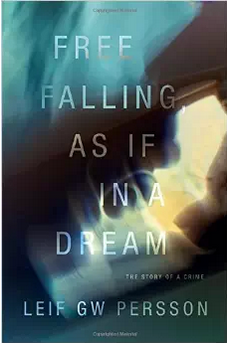
Day 735: Free Falling, As If in a Dream

Cover for Free FallingWith the last book in the series Leif GW Persson calls the Fall of the Welfare State, he finally, as promised, gets to the actual assassination of Swedish Prime Minister Olof Palme in 1986. The novel begins in 2007, when Chief of the National Bureau of Criminal Investigation Lars Martin Johansson (whom we have met in the two previous books) decides it is about time someone solved Palme’s murder.

Most Swedes believe the murderer was a madman named Christer Petersson. But Johansson doesn’t believe this, and he has brought together a team of Superintendent Anna Holt and Chief Inspectors Lisa Mattei and Jan Lewin to try to solve the crime before the statute of limitations expires.

This excellent police procedural, like the others in the series, is based on actual events and written by the man considered the foremost expert on crime in Sweden. To see if anything was missed, the detectives laboriously untangle the threads of various “tracks,” or theories of the crime, that were followed during the original investigation. Almost immediately they find evidence of a witness that may indicate the assassin took a different escape route than prevously believed. The witness’ testimony was discounted because she was a drug addict and prostitute. Although struggling with difficulties of an unofficial case and long-dead witnesses, the detectives make impressive strides.

In the meantime, Johansson explores the perilous channels of political intrigue, for Persson’s novel makes an almost perfect combination of political thriller and police procedural. In this novel, we encounter some of the people whose exploits were featured in the previous two, including the ridiculous buffoon Bäckström, who thinks every crime has to do with money or sex, and the dangerous Waltin, long dead but important to the case.

This is an excellent series. Its political ramifications are similiar to those of the works of Stieg Larsson. It is well written, sometimes funny, and also compelling.

Related Posts

Between Summer’s Longing and Winter’s End

Another Time, Another Life

The Girl with the Dragon Tattoo

Day 734: The Sun Is God

Cover for The Sun Is GodI have just become aware of the work of Adrian McKinty, said to be one of the best Irish crime novelists. The Sun Is God is set in New Guinea in 1906 and is based on an unsolved true crime.

Will Prior is a failing plantation owner in German New Guinea when his friend Lieutenant Kessler comes to request his assistance. Will is a former British military police officer who left the service after a massacre of rioting prisoners in South Africa. Kessler has come to ask him to help investigate a possible murder on a nearby island.

The island is occupied by a cult of mostly German nudists who call themselves Cocovores. They eat only coconuts and bananas and are sun worshippers. The pilot who brought Max Lutzow’s body back to Herbertshöhe, the regional capital, was told Lutzow died of malaria. But an autopsy reveals that he drowned.

Prior and Kessler are dismayed to find that they are expected to take a woman along with them on the investigation, Bessy Pullen-Burry, a travel writer. She is coming as a representative for Queen Emma.

The investigation seems to go nowhere almost immediately. Although the autopsy indicates otherwise, all the Cocovores tell the same story of malaria. The only discrepancy is whether Ann Schwab was with Lutzow right until he died. Yes, the investigators are surprised to find three women among the nudists, whom they had understood were all men.

Even though the investigation seems to stall, hampered by the islanders’ consumption of high-grade Bayer heroin, which they believe to be nonaddictive, Will grows worried about his party’s safety. They are not finding any evidence, but something is wrong, and they only have one opportunity a day to leave the island.

This novel is very well written and compelling, although it suffers from the feeling that no investigation is going on. So many men are on the island that I had difficulty keeping track of them and didn’t get much of a sense of their personalities. Still, the setting and situation are atmospheric and there’s a surprising shift of point of view at the end.

Related Posts

The Luminaries

The Bone People

Arcadia

Day 731: Antidote to Venom

Cover for Antidote to VenomIn this Golden Age mystery written in 1938, Freeman Wills Crofts had the goal of showing both the murder and the investigation. The result is a fascinating psychological mystery.

The first section of the book shows how George Surridge becomes involved in a murder. A mental degradation begins because of monetary difficulties caused by gambling and his attraction to a young woman who is not his wife. He is his elderly aunt’s heir, but when the thought occurs that it would help if she died faster, he pushes that idea out of his mind, thinking that he doesn’t wish her harm.

When his aunt, Miss Lucy Pentland, dies, he feels his troubles are over. His girlfriend loses her job as a companion around the same time, so he anticipates his legacy by buying her a cottage. By coincidence, his aunt’s affairs are being handled by David Capper, the nephew of an old gentleman doing research on snake venom at the Birmingham Zoo, where George is director. But when George visits Capper to find out about his inheritance, Capper admits to having stolen it and lost it all.

George is ready to go to the police, but Capper tells him then he won’t ever see his money if he does so. However, if George would help him with one little thing, the murder of his own uncle, he will get his money. All George has to do is steal a venomous snake from the zoo.

link to NetgalleySo, we see how George is slowly drawn into being an accomplice to murder. The rest of the novel shows how Chief Inspector French first recognizes that the crime is a murder and then solves it.

Although the murder involves a complicated device I couldn’t make hide nor hair of, for a Golden Age mystery it is fairly uncomplicated. I enjoyed this introduction to Croft’s work.

Related Posts

Behold, There’s Poison

At Bertram’s Hotel

Unnatural Death

Day 721: Death in Brittany

Cover for Death in BrittanyI selected this book just because of its setting, and it certainly makes an effort to impart the scenery and atmosphere of Brittany.

Commissaire Georges Dupin is originally Parisian, but he is enjoying his relocation to Brittany. He is sitting in a cafe with his morning coffee when he is summoned to Pont-Aven, where the 90-year-old owner of the Central Hotel was stabbed to death in the bar. It was Pierre-Louis Pennec’s habit to spend the evening there, sometimes with other people, sometimes alone. The death happened after the restaurant was closed.

No one at the hotel reports anything unusual. Pennec’s life revolved around the hotel, which had been in the family for generations. His grandmother had helped build Pont-Aven’s reputation as an artists’ haven by supporting artists, the most famous of whom was Gaugain. Copies of their paintings hang throughout the restaurant. The only unusual thing Dupin and his team can discover is that Pennec was told that week that he would not live long.

Under suspicion are Pennec’s son and daughter-in-law, but they seem to have no motive. Also under suspicion is Pennec’s estranged half-brother.

The night after the murder someone breaks into the restaurant. But to all appearances, nothing was taken or has changed.

link to NetgalleyI was reading an advance copy and was at first put off by the writing, which was not stellar, particularly overuse of the word “very.” But these problems may be resolved in the published version. One thing Bannelec attempts is to illustrate the beauties of Brittany. Most of this material was interesting, and I appreciated the effort, even though sometimes the novel reads like a travel guide. But I have criticized other novels for not providing a sense of the location, and this one certainly attempts to do so.

The characters aren’t particularly distinctive. I kept confusing two of Dupin’s inspectors and several of the suspects. So, overall, I would rate this novel as just average.

Related Posts

Murder in Pigalle

Murder on the Eiffel Tower

The Bones of Paris

Day 681: Literary Wives! The Bishop’s Wife

Cover for The Bishop's Wife

Today is another Literary Wives discussion about the book The Bishop’s Wife by Mette Ivie Harrison.

Be sure to read the reviews and comments of the other wives!

***

Linda Wallheim is the wife of a Mormon bishop. She has no official role in his duties but he occasionally asks her to help him by talking to someone he thinks is troubled. The couple’s lives are busy with many church functions and many visitors for the bishop. But it is one woman who doesn’t come who is soon to cause an uproar.

Jared Helm comes over very early one morning with his five-year-old daughter Kelly to report his wife Carrie missing. He claims she got up in the middle of the night and left. Linda is angered by his crude and sexist remarks about his wife and begins to wonder about his story. She is even more concerned when the Westons, Carrie’s parents, tell Linda and her husband Kurt that Carrie would never have left without Kelly.

Soon, there’s a full-blown police investigation into Carrie’s whereabouts. Although Jared’s father Alex is even less likable and more misogynistic than Jared, Linda tries to stay on pleasant terms with them to look after Kelly.

In the meantime another neighbor finds out suddenly that he is dying. Kurt has noticed that Anna Torstenson has a problem, and Kurt and Linda soon find out that her husband Tobias is dying. Anna loves Tobias, but she is his second wife and he has refused to be sealed in the temple with her, meaning they will not live out eternity together. He has instead often talked about his first wife. As he gets very ill, he wants to visit his first wife’s grave, but neither Anna nor either of Tobias’ grown sons know where she is buried. Upon examination, different people realize they’ve been told different things about the cause of her death.

This novel is fascinating, as much of interest because of the details of life in a modern Mormon ward as for the mystery. Linda is a complex character, always ready to help but sometimes struggling with her role in her husband’s work. The novel is apparently based upon a true case.

What does this book say about wives or the experience of being a wife?

I think that The Bishop’s Wife is the most complex of the books I have read for this club in its examination of “wifehood.” As in the other books, there are several marriages depicted, some of them quite off-kilter. Linda’s and Kurt’s is very much a partnership. Although her primary role is as a wife and mother, he engages her in his work when he can, even though people’s confidences remain confidential. When he thinks a troubled person might be more likely to confide in his wife, he asks her to visit them. Although they have several disagreements about her involvement in the Helm case, he agrees that she must do as she thinks best.

Anna finds, I think, that she has subsumed some of her own personality to please her husband. It takes her awhile, but she learns to look forward to a new start to her own life after his death.

Some of the other marriages depicted are shaded by childhood trauma or by completely dysfunctional relationships. Linda is sensitive to any hints of sexism, but there appears to be plenty in the community. One of the things I found a little shocking was the speed with which one widower decides to remarry and the acceptance that decision apparently has in the community. And there is another marriage that is entirely shocking.

Literary Wives logoIn what way does this woman define “wife”—or in what way is she defined by “wife”?

The old-fashioned phrase “help meet” seems to describe Linda’s role as wife. She is concerned about the hours Kurt puts into his work without being jealous of the time taken away from her. She and Kurt have a warm give and take of views, and she has a close relationship with her sons. Her biggest regret is the death of her stillborn daughter.

Day 680: As Chimney Sweepers Come to Dust

Cover for As Chimney SweepersAfter 12-year-old Flavia de Luce’s last adventures, she starts out this most recent novel in the series on her way to Toronto. She has been sent away to school, to Miss Bodycote’s Female Academy. Lest you worry that this will turn the series into a nonmagical version of Harry Potter, never fear.

Flavia has arrived by boat in the company of Dr. and Mrs. Rainsmith, an unlikable couple who are associated with the school. They drop her there late at night, and true to form, Flavia has discovered a corpse by morning.

Or rather, another of the boarding students by the name of Collingwood has. In an attempt to hide from the headmistress when she is out of her room at night, Collingwood crawls up the chimney in Flavia’s room, only to fall down again along with a desiccated body wrapped in a Union Jack.

Of course, Flavia is soon on the job, trying to identify the body. Several girls are rumored to have disappeared from the school. And then there is the mysterious death of Dr. Rainsmith’s first wife, even though she went overboard during a cruise, which makes the death a little harder to fit.

Although the series has taken a somewhat fantastical turn, with Flavia seemingly being groomed to be some sort of spy, she continues her inimitable self, naive enough to draw some pretty ridiculous conclusions from her evidence but smart enough to find the facts, and entirely neglectful of the school rules. I have to admit, though, that I miss Flavia’s village and the eccentric members of her family.

I’m sure I am not the only one to enjoy Flavia, an expert in chemistry who thrills over an electron microscope but still believes in Santa Claus, as we discovered a few volumes ago.

Related Posts

The Sweetness at the Bottom of the Pie

The Dead in Their Vaulted Arches

Speaking from Among the Bones


Day 674: In a Lonely Place

Cover for In a Lonely PlaceWhat makes this post-World War II noir crime novel stand out is that it was written by a woman and the crime is solved by two sharp women. Although there are plenty of women mystery writers, it is less common to find women writing noir mysteries at that time. Reminiscent of The Killer Inside Me, In a Lonely Place tells the story of a serial killer of women from the point of view of the killer.

Dix Steele is an ex-pilot being supported by his uncle in Los Angeles while he pretends to write a novel. He is living in a posh apartment of an old Princeton friend, wearing his clothes and driving his car and telling everyone his friend is in Rio. About once a month he picks up a girl at a bus stop or some other lonely place and strangles her.

Dix decides to get in touch with an old friend from the military, Brub Nicholai, but is taken aback to find Brub is now a police detective. Brub has also married, and his wife Sylvia doesn’t like Dix.

Dix meets an attractive redhead, Laurel Gray, who lives in the apartment complex and is divorcing her wealthy husband. Soon they begin a torrid romance.

This novel was convincing in its depiction of a serial killer. Although we see things from Dix’s point of view, we are not drawn into his dilemmas as we are, say, for The Talented Mr. Ripley. We want him to be caught and worry about Laurel or about the next time he is going to find the need to kill.

Related Posts

The Killer Inside Me

The Talented Mr. Ripley

Roseanna

Day 667: Alias Grace

Cover for Alias GraceBest Book of the Week!
Most of what I have read by Margaret Atwood has been futuristic and dystopian, so I was quite surprised to find that Alias Grace is an apparently straightforward historical novel. But then, nothing with Atwood is exactly straightforward.

The novel is based on a notorious Canadian murder, in which two servants were found guilty of murdering their master and his paramour housekeeper. The man was hanged, but there continued to be debate about the extent of the guilt of the woman, Grace Marks.

The novel begins some years after the event, when Dr. Simon Jordan, studying new discoveries in the field of mental illness, is hired by a group trying to gain Grace a pardon. Grace has always claimed she cannot remember the crimes, and he hopes to revive her memory. He begins in a way meant to slyly nudge a modern sense of humor, by bringing her an apple followed by a series of root vegetables he hopes will remind her of a cellar, where the bodies were discovered.

Grace, who was very young at the time of the crime, eventually tells him what she can remember, beginning with her early life. She relates her story in a simple way, conveying the persona of a proper young girl.

Dr. Jordan appears as if he is going to be the hero of this novel, but he has his own obsessions and difficulties.

As Grace tells her story, we are drawn slowly in, waiting to learn what really happened. This novel is rich in detail and beautifully written, but it is also slyly humorous and dark.

Related Posts

Stone Mattress

Corrag

Burial Rites


Day 647: Spider Woman’s Daughter

Cover for Spider Woman's DaughterIn summary, ho hum. I think I’ve read all of Tony Hillerman’s Joe Leaphorn and Jim Chee mysteries. I especially like Jim Chee, because he follows the Navajo Way, and I find the information about these customs and beliefs fascinating. I am not so fond, though, of writers picking up other writers’ series after their deaths. However, in the interests of being fair, I decided to try Spider Woman’s Daughter, a Leaphorn and Chee novel by Anne Hillerman, Tony’s daughter.

This novel is written from the point of view of Bernie Manuelito, now Jim Chee’s wife and a Navajo Nation police officer. She is attending a breakfast with retired Lieutenant Leaphorn and some other police officers when she witnesses Leaphorn being shot. In the parking lot of the restaurant in broad daylight, a short hooded figure emerges from the car next to his and shoots him.

Bernie does what she can to help him but feels as if she could have done more if she moved faster. Leaphorn is shot in the head and is moved from Albuquerque to Santa Fe to get care. Bernie is only allowed to follow through to contact relatives and then is off the case because she is a witness. The police are also having trouble finding Louisa, Leaphorn’s partner.

Because of Bernie’s thorough description of the getaway car, the police are able to identify it quickly. But it turns out that many people could have been driving it, as the owner’s son regularly loans it out.

Jim and Bernie become convinced that the attack relates to an old case, but a report is missing for a new case Leaphorn is on, evaluating the documents for a collection of native American artifacts that is being donated to a research facility in Santa Fe.

I was disappointed in this novel. First, except for Bernie, it does almost nothing to develop its characters. Frankly, Jim Chee did not seem like Jim, and Leaphorn was unconscious almost the whole time. The minor characters have little personality.

More importantly, by two thirds of the way through, I knew who the murderer was and why, while it took being abducted for either Chee or Bernie to figure it out. This is too early in the book to be thinking the detectives are idiots. With the old series, I seldom knew the murderer before Hillerman wanted me to, and if I did, I was interested enough in the plot or other details to want to continue.

Related Posts

The Cold Dish

The Wives of Los Alamos

Folk Tales of the Native American

Day 642: The Silkworm

Cover for The SilkwormThe Silkworm is Robert Galbraith’s second Cormoran Strike mystery. It picks up about a year after private investigator Strike solved the murder of the famous supermodel Lula Landry. Since then, he has gained a lot of business, mostly from wealthy or famous clients. So, he does something unexpected when he kicks an entitled client out of his office to take on an apparently simple job of finding the wandering husband of the downtrodden Leonora Quine.

Owen Quine, Cormoran learns quickly, is prone to drama and disputes and is not very likable. He long ago wrote one notable novel but since then has been considered second rate. He is known for his attention-seeking disappearances, but this time Leonora thinks he’s been gone too long, ten days.

Strike finds that Quine disappeared after a loud, public fight with his agent, Elisabeth Tassel. Quine has just finished a book that he considers his masterpiece, Bombyx Mori, named after the silkworm. Leonora reports that Tassel was encouraging Owen and telling him it was his best. But Tassel says that when she read it, she was appalled. It grotesquely defames almost everyone Quine knows in the publishing world, including Tassel herself, Quine’s editor Jerry Waldgreave, a famous writer and ex-friend Michael Fancourt, Quine’s publisher Daniel Chard, Quine’s girlfriend and writer of erotic romances Kathryn Kent, and Quine’s student from a creating writing class, a transgender woman named Pippa Midgely. Although Quine’s manuscript was suppressed, all of these people had an opportunity to read it. Leonora, also ridiculed in the book, is the only one who claims not to have read it.

Cormoran is unable to find a trace of Quine, and he begins to feel odd about the situation. When he learns that Quine co-owns a house with Michael Fancourt that neither of them ever visit, he goes there immediately. He finds the house marred by acid and Quine’s body, tied up and disemboweled.

Strike’s old friend Richard Anstis is head of the investigation, but the police are not happy to have Strike involved since he made them look bad when he solved Lula Landry’s death as a homicide after they declared it a suicide. In any case, Anstis is inclined to suspect Leonora.

Meanwhile, the date of Strike’s assistant Robin Ellacot’s wedding is approaching, and she has still not managed to reconcile her fiancé’s dislike of her job with Strike. She is hoping Strike will train her to be a detective, but she is worried he has relegated her to being a secretary.

In my review of Galbraith’s first novel I complained of a dirty trick. I’m happy to report that there were none in this novel and the murderer was difficult to guess. I haven’t figured out yet how much I like Cormoran Strike, though, and I hope that his yearning after his bitch of an ex-fiancée is not going to continue in every novel. Whether she would follow through with her own wedding was a minor plot point of this novel, but I’m already tired of her and wish she would go away. Ditto with Robin’s tiresomely jealous fiancé.

Rowling as Galbraith continues to be a very good writer who keeps the story moving, but she has not quite engaged me on Strike’s behalf as yet.