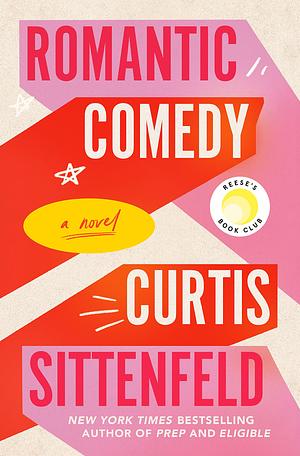
Review 2611: Romantic Comedy

For some reason, I thought I had read at least one book by Curtis Sittenfeld. It turns out, though, that I was confusing her with someone else. (Correction: I just looked, and I have read one other book by her. I thought I looked that up before I wrote this.)

Romances are not usually my genre, but I can sometimes enjoy them. Romantic Comedy was so popular that I decided to give it a try.

Sally is a comedy writer for a TV program called The Night Owls, a thinly disguised Saturday Night Live. She loves her job but after an embarrassing incident with a co-worker, has given up on romance.

Her spots usually have something to do with feminism, and for the week in question, she is working on one sketch called “The Danny Hurst Rule,” named after her office mate and friend, who is engaged to a famous, beautiful actress. The idea is that beautiful celebrity women might date average-looking men, but the reverse never happens.

For that show, the guest host and musical guest is Noah Brewster, a popular musician. Sally finds herself terrifically attracted to Noah as she helps him write a sketch, but since she considers her looks average, she can’t believe he would be interested in her. He obviously is, but at the after party she makes a crack that drives him away.

Two years later during quarantine from Covid, Noah sends her an email. This starts a chain of correspondence.

I think Sittenfeld was attempting to write a smart, witty romantic novel. I have realized I am out of step with modern humor (proved by the fact that I haven’t considered SNL funny since the 80s, and I’m waiting for younger folks to realize that fart jokes are not funny), and I did find some of the lines witty, but I found the rest of the novel only moderately interesting and was a bit bored by the string of long, heart-felt texts.

The most interesting to me was the research Sittenfeld put into the operation of SNL, the preparation and behind-the-scenes stuff. Otherwise, I was kind of meh. Although I did find both main characters sympathetic, Sally is so hung up on her preconceptions that she creates a lot of problems, and Noah is too perfect.

Also, I have an objection. Why do most modern romances involve a woman ending up with someone wealthy? Although there is certainly a long history of that, it used to be that sometimes two ordinary people could make a romance.

Related Posts

Eligible

Beautiful Ruins

Wonder Cruise

Review 1338: Eligible

Cover for EligibleSo far, the Austen Project, for which current writers rework Jane Austen’s novels within a modern framework, hasn’t worked for me. I have a theory that the readers who like them are reading mostly for plot, whereas I read Austen for her quick but subtle wit and her precision. Let’s face it, although humor is always in style, these days subtlety is not. Still, I thought I’d give Eligible, Curtis Sittenfeld’s reworking of Pride and Prejudice, a try.

Obviously, some of the dilemmas in the original novel are just not workable in today’s society, a problem that foundered Joanna Trollope’s reworking of Sense and Sensibility. Sittenfeld is wise enough to realize this and has made significant changes to the characters and plot.

Liz Bennett is a magazine writer who lives in New York. She and her sister, Jane, a yoga instructor, have returned to their home town, Cincinnati, to help out after Mr. Bennett’s heart attack. Their help is needed even though their three younger sisters, suffering from failure to launch, are still living at home, because they are doing nothing. Mrs. Bennett, a social climber, is too involved in running a charitable event to take her husband to his doctor’s appointments.

Jane is pushing forty, so she started in vitro fertilization before returning home. Then she meets Chip Bingley at a charity event. Jane and Chip immediately become involved, but Liz has formed a negative impression of Chip’s friend, Fitzwilliam Darcy, because of remarks she overhears at a party.

Liz has been involved for years with Jasper, a man she fell in love with in her early 20’s. Jasper claims he has an open marriage, and he has been seeing Liz on the side. When Jasper hears Liz has met Darcy, he hints at some misbehavior of Darcy’s when the two attended Stanford together.

Of the Austen Project novels I’ve read, this is the most successful rewrite, but the bar is fairly low. Although the dialogue is humorous, it’s not the sparkling dialogue of the original. Kitty and Lydia, for example, are almost unbelievably vulgar and poorly behaved. It’s also hard for me to believe that these days a mother would be pushing marriage after Jane and Chip have only had a few dates.

I was fairly well entertained, though, until the emphasis went to the Eligible reality show. Although I’m sure Sittenfeld had fun with her parody, that’s where I felt the novel lost steam.

Related Posts

Persuasion

Sense & Sensibility

Northanger Abbey