Review 2667: Dean Street December! Cecil

Through about 20 years’ time, Lady Anne Guthrie becomes more and more concerned about the relationship between her husband’s much younger stepbrother, Cecil, and Cecil’s mother, Lady Guthrie. Anne’s husband Charlie was already an adult when his elderly father married Edythe, who was very young. They had only one child, and Lady Guthrie, who plays the invalid card, does everything to keep her son with her, saying he is too nervous to be sent to school, keeping him out of university, and opposing his proposed career as a diplomat. This novel is set in the late 19th century, seemingly for no apparent reason, perhaps because the events later in the novel are more believable then.

Anne, who finds Lady Guthrie tiresome, thinks her decisions are misguided, but Charlie’s cousin Nealie thinks Edythe is more selfish than misguided. As Cecil grows to an adult, it becomes obvious that his mother will do anything to prevent his marriage, but Cecil sees only the sacrifice she has made to live with his frequently ill father and raise him virtually on her own.

Charlie and Anne try to help Cecil, whom they are fond of, but the events of the novel become darker as it proceeds. This is a terrific character study of a “delicate” woman who uses her health and close relationship with her son to manipulate him. I found it very involving.

Related Posts

Mrs. Martell

Alice

Family Ties

Review 2665: Dean Street December! The Coldstone

Here’s an old-fashioned mystery/suspense novel that has everything—an ancient secret, rumors of buried treasure, a curse, a possible ghost, and a romance. What more could you want?

When Anthony Colstone unexpectedly inherits Stonegate, he is asked to promise never to move or disturb a ring of standing stones (well, just two of them) in one of his fields. But offered no explanation, Anthony refuses to promise, and of course this request makes him curious about the stones.

One of the first things he does when he arrives is to go look at the stones, about which everyone in the village is suspiciously close-mouthed. He has to plunge through a hedge to see them, and while he is there, he notices a stranger staring at him with a hostile expression.

Anthony is referred for information to his benefactor’s elderly daughters, Miss Agatha and Miss Arabel, but they simply hint at dreadful things and refer him to Susan Bowyer, at more than one hundred, the oldest resident of the village. He doesn’t learn much from her, but he meets her great-granddaughter, Susan, down from London for a visit, and is much struck. We like both Susans immediately but know the younger one has some kind of relationship with the strange man Anthony saw in the field.

Anthony’s first night in the house is disturbed by a feeling that someone else besides the servants is in the house, too. He goes down to the library and is knocked over the head but not before he sees what appears to be the portrait of one of his female ancestors moving her arm. We learn that he saw Susan, and her gasp prevented two housebreakers from breaking his leg.

Anthony awakens in a different room with his head in a woman’s lap, but when he regains consciousness, she runs away. He knows it was Susan, though, because he has noticed her resemblance to the portrait. From her, he learns of a secret passageway between Susan Bowyer’s house and his. He also hears confusing rumors of fire and devils under the altar stone of the standing stones.

What is going on? Certainly, a man named Garry has copied a key to the house and is breaking in. But isn’t the secret hidden out in the field?

This novel turns out to be lots of fun, and it doesn’t fall into the cliché of having Anthony doubt Susan when he realizes she knows Garry.

Related Posts

Uncle Paul

The Secret of Chimneys

The Hours Before Dawn

Review 2661: Dean Street December! Charlotte Fairlie

When Charlotte Fairlie was a girl her relationship with her widowed father was close. Then he met someone, and she seemed to be nice, but as soon as they were married, she became jealous of Charlotte. In the end, he sent Charlotte to his brother, and she never saw him again. (Oddly, she reflects later that it was the only thing he could do, but I think not.)

Now Charlotte has achieved her goal since she was in school. She has been appointed head of St. Elizabeth’s, her old school. She is young for such a position but has been wearing a stodgy hat to board meetings to disguise that fact. The only thorn in her side is Miss Pinkerton, who thinks she should have had the position and is a real troublemaker.

A new girl starts at the school, Tessa MacRyne. She is an unusual child, self-possessed but homesick for her island home in Western Scotland. Charlotte catches her running away one day and learns that a letter from her mother has informed her that her parents are divorcing and her mother has returned to her parents in the U. S. Tessa feels she must return home to comfort her father. Charlotte’s handling of the situation earns her Tessa’s affection and an invitation to the island of Targ during summer break.

A friendship begins between Charlotte and Lawrence Swayne, the headmaster of the boys’ school. Unexpectedly, her proposes marriage to her, thinking they would make a great partnership.

I found this novel to be deeply touching and involving. I generally think of Stevenson’s books as very light romance, but I felt this book was a little deeper.

Related Posts

Music in the Hills

Winter and Rough Weather

Kate Hardy

Review 2518: Dean Street December! The Fledgling

Here’s another book for Dean Street December!

I have read two memoirs by Frances Faviell, but The Fledgling is the third of her three novels and the first of her novels I’ve read. For me, It wasn’t as successful as her memoirs.

One reason is the main character. He is not very appealing. I’ll explain why later.

Neil Collins is serving his compulsory military service in 1950s England. This service was apparently controversial because the country was not at war.

Neil is a fragile, small young man who gets so nervous when ordered around or bullied—which he frequently is—that he gets stupid and can’t remember how to do things. He has already gone AWOL twice and has promised his grandmother he won’t do it again.

Everyone in his unit picks on him. He thinks he has one friend, Mike, but when Mike bullies him to desert, planning to follow him and use Neil’s contacts to get to Ireland, he realizes Mike has just been using him. So Mike bullies him more until he goes. Sexual abuse is implied.

Neil shows up in his grandmother’s rooms hoping to get his twin Nonnie’s husband, Charlie, to take him to Southampton before the arrival of Mike, who was supposed to leave the next day. However, his grandmother wants to turn him in, like she did last time, and Charlie doesn’t want to help him. To make matters worse, the walls of the rooms are very thin and people keep dropping by and trying to come in. Meanwhile, unbeknownst to the family, Mike is across the street all day watching the house.

I found Neil unlikable not so much because of what he is doing but how he acts. He is like the most timid heroine in a Gothic novel. He gasps loudly when he’s hiding, he keeps raising his voice despite many warnings about the nosy neighbors. He actually falls through the door when he is eavesdropping on his grandmother and her social worker. Basically, he’s an idiot with no control over himself. He acts more like a five-year-old than a twenty-year-old.

Of course, the book is about how he gets some stuffing to brace him up, but some of the book’s values are very dated. For example, Nonnie is supposed to tolerate Charlie’s infidelity because he’s jealous of her connection with her twin. And Neil has to get in a physical fight to gain some confidence. I also didn’t really find any of the characters to be that likable.

Related Posts

A Chelsea Concerto

The Dancing Bear

The World My Wilderness

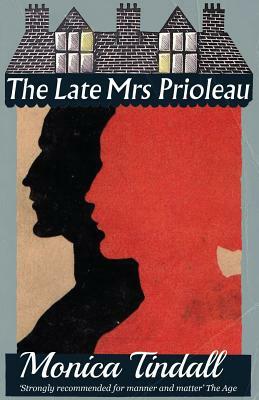
Review 2515: Dean Street December! The Late Mrs. Prioleau

Here’s another one for Dean Street December!

Because of the war, Susan Prioleau never meets her mother-in-law before she dies. Mrs. Prioleau seems to have kept an unhappy home, with children who left it as soon as they could, excepting Austin, her oldest son. She adored him but convinced him he is an invalid with a bad heart, which his doctor says is not true. He is immensely fat and makes his heart an excuse for doing nothing.

Susan hears stories about Mrs. Prioleau that don’t agree. She was adored by her servants of long ago, but she has written people cruel, vindictive letters. Both her daughters say she never gave them any attention, although the oldest, Nonnie, remembers a time when things were different. Her daughter Melissa disliked her, and she was estranged from her sister, Catherine, for years.

As Susan gets to know the family and helps Austin clear the house (although he won’t let her remove much), she begins to learn more about her mother-in-law’s life. Eventually, she learns about events that turned her from a selfish but warm-hearted girl to a spiteful old woman.

It’s a pity Monica Tindall only wrote one novel, because this is a good one. Although some of its secrets are easy to guess, the journey was absorbing.

Related Posts

Expiation

Which Way?

The Awakening

Review 2512: Dean Street December! The Dancing Bear

The rate I’m knocking out books for my A Century of Books project has been slow lately because first I was reading books for Novellas in November (some of which also qualified for ACoB), and I also wanted to read at least a few books for Dean Street December. And I don’t know what I was thinking, but I also put several books for my other projects on my library reserve list, and they have arrived. I must be crazy! Anyway, I read The Dancing Bear for Dean Street.

Although The Dancing Bear is set in time after Faviell’s A Chelsea Concerto, it is actually her first memoir. It covers her time in post-World War II Berlin, where her husband was part of the Occupation. The people in the city are freezing and starving, and even their occupiers are on strict rations of many commodities.

Much of the book is about Faviell’s relationship with the Altmann family. She is being driven in her car when she spots Frau Altmann, an older lady of fragile build, trying to move a heavy cart of furnishings through the streets. Faviell’s German driver thinks it’s hilarious when she falls, but Faviell stops to help her and shames him into helping, too. Despite the dictum not to give rides to Germans, she takes Frau Altmann home in her car.

There, she gets to know Herr and Frau Altmann, two gentle and dignified older people, their daughters Ursula and Lilli, and their sulky son Fritz, a former member of a Nazi youth group against his parents’ wishes. Ursula is the only bread-winner, making money by fraternizing with the British and American soldiers. Lilli, extremely frail, is a ballet dancer.

Aside from descriptions of the living conditions and the changing situation between the Soviet and the other occupiers, much of the story is about Faviell’s relationship with the Altmann’s and with her regular driver, Stampie, who trades on the black market to keep some German families alive.

This is a fascinating account of how some people meet and overcome difficult situations and some don’t. I also wasn’t aware of the conditions in Berlin (although I had heard of the Berlin Flyover) and all the manipulation the Soviets did to try to claim the entire city from their other allies.

Related Posts

A Chelsea Concerto

In the Garden of Beasts: Love, Terror, and an American Family in Hitler’s Berlin

The Oppermanns