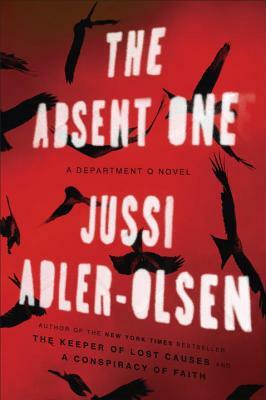
Review 2644: RIPXX! The Absent One

This book is the second in Adler-Olsen’s Department Q series. It’s Danish super noir.

Someone has put a file on Carl Morck’s desk. It’s the case of two murdered teens, brother and sister, from 20 years ago. The only thing is, it’s been solved. Nine years after the murders, Bjarne Thøgerson confessed. He was part of a group of students who were originally suspected of the crime—Ditlev Pram, now the owner of several hospitals; Torsten Florin, a famous designer; Ulrik Dybbal, a stock market analyst; and the deceased shipping magnate, Kristian Wolf. The other member of this group was Kirsten-Marie Lassen, who has disappeared. Of the group, only Bjarne did not come from wealth.

So, Carl wonders, was Bjarne innocent of the crime, or did he take the fall for the others? He has become wealthy in prison, which might indicate the answer.

In the meantime we learn that the above-mentioned group of powerful men—who prove to be vile human beings—are searching for Kirsten-Marie Lassen, whom they call Kimmie. That’s because she has proof that they committed not just the double murder but scores of beatings of random strangers and some other murders. Kimmie is now a homeless person who is hiding from them.

As Carl and Assad investigate, they are blocked by their boss because the case is closed but also because someone is bringing pressure from above. There is a spy in the force, and Carl is being personally threatened.

This is really a grim entry into the series, not because of the investigation but because of the activities of the super-rich, soulless bad guys. Also, FictionFan mentioned to me that she quit reading the series because it made Assad into a figure of fun. I’m not quite seeing that yet, but the Danish characters seem to be quite bigoted, even Carl at times.

Related Posts

The Keeper of Lost Causes

Roseanna

The Tenant

Review 2609: The Keeper of Lost Causes

My husband and I were recently transfixed by the Department Q TV series, so I set out to find the books it was based on. They are by the Danish writer, Jussi Adler-Olsen.

The mystery in the first book was the same one as in the first series, but lucky for me, the TV series changed it enough so that it wasn’t totally predictable. They also changed the personality of Merete Lynggard and the motive for the crime, which was even more senseless than in the TV series.

Following a shooting incident which wounded Carl Mørck, paralyzed his partner Hardy, and killed Officer Anker, the department doesn’t quite know what to do with Carl. The media has been out to get him, claiming that he hid behind Hardy when in actuality Hardy fell on top of him, and he is difficult and not liked by most of his colleagues. Then his boss is told to set up a special department to investigate cold cases and given a large budget to fund it. So, the boss takes most of the money for the homicide department and sticks Carl in a basement with only one assistant, a Syrian refuge named Assad, charged with cold cases.

At first, Carl is totally apathetic. He spends his days playing games on his phone and visiting Hardy in the hospital. When they finally get some files, it is Assad who reads them and encourages him to pick the case of Merete Lynggard.

Merete was a rising political star when she disappeared without a trace from a ferry on vacation with her disabled brother Uffe. The investigators eventually decided she had fallen overboard. But we readers know she is alive and being held captive, because occasionally the novel flashes back to events five years before, when she was taken, and to her situation in the present.

Despite my knowledge of many of the plot points, I found this novel intriguing. The characters are interesting—Carl is actually a tad more sympathetic than in the TV series (although probably not as handsome)—and the mystery is a good one, with a suspenseful climax and a touching ending. Now I just need to read the second book before the next series comes out.

Related Posts

The Tenant

Borkmann’s Point

Roseanna

Review 2586: The White Bear

The newly released (today, I think) reprint of The White Bear by NYRB is actually two novellas, The White Bear and The Rearguard. I wasn’t familiar with Pontoppidan but find he was an early 20th century Danish Nobel laureate. Both of these novellas were published in the late 19th century.

In The White Bear, we meet Thorkild Müller, who as a young misfit was directed into the ministry because of a grant that offered a generous university stipend for a theological degree if the recipient was willing to minister in the frozen north for an unspecified period. Thorkild takes the stipend but fritters away his time at university, barely setting foot in the classroom.

But then because of the deaths of two ministers, he receives his summons, which he tries to avoid by flunking his exams. That doesn’t work, and he ends up in Greenland ministering to the Inuit.

There he is miserable until one summer when, instead of returning to a trading post as expected while the Inuit were leading their nomadic summer lives, he goes with them.

Much of the story is about what happens when, as an old man, he decides to return to Denmark.

I really loved this story. I have a fascination for books about cold and desolate climates, but what’s more important is that Thorkild is an unforgettable character—huge and covered with an unkempt white beard, boisterous, simple, yet not as simple as he seems.

The Rearguard is about Jørgen Hallager, in some ways a bit like Thorkild but in others, not. He is also a big boisterous man, a social realist painter who considers that artists who turn away from realism are traitors, who is loud in his condemnation of almost everyone that doesn’t believe what he does.

He has recently become engaged to Ursula Branth, the frail, gently reared daughter of a state counselor. He has become engaged to her in Rome, where they make a lengthy stay and eventually marry. Her father and Hallager dislike each other. He is trying to separate her from her friends and family because of his socialist principles, and her father is worried about her.

I found Hallager to be insufferable—so full of himself and sure of his ideas, belligerent with anyone who disagrees, and verbally abusive to his wife, trying to bring her to a mental place where he wants her. I didn’t understand some of the basis for his rants (not being up on 19th century Danish politics and art).

I liked Thorkild a lot better. Both of the novellas are wonderful character sketches, though.

I received this book from the publishers in exchange for a free and fair review.

Related Posts

Germinal

The Devils

The Return of the Native

Review 2257: The Tenant

I’ve given up or finished a few mystery series lately, so I thought I’d try the first Kørner and Werner series by Danish author Katrine Engberg.

An older man who lives in an apartment building in downtown Copenhagen is surprised to find the door open in his downstairs neighbors’ apartment, occupied by two young girls. When he tries to investigate, he falls over the body of one of the girls, Julie Stender, who has been gruesomely murdered.

For Detective Jeppe Kørner, this is his first important case since his breakdown after his divorce. To identify the victim, he and Anette Werner turn to Esther di Laurenti, the owner of the building who also resides there. She knows both the girls, but Julie was kind of a pet of hers. Esther has another young friend, Kristoff, her music teacher.

The police discover that Esther has been writing a murder mystery and she has used Julie as a model for the victim. Further, the murder is very much as described in the book. Only Esther and her writing group are supposed to have access to her draft.

I finished the book because I wanted to see how it came out, but what stood out almost immediately was the mediocre writing. When Engberg introduces each character, she tells a bunch of things about them, kind of a clumsy approach. Then there are lots of clichés, odd word choices, and inept metaphors. Part of this could be the translation, of course. One passage that I marked, a saying that Jeppa’s mother used, was “When you love someone, the callousness moves from your heart to the palms of your hands.” What does that even mean? Is callousness even the intended word?

As far as characterization goes, we learn a lot about Jeppa, but not so much about anyone else. In fact, I was taken aback by how over-the-top everyone was acting, with the police team snapping at each other all the time. It reminded me of the French mystery series Murder In that my husband and I have been watching, where I couldn’t decide whether everyone was overacting or they were just being French. (Just kidding. I have lots of French friends.)

Finally, the payoff was supposed to be weird, but it also seemed completely unlikely. I don’t think I’ll continue this series.

Related Posts

The Witch Hunter

The Mist

Girls Who Lie

Review 1484: The Sealwoman’s Gift

With one foot in the world of myth and saga and the other based in a true historic event, The Sealwoman’s Gift should have been a great book. Sadly, it is not quite so good as I expected. It has an interesting beginning and a touching end but tends to drag sometimes in the middle.

One morning in 1627, Oddrún comes to Ásta, saying she’s had a vision of men crossing their island to attack them. However, Oddrún thinks she’s a sealwoman and only one of her visions has been known to come true, so no one pays attention. Shortly thereafter, their small Westman Island, part of Iceland, is attacked by Barbary pirates. Almost everyone is killed or enslaved.

This is Sally Magnusson’s imagining of a true event the remains one of the most significant in Icelandic history. Out of a population of about 40,000, many were killed and 400 taken. Among those taken are Ásta and her husband, the minister Ólafur, and all but one of their children. Ásta, hugely pregnant, begins giving birth on the ship, and one of my complaints is that, with all the flashbacks and background information, it takes from chapter one until the end of chapter five before she actually has the baby. I have to say that this seemed interminable, and Magnusson could have figured out a better way to handle the background information. Finally, they arrive in Algiers.

Ásta and Ólafur and two of their children are bought by a powerful trader named Cilleby, while their oldest son Egill, is purchased by the Pasha and never heard from again. Ólafur is surprised to be given no duties, but after a few months Cilleby dispatches him with a safe passage back to Denmark to try to obtain ransom for Denmark’s Icelandic citizens.

Ásta, who has been a dreamy woman with a love of Icelandic sagas, remains as a seamstress, trying to bring up her remaining two children and listening to the stories told in the evening by members of the harem.

During this period, Magnusson might have tried to more fully imagine life in Algiers, but this world is not fully realized. Or, she could have stuck with Ólafur on his journey back to Denmark and in his years of fund raising to free the captives. But she is more interested in Ásta and has her develop a relationship with Cilleby. I found this the least likely and least interesting part of the book.

Still, I was glad I finished the book, because the story eventually ends in Iceland, which Magnusson depicts more convincingly. The ending was touching and redeemed the novel quite a bit.

Related Posts

Iceland’s Bell

Burial Rites

The Greenlanders

Day 967: The Danish Girl

Cover for The Danish GirlThe Danish Girl is another example of how untrustworthy book blurbs are for conveying the sense and feel of a novel. The blurb talks about “the glitz and glamour of 1920’s Copenhagen, Paris, and Dresden.” Yes, there is a bit of going about to bistros in Paris, but this novel is not about glitz and glamour. It is mostly about the tender relationship between two people, Greta and her husband Einar, who becomes the first man to undergo a sex change operation. Ebershoff lightly based this fictional book on the lives of Lili Elbe and Gerda Wegener, both artists, but he says the details of their lives are wholly invented.

It is Greta who realizes something first. She is a portrait painter with a deadline. When an opera singer can’t make her sitting, Greta asks Einar to put on a stocking so she can use his leg as a model. Later, she has him put on a dress. Einar is a delicate man who is not self-aware. From the time he begins dressing up as Lily, he becomes more and more abstracted from his painting and his former life. Greta sees him drifting vaguely away from Einar, becoming Lily.

I wondered if Ebershoff’s description of Lily’s state of mind really reflected how a transexual person would feel, as Lily seems barely able to remember anything about Einar and vice versa. It almost seemed more like a description of a person with multiple personalities. But I don’t know much about this subject.

This is not a novel of action or plot. It is more about the states of mind of the people involved. It is sympathetic and touching. I didn’t think it would be my subject matter, but I found it affecting.

Related Posts

The 19th Wife

A Place Called Winter

The Other Daughter


Day 520: Iceland’s Bell

Cover for Iceland's BellIceland’s Bell is a curious novel. Most of the characters are based on actual people who were involved in court trials in Iceland and Denmark at the turn of the 18th century. One way to look at this novel is as the Icelandic version of Bleak House.

The novel begins with Jón Hreggviðsson, a disreputable farmer. He has been sentenced to a whipping for making a bawdy joke about the Danish king. While he is awaiting punishment, the king’s hangman has him help take down Iceland’s bell.

Although Iceland’s bell does not feature much in the novel, it is a symbol for the treatment of Iceland by its Danish overlords. The novel makes clear how impoverished the nation is and how the Danes bleed it dry. Iceland’s bell is at the time Iceland’s only national treasure. It has hung for centuries and is rung for court hearings and before executions. After a war with Sweden, the Danish king orders the bell to be removed so it can be melted down to help rebuild Copenhagen.

Jón Hreggviðsson has his beating and then goes off drinking with some men, including the hangman. On the way home the drunken men get lost in a bog. According to Jón’s story, when he wakes up the next morning, he’s lost his hat and his horse, so he takes the ones that are nearby. These turn out to belong to the hangman, who is later found dead in a nearby stream. A few days later, Jón is accused of his murder. We never find out if he murdered the hangman or even if the hangman was murdered, but thus begins a series of trials that last 32 years.

The day after Jón returns home from his beating, two other important characters enter the novel. Arnas Arnæus is a famous Icelandic scholar and a professor at the University of Copenhagen who comes to Jón’s farm with a group of eminent Icelanders searching for old manuscripts. Among the trash in Jón’s mother’s bed, Arnæus find several pages from a Skálda, a manuscript of Eddaic poems. Arnæus is trying to rescue Iceland’s heritage from destruction by searching out these old manuscripts. Having discovered the fragment of Skálda, he considers it the jewel of his collection.

With Arnæus is the bishop, his wife, and her sister Snæfríður, the beautiful young girl known as Iceland’s Sun, daughter of the magistrate. Snæfríður, we learn later, is in love with Arnæus. Arnæus leaves Iceland, promising Snæfríður to return for her. However, he soon marries an elderly rich Danish woman to save his precious manuscripts from being claimed for debt.

When Arnæus returns to Iceland years later, it is as a representative of the Danish king. He comes with the mission to end some of the Danish abuses of the Icelandic people. But his reversal of some of Snæfríður’s father’s decisions takes the perversity of their personal affairs to the international level.

Iceland’s Bell is written with the stark and cynical humor I encountered in Independent People. Laxness brutally depicts the state of the Icelandic people and their diminishment by the Danes. This novel is dark and comical at the same time—and beautifully written.

Day 328: Hamlet

Cover for HamletMy husband likes his jokes. When I told him I was re-reading Hamlet, he said, “It’s full of clichés, you know.” But it was amazing to see how many lines from this play are so familiar to all of us, have almost entered our societal DNA.

Everyone is familiar with the plot. Hamlet’s father, the King of Denmark, has died, and Hamlet’s mother Gertrude has married his uncle Claudius, his father’s brother, who is now king. Hamlet is in grief and dismay at his father’s death and his mother’s quick remarriage. In the first act of the play, Hamlet meets the ghost of his father, who tells him that Claudius murdered him by pouring poison in his ear as he slept. The ghost orders Hamlet to avenge his death.

One of the puzzlers for me about this play is the reason why Hamlet then chooses to fake insanity. It allows Hamlet to continually bait Claudius and Gertrude without consequences, but otherwise does not make sense to me.

An interesting point raised in the introduction of my version of the Collected Works is that Polonius, in appearance and behavior, is meant to be William Cecil, Lord Burghley, Queen Elizabeth I’s chief minister. The claustrophobic feeling in the play of not being able to trust anyone, of being spied on (depicted marvelously in the 2009 Royal Shakespeare Company production, starring David Tennant and Patrick Stewart), reflects the paranoid nature of Tudor society because of the prevalence of espionage at that time.

Of course, Hamlet’s musings on suicide, death, and the nature of revenge are a major focus of the play. An undoubted message seems to be of the unintended consequences of actions, particularly of revenge. Hamlet and Laertes are bent on revenge, but in obtaining it, they manage to wipe out both their families.

I have seen Hamlet played as a drooping figure of indecision, but I don’t think this is a correct interpretation. Hamlet is caught on the crux of a dilemma. He wants to do what is right but knows that whatever action he chooses, the results will not be pretty. Hence, the inaction.

Day 226: I Curse the River of Time

Cover for I Curse the River of TimeI Curse the River of Time is a sad book about Arvid Jansen, a man trying to cross a divide between himself and his dying mother. At the same time his marriage is failing and the Berlin Wall is coming down. Things are coming to an end in his life.

Jansen remembers decisions he made, particularly the one to leave university and join the Communist party. As the wall falls, he considers his loss of faith in the party. 

In contemplating his failing marriage, he also remembers his courtship of a young girl, although it is not clear whether he is thinking about his wife. He goes to his mother’s home country of Denmark, to a beach house where his family spent the summers, and recalls his childhood bond with his mother.

The novel is moody and inconclusive, and for some reason I kept expecting it to become sinister, although it did not. Even though the novel is focused around his attempts to reconcile with his mother (although that is perhaps not the correct word since there has not been a falling out–she is simply cold and unresponsive to him), it seems to me that Jansen thinks about her too much, is too obsessed with her.

The writing is excellent, spare but full of details. However, the entire feel of the novel is tenuous. There does not seem to be much to fasten onto.

Day 166: We, The Drowned

Cover for We, The DrownedBest Book of the Week!

We, The Drowned is an unusual novel by Danish writer Carsten Jensen that has become an international best seller. It relates the history of the author’s home town, the port of Marstal, Denmark, from 1848 to 1945. Although it picks principal characters to follow during these times, large portions of the novel are written in the first person plural, as though the entire town is the Greek chorus in a play. The novel follows the fate of the town as it rises to become a major shipping port to its near demise just before and during World War II.

The narrative style of the novel feels like a series of seafaring tales. Ships sink, sailors are never seen again, but the townsmen of Marstal continue to be lured out to sea. We follow them as the Danes go to war with Germany in the mid-19th century and the men of Marstal wonder why they are fighting men they traded with the week before. In this conflict, Laurids Madsen is shot upward from an exploding ship and lands again on his feet, unharmed, creating a legend about his boots.

Years later, his son Albert travels the South Pacific looking for his father, who went to sea when Albert was four and never returned. He finds him with a second family in Samoa.

As an old man retired from a prosperous career as a sea captain, Albert befriends a young boy, Knut Erik Friis, whose widowed young mother does everything she can to keep her son from going to sea. When she gains some economic power in the community, she undercuts the town’s shipping industry in an attempt to keep all the young men home.

These stories and many more, ending with Knut Erik’s experiences during World War II, tell the rich tales of the lives in this seafaring town. Although I was initially a little put off by the narrative style, I found myself barely able to put down this book.