Day 166: We, The Drowned

Cover for We, The DrownedBest Book of the Week!

We, The Drowned is an unusual novel by Danish writer Carsten Jensen that has become an international best seller. It relates the history of the author’s home town, the port of Marstal, Denmark, from 1848 to 1945. Although it picks principal characters to follow during these times, large portions of the novel are written in the first person plural, as though the entire town is the Greek chorus in a play. The novel follows the fate of the town as it rises to become a major shipping port to its near demise just before and during World War II.

The narrative style of the novel feels like a series of seafaring tales. Ships sink, sailors are never seen again, but the townsmen of Marstal continue to be lured out to sea. We follow them as the Danes go to war with Germany in the mid-19th century and the men of Marstal wonder why they are fighting men they traded with the week before. In this conflict, Laurids Madsen is shot upward from an exploding ship and lands again on his feet, unharmed, creating a legend about his boots.

Years later, his son Albert travels the South Pacific looking for his father, who went to sea when Albert was four and never returned. He finds him with a second family in Samoa.

As an old man retired from a prosperous career as a sea captain, Albert befriends a young boy, Knut Erik Friis, whose widowed young mother does everything she can to keep her son from going to sea. When she gains some economic power in the community, she undercuts the town’s shipping industry in an attempt to keep all the young men home.

These stories and many more, ending with Knut Erik’s experiences during World War II, tell the rich tales of the lives in this seafaring town. Although I was initially a little put off by the narrative style, I found myself barely able to put down this book.
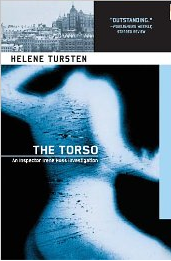
Day 150: The Torso

Cover for The TorsoThe Torso is a pedestrian police procedural by Helene Tursten. A torso washes up on a Swedish beach. The investigation finds that a similar murder occurred in Copenhagen, so Detective Irene Huss travels there to consult with the Danish police. Victims are being strangled and then after death dismembered and their organs removed. Not only are the leads to the murderer few, but the police are having difficulty identifying the original torso.

The novel is ploddingly written with no particular suspense. The characters all remain sketchily depicted except Huss, and her every thought is recorded, no matter how mundane. Unfortunately, many of her thoughts are mundane. Every character is thoroughly described including each person’s changes of outfits.

Speaking of Huss’s thoughts, despite having a loving husband and two teenage daughters, she seems to be prepared at one point to launch into an affair with a Danish policeman without any thought at all for her family.

My biggest negative reaction has to do with unlikeliness in the investigation. Perhaps police procedure is different in Sweden than here, but I was surprised to find the coroner providing a profiler lecture based upon one examination of the body and a lot of supposition. For example, there is an assumption throughout that the organs are removed to be eaten, even though there is no proof of that. In addition, the reactions of Huss and other offficers to some sights and remarks seem to be implausibly squeamish, considering their positions. It also seems implausible to me that the team would retain the obnoxious alcoholic cop Jonny, who seems to be incompetent to boot. Rather than assume Swedish procedure and police behavior is that different, I am inclined to believe that Tursten doesn’t know anything about criminal investigations.

Finally, the denoument of the novel is anticlimactic. The murderer has been stalking Huss, so we might expect a terrifying finale. No such thing happens. Although the novel is clearly meant to appeal to those who like dark, gruesome fiction, it completely fails to provide any suspense or atmosphere.