Review 2700: World of Wonders

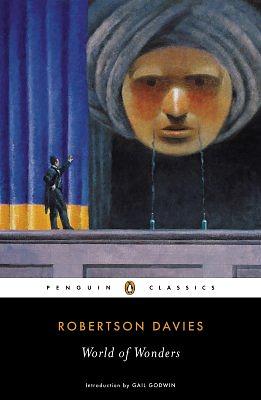
World of Wonders is the third book of Robertson Davies’ Deptford Trilogy and the one I least got along with. All three books deal with the repercussions of a malicious act—a snowball with a rock in it that Boy Staunton threw at Dunstan Ramsay when they were boys.

To make any sense of the plot of this one, I have to recap the action of the first book, so if you are planning to read it, you might do better to just read my review of it, Fifth Business. Boy’s snowball hits, not its intended target because Ramsay ducks, but the pregnant wife of the vicar, Mrs. Dempster. Her son Paul is born prematurely, and Mrs. Dempster is not quite right thereafter. Paul disappears as a boy and reappears after years and years as Magnus Eisengrim, the world-famous magician. Fifth Business ends with Boy Staunton’s possible suicide/possible murder with the selfsame stone in his mouth just after Boy meets Magnus. Did Magnus somehow murder Boy?

In World of Wonders, Dunstan Ramsay, now an old man, is living with Magnus and his friend Liesl. Magnus is starring in a film about another magician, French illusionist Robert-Houdin, and three of the film makers are visiting. Magnus has published a largely imaginary biography through Dunstan and now he agrees to tell the true story of his life from the time he disappeared as a boy. It’s quite harrowing at first, because he was kidnapped by a small-time magician in the World of Wonders carnival, held captive, and repeatedly sodomized. That’s just the beginning of an unusual and varied life.

I thought the story of Magnus’s life was interesting, but after each segment, his friends sit around and philosophize about it, maybe the sort of discussion that is exciting and interesting when you’re engaged in it but frankly not very interesting to read, at least not to me. I thought we were leading up to some surprising exploration of Boy Stanton’s death, but that wasn’t exactly how it ended, or at least what was revealed was not surprising.

Of the three books, I really enjoyed Fifth Business. The Manticore, from the point of view of Boy’s son David, was less interesting because of its emphasis on Jungian therapy. And I found this book the least interesting. In fact, I kept putting it down and reading other things, which is not usual for me.
Related Posts

Fifth Business

The Manticore

The Bird Artist

Review 2637: The Manticore

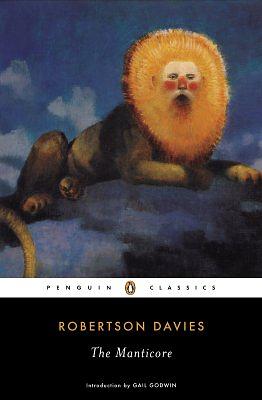
The Manticore is the second volume in Robertson Davies’ Deptford Trilogy. The trilogy itself is about the ramifications through several people’s lives of one malicious act—a snowball with a rock in it thrown by Boy Staunton at Dunstan Ramsey when they were children.

Davies takes up this story again in The Manticore with the next generation, specifically David Staunton, Boy’s son. At the end of Fifth Business, Boy was found dead, having apparently driven himself off the end of a pier, but oddly found with a stone in his mouth. David is a successful, much-feared criminal attorney, but he realizes he drinks too much when he finds himself shouting during a magic show, “Who killed Boy Staunton?” This scene has all kinds of ramifications that David himself doesn’t know about but we do, because we learned in the previous book that the magician, Magnus Eisengrim, was the self-reinvented baby who was prematurely born after the throwing of that stone and may somehow be responsible for Boy’s death.

Davies uses the device of having David seek therapy to develop the story more, in particular what a horrible father Boy was despite David’s continued regard for him. (In fact, it’s fairly clear that Boy was a horrible person in many respects, despite the general respect for his wealth and accomplishments.) In this way, David is an unreliable narrator because there are so many things he doesn’t understand that others, including the readers, do.

To keep his therapy a secret, David goes to Switzerland and seeks the help of Jungian psychiatrist Dr. Johanna van Hallen. This therapy begins on page 7 and lasts for most of the book, so David tells story after story and Dr. van Hallen talks him through therapy. I have no idea if these discussions truly reflect Jungian therapy or if the therapist would indeed go into discussions of archetypes and so on, but the stories were far more interesting than the revelations of Jungian techniques.

The ending of this book I found a little too symbolic and fantastic—in a mild way. I’m not sure how I feel about this book overall.

Related Posts

Fifth Business

The Northern Lights

The Bird Artist

Review 2489: #1970Club! Fifth Business

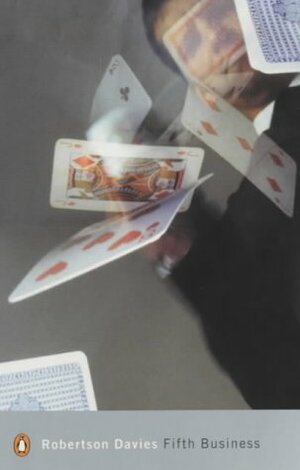
I have long meant to read something by Robertson Davies, so when I saw that Fifth Business qualified for the 1970 Club, I got hold of a copy. This novel is Davies’ fourth book and the first in his Deptford Trilogy.

In the 1910s, Dunstable (later called Dunstan or Dunny) Ramsey is ten years old when a snowball thrown by Percy Boyd Staunton locks his fate with that of Staunton and two other people. Dunny knows that Staunton, who is rich and a bit of a bully, is planning to hit him with the snowball, so he gets behind Reverend Amasa Dempster and his young, pregnant wife for protection. Staunton throws the snowball anyway and hits Mrs. Dempster in the head. She has a kind of hysterical fit, goes into premature labor, and gives birth to Paul, who has to be tended carefully to keep him from dying. This work is done by Dunny’s mother. Mrs. Dempster is not quite all there after this experience. Dunny’s guilt at having tried to use the Dempsters as a shield leads him to a lifelong connection with Mrs. Dempster and a more sporadic one with Paul.

Dunstan begins with this story in telling his headmaster about his life, because he feels diminished by the speech about him made at his retirement party. He claims to be fifth business, a theater and opera term used of a character who does not seem important but is required for the plot to work.

I found this novel fascinating, because it goes on, telling the events in Dunstan’s life in an interesting and entertaining way, but you wonder where it’s going. Then, in a breathtaking last few pages, Davies ties together all the major events and principal characters. Warning to everyone: the book reflects misogynistic tendencies, not a surprise for the earlier time setting of the book, beginning before World War I and continuing after World War II (or for 1970, for that matter). But what a book!

Related Posts

The Northern Lights

The Bird Artist

Road Ends