
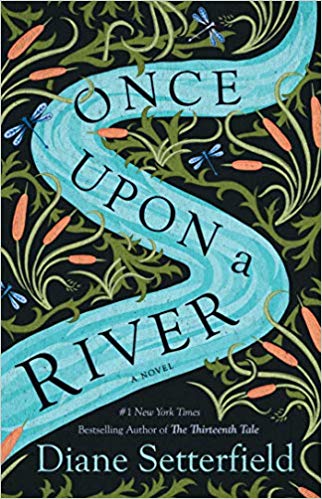
 Here we are with another novel that was difficult for me to rate. On the one hand, it is more fairy tale-like than is usually my taste. On the other hand, it kept my attention. Yet again, it presents us with a mystery that isn’t very difficult to solve.
In an inn along the Thames at an unspecified period in time, the patrons and owners occupy themselves with telling tales. One dark night, however, a tale comes right to the house. A man staggers in, all beaten and bloody, carrying what appears to be a puppet. It turns out to be a little girl, apparently dead. Indeed, when the local nurse, Rita, is summoned, she sees that the girl has dilated pupils and no pulse. But something doesn’t seem right, and the girl comes back to life.
She doesn’t speak, however, and no one knows who she is. The injured man, Henry Daunt, only saw her in the flood before he lost his boat.
Soon, there are several possible identities for the girl. Robert Armstrong finds a letter for his son, Robin, from a woman begging for help for her and his daughter. When Robert goes to her, she has just committed suicide and no one knows what happened to her four-year-old daughter, Alice. Lily White, the parson’s housekeeper, says the girl is her sister, Ann. Then the Vaughns claim her. Two years ago, their daughter, Amelia, was kidnapped. When they paid the ransom, the girl was not returned.
There are problems with all these stories. Robert Armstrong has never seen his grandchild, and his son, Robin, seems to be unsure whether the girl is Alice. Sadly, Robin is frequently up to no good. Lily is far too old, in her forties, to have a four-year-old sister. Finally, although Helena Vaughn is convinced the girl is Amelia, Anthony Vaughn, Rita can see, clearly doesn’t believe it.
Lots of secrets come out before we learn who the girl is, or rather, because I thought it was obvious, have it confirmed. In addition, there are lots of subplots, like a stolen pig, a runaway boy, a mysterious visitor, that all somehow related to the book’s central mystery.
The novel has some really rotten bad guys, as all fairy tales must have. It also has some very likable characters, in particular, Henry Daunt, Rita, and Mr. and Mrs. Armstrong. I think that readers who enjoy fairy tales will like this book and some others will, too.


 What? Me Read?