
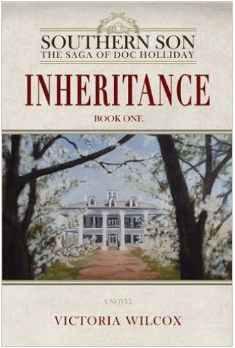
 It seems extremely difficult to write a novel about an actual historical person. The writer must strike some kind of balance between doing justice to the person and to actual events and inventing details and dialogue to make the novel interesting. As well as having to invent huge swaths of the subject’s life, I am guessing that the author sometimes has to struggle with whether to include all the known events, especially if they don’t fit in with the author’s view of the subject’s character.
Inheritance, the first book of a trilogy about John Henry (Doc) Holliday, shows evidence of a great deal of research. It begins when Holliday is ten years old, shortly before he finds out his mother is dying from tuberculosis, or consumption. The novel follows his life until his departure from his home state of Georgia for Texas when he is twenty-one.
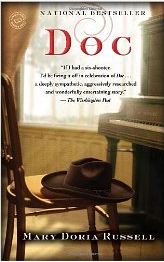
The engaging Doc by Mary Doria Russell, which I read a few years ago, revealed Holliday as a much-misunderstood individual, demonstrating how his reputation as a gunslinger was exaggerated by the press from a few incidents, showing his innate courtesy and all his contradictions. Despite its obvious intentions, Inheritance had the opposite effect on me, at times making me lose a considerable amount of my sympathy for him.
One false step is taken, I think, by starting the story so early in his life. He is supposed to gain our sympathy as a motherless boy with a stiff and judgmental father, but the depiction of children in this novel is not convincing. In fact, at the beginning of the novel I was troubled by flat characterization, as most of the main characters’ relatives and acquaintances have only one quality. His cousin Robert is competitive, his mother and cousin Mattie are loving, and so on. Only very slowly do some of the characters develop a few other dimensions.
The novel is written in a workmanlike style, a little too given to clichés, but certainly fluent enough except for a tendency to use “refugee” as a verb. There is some evidence of this usage as a colloquialism, especially during the Civil War, but it is used here in the narrative as well as in the dialogue.
Although the point of view appears to be third-person limited, at times it slips into third-person omniscient, which causes some confusion and a problem. Certainly, I do not hold with changing a person’s views to make that character more acceptable for the current time. Even when a fictional historical character has too modern a viewpoint, that bothers me. Holliday is definitely depicted as a racist who treats African-American characters even worse than I would expect from a character self-described countless times as a “gentleman.” So, when the reader cannot always discern the attitudes of Holliday from the attitudes of the narrator, the effect is unfortunate.
Overall, Inheritance is a novel that balances a great deal of knowledge of its subject with some inexperience in writing.
I received this book through a giveaway from Unabridged Chick.
 What? Me Read?