Day 1031: A Country Marriage

Cover for A Country MarriageMary Springer marries George Strong even though she hardly knows him. She has been raised with the idea that a good marriage is her only option in life, and George is a good catch. His family owns the farm of Summerleas, and even though he is not the oldest son, she will be provided for. What Mary doesn’t know is that someone else wants her new husband, Annie, his brother Tom’s wife.

Mary has other surprises in store. She is not to live at Summerleas after all, because the farm will not support the two youngest sons. Instead, she and George will live at dark, damp Keeper’s Cottage. Also, George has only one idea about their intimate life, and it doesn’t include affection or companionship.

George is also involved with a group called the Radicals, who are working for better pay for farm laborers. But they use extreme tactics, like destroying farm machinery and burning hayricks.

This novel conveys the difficult life of rural workers in the early half of the 19th century and covers an important issue of the times. I sympathized with Mary’s plight, but felt that some of her behavior later in the novel was completely out of character.

At some point, the plot devolves into a focus on two illicit love affairs. I didn’t find this plot line interesting, nor do I care for three-page-long sex scenes, although some may think they’re romantic. Goddard has given this novel a subtitle “A Summerleas Novel,” so she seems to be planning a series about the family. I didn’t have enough interest to continue, however.

Related Posts

Far from the Madding Crowd

Tess of the D’Urbervilles

The True Heart

Day 1021: Mariana

marianaAt the opening of Mariana, Mary hears that her husband’s ship has struck a mine and that there were many casualties. Her phone is dead and it is nighttime, so she must spend the night convinced her husband is dead. She goes back in her memory to her childhood, adolescence, and young adulthood to consider how her life began.

As a young girl, Mary lives for her summer vacations at Charbury, her grandparents’ home, and it is Charbury she first remembers. Charbury means her wonderful room at the top of the house, her pony, and lots of running around with her cousins. In particular, this means Denys, with whom she is infatuated. Dickens’s descriptions of Charbury are delightful.

In the fall, Mary reluctantly returns home to the small flat where she lives with her mother and uncle, a largely unemployed actor. Her father married beneath him, but since his death Mrs. Shannon has insisted on her independence, and the small family struggles along. Certainly, her upbringing is unusual, because her mother and her brother are on the Bohemian side, although certainly affectionate guardians.

This novel follows Mary as she grows up and through her various relationships in her youth. We are pulled along by our interest in her and our curiosity about who she marries rather than by the plot. This novel is romantic without being a romance novel as such. Monica Dickens was Charles Dickens’s great-granddaughter, and she certainly inherited his ability to tell a tale.

Related Posts

Family Roundabout

Greenbanks

One Fine Day

Day 955: Family Roundabout

Cover for Family RoundaboutBest Book of the Week!
It is 1920, and the Fowler and Willoughby families are about to be united by marriage. The Fowlers are an old county family, now getting a little shabby, while the Willoughbys are forces in the town, wealthy but not so genteel. Up until now, the families have held apart, but in this generation there are friendships between the children. Now, Max Willoughby, good-natured and charming, will marry the determined and managing Helen Fowler.

The two families are headed by widows. Ever since she married her husband, Mrs. Fowler has hid her true self, whom she wryly refers to as Millicent, behind a façade of vagueness and stupidity that she calls Millie. Although she never seems to make a decision or take charge of anything, everything seems to get done they way she wants it.

Mrs. Willoughby is made of sterner stuff. She manages everything, including the family business and the lives of her grown children. When she tries to manage Mrs. Fowler over the wedding, though, it’s like pushing jelly around. Everything gets done, just as Mrs. Fowler wishes it to. From the beginning of the marriage, Helen is more like Mrs. Willoughby’s daughter than Mrs. Fowler’s.

Endpaper
Endpaper for the Persephone edition

Other future partnerships seem foreseeable from the wedding. Anice Fowler gets engaged to Martin Newbolt, a poor but intellectual young man who works in his uncle’s book shop. We can see trouble ahead because of Anice’s unspoken rivalry with Helen. The youngest Willoughby, Oliver, finds himself attracted to his young sister Cynthia’s best friend, Judy Fowler, who is looking beautiful and grown up at the wedding. Then there is the already married couple, Peter and Belle Fowler. They have a young daughter, Gillian, but things are not looking good for them. Peter is sensitive and mild-mannered, but Belle is a self-centered, temperamental beauty.

Family Roundabout follows the fortunes of the Fowler family and some of the Willoughbys through almost 20 years, until just before the war. Although it has many characters, I found myself deeply interested in their lives and problems. This is a compelling novel about the everyday lives of ordinary people, with an ending that eerily contrasts what we know about the coming war with what the characters don’t know. Although I don’t usually lose this perspective with fictional characters, it made me wonder what happened to them next.

Related Posts

Wild Strawberries

Greenbanks

Cheerful Weather for the Wedding

Day 934: One Fine Day

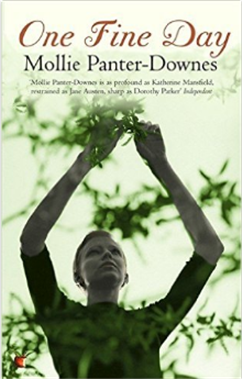
Cover for One Fine DayBest Book of the Week!
It is shortly after World War II, and Laura Marshall and her family are trying to return to normal life during the privations of post-war England. With only one part-time housekeeper, Laura is struggling with unaccustomed chores. The house and garden are beginning to look shabby, which bothers Laura’s husband Stephan, who struggles with the lawn every weekend.

The family is also having to accustom itself to living together again. Through the war, Laura and her daughter Victoria shared the house in a relaxed way of life with various female friends and children. Stephan is inclined to be more fastidious, while Laura is dreamy and untidy.

This novel takes place over the course of a fine summer’s day as Laura does her chores and thinks about a way of life that is disappearing. It is beautifully written, with evocative descriptions of nature. Barrow Down, which looms over the landscape, is an important feature of this novel.

This is a lovely short novel.

Related Posts

Enter Sir Robert

Greenbanks

Wild Strawberries


Day 905: The Rector and The Doctor’s Family

Cover for The Rector and The Doctor's FamilyThe Rector and The Doctor’s Family is in fact a collection of two novellas in Mrs. Oliphant’s Chronicles of Carlingford, the first two works, I believe. Out of order, I have already reviewed two of this series—Miss Marjoribanks, which I found delightful, and Salem Chapel, which was funny and moving. Fortunately, although these novels have some characters in common, they don’t depend upon one another except for incidentals and the occasional reappearance of characters.

The Rector, a very short work that is mostly a character study, begins on a comic note but then becomes more serious. Before Mr. Proctor, the new rector, arrives, everyone wonders whether he will be high church or low church. Upon his arrival, all Carlingford finds that they can’t tell what he is. Instead, they wonder if he will marry Miss Wodehouse.

Mr. Proctor knows nothing of women and is upset by the notion that he might marry, even though he first learns of this idea from his elderly mother. Soon, though, there is something more to concern him. Called in to comfort a dying parishioner, Mr. Proctor finds himself useless. His 15 years at All Souls College have not prepared him for certain of his duties. All his essays on religious doctrine are no help. Mr. Proctor is appalled, and doesn’t know what to do, and he is humbled when he sees that the young Perpetual Curate does.

The main character of The Doctor’s Family is young Dr. Edward Rider, who is trying to build a practice in Carlingford. He is a little bitter because his poor financial position obliged him the year before to give up the idea of marrying Bessie Christian, but instead he gained a more unwelcome burden. His shiftless older brother Fred returned from Australia five months earlier and has been lounging around the doctor’s home drinking and smoking ever since. Edward Rider has been all the more resentful because Fred’s behavior apparently cost him his previous practice.

To this unhappy household some unexpected visitors arrive. Edward is shocked to learn that Fred left behind him in Australia a wife, Susan, and three children. They have journeyed to find Fred, accompanied by Susan’s astonishing sister Netty. Edward is immediately attracted by Netty, who is small and dynamic. Fred’s wife Susan is lethargic and stupid and quickly shows a disposition to blame her family’s situation on Edward. Netty removes the household to its own lodgings and runs it single-handedly, taking on all the responsibilities of the family for the two lazy and irresponsible parents.

Now Edward has rid himself of his brother, but he haunts their household to see Netty and falls in love with her. But Netty won’t relinquish her duties. Who will do them if she doesn’t? she reasons. And she knows that Edward won’t be able to tolerate the situation with his brother’s family.

This little novel shows such a knowledge of human foibles. I was completely captivated by the story of Edward and Netty, even while realizing that Netty would not be thanked for her efforts. I was also not at all sure how the story would end, because Oliphant often surprises us.

Related Posts

Salem Chapel

Miss Marjoribanks

The Warden

Day 892: Wild Strawberries

Cover for Wild StrawberriesThis title does not refer to the Ingmar Bergman film but to the second (or third, depending on where you look) Barsetshire novel by Angela Thirkell. Unlike the others I’ve reviewed lately, Wild Strawberries was written before World War II. It is a delightful and gentle comedy with a romantic triangle.

Wild Strawberries is about a summer with the Leslies. Lady Emily is universally adored, a vague woman always leaving a trail of her possessions behind. She is also a managing type whose attempts to arrange things that are already decided repeatedly throw the family into chaos. The novel opens with a hilarious scene in which the family is late for service and disrupts the sermon while Lady Emily tries to tell everyone where to sit. Lady Emily is the mother whose passing is much lamented in Enter Sir Robert, which I reviewed a few months ago.

And if I am not mistaken, Agnes, a daughter of the house, is the same Lady Graham who is a major character in Enter Sir Robert, and as in that novel, Robert is continually referred to but not present. Agnes is a young mother with three children, kind but silly, and entirely obsessed with the children.

Other members of the household are Mr. Leslie, gruff but kind, sons John and David, and grandson Martin. Martin is the son of the Leslies’ deceased oldest son. John is a widower who has been mourning his wife Gay. David is a charming but selfish playboy.

The Leslies have invited Mary Preston to spend the summer with them while her mother recuperates at a spa on the Continent. Mary is Agnes’s niece by marriage, and her affections play a major part in the plot. She is a young, naive girl who is immediately charmed by David. John, on the other hand, falls in love with her when he hears her singing. We find ourselves rooting for John, but in Thirkell’s novels, the characters we like best are not always successful in love.

Providing humor are a visit from Mr. Holt, a toady to the upper class and expert on gardens, who invites himself to visit the Leslies, and the establishment at the vicarage of a French family. Seventeen-year-old Martin gets himself embroiled in a demonstration to restore the French monarchy, and Mr. Holt finds himself rewarded for his gate-crashing by being entertained by Agnes and her children.

This is a delightful novel with sympathetic and engaging characters and a great deal of humor. I enjoyed it very much.

I have to say that my Moyer Bell edition (not the one pictured above) was riddled with typographical errors, including a chapter that literally ended in the middle of a word, to be completed after the next chapter title. I just picked this up at a used bookstore, but next time I buy Thirkell, I will look for a Virago edition.

Related Posts

Enter Sir Robert

Miss Bunting

Happy Returns

Day 876: The Diary of a Provincial Lady

Cover for Diary of a Provincial LadyBest Book of the Week!
The Diary of a Provincial Lady was popular again quite a few years ago, but I didn’t read it then. Now that I have read it, I wish I’d read it earlier.

Considering that I have little in common with a 1930’s suburban upper-class English housewife and mother struggling with servant problems, I found this novel very funny.

The novel begins with a visit from Lady B., for whom the narrator’s husband Robert works as a land agent. Lady B. is in turn patronizing and demanding, first nearly sitting on the indoor bulbs, then questioning where the narrator got them and telling her where she should have got them, then telling her it’s too late to plant them anyway. The bulbs appear throughout the novel as a running joke. They get moved to the basement and then to the attic, are over-watered and under-watered, get stepped on by Robert when he is bringing down the suitcases, and are nibbled by mice. What they don’t do is bloom.

The house is made lively by a constant stream of visitors, including Our Vicar’s Wife, who always must be getting along but stays another hour. Another less pleasing visitor is the hearty Miss Pankerton, who barges her way into invitations and thinks nothing of bringing along an extra three people and two dogs on what was supposed to be a family picnic.

The narrator has two lively children—Robin, who makes frequent visits from prep school, and Vicky, who is at  home with a very French governess, Mademoiselle. I had to break out Google Translate for Mademoiselle, who continually manages to insult her employer and persists in being overly dramatic.

The narrator’s husband is taciturn except when complaining about expenses or the condition of the house, but he never denies her and is often kind. Many paragraphs, though, end with “Robert said nothing,” which begins to be very funny after a while. In fact, there is a lot that Robert finds nothing to say about. Meanwhile, the poor narrator is constantly scrambling for money, hocking her grandmother’s jewels and so on, to be able to keep up a decent appearance.

To some extent Delafield is depicting types but they also seem like real people, very funny real people. Delafield’s sense of humor is dry. Particularly amusing are her memos to herself and her queries. For example, after arguing with the children about washing up for tea:

(Mem: Have sometimes considered—though idly—writing letter to The Times to find out if any recorded instances exist of parents and children whose views on this subject coincide. Topic of far wider appeal than many of those so exhaustively dealt with.)

All I can say is, I can’t tell you how many times a page I chuckled, or just plain laughed out loud.

Related Posts

Where’d You Go, Bernadette?

Love in a Cold Climate

The Pursuit of Love

Day 867: The Squire

Cover for The SquireI don’t think I paid attention to what The Squire was about when I picked it up. Instead, I homed in on the author’s name when selecting it from a list of Persephone books. I’m not sure whether I would have picked it out if I had noticed, since it is about childbearing and motherhood, something I have no experience with. Further, some of the attitudes expressed, particularly about the role of men, are very out of date, although well in tune with the novel’s time.

The squire, who is known only as that through the novel, is a woman past 40 who is due to give birth. With her husband away, she is trying to run her household in the last days of her pregnancy, and there are quite a few crises, particularly with the servants. The squire already has four children, the youngest about four, and she spends a lot of time observing them and thinking about their characters.

There are some things about this novel that I found very foreign. One is how much time the squire spends thinking about death. First, I thought this was because she was about to give birth, but later she considers the same trait in her daughter Lucy, who is only 11 or 12. The other was my surprise at the role of the midwife, who is there more for after the birth than the birth itself. She keeps the squire almost totally isolated and quiet, trying to get her milk to come in correctly. What a contrast to today, when women are practically booted out the door of the hospital. But also, there is a strong class aspect to this and to all the squire’s problems. A woman from another class would have to take care of all her children during this time, unless she was lucky enough to have a neighbor or family member to help, and her biggest concern wouldn’t be hiring a new cook or nursemaid.

I found some aspects of this book interesting, but I didn’t really relate to the main character. But then again, I also felt some distance from The Happy Foreigner, so maybe my problem is with Bagnold as a writer rather than the subject matter of this novel.

Related Posts

The Happy Foreigner

The Land of Green Ginger

Someone at a Distance

Day 859: They Knew Mr. Knight

Cover for They Knew Mr. KnightBest Book of the Week!
At the beginning of They Knew Mr. Knight, the Blakes are an ordinary, relatively happy middle-class family. Things are fairly tight for them financially, and their house is too small for the family. The two girls, Freda and Ruth, share a small room, and the boy Douglas lives up in the cold attic. Still, only two family members are discontented. Thomas Blake has always resented his feckless father having sold the family factory just as Thomas was old enough to work there and learn the business. He works there but only as an engineer, not as the owner. And his father left his mother and siblings penniless, so that Thomas and his wife Celia have had to support them ever since, his brother Edward being unable to hold down a job. The other discontented family member is Freda, the oldest girl, who dreams of leading a wealthy and fashionable life.

On the way to work one morning, Thomas saves Mr. Knight from falling on the stair to the train. Mr. Knight is a wealthy financier, and he immediately takes Thomas under his wing. He helps him buy back his family’s factory and gives him tips on investments. Soon, the family is doing enough better to move into a bigger house.

But Celia doesn’t like Mr. Knight or the effect he has on Thomas. She doesn’t like how Mr. Knight leaves Mrs. Knight alone all the time and flaunts his young mistress before her. She doesn’t like how Thomas has become a little self-important and doesn’t confide in her anymore or spend as much time with the family. She doesn’t like their new house and misses her old busy life.

As the Blakes’ fortunes improve, we get a growing sense that all will not be well for long. Celia finds herself in a big house with maids and nothing to do. Her new garden doesn’t inspire her, and the children are grown and going about their business. The two eldest have unhappy love affairs, both with charming but morally lax people they meet at Mr. Knight’s parties.

Through all this, Mr. Knight himself remains a shadowy figure, appearing seldom. He seems generous, but we already know he is restless and prone to losing interest in projects. We wonder what will happen when he loses interest in Thomas, who keeps trying to pay back the money he owes him, only to have Mr. Knight point him toward a new investment opportunity.

Celia is the main character in this novel, which manages to build up a fair amount of suspense over everyday concerns. Part of the novel touches on her spiritual needs, as she has sometimes felt she’s had a glimmer of the knowledge of God and wishes she could get closer to it.

I was completely gripped by this novel and its picture of the fleeting quality of happiness, the corroding effects of greed. Except for Mr. Knight, the main characters are mostly very human and likable. You want the Blakes to come through their acquaintance scatheless, but you know they will not. If it’s not telegraphing too much about the book to say so, this novel reminds me very much of The Way We Live Now by Anthony Trollope, only we are more attached to the characters.

Related Posts

Someone at a Distance

Greenbanks

A View of the Harbour

Day 820: Enter Sir Robert

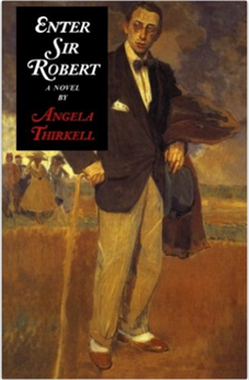
Cover of Enter Sir RobertLady Graham and her youngest daughter Edith are the main characters of Enter Sir Robert, set in post-World War II Barsetshire. Thirkell relates her novels as if she’s personally telling you a story, and although all the novels are set in Barsetshire, this one seems a little more rural than the others I’ve read recently. People are always running off to look at the pigs.

Lady Graham is a charming woman whom everyone loves, although she is a little scatter-brained. With most of her children married and her husband, Sir Robert, almost always away on some vital service to the nation, she has only Edith, who is 18, left at home.

Mrs. Halliday has an invitation for Edith. Her daughter Sylvia, who is expecting, is coming for a visit. Mrs. Halliday would like Edith to stay for a while to be company for Sylvia. Mrs. Halliday is taken up with Mr. Halliday, who is not well, and her son George has been working the farm as best he can alone. Meanwhile, Lady Graham is preparing a small memorial service for the anniversary of her own mother’s death.

Edith enjoys herself very much at the Halliday’s, visiting with Sylvia, entertaining Mr. Halliday, and viewing the farm with George, who seems to like her company. When the Hallidays all go to view the Old Manor House, which they have been leasing to a bank, they meet Mr. Cross, son of Lord Cross and also a delightful young man.

Like Thirkell’s other novels, Enter Sir Robert depicts the everyday life of the people of a certain social station with wit and humor. Her characters are mostly nice people, with only a few barbs directed at the bishop. The countryside is lovingly described, and there is always a little light romance. They are a pleasure to read. Oh, and if you care to read this one, you’ll find that the title is Thirkell’s little joke.

Related Posts

Happy Returns

Miss Bunting

Barchester Towers