Day 453: Burial Rites

Cover for Burial RitesBest Book of the Week!

Based on the true story of the last woman to be executed in Iceland, Burial Rites is an unusual and original novel.

Agnes Magnúsdóttir has been found guilty of the murder of her employer, Natan Ketílsson, and another man when the novel begins. There is no doubt that Fridrik Sigurdsson committed the act, but Agnes and her fellow servant Sigrídur Gudmundsdóttir have also been found guilty on little more evidence than that they were present at the scene. The younger, prettier Sigrídur, who was Natan’s mistress and Fridrik’s fiancée, is being considered for a pardon, but Agnes is not.

Because Iceland does not apparently have facilities for housing criminals at the time, the District Commissioner Björn Blöndal decides to lodge Agnes until her execution at Kórnsa, the farm of the District Officer of Vatnsdalur, Jón Jónsson. Agnes has requested that the young Reverend Thorvardur Jónsson, newly ordained, supervise her spiritual welfare.

Jón Jónsson’s wife and daughter are horrified to learn they are to have a convicted murderess in their house. Reverend Jónsson, known as Tóti, is confused, feeling insufficiently experienced for the task and unaware that he has already met Agnes.

We first see Agnes on her way to Kórnsa. She has been kept in a storeroom, living in filth and seldom fed, since her conviction. When she arrives at the farm, she seems almost subhuman, grimy and greasy and so thirsty that she gulps down some dirty dishwater given her to wash in. Slowly, through her hard work and unobjectionable demeanor and their own basic decency, the family comes to believe Agnes may not be guilty of the crime.

Although the focus of this novel is the life on the farm and the evolving relationship between Agnes and the family of Jón Jónsson, we eventually learn the truth about the crime, as Agnes confides it to Tóti and the family.

Kent’s gift is for depicting the hard life of 19th century Iceland—the merciless fate of itinerant servants, the prevalence of gossip and superstition, the brutal conditions and physically demanding work. Kent also describes the mental landscape of Agnes, her memories, thoughts, and nighttime dreams, and less frequently those of Margrét, Jón Jónsson’s wife, and of Tóti.

This novel is evocatively written in beautiful, spare prose. It tells a heartbreaking and haunting story.

Day 386: Bridge of Sighs

Cover for Bridge of SighsOne of my favorite books from recent years is Richard Russo’s Empire Falls. Unfortunately, the problem with reading your favorite book of an author’s first is that the others may not quite live up to it. But Bridge of Sighs comes a little closer than some other Russo novels to my initial delighted feelings about Empire Falls. (I know, I’m a bit behind the times with this one.) This novel shares some of the same themes as Empire Falls and is set in a similar working-class, industrial small town, this time in upstate New York.

The novel is narrated principally by Lou Lynch, one of three main characters. Lou is writing a novel about his life, even though he admits it will probably be boring. The son of Lou, an optimistic, cheerful if not very bright milk man turned convenience store owner, and Tessa, a sharp, insightful bookkeeper, Lou has always felt as if his parents are in conflict, and he is on his dad’s side. We understand, though, that Tessa is not really in conflict with her husband and son, she just wants them to see reality as it is, not as they would like it to be.

Seeing things as they are is also a problem for Lou’s best friend Bobby. At least, Lou thinks of Bobby as his best friend, but that is one more thing Lou doesn’t see clearly. Bobby’s father bullies his mother, who is eternally pregnant. She runs away every time she gets pregnant, but he always finds her and brings her back. It isn’t until late in the book that we find there is more than one way to look at their relationship.

The book begins when Lou is sixty and traces back through his childhood and adolescence through the device of his novel. The adult Lou is married to his high school sweetheart Sarah, and they are soon to take a trip to Italy, hoping to visit Bobby, now Robert Noonan, a famous American painter who lives in Venice. But Robert isn’t answering Lou’s letters letting him know they are coming. This trip is an anxious one for both Lou and Sarah, Lou because he has hardly ever left his home town, and Sarah because she once had to decide between Lou and Bobby.

In the background is the story of the small town of Thomaston, an industrial backwater dominated by a tannery, the dyes of which used to color the river waters differently each day and resulted in high levels of cancer in the community. The town is dying. The tannery has finally closed.

The town is divided into three areas that are widely separated by class, even though Thomaston’s richest citizens are probably big fish in a small pond. As the story moves into the present time, the wealthier citizens begin moving away. But Lou doesn’t see any reason not to love his town or his life. Sarah has always wanted to travel and experience more, but they have stayed put.

The Lynch family, as Russo creates it, is a warm and welcoming one. Both Bobby and Sarah are attracted as youngsters to the little store by the promise of a substitute family, Sarah’s own being particularly bizarre. In the modern-time story, Lou’s father is dead, and his uncle Declan has gone away, but Lou’s son works in the store, and his mother still lives above it.

As the story moves back and forth in time, I felt myself occasionally tiring of Lou’s reminiscences, especially of junior high, where he spends an inordinate amount of time. As Bobby reflects when he returns to town during his senior year after being sent off to military school, he doesn’t understand why Lou continues to bring up those years as if they were good times when actually they were horrible and Lou was not treated well at school. I personally was much more interested in the current-time story, of which there is much less, even though I understood that its seeds are in the past. But then again, the fact that Lou dwells on the past is part of the point of the novel.

This novel possesses a few characteristics of postmodernism, without being exactly postmodern. Here perhaps Russo is dabbling in some of the techniques without going full-thrust for its inventiveness and irony. The alternating point of view among Lou, Bobby, and Sarah, the alternating time streams, the metafiction, and Lou’s essential untrustworthiness as a narrator, not because he is not truthful to us, but because he is not truthful to himself, all are postmodern techniques. Within the time and narrator changes, though, Russo proceeds with a traditional narrative style.

Russo’s writing is leisurely, and he likes to muse. Still, he creates some complex and attractive characters and makes you want to contemplate their lives with them. He is also one of the few writers willing to explore the theme of class in America, a theme that is very important to this novel.

Day 376: Where’d You Go, Bernadette

whered-you-go-bernadetteDespite the cover, Where’d You Go, Bernadette is not chick lit; however, it is a great beach read, and summer is almost over (except if you live in Texas, like I do)! This novel is quite a romp. It has a zany, ridiculous plot and is full of little jibes at such things as suburban mothers who are overly involved in their children’s schools, Microsoft, and Seattle.

Bee loves her mother, who is creative and funny, but Bernadette has managed to alienate the other mothers at Bee’s school. She is slightly agoraphobic, so she stays home most of the time and does not volunteer at school, and she has hired a virtual personal assistant to help her run errands, even though Bee’s father doesn’t approve. Bee’s father Elgie is a computer genius who is practically worshipped at Microsoft and is seldom at home.

Bee’s parents have promised her that if she gets perfect grades, she can have any gift she wants. She picks a trip for the entire family to Antarctica over Christmas. To Bernadette, the idea of such a trip is intimidating, but she thinks Bee deserves it, so she begins ordering supplies online and getting Manjula, her online personal assistant, to take care of travel arrangements.

However, Bernadette’s dispute with a neighbor (and school mom enemy) about blackberry brambles creates complications that are both appalling and hilarious. When Elgie gets drawn in, he misunderstands what is going on because of his ignorance of home events. Crisis ensues, and Bernadette disappears on the eve of the trip.

Elgie is convinced that Bernadette had a breakdown, but Bee refuses to give up on her mother. She decides to try to figure out what happened the last few weeks before her mother disappeared.

My description does nothing to convey how cheeky, inventive, and funny this novel is. It is told in an epistolary style through emails from Bernadette to Manjula, emails between plotting mothers who hate Bernadette, emails between Elgie and his administrative assistant, and Bee’s record of her search for her mother. Bee and Bernadette are appealing, even while Bernadette is going a little crazy. If I have one little quibble, it’s that I don’t believe the personality change that one character undergoes. Still, if you want something light and lots of fun, this is the book for you. I have to thank my friend Gunjan for this recommendation.

Day 371: A Good Hard Look

Cover for A Good Hard LookA Good Hard Look is a novel about the last few years of writer Flannery O’Connor’s life. The book begins with the wedding of Cookie Himmel and Melvin Whiteson, which Cookie believes has been ruined because Flannery’s peacocks made so much noise the night before that Cookie fell out of bed and gave herself a black eye. Flannery’s mother Regina insists that Flannery attend the wedding, but Cookie is not happy to see her there.

Lona Waters lives her life absentmindedly and takes pleasure only in the hour of solitude she has every day before her daughter Gina comes home from school. Then her friend Miss Mary asks her if she will give her awkward teenage son Joe a job, thereby eliminating her hour.

Soon Melvin Whiteson has struck up a friendship with Flannery, but he keeps it a secret from his wife because of her dislike of the writer. Cookie is busily serving on committees in town and trying to get Flannery’s books banned from the library, while Melvin, a successful New York banker who gave up his career to move to this small town in Georgia with Cookie, is feeling out of place and bored with his insurance job.

These seemingly mundane stories eventually result in tragedies that force the main characters to take a good hard look at themselves, as Flannery states is a technique she uses in her fiction.

The novel is well written but not evocative. It does not evoke the 60’s South, and my feeling is that it does not evoke Flannery O’Connor. I am not an expert on her or her life, but the incisive spirit I would expect from her is missing in this character. Napolitano uses O’Connor’s peacocks to great effect, but I found that the novel tidied things up a bit more neatly than I would expect from one inspired by O’Connor’s life and works. Finally, the character of Cookie is essentially a caricature of the southern junior matron, similar to Hilly Holbrook in The Help, although Cookie evolves a bit. Most of the other characters are only sketchily drawn.

It is rather risky to use an actual person as a main character in a novel, especially if you are not able to create a character who is convincing as that person. For a much better attempt at using a famous writer as a main character, see Colm Toíbín’s wonderful The Master.

Day 353: Friday’s Child

Cover for Friday's ChildFriday’s Child is one of Georgette Heyer’s funniest Regency romances. Although some of her novels are a bit closer to being “serious” romances (that is, with the emphasis on the romance, but always with witty dialogue), this novel is endearing in its plethora of foolish characters.

Anthony Verelst, the Viscount Sheringham, is a wild young man who is extravagantly wasting his inheritance on gambling and women, but his estate is left so that he cannot touch the principal unless he marries. He has fancied himself in love with the current reigning beauty, Isabella Milbourne, but he is not tempted to matrimony until he becomes fed up with his mother and her brother, one of his trustees, whom he believes is milking his estate. He proposes to Isabella, plainly expecting an answer in the positive, but piqued by his lack of ceremony, she rebukes him for his dissipated lifestyle. In a rage, he storms off, vowing to marry the first female he meets.

As he is returning to London from his mother’s house in the country, he meets Hero Wantage, a very young lady who is an impoverished orphan and a neighbor. He thinks of her as a little sister, so he has no hesitation in relating the tale of his misfortunes. When he tells her of his vow, she answers, “Silly, that’s me!” So, the heedless viscount throws her up into his curricle and drives her off to London to get married. Since she has long worshipped the Viscount, or Sherry, as he is known to his friends, and has been mistreated by her Bagshot relatives, she is happy to go.

The couple is naturally headed for trouble, for Hero is completely naïve and badly brought up, with no idea of how to behave in society. The heedless Sherry seems to feel that he can go on about his business as always without paying much attention to her, so she begins befriending the wrong people and otherwise falling into scrapes.

This novel features an outstanding cast of secondary characters, especially Sherry’s close friends–Gil Ringwood, a thoughtful young man who vaguely feels there is something wrong with the way Sherry neglects his wife; Ferdy Fakenham, a silly but warm-hearted dunderhead reminiscent of Bertie Wooster; and George, Lord Wrotham, a hot-tempered gentleman who constantly challenges other men to duels and is madly in love with Isabella. As a side comment, I think it is a hallmark of a good Heyer novel that the characters who would be the heroine and hero in a typical romance novel (that is, Isabella and George) provide some of the humor in her own novels, especially the devastatingly handsome George, with his exaggeratedly romantic behavior.

Heyer is one of my favorites for light reading, and Friday’s Child makes me laugh out loud, particularly when Ferdy gets it into his head that he and Gil are being pursued by “that dashed Greek we learned about at Cambridge. Kept lurking about in corners,” in other words, Nemesis. The characters are funny, the dialogue is witty, and the plot is full of twists and turns.

Day 343: Poor Caroline

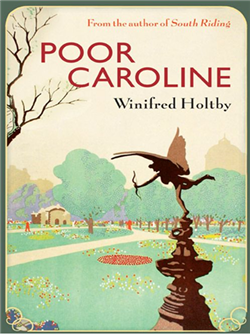
Cover for Poor CarolinePoor Caroline begins with the death of Caroline Denton-Smyth, a do-good spinster who has dreamed of forming the Christian Cinema Company, which will clean up the film industry. This satire of charitable organizations is a little different from the other Winifred Holtby novels I have read, which are about small town Yorkshire.

Caroline, an elderly eccentric, although virtually penniless, forms the film company and manages to put together a board of directors of dubious character. Basil St. Denis is an elegant dilettante who is hoping to use the charity to make some money. Clifton Johnson is a seedy American scammer. Joseph Isenbaum is a wealthy social climber (and not a Christian) who wants St. Denis to sponsor his son at Eton. Charles Guerdon is a Quaker nonentity, Father Mortimer is carrying scars from World War I, and Hugh Macafee is a film inventor who is obsessed with his work. The makeup of the board alone is an object for satire.

Caroline is in some ways admirable, with a buoyant, energetic personality, who devotes herself to one cause or another, only to have it fail or have the rest of the workers desert her. However, she is totally self-absorbed as she pursues her goals.

There are only two completely sympathetic characters in the novel. Caroline’s young cousin, Eleanor de la Roux, wants to learn to be successful in business and break ground for other women. Roger Mortimer, a young Anglican priest, wants to live a life of poverty and service and falls in love with Eleanor.

I am not sure whether I like this novel or what I think about Caroline herself. She is completely blind about her charities, and from the point of view of her relatives has cadged from them shamelessly for years. Certainly she is a believable type, reminiscent of Mrs. Jellyby in Dickens’ Bleak House, who spends all her time on charities for Africa while her children are uncared for and her house falls to pieces.

Day 308: Love in a Cold Climate

Cover for Love in a Cold ClimateLove in a Cold Climate is more of a companion novel to Nancy Mitford’s The Pursuit of Love than a sequel, because it focuses on a different group of characters. Fanny is still the narrator, and she returns to tell a little more of her own story but mostly that of her beautiful friend and distant relation Polly Hampton.

When Fanny receives an invitation to stay with the family upon their return from India, she is happy to renew her friendship with Polly. Polly’s demanding mother, Lady Montdore, has been pushing her toward marriage, but Polly resists. Polly has always been difficult to read, unlike Fanny’s Radlett cousins from The Pursuit of Love, who “told everything.” Although Polly is so beautiful that she could have her pick of the eligible bachelors, she tells Fanny that she finds the whole life of the social season boring.

Lady Montdore is a rapacious, snobbish manipulator with social ambitions, although not without charm. Another family member who is important to the novel is also a snob, “Boy” Dougdale, the husband of Polly’s aunt, Lady Patricia. Fanny and her cousins have always called Boy “the Lecherous Lecturer” because of his tendency to furtively grope very young girls. Much to everyone’s surprise, Polly’s secret comes out when, shortly after Lady Patricia’s death, she marries a reluctant Boy, for she has been in love with him for years.

Polly is ostracized from her family and cut out of her father’s will as a result. But the plot thickens upon the arrival of Lord Montdore’s heir, the effeminate and hilarious Cedric Hampton.

As usual with Mitford, we have a strong suspicion that all her ghastly and funny characters strongly resemble real-life society members of her time. Her novels are full of vivid characterizations and incisive dialogue. Even in today’s world, so removed from her own, her novels are extremely funny.

As a side comment about the cover art, I find the covers of the most recent editions of Mitford’s novels to be too romantic and to do nothing to convey the spirit of her novels. I was able to find a better cover for The Pursuit of Love, but this was all I could find for Love in a Cold Climate.

Day 297: Persuasion

Cover for PersuasionMost people have probably read Pride and Prejudice, which is a wonderful book, but if I had to pick my favorite Jane Austen heroine, it would be hard to decide between Elinor Dashwood of Sense and Sensibility and Anne Elliot of Persuasion. Probably fewer people are familiar with Persuasion.

Anne is no longer in the bloom of youth. Seven years ago she fell in love with a young naval officer named Frederick Wentworth, but Sir Walter, her superficial, supercilious father, did not approve. Perhaps the gentle Anne would not have been dissuaded from marriage, but her older friend and mentor, Lady Russell, talked her out of the engagement because of Wentworth’s lack of wealth and social position. Anne listened because she viewed Lady Russell as a surrogate mother, and she hasn’t heard from Wentworth since.

Now the family has fallen upon hard times, and Sir Walter is forced by his profligacy to lease their house and take rooms in Bath. He and Anne’s fashionable sister Elizabeth care very little for Anne, and they leave her to close up the house and make all the arrangements for its occupation by an Admiral Croft. Much harassed, she readies the house and tends to her hypochondriac, selfish sister Mary Musgrove. At least she enjoys the company of the children and Mary’s genial in-laws, with their two daughters Henrietta and Louisa and Anne’s brother-in-law Charles.

Anne meets the friendly Admiral and Mrs. Croft, and between their society and that of the Musgroves, begins to find a little pleasant enjoyment. However, she is soon dismayed to learn that Frederick Wentworth is Mrs. Croft’s brother, and he will be arriving soon. Wentworth is now wealthy and has retired from the service.

When he arrives, Wentworth pays little attention to Anne; in fact, she overhears him saying that she has changed so much he would not have recognized her. This remark distresses her very much, as her feelings have not altered. Soon he appears to be courting Louisa Musgrove. Anne finds it easiest to send Mary off into company while she stays home with her nephews.

After Louisa has a fateful accident on an outing in Lyme Regis, Anne finds herself taking charge and summoning help. Then she returns with Wentworth to notify Louisa’s parents. Feeling superfluous after the Musgroves leave with Wentworth for Lyme Regis, Anne decides she has no choice but to join her unpleasant father and sister in Bath.

What I love about Anne is her understated good will. Despite the insults by her family members and their general bad treatment of her, she tries to help them and to be a true sister and daughter to them. Despite Wentworth’s slights and attention to Louisa, she hides her feelings and remains faithful in her heart. Anne has much in common with Elinor Dashwood, except that Elinor is well regarded by her family and Anne is not. There is something delicate and understated in this novel, and in all of Austen’s work, that I appreciate in this more tempestuous modern world.

Day 276: The Best of Friends

Cover for The Best of FriendsJoanna Trollope writes contemporary novels about real people with realistic problems who live in small British towns and villages. It is one pleasure of reading her that she seldom presents you with a trite ending with all the loose ends tied in a pretty package.

Gina Sitchell and Laurence Wood have been friends since school but were never romantically involved. Their relationship was one that Hilary made sure she understood before agreeing to marry Laurence. Around the time of their marriage, Gina came home to Whittingbourne from living in France and soon married Fergus Bedford, an antiques dealer, and Gina and Hilary became fast friends. Now, twenty years later, Laurence and Hilary run a thriving hotel in the historical Bee House and have three boys. Gina and Fergus live with their only daughter Sophy in a home that Fergus has lovingly restored.

The marriage dynamic of Gina and Fergus has always been to argue, loudly and often. To Gina, nothing has changed, so perhaps that is why she is so shocked and overcome when Fergus coldly informs her that he is leaving her, has indeed been waiting for Sophy to get older before he did so. Then he takes exactly half of the furniture and goes.

Gina is so devastated that she imposes herself on Laurence and Hilary, leaving 16-year-old Sophy in limbo between her own, now unfamiliar home and her grandmother Vi’s tiny apartment. Sophy, who adores her father, is heartbroken and furious.

Between the diverse tasks of managing the hotel and raising three teenage boys and the burden of Gina’s presence, Hilary, first sympathetic, grows tired of the toll Gina’s drama is taking on her household. When Laurence isn’t working as the hotel chef, he seems to be spending all his time comforting Gina. Little does Hilary suspect that her own family life will soon be disrupted by Laurence’s discovery that he loves Gina.

Trollope creates fully realized characters in the two couples but also in their children, and in Vi and her aged suitor. Not all of them are likeable, but they are all convincingly human. I felt sorry for Gina at first, but my sympathy was soon evaporated by her self-centeredness and willingness to wreak havoc with her friend’s family. Fergus seems almost heartless at first, but we soon grow to understand him a little better. None of Trollope’s characters are bad, just people with ordinary complicated personalities who see things from their own points of view.

Trollope creates a story that you want to see resolved but never takes shortcuts to provide a typical happy ending, in fact seldom invents plots for which there could be one. Her novels are for adults, and they deftly explore the complexities and confusions of being human.

Day 255: Anderby Wold

Cover for Anderby WoldMary Robson is a young married woman who has been working for years to save her family farm, Anderby Wold. She even married John, her much older husband, whose hard work has kept it going these past years. She is a managing woman who thinks it is her duty to oversee the welfare of the village, making herself disliked by many. Because of her preoccupations, she seems much older than she actually is.

One day she encounters David Rossiter, a young radical journalist who disagrees with everything Mary believes in. David is trying to get farm workers interested in unionizing, and Mary becomes unsuitably obsessed with the younger man. The schoolmaster, Coast, becomes involved in the unionization issue expressly to make trouble for Mary, whom he detests.

Anderby Wold is an interesting slice of Yorkshire life in the 1920’s. It reflects the issues of the times, when farmers were facing increased demand for workers’ rights. Another of Winifred Holtby’s consistent themes that appears here is getting on with life after the death of a loved one. This novel is Holtby’s first, and its realistic depictions of village life of the times reflect her background as a journalist.