Day 243: The Pursuit of Love

Cover for The Pursuit of LoveIt’s always fun to re-read Nancy Mitford’s charming and funny autobiographical novel about her youth and young womanhood. Mitford’s alter ego is Linda, a young woman with terrible taste in men, who throws herself from one extreme to another in pursuit of love.

Mitford’s strength is her portrayal of peculiar but lovable characters, all modeled upon her own eccentric family or on figures in society. The novel is narrated by Fanny, a sensible but lonely girl who spends a lot of time with her cousins, the Radletts. Her terrifying Uncle Matthew (modeled on Mitford’s father) loves to hunt his children instead of foxes, a game the children love. Aunt Sadie is unutterably vague, which she probably has to be to live with Uncle Matthew. Uncle David is a cultured hypochondriac. The Bolter, Fanny’s mother, is supposedly a portrayal of Lady Idina Sackville, a famous society woman who kept leaving her husbands and was a member of Kenya’s famous Happy Valley set.

Mitford starts the novel with childhood–the children are hunted, hang out in the linen cupboard fantasizing about running away, and generally run wild–and follows the older girls into young adulthood. The novel finally centers on the story of how Linda first impetuously marries a stuffy banker who bores her silly, then leaves him for a communist who only thinks about his causes, and finally falls into the arms of Fabrice, a French duke who is a world-class womanizer. Characterized by facetious observations of society life and dialogue brimming with zingers, Mitford’s novel is a joy to read.

Just as an aside because I’ve recently read a few posts about cover design, I originally copied into this post the most recent cover of the book, which shows a romantic black and white photo of a debutant holding a bouquet of flowers with a pink banner for the title. I decided to replace it with this older cover (the one on the copy I have), which I think does a much better job of conveying the type of novel it is, much more of a social commentary than a romantic novel.
Day 199: South Riding

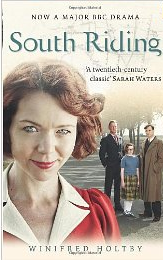
Cover for South RidingI had never heard of Winifred Holtby until I watched the excellent Masterpiece series South Riding. I enjoyed it so much that I picked up several of Holtby’s books. Holtby published 12 novels in the 1920’s and 1930’s, as well as pursuing a successful career as a journalist and nonfiction writer. She is known for regional fiction about Yorkshire and has a prize for regional fiction named after her.

Set post-World War I, South Riding is the story of the conflict between the landed gentry and social progressives in a Yorkshire town. Sarah Burton comes to town as the headmistress of a girl’s school. She has many progressive ideas and wants to improve the school and the quality of education provided to the girls. To accomplish her goals, she asks the town to invest more money in the school.

She immediately runs afoul of Robert Carne, a local landowner. He has very conservative ideas about the town and school, but he also has some heavy concerns. Previously prosperous, he has spent all his money on care for his mentally ill wife. He also has the care of a young daughter who is having her own problems.

Unlike the television series, the novel has a huge sweep and does not concentrate on Sarah, but presents the stories of about fifteen other major characters. It deals with issues like education, poverty, and governmental corruption as well as family relationships. The characters are all carefully delineated so that you feel that you know each one.

The novel is beautifully written, although it gets just a little preachy at the end. Some reviewers have compared Holtby to George Eliot because of her interest in local social issues and her breadth of scope.

Day 192: Home

Cover for HomeBest Book of the Week!

The beautifully written, subtle novel Home by Marilynne Robinson makes me thoughtful. It is 1957. After a failed ten-year engagement, thirty-eight-year-old Glory Boughton has moved home to Gilead, Iowa, to care for her elderly father, a retired Presbyterian minister.

Her father has been waiting 20 years for the return of his best-loved son, Jack. Finally, they hear that Jack is coming home. Always unreliable and setting himself apart from the family, he arrives late, and Glory feels ambivalent about his return. Soon, though, she sees that he is tired and having difficulty being there, and she tries to help him.

The novel carefully explores the relationships between the three of them–Glory loving but distrustful of the pain Jack has caused and protective of her father, Jack trying to make a new life in painful and distressed conditions, and their father forgiving and unforgiving at the same time. In the background are the events of the civil rights movement, toward which Jack and his father have radically different views.

Jack is delicate and fragile. He tells Glory he lived as a vagrant, drunk, and cheat until he met a woman named Della, and now Della has gone back to her parents. He tries to find work in town and writes countless letters to Della.

This novel is apparently related to a previous one, Gilead. I do not know whether it could be considered a sequel, although I know it shares some characters.

To modern readers the manners and dress of this devout Iowa family seem very old-fashioned, and some readers may find the novel slow, but I found it engrossing. It is, of course, a retelling of the tale of the prodigal son.

This is a simple story on the surface, but it depicts complex characters and relationships. It is a novel about family relationships and love, written with a delicate touch. I find it difficult to express how fine I felt it to be.

Day 173: David Copperfield

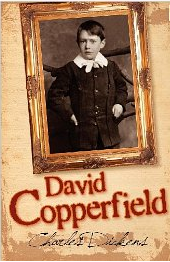
Cover for David CopperfieldBest Book of the Week!

I believe that David Copperfield was the very first book I ever received as a young girl that was not a children’s book. My dad brought it home for me one day when I was sick (beginning my collection of Modern Classics back when they were hardcover), and it transported me to another world.

People have differing opinions about which Charles Dickens book is best. For example, author Nick Hornby blogged that Great Expectations was one of the greatest books ever written. I myself have never fallen under the spell of Great Expectations, though. David Copperfield is my favorite. Tolstoy thought Dickens was the best of all English novelists and considered this book Dickens’s finest work.

David is the narrator of his own story, and he begins it on the night of his birth. David is a posthumous baby, and the novel begins with the first appearance of Aunt Betsey Trotwood, who comes to greet the appearance of her niece and terrifies David’s gentle, foolish mother. When David turns out to be a boy, Aunt Trotwood is mightily offended and departs.

Although David’s early childhood is idyllic, worshipped as he is by his mother and Peggoty the maid, it soon takes a turn for the worse. David’s mother is courted and won by the stern, apparently upright (and ultimately cruel and hypocritical) Mr. Murdstone, and the house is taken over by his cold and fault-finding sister Jane. David is a true innocent with only good intentions, but at every turn he is found to be in the wrong. He is soon shipped off to a typically horrible (if you know Dickens) boarding school.

After a bit of a rocky start, David finds himself made a pet of the popular Steerforth and also befriends Tommy Traddles. However, his mediocre education is interrupted when his mother and baby brother die. Mr. Murdstone sends him to London to lodge with the feckless Micawber family and work in a factory. When the well-meaning but impecunious Micawber is sent to debtor’s prison, David tires of his degrading life and runs off to find the only family he has left, Aunt Betsey Trotwood.

Although Aunt Trotwood is still disappointed that he isn’t a girl, she is kind, and from here, David’s life improves. The story continues with his education, marriage, and young adulthood. It is loaded with some of Dickens’s most delightful characters and a few villainous ones. Alternately turning from comedy to pathos, Dickens expertly drives the story along.

I believe one reason I find David Copperfield so touching is that David’s early life is taken from Dickens’s own. Dickens’s father was sent to debtor’s prison and Dickens went to work in a factory at an early age. This connection translates into a moving experience for the reader.

When innocent and loving David is punished by his stepfather because he is so terrified he can’t recite his lessons or when he is sent off to work in a factory, who remains untouched? When Barkis is willin’ or Mr. Micawber appears on the scene, who doesn’t laugh out loud? When steadfast and valiant Ham dies trying to rescue his rival, who isn’t tearful? When the slimy Uriah Heep finally gets his comeuppance, who isn’t delighted?

If you are not used to reading Victorian literature, you may find the writing old-fashioned, but you will almost certainly be carried along by the story.

Day 172: The Weird Sisters

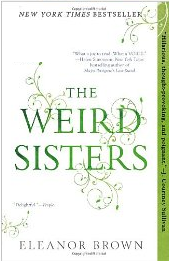
Cover for The Weird SistersRose, Bianca, and Cordelia Andreas are the daughters of a Shakespeare scholar who is obsessed with the Bard. From their earliest days they were taught to quote from Shakespeare plays, enact scenes, and use Elizabethan curses. Of course, they are named for characters from the plays. Their father’s way of communicating with them when they are away is to send them clippings from the Riverside Shakespeare. This is the setup for The Weird Sisters by Eleanor Brown. You might think such a gimmick would become tiresome, but it does not.

The three sisters have traits in common with their characters. Rose, like Rosalind, is smart and dutiful. Bianca is a flirtacious beauty. Cordelia is the much-loved youngest daughter. They are also a bit estranged from each other. Rose resents that she always has to be the responsible one, but Bean and Cordy think she takes too much upon herself. Both Rose and Bean are jealous of the unconditional love that Cordy receives from their parents. And Rose and Cordy think Bean has too great a need for attention, one that leads her to seduce men indiscriminantly.

When they receive a summons from their father because their mother has cancer (it says “Come, let us go; and pray to all the gods/For our beloved mother in her pains”), the lives of all the women are in disarray. Rose’s fiancé is about to leave for a  job in England, and he wants her to join him. She believes she is too urgently needed at home, where she is the organizer. Bean (Bianca) has been fired from her job in New York for embezzling the money she needs to perpetuate her lifestyle. Cordy has been living from man to man like a vagabond when she finds she is pregnant.

They all return to their crazy, poorly run childhood home, where piles of books are everywhere and all members of the family are perpetually reading but not, perhaps, cleaning. Slowly, the small town in Ohio that Cordy and Bean have been running away from begins to seem not so bad.

The Weird Sisters is an amusing, touching novel about how each of the women finds her path and reconciles with her sisters. It is extremely well written, and oddly enough, you do not tire of its devices.

Day 125: Arcadia

Cover for ArcadiaAfter reading Lauren Groff’s first book, The Monsters of Templeton, I was expecting something totally different, something perhaps more sinister. But Arcadia is a quiet and thoughtful novel. It is the story of Bit, the first child born in a group of a couple dozen hippies who are following a charismatic musician named Handy–essentially a bunch of groupies–during the 1970s. They are also idealists who want to create a utopian commune where they can support themselves entirely from their own efforts, living off the land. The book follows the rise and fall of the commune and its aftermath.

The first part of the book takes place when Bit is a young boy. The group has settled on a large estate in upstate New York to found their commune. Bit’s father Abe is a master carpenter and his mother Hannah is a baker and the group historian. We sense that Abe is the parent more fully invested in this way of life, as Hannah does not accept or observe all of the commune’s rules.

Hannah is a golden earth mother type who is active and ebullient in the summer but falls into severe depressions in the winter. One winter, Bit sets himself a test inspired by a fairy tale book he found in the ruins of the property’s mansion house by making himself a bargain to stop speaking until she comes out of her depression. Abe is absorbed with trying to organize the renovation of the house so that everyone will have a warm place to live, since for years they all have been living out of their cars and vans and homemade shacks.

In the second part, Bit is a teenager trying to cope with the disintegration of Arcadia, which is overcrowded with runaways, junkies, and other refugees from outside and having problems with the law. He is also in love with Helle, Handy’s disturbed but beautiful daughter.

The third part takes place a few years into a dystopian future. Everyone has left Arcadia. Bit is a photography professor living in New York City, a single parent mourning the departure of his wife. It is a time of social disintegration because of the forces brought about by climate change, especially a series of pandemics.

The novel is the work of a vivid imagination, as Groff is able to fully realize what it would be like to grow up completely cut off from the world, learning mores that are different from those of society, and how that would affect the rest of a person’s life. The novel’s biggest weakness is in having too many characters to get to know them well, especially in the middle section, where Bit’s teenage friends all sort of blur into each other. I found the tale interesting but at times slow moving, somewhat meditative, which I believe is intentional.

Day 82: Cotillion

Cover for CotillionOne of my favorite authors if I want the lightest of reading material and a good laugh is Georgette Heyer. Although I am not a romance reader, for her meticulously researched and comic Regency romances I have to make an exception. Her period pieces are absolutely convincing, as she was an expert on Regency dress, deportment, and speech. In fact, she became such an expert on the period’s idioms that she once was able to successfully sue a plagiarizer by proving that the expression the other writer copied appeared only in some records to which she had been granted private access.

But Heyer was also an expert at creating charming comic characters and situations. Cotillion is one of my favorites of her books, and one of the silliest.

Kitty Charing is an impoverished orphan who has been raised in discomfort by her miserly old guardian, “Uncle” Matthew Penicuik. A great one for manipulating his putative heirs, Uncle Matthew announces that he will leave his entire fortune to Kitty, but only if she marries one of his four grandnephews. Then he invites them all to come calling. Priggish Reverend Hugh Rattney and doltish Lord Dolphinton arrive, and the married Lord Biddenden comes to represent his rakish brother Captain Claud Rattney, but dashing Captain Jack Westruther, whom Kitty has grown up hero-worshipping, does not make an appearance, as he is unwilling to be manipulated.

Kitty is furious that Jack doesn’t appear, but even more furious at being put in this position. She soundly rebukes all of her “cousins,” except Lord Dolphinton, who is too stupid to be responsible for his actions and has been compelled to come by his mama. But then Uncle Matthew announces that if Kitty refuses to marry one of her cousins, he will leave her with nothing. What is a spunky Heyer heroine to do but run off into a snowstorm with only a few possessions and an impractical plan to get a job as a house maid?

She arrives at the local inn to find her cousin Freddy Standen, who has absolutely no idea why he has been summoned. Freddy, not the brightest of bulbs but a kind-hearted young man, is perfectly wealthy in his own right and has no intention of getting married. When he meets Kitty at the inn, she talks him into pretending an engagement with her and inviting her to go up to London so she can acquire some “town polish,” buy some nice clothes, and (she hopes but doesn’t tell Freddy) enchant Jack into a proposal.

Freddy, an expert in deportment and fashion who can always be relied upon to accompany a young married woman to a dance or concert, is not really a lady’s man. When he and Kitty arrive in London to find his harassed mother attempting to care for a house full of children with mumps, he is dismayed to find he is left responsible for a naïve girl who tends to fall into difficulties and odd friendships.

The novel is crammed with comic characters, such as Kitty’s foolish governess “Fish,” who has a turn for quoting romantic poetry; Freddy’s frippery married sister Meg, who wears color combinations that shock him to the core and spends her time trying to avoid her mama-in-law; Camille, Kitty’s real French cousin, who is impersonating a lord; Lord Dolphinton, who is terrified of his mother but strictly charged by her to get Kitty to dump Freddy and marry him; and the silly doe-eyed Olivia, whom Kitty befriends but Jack is pursuing to be his mistress.

Day 27: Major Pettigrew’s Last Stand

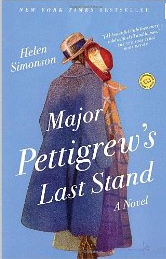
Cover for Major Pettigrew's Last StandBest Book of Week 6!

A touching love story, Major Pettigrew’s Last Stand is also a wry and witty jibe at small village life in England. Major Pettigrew is a proper widower who leads a life of quiet and habit, comfortable in his village and local golf club. Still suffering from the loss of his wife, he has just learned about his brother’s death and he is so shaken by this that he has a dizzy spell. Mrs. Ali, the widow of a Pakistani grocery store owner, has come to his house collecting for charity and helps him recover. The two begin a friendship based around discussions of books.

Besides missing his brother and wife, Major Pettigrew has other worries. He is concerned about his son, who seems only interested in money and prestige, and at times lacks gentility and honor, for which Major Pettigrew cares deeply. He is also concerned about his brother’s greedy wife and daughter, who do not seem likely to honor his father’s request that two valuable heirloom shotguns given to each of the sons be reunited when one of them dies.

Mrs. Ali is having her own battle with relatives. Her husband’s family wants her to give over her store to her religious fundamentalist nephew while she takes her expected widow’s place as a family servant.

Major Pettigrew must navigate the murky waters of village and family disapproval of his relationship because of racism and class snobbery and decide how much he wants to keep his quiet life. Mrs. Ali must in turn decide how much duty she owes to her family.

This novel is charming and delightful, one of my favorite books of 2011. Major Pettigrew’s dry and clever comments amused me throughout. The novel is beautifully written. I have been eagerly waiting to see what Ms. Simonson does next.