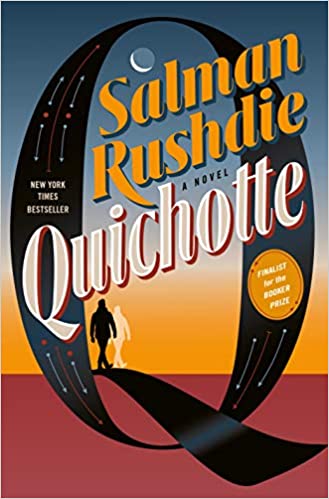
Review 1818: Quichotte

I was fairly sure I was going to hate Quichotte. I did not much like Midnight’s Children or Don Quixote for that matter, which Quichotte retells. However, this novel is part of my Booker project, so I opened it with hope.

Quichotte is Ismail Smile, an elderly consumer of all things TV who becomes infatuated with Salma R, a young TV star. He decides to go on a quest to earn the love of his beloved. This is a road trip, and for a partner he takes Sancho, his imaginary son. To add another layer, Quichotte is himself an imaginary character, created by Brother, a writer of spy novels who has decided to change his genre.

This novel is one full of circumlocution. As we meet each character—and we meet a lot of them—we go off on the tangent of that person’s life story. Further, there are lots of subplots, for example, the one about Smile’s cousin and employer, whose pharmaceutical company has developed a drug even more dangerous than OxyContin and who has himself developed a similar model to that of the makers of Oxy, delivering it in huge quantities to small rural communities.

The genre for this novel is fantasy and of course satire. Fantasy is not my genre, and although I wouldn’t have thought the same was true about satire, I have not enjoyed the satirical entries on the various shortlists. They all feel the same to me: ponderous, overblown, and written by old men. Definitely lacking subtlety. Even the reviewer from The Guardian remarked that the book was funny but not as funny as Rushdie thought it was. That is exactly how I feel about it, except I didn’t think it was very funny. I sensed Rushdie winking all the time.

Still, I was enjoying parts of the novel, although it didn’t seem to be getting anywhere. Then Sancho decided he wanted to be a real boy, and guess who popped up? Jiminy Cricket. At that point I had to restrain myself from throwing the book across the room (only because it was a library book), and I stopped reading.
The Finkler Question

You & Me

The Broom of the System

Day 707: Don Quijote

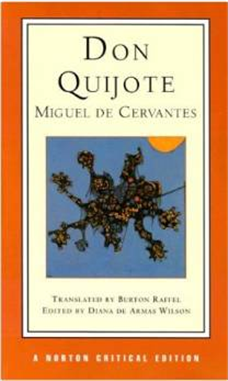
Cover for Don QuijoteI know. This is not the spelling of “Quixote” most people are accustomed to seeing, but it is the one used in my Norton Critical Edition, translated by Burton Raffel. And a sprightly translation it is.

Don Quijote is the story of an old man who has studied the popular chivalric romances so much that they have addled his brain. He declares himself a knight errant and takes to the road seeking adventure. Accompanying him is a neighboring farmer, Sancho Panza, who he has convinced to come with him as his squire in exchange for a share in certain rewards. In particular, Sancho has his heart set on the governorship of an island.

Don Quijote doesn’t just look for adventure. In the first book, he hurls himself at every passer by, convincing himself that windmills are giants, a barber is a knight, an inn is a castle. Above all else, he worships his lady, the beautiful Dulcinea, whom he has never met but whom Sancho remembers as a muscular peasant girl.

Don Quijote is both a parody of the chivalric romances and a satire against the Spanish conquistadores. Its most important distinction is that it is considered the first modern novel. I found volume one to be amusing in a sort of slapstick style, as Don Quijote’s adventures always go wrong and end up with him and Sancho Panza being beaten up.

Volume two was a little too much of the same, though. In a bit of metafiction, Cervantes lists some of the things readers criticized from the first volume and then attempts to avoid them. So, for example, the two adventurers are not beaten up as often. However, both volumes contain long disquisitions on such topics as marriage, poetry, chivalry that don’t all translate well into modern times.

Finally, after Don Quijote had himself lowered into Montesino’s Cave to see its wonders and then fell asleep and dreamt a bunch of nonsense and never even saw the cave, I had to stop. Quijote was in the midst of recounting his ridiculous dream, which he took for reality, and it seemed to go on and on. I leafed ahead, looking for the end of it, never found the end, and finally lost patience. I fully believe, since apparently someone else published a book about our hero after the first volume came out, that Cervantes only brought Quijote back out on the road so that he could kill him off at the end.

Related Posts

People of the Book

The Black Tulip

Othello