Day 176: Queens’ Play

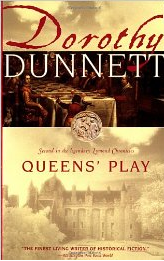
Cover for Queen's PlayBest Book of the Week!

Queens’ Play is the second book of Dorothy Dunnett’s excellent historical fiction series, the Lymond Chronicles. Although it is not absolutely necessary to read the first book, Game of Kings, you will enjoy the other books more if you do. If you decide to continue this series, it is important to read them in order after this one.

Francis Crawford of Lymond enters the scene disguised, and it is some time before we figure out which of two characters he is. Francis has been asked by Mary de Guise, Queen Dowager of Scotland and mother of Mary Queen of Scots, to travel to France and protect Mary. Although Mary is still a little girl, plots revolve around her, and her mother is afraid her life is at risk.

The Irish prince Phelim O’Liam Roe’s arrival into France is a spectacular one, as his ship almost crashes into another one when entering the harbor. This incident is perhaps not an accident, as evidence mounts that someone is trying to kill the prince. To the French court, O’Liam Roe is unbelievably provincial, and he is immediately the butt of ridicule. He is attracted to Oonagh O’Dwyer, an Irish woman living on the borders of society, but she disdains him. In fact, she is the mistress of the Irish rebel Cormac O’Connor.

O’Liam Roe has brought with him Thady Boy Ballagh, an ollav, or trained master poet. Untidy, fat Thady Boy is gaining popularity with the decadent French court through a series of reckless deeds and his brilliant musical performances.

It seems that the Queen Dowager’s fears are correct. During a hunt that employs the king’s leopards as hunting animals, someone lets Mary’s pet hare out in front of the cat near her pony. As she struggles to save her pet, the cat turns its sights on Mary.

As always, Dunnett combines heart-stopping action and suspense with a detailed knowledge of the period. This book begins some of the plot threads that will continue throughout the series.

Day 61: The Game of Kings

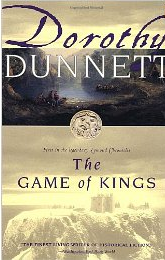
Cover for Game of KingsBest Book of Week 13!

If you love an authentic, well-researched, exciting historical novel that makes you almost feel like you are in the period, then I can’t recommend a better author than Dorothy Dunnett.  I have been trying to get people to read her for years with the caveat that her books are challenging, not for the reader of light romantic history.

Lady Dunnett is described on her Wikipedia page as a “leading light in the Scottish arts world and a renaissance woman.” Her books are loaded with detail about medieval customs, dress, politics, religion, food, and literature, and have labyrinthine plots full of action. She is most renowned for two series, the Lymond Chronicles, written in the 1960’s and 70’s and set in 16th Century Europe and Africa, and the House of Niccolò, written in the 1980’s and 90’s and set in 15th Century Europe, Asia, and Africa. Dunnett died shortly after finishing the last book in this series.

Game of Kings is the first book in my favorite series, the Lymond Chronicles. Francis Crawford of Lymond makes a rollicking and disruptive re-entrance into his home country of Scotland despite the charge of treason hanging over his head. He forms a band of outlaws and begins roaming around the countryside, sneaking across the border to play tricks on the British and harassing his own family. For quite some time, you don’t know whether he is a hero or a villain. He never explains himself, so it is left up to the reader (and the other characters) to figure out his motives for sometimes seemingly wrongful acts. His enemies think he is responsible for the explosion that killed his sister and is trying to murder his older brother Richard so he can inherit the estate. His friends are absolutely devoted to him but suffer doubts when he misbehaves, as he often does. His brother doesn’t know what to think, and his mother, Sybilla, is silent.

Francis is a mimic and a rogue, a musician and a polyglot, a poet and a swordsman, as swashbuckling a character as you will ever meet with in a novel. In among the action of cattle raids, impersonations, intrigues, duels, and archery contests, you actually learn a lot about Scottish history and politics.

Game of Kings is Dunnett’s first book, and my only criticism of it is that Lymond is a bit too fond of quoting poetry in antique languages. Most of it is incomprehensible unless you are a medieval scholar, but skipping over it does not hurt your understanding of the novel. Dunnett does this much less in the other books in the series. If you read this book and continue with the series, by the second book you won’t be able to stop.