Day 557: The Year of the Flood

Cover for The Year of the FloodThe Year of the Flood covers much the same time period as does the first novel of the Maddaddam trilogy, Oryx and Crake, only from the points of view of different characters. What the two main characters of this novel have in common is the Gardeners, an ecological religious cult.

Years ago, Toby was a pleeblander attending a mediocre college until one of the Corporations wanted her father’s land. After her father’s questionable suicide, Toby destroyed her identity and got along as best she could in the margins of society. When she found herself captive in an abusive relationship with a thug named Blanco, her friend Rebecca and the Gardeners came to her rescue. At the beginning of the novel, though, Toby is living alone in the Anoo Yoo spa after the Waterless Flood, long predicted by the Gardeners.

Ren lived in the elite Compounds where her father was a drug industry worker until her mother ran off with Zeb, a Gardener, taking Ren with her. She spent most of her childhood with the Gardeners until her mother split from Zeb and moved back to the Compounds, claiming to be a kidnapping victim. Ren is in isolation at the sex club where she works when the Waterless Flood occurs. Being locked away from others saves her from the plague.

Both women find they must leave their sanctuaries and venture out into a deadly world, the unintended consequence of the madness of Crake.

The Year of the Flood provides more insight about the events leading up to the Flood and the identities of the group calling themselves Maddaddam. The novel is ironically punctuated by the homilies of Adam One, leader of the Gardeners, and by Gardener hymns.

This novel is fascinating, full of sly humor and an incredible inventiveness. I can’t wait to read Maddaddam.

Day 516: Oryx and Crake

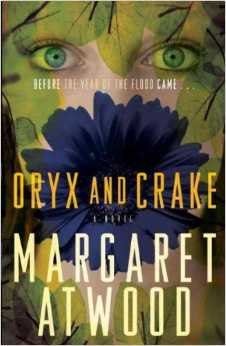
Cover for Oryx and CrakeBest Book of the Week!
Snowman may be the last human left on earth after the plague. He is not alone, though, because nearby is a race of human-like beings that his friend Crake bioengineered. Snowman himself lives like a vagrant—wearing nothing but a sheet in the unbearable heat from global warming, scrounging through the detritus of a lost civilization for food.

Snowman soon realizes that he will starve if he doesn’t return to the compounds for food. Not long before, he lived in a world where the privileged workers for the biochemical industry and their families lived apart in their own secure compounds. The other people, called pleeblanders, could fend for themselves. Gene splicing to create new species was rampant without regard for any consequences, and greed and consumerism all-important.

As Snowman makes his journey, he recalls his childhood with an embittered mother and oblivious father and his long friendship with Crake. Most fondly he remembers Oryx, the love of his life. Through these memories we learn how the world got into this dire situation.

This novel is both inventive and absorbing. Although Atwood’s descriptions of the pre-plague world with its abominations of nature seem comic at times, they are still horribly believable. This is dark humor with a knife edge about a world that has lost its sanity.

Oryx and Crake is the first of a trilogy, and I am looking forward to reading the other two volumes.

Day 200: Stranger in a Strange Land

Cover for Stranger in a Strange LandDay 200 for the blog!

First, let me preface this review of Robart A. Heinlein’s Stranger in a Strange Land by saying that I know this is a cult classic and my review may offend some die-hard Heinlein fans, if I have any readers who are die-hard Heinlein fans. So, let that be your warning.

The first sentence in my notes is “What an overrated book.” I read this novel long, long ago, and I vaguely remember thinking the first part was interesting but disliking the second part. Other than the barest outlines of the plot, that’s all I remembered. This time through, I liked the first part less and hated the second part.

Valentine Michael (Mike) Smith is the only survivor of the first manned mission to Mars. He was born on the mission to two of the astronauts and raised by Martians. Since that mission disappeared without a trace, no one knew he existed, so he is only discovered when a second mission goes to Mars. He is brought back as a young man, and political shenanigans ensue, especially when he turns out to be heir to a fortune. Besides these plot elements, the first portion of the novel deals, sometimes cleverly, with his adjustment to life on Earth. In the second part of the novel, he decides to start his own religion, which practices free love and teaches the psychic abilities he learned from the Martians.

The novel does not translate very well to the 21st century because of its blatant sexism and use of slang that I suspect was out of date when the book was published. The sexism is ironic in a way, because I believe that Heinlein would have thought his book was sexually liberating. Frankly, though, I don’t think that patting your female employees on the butt was considered liberated even in the early 1960’s.

Another criticism is that Heinlein appears to have no coherent vision of what a future world would be like. The novel reads as if he came up with a few ideas that he thought would be cool and interesting but not as if he sat down and imagined what fundamental changes might have taken place. For example, carpets are made of real grass, but he lacks the imagination to figure out that computers wouldn’t always need punch cards and we might not be using typewriters forever. As far as futuristic prescience is concerned, I would give a better grade to Jules Verne. My final point in this regard is that for a science fiction writer, he seems to know very little about science, and I mean the science that was known in his own time.

I think I could bear with these things because I generally have a rule not to judge a book on standards that are not of its own time. But the worst feature of the book for me was the hundreds of pontificating speeches made by Jubal Harshaw, a crusty author who I’m sure is meant to be Heinlein himself. Despite being presented in a conversation style, the speeches are pompous and pedantic and go on for pages and pages. Heinlein seems to be very proud of the ideas expressed and of the world Mike creates with his religion, but I think the environment in his church would give most people the creeps.

I made a good faith effort to finish the book, but I finally gave up less than 50 pages from the end. And if anyone says “grok” to me ever again, I’ll scream.

Day 163: Ghostwritten

Cover for GhostwrittenBest Book of the Week!

Ghostwritten, one of David Mitchell’s earlier books, is about the nature of fate and the strange interconnections between people and events in the modern world. In this unusual novel, Mitchell illustrates his points through the narrations of nine different characters, who at first seem only vaguely connected.

The novel begins with the crazed Quasar, a member of a religious cult who has fled to Okinawa after placing poisonous bombs in the Tokyo subway. As his sect falls apart, he waits for word and instructions from his leader, His Serendipity.

In Tokyo, Satoru, a teenage employee of a record store, falls in love with a pretty customer. In Hong King, Neal Brose, a financier who has conducted some shady business with a mysterious Russian, is letting his life fall apart after his wife leaves him.

In China, an old lady lives through the various upheavals of the 20th century while she tries to keep her tea shop on a sacred mountain from being destroyed, again. In Mongolia, an entity that can move from one human being to another tries to find out what it is and where it came from.

In Russia, Margarita Latumsky, a woman who has made her way in life by seducing powerful men and has landed a job at the Hermitage, is plotting with her gangster boyfriend to steal a Delacroix. In London, Marco Chance is a drummer, ghostwriter, and womanizer whose day isn’t going very well.

Mo Muntervary is a world-famous physicist who returns home to a remote Irish island after fleeing from the CIA for several months. Her decision to stop running has fateful results. Finally, Bat Segundo is a late-night DJ in New York who begins getting annual phone calls from the mysterious Zookeeper.

As these characters pursue their own activities and thoughts in a way that seems completely organic to their natures, Mitchell slowly and skillfully weaves their stories into a dystopian nightmare that works in actual events from the late 1990’s, when the book was written.

I am continually amazed by Mitchell’s imagination and intellect and his ability to write novels that are completely engrossing. Although not every technique he uses is completely successful–for example, there are real and metaphorical ghosts in the novel (in addition to the entity, whatever it is)–his approaches are all still interesting. Ghostwritten reminds me a bit of one of his later books, Cloud Atlas, which I admire very much.

Day 125: Arcadia

Cover for ArcadiaAfter reading Lauren Groff’s first book, The Monsters of Templeton, I was expecting something totally different, something perhaps more sinister. But Arcadia is a quiet and thoughtful novel. It is the story of Bit, the first child born in a group of a couple dozen hippies who are following a charismatic musician named Handy–essentially a bunch of groupies–during the 1970s. They are also idealists who want to create a utopian commune where they can support themselves entirely from their own efforts, living off the land. The book follows the rise and fall of the commune and its aftermath.

The first part of the book takes place when Bit is a young boy. The group has settled on a large estate in upstate New York to found their commune. Bit’s father Abe is a master carpenter and his mother Hannah is a baker and the group historian. We sense that Abe is the parent more fully invested in this way of life, as Hannah does not accept or observe all of the commune’s rules.

Hannah is a golden earth mother type who is active and ebullient in the summer but falls into severe depressions in the winter. One winter, Bit sets himself a test inspired by a fairy tale book he found in the ruins of the property’s mansion house by making himself a bargain to stop speaking until she comes out of her depression. Abe is absorbed with trying to organize the renovation of the house so that everyone will have a warm place to live, since for years they all have been living out of their cars and vans and homemade shacks.

In the second part, Bit is a teenager trying to cope with the disintegration of Arcadia, which is overcrowded with runaways, junkies, and other refugees from outside and having problems with the law. He is also in love with Helle, Handy’s disturbed but beautiful daughter.

The third part takes place a few years into a dystopian future. Everyone has left Arcadia. Bit is a photography professor living in New York City, a single parent mourning the departure of his wife. It is a time of social disintegration because of the forces brought about by climate change, especially a series of pandemics.

The novel is the work of a vivid imagination, as Groff is able to fully realize what it would be like to grow up completely cut off from the world, learning mores that are different from those of society, and how that would affect the rest of a person’s life. The novel’s biggest weakness is in having too many characters to get to know them well, especially in the middle section, where Bit’s teenage friends all sort of blur into each other. I found the tale interesting but at times slow moving, somewhat meditative, which I believe is intentional.

Day 92: Parable of the Sower

Cover for Parable of the SowerIn the dystopian novel Parable of the Sower, Lauren Olamine is a young African-American girl living with her family just outside of L.A. Octavia Butler’s novel begins when Lauren is 15 and just beginning to form her own philosophy to describe the chaos of life.

The U.S. is poor and arid, crowded with roving homeless people and drug addicts. If they can afford to, people live in walled communities and only venture out in large, armed groups. The ability to go out to work is almost nonexistent. People who go out sometimes disappear, which is what eventually happens to her father. Gas is so expensive that it is only used by addicts to burn houses, as the drug they use makes them want to see things on fire. Water is so expensive that it has to be carefully rationed.

Lauren suffers from hyperempathy syndrome, a genetic disorder that makes her experience the pain of others as her own. She dreams of a better world and so develops her own philosophy/religion.

When she is 18, Lauren’s community is attacked and overrun. She decides to walk north with what is left of her family in hopes of founding a community that will follow her in her beliefs.

The dystopian part of the story is interesting, especially as it is all too easy to see the seeds for Octavia Butler’s dystopian vision of a possible future, especially since it was written in the 1980’s. However, I have less patience with the religious slant of the novel. My understanding is that the ideas Lauren evolves during the novel are those of Butler herself. Perhaps that is not relevant, but it explains their prevalence in the novel. I feel that the interest in the novel lays with the vision of the future and the suspense of what will happen to the main characters on their journey, but the novel dwells on the religious angle a little too heavily.

Day 55: Guest Blog! The Hunger Games

Cover for The Hunger GamesFolks, we have something different today. After several people asked me if I had read The Hunger Games, I invited the last person who asked to write a guest blog about it. My friend Aaron has just submitted a brief review. By the way, I did actually read the book, finally.

So, here is Aaron.

—————————–

Although I was initially hesitant to read Suzanne Collins’s The Hunger Games because of its theme of teenagers killing teenagers, I was surprised to find it so engaging. Fortunately, the graphic descriptions of violence are kept to a minimum. (The novel is written for young adults, after all.)

The Hunger Games is set in the future, when a repressive government forces each of its twelve member districts to send two young adults to compete in a deadly game of survival by attrition. The winner is awarded food, a new home, and fame for being the sole survivor.

While reading Collins’s novel, I was reminded of Shirley Jackson’s short story “The Lottery,” Stephen King’s book The Running Man, and J. K. Rowling’s Harry Potter series. Those are all stories worth a second read.

The Hunger Games was difficult to put down once I started. Luckily, the story continues in two more novels. May you find the story as engaging as I did. To quote Effie Trinket, “Happy Hunger Games!”

——————————

Me again with just a little more explication of the plot. The main character is 16-year-old Katniss, who lives in the poorest of the twelve districts and has been helping support her family since her father died. When her younger sister, Prim, is picked for the games, she volunteers to go in her place. Not only must she battle the other contestants, but she must try for the viewer sympathies to get necessary supplies from “sponsors” throughout the games.

I also wanted to point out that in my opinion, the story is a sort of perverse but  logical extension of some of the “reality shows” we have on TV now. And my husband mentioned that the book reminded him of the 70’s sci-fi film Logan’s Run.

Day Thirteen: The Handmaid’s Tale

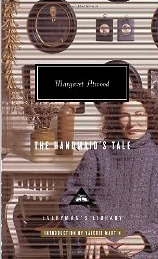
Cover for The Handmaid's TaleWhen I first read Margaret Atwood’s The Handmaid’s Tale back in the 80s, I believe my reaction was that the Canadian author might be over-reacting to the rise in American religious fundamentalism, although that also made it fairly scary reading. Not only does the novel translate well into this century, it is even more effective and foreboding in a time when hard-won civil and reproductive rights are being abrogated, education is being dumbed down and tampered with (as we know who have to fight the “intelligent design” battle every two years), and fundamentalism of all kinds is on the rise. Everyone should read or re-read this book.

Atwood presents the story skillfully. It is from the point of view of one person, the handmaid, as she struggles with her everyday life but remembers her previous one–one that we would consider normal. Instead of explaining what happened, she muses about her life as her thoughts come to her and as things happen, so it takes us awhile to understand what is going on. More than 20 years later, I still remember my horror when I realized the handmaid’s function in this dystopian society.

All we understand at first is that the handmaid lives in a rigid, stratified society in what used to be the U.S. in the not-too-distant future. It is a time of war, and there are terrifying checkpoints everywhere. All women are forced to wear uniforms in specific colors that indicate their station and function, and hers is red. She is treated as an outcast, and almost her every action is supervised. It takes us awhile to figure out that she lives in a theocracy, the laws of which were made as an apparent backlash against the successes in the late 19th century of women’s rights. In a foreword to the version I read, Atwood says that she purposefully didn’t include anything in the book that people have not already done to each other, which makes a statement in itself.

The novel is beautifully written. Although education for women is against the law, the handmaid was educated in her previous life, and constantly plays with language as she muses.

Read in the current climate, some of the themes and statements in this book will send a chill down your spine.