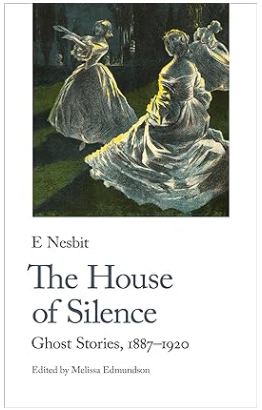
Review 2643: #RIPXX! The House of Silence

Marble knights walking in the night, a man coming back from the dead, a man who acquires a sweetheart in the graveyard, a haunted picture frame, killer vines, such are the fodder of E. Nesbit’s collection of 18 ghost stories. None of these stories are truly terrifying, but some of them are at least original.

There are a few that turn out not to really be ghost stories—for example, a salesman who uses a ghost story to get a better room—and I liked those better than most of the ones involving the supernatural, although I do like a nice, chilling story.

Several of the stories are about thwarted love affairs or unscrupulous rivals for a girl’s affections. Some have sad endings, but in others people get what they deserve.

This book is about on par with the volume of Victorian ghost stories I reviewed a few years ago, but uniformly better written and sometimes more subtle.

Related Posts

The Oxford Book of Victorian Ghost Stories

Tales of Mystery and the Macabre

The Casebook of Carnaki the Ghost Finder

Review 2439: Classics Club Spin Result! The Prophet’s Mantle

I picked this book out of my collected works of E. Nesbit for the Classics Club as one of her first novels for adults. In fact, it is her first novel. So, I wasn’t aware until I looked for a hardcopy that it was publicized under the name of Fabian Bland. In fact, I was confused, because some editions showed both names, so I thought they were two different people. I don’t agree with the custom some publishers use of listing works under the most well-known name just to make more money, but I have had to revise my listings of this work because of this error and listed both so as not to confuse.

In the prologue to this novel, Count Michael Litvinoff prevents Armand Percival from drowning himself after gambling away all his money. Litvinoff takes Percival as his secretary to Russia. But Litvinoff is the author of a pamphlet that the Russian authorities deem dangerous, so the two have to flee. On the trip, it is reported that the secretary is killed by their Cossack pursuers.

It takes a while to see the connection between this story and the body of the novel, which begins with two brothers, Richard and Roland Ferrier. Their father leaves his mill to both of them, hoping to keep them friends, as they are rivals for the same girl, Clare Stanley. If they can’t run it together, the business will fold.

However, Richard believes a rumor in the village that Roland is responsible for the disappearance of Alice Hatfield, the assumption being that she left because she was pregnant. When Roland learns this, the two become unreconciled and the mill is closed. It’s clear from the beginning that Roland knows nothing about Alice, though.

In London, we again meet Count Litvinoff, a Nihilist (although Nesbit doesn’t seem to understand what one is, and although there is a lot of discussion about revolutionary principles, no one actually states what the characters believe) who has published several books and has been speaking around town. Clare Stanley is in town, and she is trying to attract the count, but after she hears a talk by another Russian, Mr. Petrovich, she begins to be interested in the cause. It soon becomes clear that it is Litvinoff, not Roland, who is responsible for Alice’s plight.

It’s not long before several plots are going. Who will win Clare? What will happen to Alice? Who is the mysterious Petrovich? Is Litvinoff a hero or a villain? Will Richard and Roland make it up? And what about the poor mill workers?

Despite its revolutionary theme and good intentions, I fear the mill workers get the short shrift. This novel goes in too many directions to really do a satisfactory job in 159 (small print) pages. I guessed all its secrets almost immediately, and only Litvinoff has anything approaching a rounded character. The novel is supposed to have a stunning romantic ending, but I wasn’t interested enough in the characters to care much. I think Nesbit’s young revolutionary fervor (she was a Fabianist) gets in the way of this being effective fiction.

Related Posts

That Lass O’Lowrie’s

Challenge

Sofia Petrovna

Review 1657: The Wouldbegoods

In my return to my project of reading the collected works of E. Nesbit, among others, I realized I had forgotten how charming and funny her first Bastable novel, The Story of the Treasure Seekers, was. The Wouldbegoods is the second entry in the Bastable series.

The Bastable children have a habit of unwittingly causing havoc, and after a disastrous attempt to make a jungle while acting The Jungle Book, the children and their guests, Danny and Daisy, are shipped off to the country to stay with the uncle of Albert (referred to as Albert-next-door in The Treasure Seekers). Albert’s uncle is a writer usually installed in his study, which gives the children lots of unsupervised scope to get into trouble. So, they decide to form a society called the Wouldbegoods to try to be good. Of course, their attempts all go sadly awry.

Their decision to hand out free lemonade to passersby results in a fight with some unruly men and boys. Giving a tramp some coins ends up with them being trapped at the top of a tower. All their attempts at play go out of control, such as when they create a zoo in the paddock and the dogs chase the sheep into a stream.

One of the biggest charms of this novel as well as its predecessor is the “anonymous” narration by Oswald, who has obviously read a lot of florid literature. I think this series is funny for children but even funnier for adults, because the children have a naïve way of believing legends or taking things literally that will tickle adults while children may not see what’s coming. These books are delightful.

Related Posts

The Story of the Treasure Seekers

The Railway Children

The Lark

Day 1044: The Lark

Cover for The LarkBest Book of the Week!
The Lark was E. Nesbit’s last novel for adults, and it is a delightful romp with lovable characters. I had been reading her books in order, but because of the recommendation of a friend, I skipped to this one. Written in 1922, it is set in post-WW I England.

The novel begins with a few scenes set several years before the main action. Exuberant 15-year-old Jane Quested finds an old book with a spell for seeing her true love, and she is determined to try it in the garden at night. John Rochester has just been advised by his mother to marry the wealthy Hilda Antrobus. (Jane and Rochester. Can this be a coincidence?) John is walking in the woods after missing his train and happens to come upon the scene just after Jane finishes her spell. She thinks she’s seen a vision of her future.

The war intercedes, and Jane and her cousin Lucilla are still in school at the end of it, both of them orphaned. They are surprised to get a sudden summons from their guardian, Arthur Panton. They are delivered to their new home, a small house called Hope Cottage, where they learn that Panton has lost all their money in investments and is leaving the country. He has left them with the house and 500 pounds.

Instead of being discouraged, Jane declares that they will live life as a lark, and the first thing to do is find a way to make money. Unfortunately, they don’t know how to do anything.

One morning Jane hands out flowers to the workmen on their way to work. One of them suggests she sell the flowers. So, she and Lucilla begin selling flowers out of their garden but soon find the garden isn’t big enough. The next thing to do is to find a place that is.

Of course, John Rochester appears on the scene, as the nephew of the man whose house they want to lease. But Jane is determined not to be side-tracked by a vision from making her own way in life.

This novel is lively and full of enjoyable characters, as Jane and Lucilla attempt to earn their living and so meet all kinds of interesting people. It is a light-hearted novel that I enjoyed immensely.

At the suggestion of my friend Deb, I’m attaching a link for The Lark online, since it is difficult to find: http://dbooks.bodleian.ox.ac.uk/books/PDFs/N10292048.pdf. I myself bought E. Nesbit’s complete works from Delphi Classics, also in the form of an ebook (the only disadvantage, in my opinion). If you live in the U. K., it looks like there are some newly printed paperback copies available.

Related Posts

The Story of the Treasure Seekers

The Railway Children

The Making of a Marchioness

Day 946: The Story of the Treasure Seekers

Cover for The Story of the Treasure SeekersA while back, I read E. Nesbit’s The Railway Children. Although I liked it well enough, I did not find it as delightful as the book I’m reviewing today, The Story of the Treasure Seekers. This first novel of Nesbit’s is about the Bastable children, Alice, Dicky, Dora, Horace Octavius (known as H. O.), and Oswald. The narrator keeps his identity secret, but we can tell fairly soon that it’s Oswald.

The Bastable’s mother died not long ago, and the children are vaguely aware that their father is having financial problems. He has removed them from school, and the house isn’t nicely kept up. So, the children have a council, and they each come up with a plan for finding treasure.

The novel is about what happens as the children try to raise money, their plans ranging from holding up people on the common to dowsing for gold. The novel is very funny, I think even more for adults than for children. Children will enjoy the kid’s adventures, but adults can understand an entire additional layer of information that the children in the book don’t, for example, that the Robber they find in their father’s study is probably not a Robber.

The naivety of the narration lends this novel a charm and humor that a straightforward third-person narrative would not. This is a lovely, funny book.

Related Posts

The Railway Children

Ballet Shoes

Anne of Green Gables

Day 929: The Railway Children

Cover for The Railway ChildrenThe Railway Children is a classic British children’s story, written in 1906. At the beginning, Roberta (Bobbie), Peter, and Phyllis live a happy and comfortable life with their parents in a suburb of London. Then one evening two men come to see their father, and they hear angry voices. Their father goes away with the men, and shortly afterward they move with their mother to a cottage in the country.

Here things are a bit more primitive. They only have one servant, a housekeeper, and a pump in the yard for water. They have to help their mother more, and Peter can’t go to school. Their mother can’t play with them, because she is busy writing stories for money. They are poor and have to be careful how much coal they use and what they eat.

Near their house is the railway, and they find lots to entertain themselves watching the trains and getting to know the men at the station. They wave to an old gentleman on the morning train every day, and they have adventures related to the railway.

I can see why children would love this story. Although the children’s adventures are all realistic, they would be exciting reading for children. There is also the mystery about their father. Character development is not a strong suit of the novel, but the children and their mother are sympathetic and the children behave like actual children.

Perhaps the novel does not have as much to offer adults, especially those who didn’t read and love the book as children. Still, it’s easy to see why the book is still popular.

Related Posts

The Secret Garden

Anne of Green Gables

Charlotte’s Web

Day 907: Victorian Fairy Tales

Cover for Victorian Fairy TalesApparently, in Victorian times there was a fashion for fairy tales. Not only did some writers, especially of children’s books, concentrate on them, but many writers of other types of works wrote them as well. Although Victorian Fairy Tales is published as a scholarly work with notes and essays, the tales are well worth reading by anyone, and many of them are by well-known writers.

My favorite tale was “The Rose and the Ring,” by William Makepeace Thackeray. It is about a couple of usurping kings and the confusion that results when an enchanted ring and a rose that each make the wearer irresistible to the opposite sex are traded around among the characters. The story is very funny, with different types of humor to appeal to both adults and children, as well as silly names and repetition, which children love. The pictures by Thackeray from the original are wonderful.

“Prince Prigio” by Andrew Lang is another funny tale, about a prince who is so smart that he annoys everyone. Another outstanding tale is by E. Nesbit, “Melisande,” about a princess who is cursed by a wicked fairy to be bald. Her father gives her a wish, and as happens in fairy tales, she doesn’t wish wisely.

Other favorite stories are “The Queen Who Flew” by Ford Madox Ford and “The Reluctant Dragon” by Kenneth Grahame. “The Reluctant Dragon” and “The Selfish Giant” by Oscar Wilde are the only stories in the volume I have read before, although I vaguely remember there being a copy of “The Little Lame Prince” by Dinah Mulock Craik around our house.

There is much to enjoy in this book, both for children and adults. I thought a couple of the stories were a bit ethereal and symbolic to be enjoyed much by children (or by me), but most of them were fun to read.

Related Posts

Folktales of the Native American

The Oxford Book of Victorian Ghost Stories

St. Lucy’s Home for Girls Raised by Wolves