Review 2657: Literary Wives! The Soul of Kindness

Today is another review for the Literary Wives blogging club, in which we discuss the depiction of wives in fiction. If you have read the book, please participate by leaving comments on any of our blogs.

Be sure to read the reviews and comments of the other wives!

My Review

Although this novel has a main character, Flora, it is more of a community novel, about a group of people whose lives are affected by Flora. I was going to say by her actions, but Flora doesn’t really act.

Flora’s best friend Meg has never approved of how much Flora’s mother, Mrs. Secetan, cossets her, but in school Meg picks up the cossetting herself. Flora is a beautiful young woman, getting married to Richard in the first chapter, and people tend to worship her and try to protect her. Her influence is well-intentioned, but she doesn’t seem to understand that what she believes is good for other people may not be.

There’s her father-in-law, Percy, for one. He is a widower who drinks a bit too much and whom Mrs. Secetan thinks is uncouth. He has been happy with his mistress Ba for years, living apart, having his days to himself and his nights with Ba. And Ba, who owns a dress shop, likes the independence this gives her. But Flora thinks they will be happier married.

And Kit, Meg’s younger brother, adores Flora. She encourages him in his career as an actor even though he can’t act and is a financial burden on Meg.

And Meg loves her friend Patrick, whom everyone but Flora realizes is gay. Even when Richard tells her that, she can’t believe it and persists in wondering why they don’t get married.

If you ask Richard, he’s happily married, although he works a lot. Yet he occasionally seeks out the company of a neighbor, Elinor Pringle, whose playwright/activist husband leaves her alone almost all the time, even when he is home. Their friendship is entirely innocent, but when Flora learns about it, she can’t grasp that.

In fact, Flora, meaning well, is often cruel because she utterly fails to see anything from anyone else’s point of view. And only Kit’s friend Liz sees her for what she is. Everyone else thinks she’s wonderful.

I feel that Taylor is very observant of people’s foibles. As a realist writer, she doesn’t really deal in unmixed joy. She has a fine eye for complex personalities, though.

What does this book say about wives or about the experience of being a wife?

There are three marriages on view here—Richard and Flora’s, Percy and Ba’s, and the Pringles’, although we don’t get much perspective on the feminine half of the marriages except Elinor’s. From the beginning I didn’t forecast success for Flora’s marriage because she wasn’t paying attention during the groom’s speech and seemed more concerned about her doves. But it seems to be surprisingly successful. Yet, Richard is clearly getting something out of his friendship with Elinor that he doesn’t get from Flora. He is innocent of any intent to deceive, but Flora is beginning to doubt him by the end of the book, and I foresee trouble from that.

Percy was happier with Ba as his mistress, because he had time for himself. And perhaps Ba, although we don’t see much from her point of view, was happier, too.
Literary Wives logo

In the introduction to my edition, Philip Henshir states that Taylor felt it was better to be lonely than bored. Certainly, there are some lonely people in this book. Elinor Pringle is one of them. Between his activist meetings and his time spent writing bad plays, her husband Geoffrey leaves her almost entirely alone. She has little to do, so she is both lonely and bored. In this marrriage, we see only her dissatisfaction.

As for Flora, she seems perfectly happy as wife, mother, and interferer in other people’s business until her interference nearly causes a tragedy and she gets a letter from Liz. And then, at least to her, her husband seems to be meeting another woman.

Related Posts

A View of the Harbour

A Wreath of Roses

Mrs. Palfrey at the Claremont

Review 2291: Stories for Winter and Nights by the Fire

Here’s an appropriate book for the first day of the new year!

Stories for Winter is British Library Women Writers’ seasonal collection of 14 stories set in winter. They are arranged chronologically (sort of), starting with a story from 1902 by Edith Wharton and ending with one by Angela Carter for which a date is not given but may have been published in 1974. Most of them deal in some way with changes to society that affect women.

In “The Reckoning” (1902) by Edith Wharton, Mrs. Clement Westall has noticed a disturbing change in her husband’s behavior. He has begun lecturing on his radical views of marriage—views the couple agreed on when they married—when before he preferred not to discuss them. The problem is that Jula no longer thinks the same way—that if one of a couple finds they no longer are happy together, they should part.

In “My Fellow Travellers” (1906) by Mary Angela Dickens, Miss Lanyon tells a girl a story about why she believes in spiritual things. This story fits right into the Christmas tradition begun by Dickens’s grandfather, Charles.

In “The Woman Who Was So Tired” (1906) by Elizabeth Banks, “the little reporter” writes an article about a poor woman supporting a large family and then becomes embarrassed when it becomes very popular. Her boss thinks she made the situation up, but that’s not exactly what’s going on.

In “A Cup of Tea” (1923) by Katherine Mansfield, Rosemary Fell thinks she’s doing a charitable act by inviting a poor woman to tea. But she soon decides she’s made a mistake, highlighting the divide between rich and poor.

In “A Motor” (1922) by Elizabeth Bibesco, Eve spots her ex-lover’s car on the street and knows he is visiting his current lover.

In “Ann Lee’s” (1926) by Elizabeth Bowen, two women visit an expensive hat store only to have a slightly disreputable man insistently interrupt their shopping.

I couldn’t really get on the same wavelength with Elizabeth in “The Snowstorm” (1935) by Violet M. McDonald. A stranger talks her into a dubious adventure even though she has only met him once and found him irritating. I couldn’t really understand what he wanted to confide in her or why he wanted to handle it the way he did or why she even agreed to go, much less what happens afterward.

“November Four/Ffair Goeaf” (1937) by Kate Roberts follows a group of Welsh workers to town for the fair, and two women also try to buy a hat, with less success than the women in “Ann Lee’s.”

“My Life with R. H. Macy” (1941) shows a different side of New York than Wharton’s story—a satiric look at Shirley Jackson’s brief employment at Macys, where the workers are so degraded that they’re known by their employee numbers rather than their names.

“The Cold” (1945) by Sylvia Townsend Warner shows how different the staff who are ill are treated from the family.

As Simon Thomas points out in the Introduction, tea is very important to the British, and it is the offer of a cup of tea that begins an acquaintance in “The Prisoner” (1947) by Elizabeth Berridge. Miss Everton offers tea to a German prisoner of war, a young man who is part of a crew digging ditches near her house.

In “The Cut Finger” (1948) by Frances Bellerby, five-year-old Julia makes an upsetting discovery when she seeks help from her mother for her cut finger.

In “The Thames Spread Out” (1959) by Elizabeth Taylor, a mistress has an adventure that leads her to reconsider her relationship with her married lover while her house is flooded by the Thames.

Frankly, I had no idea what was going on with “The Smile of Winter” (1974?) by Angela Carter except someone is depressed.

Except really for one story, I very much enjoyed this collection. I received it from the publishers in exchange for a free and fair review.

Related Posts

Stories for Christmas and the Festive Season

Good Evening, Mrs. Craven: The Wartime Stories of Mollie Panter-Downes

:Let Me Tell You

Day 893: Classics Club Spin! A Wreath of Roses

wreath-of-rosesToday is another Classics Club Spin, and the book that was chosen for me from my Classics Club list is A Wreath of Roses by Elizabeth Taylor. Compared to the other two books I’ve read by Elizabeth Taylor, this novel seems less blighted in its setting. It takes place in a countryside that is lushly described. But before we get there, a shocking event occurs in the railway station that foreshadows the atmosphere and events to come.

Camilla is on her way for her annual holiday, which she has spent for years with her closest friend Liz and Liz’s former governess, Frances. Frances has become a famous painter, and they stay with her in her home. But this year things are different. First, Camilla has met a man, Richard Elton, on the train. Although she ordinarily wouldn’t have even spoken to him, categorizing him as a certain type, the incident at the train station has shocked them both. Then, Liz has brought along her baby Henry. Liz’s marriage to Arthur, whom Camilla dislikes, has created distance between the two women, and Camilla isn’t interested in the baby. Finally, Frances is looking like an old woman. She has difficulty painting, and has radically changed her style.

But the focus of the novel is on Camilla’s relationship with Richard Elton. When we see him on his own, we realize he is a liar who has difficulty telling his own lies from the truth. He may also be dangerous. He has told Camilla stories about violent activities during the war, but they seem unlikely. And he keeps reading in the paper about the murder of a woman.

Camilla is both repelled by and attracted to Richard. At first, she agrees to see him only to irritate Liz, but then she begins to feel sorry for him. Also, she sees herself drawing ever closer to a sort of dried-up spinsterhood, while Liz is positively blooming in her fecundity.

Although some of Taylor’s other novels are depressing in their realism, A Wreath of Roses is much darker. It juxtaposes the heat and lushness of its country setting with Camilla’s feelings of sterility and the themes of murder and suicide. The novel is disturbing yet compelling.

Related Posts

Mrs. Palfrey at the Claremont

A View of the Harbour

The Moviegoer

Day 598: Mrs. Palfrey at the Claremont

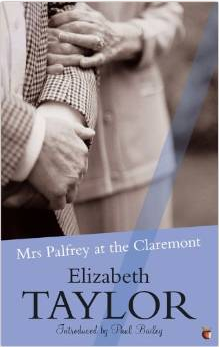
Cover for Mrs. PalfreyI’ve read two books by Elizabeth Taylor, who is beginning to be appreciated as a novelist years after she authored the books. Both the novels are melancholy, about sad people in realistic situations.

Mrs. Palfrey is an old lady who takes a permanent room at the Claremont, a hotel that has seen better days. Staying at the Claremont are several other older people who are all living on limited means.

One reason Mrs. Palfrey chose the Claremont instead of a seaside resort her daughter recommended is because her grandson Desmond lives in London and works at the British Museum. Mrs. Palfrey regrets having mentioned him to the other guests, though, as day after day passes and no one comes to visit.

The life of all the permanent residents of the Claremont is similar to hers, as they sit waiting for something to happen. Mrs. Post knits while Mr. Osborne writes letters to various newspapers hoping to see them in print. Any incident, no matter how trivial, constitutes a break in the monotony.

One day while out walking, Mrs. Palfrey falls. A young man runs out from a nearby building and helps her. He is Ludo Myers, an impoverished would-be novelist. After this encounter, the two become friends of a sort. Mrs. Palfrey doesn’t know that Ludo has decided to write about old people and is using her as a model. Still, they both behave kindly to one another, he even pretending to be her grandson so she can save some face with the other hotel residents.

Underlying the lives of all the old people are sadness and boredom, but Ludo also feels lonely. His mother goes from one affair to another and doesn’t seem to care if he comes to visit. He eventually takes up with Rosie, a young woman who also doesn’t care for him much.

This novel is observant enough of people’s behavior that it is sometimes funny, but mostly it sensitively explores the solitude that is in all of us. I saw the movie a few weeks after I read the book and was interested, but not surprised, to see how the movie was just enough more heartfelt and touching to make it avoid the central message and atmosphere of the book. I liked the movie, but it missed the point.

Day 494: A View of the Harbour

Cover for A View of the HarborElizabeth Taylor was a mid-twentieth century writer who was interested in the realistic depiction of ordinary lives, particularly those of the working class. In A View of the Harbour, she provides glimpses into the lives of residents along the harbor of a shabby seaside village in post-World War II England.

Newby has seen better days. The trendy tourist area has moved away around the point, and all that is left aside from a few houses are a wax museum, a pub, a small store, a closed-down fun fair, and a lighthouse.

The main characters of this novel are Beth and Robert, a married couple, and Beth’s longtime friend Tory, recently divorced. Beth labors under the delusion that she is observant, but most of her focus is on her writing, as she is an author. Toward her family she is myopic. She doesn’t see when her five-year-old daughter Stevie is manipulating her, and she pays very little attention to her older daughter, Prudence, or to her husband. All family drama provides fodder for her prose.

Most people in town seem to think Prudence is slow, but she has noticed something that others haven’t—that her father is secretly visiting Tory.

Tory is torn between her feelings for Robert and her loyalty to Beth. She mostly seems to be at loose ends, however. She still cares for her ex-husband Teddy and makes a point of stopping in to see him if she is in London. In Newby she flirts with Bertram, a retired naval officer with ambitions to be a painter but little talent, and dallies with Robert.

Loneliness is a strong theme of this novel. Tory is clearly lonely, even though she is beautiful and has no trouble attracting attention. The attention she wants, from Teddy, is not available. Lily is a recent widow who goes to the pub nightly for companionship. She is timid and terrified of the walk home in the dark. The proprietor of the wax museum, she is afraid to pass the figures on the way up to her flat. The brief attention she gets from Bertram ends unfortunately.

Maisie, the hard-working daughter of invalid Mrs. Bracey, manages to attract Eddie, the boarder, but Mrs. Bracey is immediately jealous of the distraction of Maisie’s attention. Mrs. Bracey is a complex character. We have sympathy for her because she is paralyzed, but she has a terrible tongue and is a vicious gossip. She easily finds a way to squash Maisie’s romance.

Taylor’s characters are too realistic to be entirely likable, although Beth is less at fault than Robert or Tory. I found Maisie and Prudence the most sympathetic of the characters.

Taylor is highly regarded but relatively unknown because she was overshadowed in her time by the more famous Elizabeth Taylor. Her writing is observant of the small details of life. Although there is not much humor in the novel, Tory’s letters from her young son at school are believable and funny. My overall impression of the novel is that the lives of its characters are as sad and dilapidated as the village.