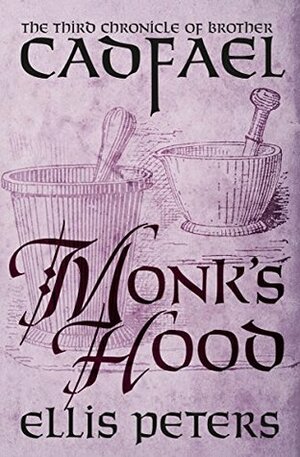
Review 2614: Monk’s Hood

It is autumn 1138, during the war known as the Anarchy. Although King Stephen’s army has withdrawn from Shrewsbury, he is now in control of the area. Abbot Heribert has been recalled to a conference to justify his tenure as abbot. As he didn’t support King Stephen, he does not expect to remain in that position. However, Prior Robert clearly anticipates stepping into his shoes, so most of the monks are depressed.

Because Abbot Heribert has been recalled, he doesn’t feel it would be right to ratify some outstanding agreements before he leaves. One of these is that of Master Bonel, who wants to donate his estate in exchange for lifelong housing and support for himself and his wife at the abbey.

Cadfael takes one of his mixtures to treat an elderly monk with rheumatism. There he meets a young Welsh kinsman of the monk, Meurig, who has been applying some of the mixture to the old man. Cadfael checks that Meurig has been warned to wash his hands and not touch his face before that, as the mixture contains a strong poison, monk’s hood.

Later, Cadfael is urgently summoned to the bedside of Master Bonel, who has been taken ill after dinner. Cadfael recognizes the symptoms of poisoning right away, and by his own embrocation. In the house are Bonel’s wife, Richildi, whom Cadfael recognizes as his old sweethheart; Richildi’s son Edwin by her first marriage; Edwy, Edwin’s lookalike nephew; Aldith, the servant girl related to Richildi; and Meurig, who apprenticed as a carpenter with Richildi’s first husband, whose brother has apprenticed Edwin.

Edwin has been estranged from the household because Master Bonel thinks he spends too much time with lower elements (i. e., Edwin’s relatives). And in fact, Bonel was entering into the agreement with the abbey to disinherit Edwin. He had come to dinner to try to reconcile with Master Bonel, but Bonel began berating him and was trying to make him kneel for forgiveness. Instead, Edwin stormed out. To the sergeant, though, this is enough proof that Edwin is the murderer. Cadfael, who has met both boys, Edwin and Edwy, doesn’t think Edwin did it, but Edwin has fled. Cadfael, helped by his new assistant, Mark, decides to investigate.

I didn’t find this mystery very difficult to solve, but I am liking Cadfael more and more, and Peters has created some vivid characters.

Related Posts

One Corpse Too Many

A Morbid Taste for Bones

Grave Goods

Review 2602: One Corpse Too Many

It’s 1138 during the war between King Stephen and Queen Maud, which became known as the Anarchy. King Stephen is besieging Shrewsbury, which is soon to fall. FitzAlan and Adenay, the castle defenders, wait until the last minute to flee with their men, but rumor has it that Adenay’s daughter and FitzAlan’s fortune are still inside the castle.

In the monastery, Cadfael is assigned a new helper, a boy named Godrik, who is a hard worker. It doesn’t take Cadfael long to figure out Godrik is a girl, Adenay’s daughter Godith, whom Stephen is searching for to use as leverage.

Stephen has the remaining defenders of the castle executed after he takes it, and Cadfael takes charge of identifying and burying the bodies. However, he finds there is one corpse too many. In looking more carefully at the corpses, he sees that one man has been garroted. So, he reports to the king the information that someone has tried to hide a murder by mixing the body with the executed and is given permission to try to identify the body.

A young lady of the town, Aline, identifies the body as Nicholas Faintree, a squire of FitzAlan. She has recently also identified one of the executed men as her brother.

Meanwhile, Godrik, whom Cadfael has sent reaping to escape the attentions of a mysterious man, Hugh Beringer, who has been following him, finds a wounded man. It turns out that the wounded man Godith finds is Torond Blunt. He was sent off with Nicholas Faintree to carry FitzAlan’s fortune into Wales. However, they were ambushed at night. Briefly separated, Torond returned to find Nicholas dead and then someone attacked him from behind, but he managed to get away and hide the fortune.

Now Cadfael is hiding Godith and Torond and trying to make arrangements to get them both to Wales along with the fortune. Meanwhile, it’s clear that Beringer is dogging his steps ever since he visited Godith’s old nurse to tell her she is safe. Incidentally, Beringer is engaged to Godith, although they haven’t seen each other for years. And she has fallen in love on sight with Torond.

Beringer seems to be playing a game with Cadfael, so he decides to play back. But is Beringer a friend or foe?

Although this mystery doesn’t really give clues to the murderer’s identity until the end, it does a good job of misdirection. This book is the second of the Cadfael series, which I would describe as Medieval cozy. It has likable characters and seems to be well grounded in its time period.

Related Posts

A Morbid Taste for Bones

A Murderous Procession

Grave Goods

Review 2539: A Morbid Taste for Bones

I didn’t really like the Cadfael series on TV, and I thought I had read at least one book long ago and decided not to pursue it. However, I saw that the first book filled a hole in my A Century of Books project, so I thought I’d give it another try. Now, I’m not sure I ever read any, because this book is pretty good!

In 1137, Brother Cadfael is a Welsh monk in a Benedictine order in Shrewsbury. He has led an exciting life, but now a quiet one taking care of the monastery garden suits him. He has two young assistants. Brother Columbanus is from a family of high Norman blood who seems almost too devout and eager to please. Brother John is practical and full of mischief.

Brother Columbanus is stricken with something that seems like epilepsy, so Prior Robert, an ambitious, proud man, suggests sending him to the Shrine of Saint Winifred in nearby Wales. When Brother Columbanus is miraculously cured, Prior Robert suggests that what the order needs are some relics, and Saint Winfred’s bones may answer the case.

Although Prior Robert wouldn’t normally include Cadfael in his expedition to get the bones, he needs him as a translator. Brother Columbanus is allowed to go as the subject of the miraculous healing, and Brother John offers to take care of the livestock. After getting permission from the Welsh authorities to remove the bones, the party encounters opposition from Rhisiart, the major landowner in the area, and thus from the rest of the locals.

Prior Robert meets with Rhisiart to try to talk him around, but he mishandles this discussion badly by trying to bribe him. They schedule a second meeting, but Rhisiart never arrives. Once they learn he left home for the meeting and never returned, everyone goes out to look for him. They find him shot in the chest with an arrow that belongs to Engelard, a Saxon boy who wants to marry Sioned, Rhisiart’s only child and his heir.

Suspicion immediately focuses on Engelard, but to Cadfael that doesn’t make sense. Even though Rhisiart opposed the marriage, he has treated Engelard like a son since he arrived, in a country where you usually must belong to a family to get work.

Does the murder have to do with the marriage? with Sioned? a love triangle? the monk’s expedition?

I enjoyed this mystery. It seems well-researched and is written with a wry sense of humor. Although I did guess the murderer, Peters tricked me enough to move my guess to two other people before I returned to my original suspect just about the time Cadfael did.

Related Posts

A Murderous Procession

Grave Goods

The Serpent’s Tale

Review 2281: Who Killed Father Christmas?

British Library Crime Classics’ latest book is another of their holiday mystery collections. This one includes some clever puzzles, some ghost stories, and one truly exciting chase.

“The Christmas Thief” by Frank Howel Evans, published in 1911, features the adventures of two endearing young men, Tommy and Harry, two homeless boys who thwart a gang of thieves.

In “The Christmas Spirit” by Anthony Gilbert from 1952, Sedley busts the ghost of the Green Girl—or does he?

In Patricia Moyes’ “Who Killed Father Christmas?” from 1980, someone murders the substitute Father Christmas in the toy department of a store, and he turns out to have been an undercover policeman. The motive for the murder was fairly obvious, I thought, but not so much identity of the murderer.

In “Death at Christmas” by Glyn Daniel from 1959, a colleague dies of a heart attack after telling Dilwyn Rees he is being haunted by his dead wife. Although his boss thinks an overactive imagination killed him, Rees isn’t so sure.

Another crime in the toy department takes place in “Scotland Yard’s Christmas” by John Dickson Carr from 1957. Detective Inspector Robert Pollard is accompanied by his girlfriend and her nephew, and all I can say is, he’d better not marry her.

Will Scott’s “The Christmas Train” from 1933 features a Simon Templar-ish thief who intends to steal some jewels on the train, even though the owner is accompanied by the police.

“Herlock Sholmes’ Christmas Case” by Peter Todd from 1916 is a spoof of another mystery writer’s detective stories.

“A Present for Two” by Ellis Peters from 1958-9 features a quite exciting kidnapping and chase after someone steals a priceless manuscript from the village museum.

As usual, I enjoyed some of the stories more than others, but this is a fun seasonal read for mystery lovers.

I received this book from the publishers in exchange for a free and fair review.

Related Posts

The Christmas Card Crime and Other Stories

Silent Nights

Murder at the Manor