Review 2044: Crook O’Lune

Crook O’Lune is named for a crook of the Lune River in the remote fells of Lancashire. Here, Chief Inspector Robert Macdonald has chosen to take his holidays, staying with his friends Giles and Kate Hoggett. Macdonald is looking for a farm to buy for his retirement.

For his part, Gilbert Woolfall has just inherited his uncle’s farm at High Glimmerdale, called Aikengill, and is trying to decide what to do with it. His commonsense tells him to sell it, since his career is in Leeds, but he wants to keep it.

Almost as soon as he settles down to examine some old papers, he has a series of visitors. Betty Fell wants to marry Jock Shearling, but they don’t want to live with her parents. She asks if she and Jock can look after the house for him, but in Gilbert’s mind, that depends on the housekeeper, Mrs. Ramsden, who can’t decide whether to return to her family or stay. Then the Rector, Mr. Tupper, arrives indignant that Gilbert’s uncle left nothing to the church. Gilbert knows that his uncle felt there was something suspicious about an ancient grant by the family to the local school and church that was reappropriated for another community, so he is not inclined to help Mr. Tupper. Finally, his neighbor, Daniel Herdwick, wants to buy some property.

Although it seems that we’re never to learn much about Macdonald (except that he wants to own dairy cows), I enjoy Lorac’s books because they focus a little more on characters than the usual Golden Age mysteries do and because the crimes aren’t over-complicated and unlikely. This one also has a lot of descriptions of this area of England, enough to make me want to go there. In that respect, It reminds me of some of the Molly Clavering books and their setting in the Scottish borderlands.The night after Gilbert returns to the city, two things happen: there is a fire in his cellar that kills Mrs. Ramsden, who was supposed to be away for the night, and some sheep are stolen from the valley.

Macdonald begins investigating certain aspects of the case, like who the stranger seen in a wild area of the fells might be or which way the sheep could have been driven out of the area.

I received this book from the publisher in exchange for a free and fair review.

Related Posts

Fell Murder

Murder in the Mill-Race

Post after Post-Mortem

Review 2041: The Marble Staircase

Charlotte Moley’s life has always been dominated by others—first by her mother, both before and after her marriage and widowhood, and lately by her grown daughter Alison. Her only periods of happiness were the summers she spent in Italy with Mrs. Gamalion and her friends, long ago before the war.

Now Mrs. Gamalion has left her a legacy—a run-down old house in the coastal town of Nything. It is full of souvenirs of the old lady’s life, and Charlotte decides to keep it and stay there, much to Alison’s disapproval. She also begins making friends, meeting Mrs. Bateman her first night on the esplanade.

Charlotte has old memories to deal with, both of her mother and her disappointment in love one Italian summer. It is Mrs. Gamalion’s gift that helps Charlotte let go of the past and make herself a new life.

I have read and enjoyed every Elizabeth Fair novel that Dean Street Press has reissued. This is another very pleasant light read in this imprint.

I received this book from the publisher in exchange for a free and fair review.
Related Posts

Seaview House

Landscape in Sunlight

The Mingham Air

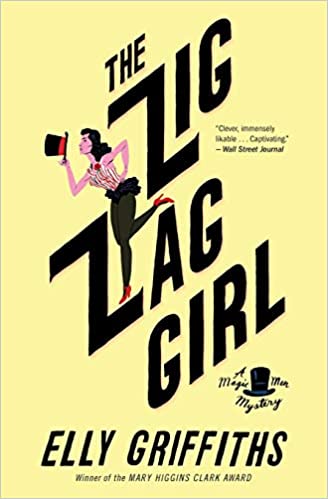
Review 2040: The Zig Zag Girl

I’ve been enjoying Elly Griffiths’ Ruth Galloway series, so I thought I’d give her Brighton series a try. This first novel takes place in 1950.

Detective Inspector Edgar Stephens has always felt a little self-conscious about part of his war work. After helping the Finnish army, he was part of a group of illusionists called the Magic Men, whose job was to fool the Germans that Scotland was well defended. After a disastrous accident in which their commanding officer, Charis, was killed, they were disbanded. Edgar had been in love with Charis.

Edgar’s best friend in the service was Max Mephisto, a well-known magician. Although Edgar hasn’t seen Max since the Magic Men were disbanded, the murder of a young woman reminds him of Max. She has been cut in three, like the illusion of the Zig Zag Girl, which Max created. Edgar consults with Max, who is still working the magic circuit, and his old army group members begin showing up. There is Diablo, an old magician who spends most of his time drinking; Bill, the carpenter who constructed the illusions; and Tony Mullholland, a magician whom no one much liked.

But before the rest of these characters reappear, Max recognizes the murder victim as Ethel, his assistant who left the act to get married. When Tony Mullholland is also killed, Edgar begins to believe that the crimes are connected somehow to the Magic Men.

Although I feel I need to get to know Edgar better and he didn’t really figure out much in this case, the series promises to provide more entertainment. Max is an interesting character, and I’m curious how he’ll be brought into the upcoming mysteries.

Related Posts

The Stranger Diaries

The Postscript Murders

The Night Hawks

Review 2036: A Slow Fire Burning

Laura Kilbride often has poor judgment, such as when she spent the night with Daniel Sutherland. That night turned ugly, and she was seen by the writer Theo Myerson leaving the area with blood on her face. She says she didn’t kill Daniel, but an accident in her youth has left her with a condition that causes her to react inappropriately, and the detectives think her behavior is odd.

Another odd witness is the woman who discovered the body, Miriam Lewis, whose narrowboat is next to Daniel’s. She hasn’t told the police that she bears a grudge against Theo Myerson, who stole significant portions of her memoir for his best-selling thriller. And Theo happens to be Daniel’s uncle.

Carla and Theo’s marriage did not survive the death of their young son when he was in the care of Angela Sutherland, Daniel’s mother. This accident happened many years ago, but Carla and Theo were never able to forgive Angela, and Angela has recently died.

There are more secrets to come out before the murder is solved. Hawkins does a good job of keeping the pace moving while keeping the readers on the edges of their seats.

Related Posts

The Girl on the Train

Into the Water

The Hunting Party

Review 2035: The Appeal

Janice Hallett, and others obviously, thought she was being original when she decided to write a murder mystery entirely in texts, emails, and documents. Maybe she was, but it seems she couldn’t have chosen a more cumbersome way to convey her story. At almost 450 pages, the novel has about 200 pages of plot, and no one is killed until 100 pages from the end.

Further, Hallett cheats by leaving out some of the correspondence until the end. But my biggest problem with the novel is the complete lack of plausibility of the situation. A professor gives two students the task of analyzing the case, but he is hiding information from them and asking them questions he already knows the answer to, not asking them to find evidence of who really is the murderer. I wonder what kind of class the author could have been envisioning.

The plot is this: an amateur theater company is putting on a play. However, the usual director, Martin Hayward, asks his son James to take over because his granddaughter Poppy has cancer, and he is involved in fund raising to pay for an experimental treatment.

Two newcomers to town, Kal and Sam Greenwood, try out for parts in the play at the urging of Isabel Beck, a clingy girl who is Sam’s coworker and new bestie. But there is something unexplained about the Greenwoods, who have just returned from working as aid workers in Africa. Sam also seems hostile to Tish Bhatoa, the doctor who is arranging Poppy’s treatment.

One side-effect of its approach is that the novel also contains about 100 pages of exposition of the murder, which bogs things down so much that, unbelievably, I finally gave up on it less then 50 pages from the end because I couldn’t take it anymore.

What is most unlikely, though, is the role of the police. There isn’t one! There are two minor events involving the police, but their reports are so amateurish as to be unbelievable. What kind of police report takes down testimony without bothering to take the name of the witness?

Then, finally, the victim is killed. Hallett withholds the victim’s name, and in fact one of the puzzles set by the professor is to figure out who is killed! What nonsense! After the murder, there is no evidence of a police investigation except the documents, and lots of questions are unanswered that the police would have to investigate.

A great deal is made of the status of the characters in terms of class. I didn’t understand things this way at all. For example, one student states that no one listens to Isabel because she is low status. No one listens to her because she’s silly!

Finally, the theory of murder is presented, as far as I could tell, with absolutely no proof. I say “as far as I could tell” because I finally stopped reading. What balderdash! I can’t believe this book was so popular.

This year I forgot about Readers Imbibing Peril for September, but I have some nice chilling books coming up!

Related Posts

The Killings on Jubilee Terrace

Found Wanting

The Witch Hunter

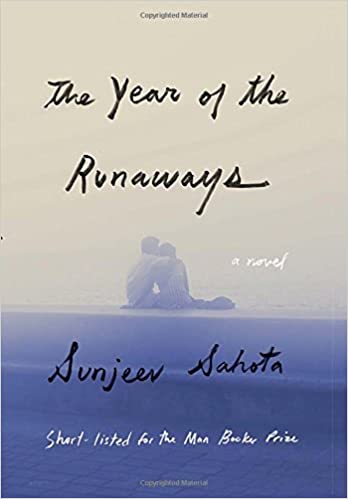
Review 2034: The Year of the Runaways

The Year of the Runaways is another book I read for my Booker Prize project. It follows the fortunes of a group of young Indian men who are living illegally in England looking for work.

Tochi is a young man from a low-caste family who in India had been finally getting his head above water since he had bargained for an auto so that he could work as a taxi driver. But after an election where one party rabbled-roused on the slogan of “racial purity,” his entire family was murdered. He travels illegally to England to start again.

Alvar’s father’s shawl business isn’t doing well and his younger brother will soon have school fees to pay. He also wants to marry Lakhpreet, his friend Randeep’s sister. He is able to get a student visa for England with no intention of studying, because he has had to borrow money from a moneylender for his fare.

Randeep comes from a wealthier family, but his father, a government official, loses his job after a mental breakdown. Randeep is kicked out of college in India and attacked for sexually assaulting a girl because he is constantly misreading people’s reactions. To get to London, he enters into a visa marriage with Narinder, a devout Sikh.

All of these young men travel to England with completely unrealistic ideas of how much money they can make or how easy it will be to even find work. They end up living together in a house packed with illegal immigrants working for low wages at menial work, most often employed by their own countrymen. Those with families receive constant demands from them for more money. And things get worse.

This novel is a throw-back to the 19th century social realism genre. The story is compellingly told and illuminates the dilemma of the illegal immigrant. I didn’t feel particularly attached to any of the characters, but I felt sorry for all of them.

Related Posts

The Lives of Others

Nectar in a Sieve

The Lowland

Review 2029: Long Summer Day

R. F. Delderfield is known for his ability to capture slices of English life, and he certainly does that in this long volume, the first book of A Horseman Riding By.

Paul Craddock is just recovering from being seriously wounded in the Boer War when he learns that his father has died, leaving him a great deal of money and a half share in a scrap metal business. Paul wants nothing to do with scrap metal but thinks he’d like to buy a farm. However, Franz Zorndorff, his father’s business partner, sends him to the West Country to look at Shallowford, a large estate that’s for sale. Although it is much bigger than he had in mind, he ends up buying it.

At first people tend to treat Paul as a dabbler, but he begins to win over the regard of the people in the dale by making improvements to his tenant’s property and by his commitment to his new life. He makes friends with Claire Derwent, and people expect them to marry, but on his original trip to look over the property, he was struck by Grace Lovell.

This novel covers the first nine years of Paul’s Westcountry life, beginning with the accession to the throne of Edward VII in 1902 and ending with the accession of George V. Of course, by then, the First World War is approaching, but not many of the characters in the novel seem to be aware of it. The novel gets somewhat involved in the politics of the time and in the suffragette movement, but it mostly centers on life in the valley.

There is a strong awareness of the dale with many descriptions of it. The novel itself is slow moving with only a few major events, mostly to do with the private lives of the inhabitants—marriages, births, and deaths among them. One thing I found surprising was that there was so little emphasis on actual farming issues. It’s like the estate just runs itself.

There was much of interest about this novel, but for me some of it was hampered by Delderfield’s writing style. He likes long, involved sentences that verge on being and sometimes are run-ons. He also has the odd habit of leaving out the comma in a compound sentence, which many times forced me to reread. Even with the modern tendency to use fewer commas, I’ve never seen anyone else do that and am surprised his editors didn’t add in a bunch of commas.

Am I ready to read the second book? I don’t think so. The novel has a lot to recommend it, but at 800+ pages, this first book in the series indicates that it will be very lengthy.

Related Posts

Ross Poldark

The Children’s Book

A Place Called Winter

Review 2026: Checkmate to Murder

In a bare studio on a foggy night during the Blitz, five people are occupied. An artist, Bruce Manaton, is sketching an actor, André Dalaunier, dressed as a cardinal. On the other end of the big room, two men, Robert Cavendish and Ian Mackellon, are playing chess. Rosanne Manaton, the artist’s sister, looks in occasionally from the kitchen and once steps outside to check the blackout.

A Special constable arrives at the door with a Canadian service man in tow. He claims that the old man in the house next door, Mr. Folliner, has been murdered and he caught the service man fleeing the scene. The soldier, Neil Folliner, says he went to visit his uncle and found him shot dead. The Special wants the people in the studio to guard Neil while he goes to call the police.

When Inspector Macdonald’s team begins investigating, they learn there is a rumor that the old man was a miser, although Mrs. Tubbs, his charwoman, had been bringing him food for fear he would starve. The house itself is absolutely bare, but there is an empty strongbox in the bedroom where the murder was committed.

Questioning a soldier who stood at the corner for a long time waiting for his girlfriend reveals that the only people who passed him on the street at the relevant time were Mrs. Tubbs, Neil Folliner, and the Special. It would seem that the people in the studio, all but Rosanne, alibi each other. But Inspector Macdonald doesn’t take anything for granted, and he is also interested in the studio’s previous tenants, who spread the rumor about the old man being a miser.

This mystery presents an interesting puzzle, although one not as complex as is sometimes found in Golden Age crime novels, for which I was thankful. On the other hand, I’m not sure if I think the solution isn’t a bit far-fetched. Also, it didn’t seem as if Lorac paid as much attention to characterization as she usually does, perhaps because there are quite a few characters. Still, I think her novels are some of the better ones in this series in general.

Related Posts

Murder by Matchlight

Fell Murder

Two-Way Murder

Review 2021: A House in the Country

All during the war, Ruth, her husband, four friends, and the Adam children have been stuffed into an uncomfortable house in London, suffering privations of every sort. As early as 1941, they all began dreaming of taking a house in the country together, where they could have space, good food, and plenty of fresh air for the children. At the end of the war, Ruth finds an ad for a large house in Kent, 33 rooms. They go to see it and fall in love.

They figure that with their combined incomes, they can barely afford it. Ruth will do the housekeeping. The house comes with Howard, a handyman/gardener who has lived there most of his life and whose assistance proves invaluable.

Adam lets us know right away that this plan doesn’t work, but the descriptions of the beauties of the landscape and garden sometimes made me forget this. Written with a deadpan humor, the autobiographical novel tracks the ups and downs of this experience, through employment issues, attempts at agriculture, paying guests, house sharing. But as Adam repeatedly states, the house was built to be served, not to serve.

The story of the hapless occupants is funny and touching. I found it fascinating.

Related Posts

The Half-Crown House

Merry Hall

Greengates

Review 2020: #ThirkellBar! Peace Breaks Out

Although Peace Breaks Out begins by returning to Anne Fielding, now almost 19, who was Miss Bunting’s student in the last book, it spends a lot of time with the Leslie family, whom we have encountered in several of the books. Anne has just met Sylvia Halliday, a beautiful, golden girl a few years older, and shortly thereafter, both girls come to the attention of David Leslie.

At 37, David should have toned down his tricks, but he hasn’t, so Anne is smitten while the older Sylvia’s reaction is a bit harder to ascertain. Anne’s being smitten puts her friend Robin Dale in a funk, which is good because he was tending to take her for granted. And David seems to be almost seriously considering her as a wife.

For the first time, we get a true sense of how tired the British are with the living conditions of the war. This is expressed by being upset about the peace, which makes conditions even worse.

In this novel, readers meet or hear of almost all of the main characters from the previous novels. Rose Fairweather, in all her beautiful idiocy, reappears from America, and more importantly, Rose Bingham, a Leslie cousin who we saw a bit of on the occasion of the other Rose’s wedding, returns from the continent.

It’s really been useful for me to have begun reading these novels in order. I only wish I had started out making charts of characters’ relationships, what books they appeared in, and some notes about each one.

Related Posts

Miss Bunting

The Headmistress

Growing Up