Review 2018: A Death at Fountains Abbey

Thomas Hawkins escaped from the gallows at the end of the last book in this series, The Last Confession of Thomas Hawkins, but Queen Caroline is still holding a threat over him—her knowledge that his beloved Kitty is a murderess. The Queen has received a request for help from John Aislabie, who has been threatened by mysterious letters. But Aislabie was the mastermind behind the South Sea Company scam, and the Queen fears that he did not destroy the green ledger of its accounts, which would show how much the Crown gained from the scam while so many others were ruined. So, she sends Thomas ostensibly to help Aislabie but really to search for the ledger. He takes with him Kitty, who now poses as his wife, and his dangerous ward, Sam Fleet.

In Yorkshire, he finds Aislabie behaving like a victim of the South Sea scandal instead of its perpetrator, claiming he took the fall for more important people. Yet he seems to have plenty of money, which he is spending on his horses and his grounds. He is not well liked, claiming common land as his own and proclaiming as poachers the families that have farmed and hunted it for centuries. In fact, Thomas finds no lack of suspects for the nasty threats Aislabie has received.

Another strange situation concerns Mrs. Fairwood, who is living with the Aislabies. She has presented herself as his daughter, thought to have been killed in a house fire thirty years before. As her bona fides she has brought along a letter from a servant who disappeared on the day of the fire and a brooch that belonged to Aislabie’s first wife, who also died in the fire. Mrs. Fairwood is also being threatened.

This is another excellent mystery/thriller in this series with its scapegrace hero and heroine. The series books always seem carefully researched and the settings authentic. The ending is quite suspenseful.

Related Posts

The Last Confession of Thomas Hawkins

The Devil in the Marshalsea

The Ashes of London

Review 2016: Post after Post-Mortem

The over-achieving Surray family is getting together for a birthday when oldest brother Richard learns that both his sister Ruth and his youngest sister Naomi may be involved romantically with the same man—a famous mountain climber named Keith Brandon. He knows Brandon for a womanizer but warms Naomi away on other grounds.

Later the Surrays have a small house party that includes Vernon Montague, Ruth’s publisher; Geoffrey Stanwood, a writer for whom Ruth helped get recognition; and Charlton Fellowes, an essayist. The next morning Ruth is found dead in bed, an apparent suicide.

After the inquest rules the death a suicide, Richard receives a letter from Ruth that she mailed the night of her murder showing she was in good spirits. Richard goes to Inspector Robert Macdonald hoping he will look into it unofficially. Macdonald refuses to do it unofficially but ends up assigned to the case.

He finds the case frustrating because he has an idea that the death is a murder but isn’t getting any cooperation from the witnesses, who are more concerned about protecting Ruth’s legacy than finding her killer. Fellowes said at the inquest that he had heard no one moving around the house after he went to bed but confesses to Stanwood that he thought he heard Montague talking to Ruth downstairs. Macdonald learns that Fellowes lied, but Stanwood refuses to repeat what he said and then Fellowes is injured after having a talk with Montague. Montague also refuses to say what Fellowes said.

Macdonald thinks someone cut a page from the end of a short story that Ruth was writing and then trimmed it to look like a suicide note written on her notepaper. But finding proof is difficult. He also hasn’t lost sight of Keith Brandon, who proves to have been in the area that night and has lied about his relationship to Ruth.

This novel is one of the best of the British Library Crime Classics series that I’ve read so far. It has an intriguing setup and interesting characters. The solution was difficult to guess. If I have any critique, it’s that the motive was fairly unbelievable. However, the novel is interesting and cleverly written.

I received this book from the publisher in exchange for a free and fair review.

Related Posts

Two-Way Murder

Fell Murder

Murder in the Mill-Race

Review 2014: Something to Hide

Tani Bankole, a teenage boy of NIgerian descent, believes that his father, Abeola, has arranged a marriage for Simi, his eight-year-old sister. He begins making preparations to flee with her, because his mother, Monifa, seems totally subservient. Soon, though, he is horrified to realize that Simi is being prepared for female circumcision to “cleanse” her in preparation for marriage.

DS Teo Bontempi is found unconscious on the floor of her apartment after being bashed on the head and dies later in the hospital. When DCI Lynley and his team begin investigating, they find that her boss, DCI Mark Phinney, had her transferred shortly before, out of a project she loved, trying to shut down female genital mutilation in London. Phinney reports that she tended to do too much on her own instead of working with the team. But it soon comes out that he was having an affair with her. Phinney’s wife Pete is wholly subsumed with caring for their severely disabled daughter and is so afraid of having another child that she refuses sex, encouraging Phinney to look elsewhere. Only Phinney had fallen in love with Teo.

Teo also had a husband, although they were separated, who wanted to get back with her. He, Ross Carver, discovered her injured but acceded to her request to help her to bed instead of calling an ambulance. Teo’s sister Rose has her eye on Ross and has become pregnant by him during the separation.

These are the immediate suspects in the murder, but suspense is added when Tani flees with his sister from their abusive father.

Although as usual Linley is having romantic problems, this series continues to be really good. George takes her time getting to the crime, but the preceding background is necessary and interesting. Although the series went astray for several books after Linley’s wife Helen’s death, it has improved again with the last few books and is getting even better. We find out more about DS Winston Nkata’s home life in this one, too.

Related Posts

The Punishment She Deserves

A Banquet of Consequences

Just One Evil Act

Review 2011: Green for Danger

The details of an operating military hospital during World War II are meticulously recounted in Green for Danger. The novel begins with the postman, Higgins, delivering six letters about the writers’ postings to the hospital. The readers then learn that one of the six people will become a murderer.

The military hospital in the Kent countryside is busy one night, because an air raid in the nearby town has caused the hospital in town to send some civilians there. Among them is Higgins, the postman, who is also a member of the local rescue, most of whom have just been killed or injured.

Higgins’s femur is due to be set in surgery the next morning. It’s a relatively straightforward procedure that shouldn’t be dangerous, but as soon as he starts to go under the anesthetic, he dies. The operating team is shocked.

What seems to be an unusual but unsuspicious death from the anesthetic has Inspector Cockrill wondering. However, there seems to be no way that the canisters containing oxygen, which are black and white, could have been switched for the green carbon dioxide canisters, and no poisonous substances could be forced into a canister. If the death was murder, only the six people in the operating room could have done it.

That evening, Sister Bates, who is jealous of womanizing surgeon Gervase Eden, has a little snit during which she announces that she knows the death was a murder and she has evidence. Later, she is found dead in the surgery, stabbed and wearing a surgical gown and a mask.

This mystery is purposefully claustrophobic and quite suspenseful at times, although the explanations at the end are a bit long. I thought I knew the motive and the murderer all along, but I was fooled! I am happy to be seeing more and more women writers represented in this crime series.

I received this book from the publisher in exchange for a free and fair review.

Related Posts

The Tiger in Smoke

Death Has Deep Roots

Juggernaut

Review 2004: Classics Club Spin Result! Phineas Finn

When I put Phineas Finn on my Classics Club list, I was just looking for a book by Trollope that I hadn’t read. I didn’t realize it was the second of the Palliser novels, so now I’m going to have to go back and read the first.

Against the advice of his father and his mentor, Mr. Low, Phineas Finn has been persuaded by friends to run for Parliament even though he has just recently finished his law studies. The difficulty is that he has no money and Parliamentary representatives aren’t paid, so his father, who is a country doctor, will have to continue to support him unless he can get a paid government position.

Nevertheless, he goes ahead and gets “elected” as member for an Irish pocket borough, where the lord who awards it has feuded with his son, the incumbent. So, Phineas begins his career.

One of his friends who has encouraged him in politics is Lady Laura Standish, a young woman who takes a great interest in politics. Although she had some fortune, she gave it away to her brother, Lord Chiltern, to pay off his debts in the hopes he can reconcile with his father, the Earl of Brentford. Both the Earl and Lady Laura are encouraging about Phineas’s career, and Phineas finds himself in love with Lady Laura. However, he has a rival, Mr. Kennedy, who is stiff and formal but very rich.

The novel details Phineas’s Parliamentary career as well as his friendships with several young ladies as he looks for a wife. It is thoughtful about the choices for women at this time and deals with the consequences when Lady Laura makes the wrong choice of husband. Another character, Laura’s best friend Violet Effingham, is wealthy in her own right and wants to remain single and run her own household but finds she is not allowed to. Finally, there is Marie Max Goesler, an intriguing character. She is a wealthy widow who is known for her select parties. She is an admitted social climber, but she takes a great interest in Phineas’s career.

Phineas himself is a likable fellow who sometimes seems a little suggestible but by and large works hard and leads an ethical life. I enjoyed this book very much. The only thing I found disappointing was that of the four women he considers marrying, he ends up with the least interesting and most insipid.

Related Posts

Barchester Towers

Doctor Thorne

Framley Parsonage

Review 2002: Water Weed

American Virginia Carew has been living and traveling in Europe when she meets an old friend, Glenn Hillier, who has been in England studying architecture. Glenn makes a date to meet her and her father for lunch but then cancels. He seems to be in the party of a wealthy and beautiful but much older widow, Mrs. Fenmore, whose friends call her Cuckoo.

Glenn keeps missing appointments, and then Mrs. Fenmore’s daughter Pam invites Ginny to stay. Ginny observes that Glenn is madly in love with Cuckoo and being kept in line by her ill health.

But shortly after Ginny goes to stay with her English cousins, Cuckoo is found strangled. Glenn is missing and presumed to be the murderer. Only Ginny is certain he is innocent.

I’m really enjoying these Alice Campbell mysteries. I liked this mystery even better than Juggernaut. It has a persistent, feisty heroine and a clever plot. I was only disappointed by Ginny’s ultimate romantic choice. She should have stuck to the reporter!

I received this book from the publisher in exchange for a free and fair review.

Related Posts

Juggernaut

Some Must Watch

The Iron Clew

Review 2001: The Heron’s Cry

In this second Matthew Venn mystery, DSI Jen is at a party when she meets Nigel, who says he wants to talk with her professionally. He apparently decides she is too inebriated and tells her he’ll call her.

The next day he is found stabbed to death with a shard of glass from a vase made by Eva, a glassmaker, in her studio at Westacombe, a farm owned by wealthy Frank Ley. Also living on the premises is Wesley, another artist, and the Grieve family, who work the farm and dairy.

When Jen goes to question her friend Cynthia, the hostess of the party, she finds herself faced with a stiff and uncooperative person. Soon, the team finds out that Nigel was investigating the suicide of a young man and trying to find out whether the mental health system was at fault. It turns out that Cynthia’s husband Roger was dismissed from a position elsewhere as a result of a similar suicide. Soon, though, Wesley is found dead at the Woodyard, Matthew’s partner Jonathan’s workplace, also stabbed with a shard of glass, and Eva has been tricked into discovering the body.

On the personal front, Matthew’s estranged mother is coming for her birthday dinner to his home with Jonathan. Matthew is anxious.

Although I enjoy Cleeves’s Vera and Jimmy Perez series, I’m still not sure about this one. Matthew is so stiff and self-contained that he seems to have no personality. I just don’t feel I’m getting to know him.

Also, although Cleeves’s mysteries are hard to guess, I don’t think she gives any clues to the identity of the murderer in this book, which doesn’t seem quite fair.

Related Posts

The Long Call

Too Good to be True

The Sleeping and the Dead

Review 2000: #ThirkellBar! Miss Bunting

Miss Bunting is another re-read for me. I’ve looked over my original review, which seems fine, so use the link for the plot synopsis. One thing I notice is that because of reading the books in order and thereby getting to know the characters better, I found the ending of this novel more affecting than I did the first time.

So, here are my observations from this time through. First, I noticed the subtleties of the class distinctions. Although I mentioned in my first review that Thirkell’s usual upper-class characters are flustered at having the wealthy and vulgar Mr. Hill thrust his way in amongst them (and thrust he does, appearing several times uninvited), Jane Gresham is shocked when he implies that he considers himself better than his landlady Mrs. Merivale, who is educated and middle class and whose daughters have better marriage prospects than Heather Hill does. Of course, Heather’s ambitions are different than Mrs. Merivale’s. I myself was surprised to find the Middletons, who seemed fully accepted in Before Lunch, being considered socially inferior (mostly by Lady Fielding, who’s a real snob). Toward the end of the novel, Lady Fielding reflects that men like Mr. Hill have taken over, and there won’t be room for people like them. Lord Fielding reassures her, but she’s not far wrong.

This novel is sad in more ways than one, but particularly affecting is Jane’s situation, not knowing whether her husband is dead or alive. I won’t give the other reason away.

Related Posts

Marling Hall

The Headmistress

Before Lunch

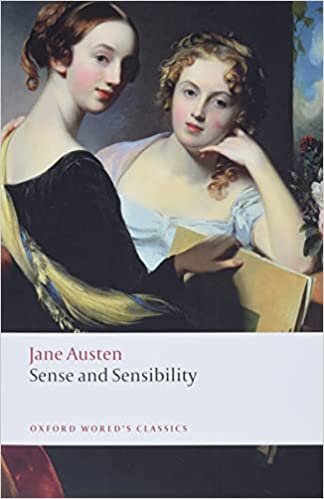
Review 1896: Sense and Sensibility

When I was making up my current Classics Club list, I realized I hadn’t reread any Austen for a while. So, I picked Sense and Sensibility.

When Mr. Dashwood was dying, he made his son John promise to take care of his second wife and daughters, since he was unable to leave them anything due to an entail. John makes this promise with good intentions and tells his wife he will give each of them £1000, but she talks him out of each of his suggestions until he gives them nothing.

On a very small budget, then, Mrs. Dashwood must find a new home for herself and her three daughters, Elinor, Marianne, and Margaret. Just as things are getting unbearable at the shared home, a relative of Mrs. Dashwood, Sir John Middleton, offers the women a cottage in Devonshire at a low rate.

Elinor regrets leaving her home all the more because she has developed what she believes is a shared attachment with her brother-in-law, Edward Ferrars. But Mrs. John Dashwood wants her brother as far away from Elinor as possible. Both she and her mother plan for him to marry well.

Relocated to their new home, the Dashwoods find their neighbors, the Middletons, and Mrs. Jennings, Mrs. Middleton’s mother, to be almost overly friendly.

One day Marianne and Margaret are caught out in a rainstorm and Marianne sprains her ankle skidding down a grassy hill. A gentleman rescues her, and he, Mr. Willoughby, becomes a frequent visitor. It is clear he is attracted to Marianne, and she, having fully adopted the ideals of Romanticism, shows plainly that she’s in love with him. Meanwhile, Elinor wonders why she isn’t hearing from Edward.

This novel is about two sisters who deal with unhappy love affairs in opposite ways and the result. It has vividly believable characters, some funny, and in its own way constitutes a sharp social satire. This novel is one of my favorites by Austen.

Related Posts

Persuasion

Mansfield Park

Sense & Sensibility

Review 1894: Jumping Jenny

When amateur detective Roger Sheringham attends a murder party at the home of mystery writer Ronald Stratton, he is impressed by the gallows with three hanging dummies that Stratton has erected on the roof as a decoration. Little does anyone expect what use it will be put to.

During the party, everyone observes the behavior of Ena Stratton, the wife of Ronald’s brother David. She behaves wildly, always trying to draw attention to herself. She is a deeply unpleasant person, who at one point tries to seduce Roger, and when he doesn’t respond, tells others that he attacked her. She also says several times that she is going to kill herself and threatens the happiness of a couple who are waiting for the woman’s divorce to get married, saying she will write to the magistrate about them having an affair, which of course would negate the divorce in those times. (The book was published in 1933.)

It is this threat that gets her killed. She is up on the roof trying to get sympathy from a party-goer by again threatening suicide and actually putting her head in the noose when her companion removes the chair under her feet.

It’s hard for me to know what to say about this book, for on the one hand, it’s unusual and also more witty than many a detective story. On the other hand, well, wait.

We think we know all along who killed Ena, and it looks like the death will be accepted as a suicide. However, Roger has noticed one piece of evidence that convinces him it’s a murder. Instead of helping the police, he spends the entire novel trying to cover up the murder, thinking he knows who the killer is, but he does not.

This novel was acclaimed for its originality, but the undertones are not so pleasant. Ena is quite despicable, but nothing she does deserves her fate, and in fact she seems mentally ill. That’s one of the problems. Everyone dismisses her as being insane, and almost everyone conspires to help the murderer. I hope I’m not judging this novel by modern standards, but it’s clear that no one feels the least regret at either her death or their own attempts to pervert the course of justice.

So, mixed feelings about this one although a desire to read more by Berkeley. By the way, his hero is exceedingly arrogant, and I got a lot of pleasure out of his getting the crime so wrong and then muddling the evidence so badly that it was almost disastrous.

I received this book from the publisher in exchange for a free and fair review.

Related Posts

The Murder of My Aunt

Death of a Bookseller

Murder of a Lady