Review 1891: Keeping Up Appearances

I’m not sure if it was because I was on vacation while reading Keeping Up Appearances, but it took me much longer to read it than usual for a novel its size. I did notice I occasionally had a hard time paying attention to it while at other times felt I was reading a script for I Love Lucy.

Daphne and Daisy are opposites in personality, but they’re constantly together. Daphne is confident, witty, and brave, perhaps a higher class than Daisy, while Daisy is shy, unsure, and not always swift on the uptake. Daisy is ashamed of her class origins and the circumstances of her birth, even though she has been raised by higher class family members. Daphne could care less about all that.

At the opening of the novel, both young women are vacationing with the Folyot family on an island in the Mediterranean. Mrs. Folyot works against tyranny and reminds me of Mrs. Jellyby. She is obsessed by her causes and so later has a hilarious scene of talking at cross-purposes with Daisy’s mother.

Both girls care for Raymond, the Folyot’s oldest son, a biologist. Although Daisy doesn’t like to look at the little animals Raymond shows her as much as Daphne does, Daisy fears she cares for Raymond more than Daphne does, but he likes Daphne more than her. Unfortunately, an incident with a wild boar makes Daisy too embarrassed to stay, and Daphne goes, too.

Daisy doesn’t think the Folyots would approve of her profession. Not only is she a successful author of middlebrow novels, but she takes assignments from a newspaper to write silly articles about women that the paper assigns her. Daisy is a snob, and she is proud of neither activity even though we suspect she is a better novelist than she thinks.

Macaulay obviously had fun skewering the newspapers, because the ideas for articles are ridiculous and sexist, as is clearly the attitude toward Daisy’s novels.

Although this novel satirizes the publishing industry, it is really about identity and self-image. Most of the characters are not quite likable except Daisy’s mother, who is a hoot.

I received this novel from the publisher in exchange for a free and fair review.
Related Posts

Dangerous Ages

The World My Wilderness

The Towers of Trebizond

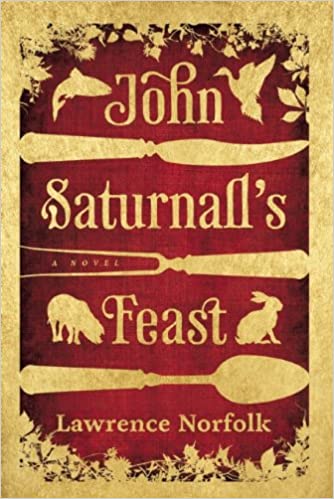
Review 1884: John Saturnall’s Feast

It’s 1625 when young John Saturnall and his mother are chased up into Buccla’s Wood by religious zealots who term her a witch. She is not a witch but a wise woman with ancient knowledge and stories of a magnificent feast that happened centuries before.

When John’s mother is dying in the wood, she sends him to Buckland Manor in the Vale, the home of Sir William Freemantle. There he learns that his mother worked in the manor before she became pregnant with him. He is taken into the kitchen, where he shows promise of becoming a great cook.

Just as John is becoming a Master Cook and Sir William’s daughter Lucretia is reluctantly betrothed to a wastrel in an attempt to save the Vale, the Civil War breaks out. As the Freemantles are supporters of King Charles I, the household has years of suffering before it.

At the beginning of each chapter is an excerpt from The Book of John Saturnall, written using the culinary language of the times. The novel is lushly written, full of the details of running a 17th century kitchen and household.

I was less interested in the unlikely romance, perhaps partly because Lucretia as a character is poorly defined. However, overall I found this novel deeply interesting.

By the way, the Grove Press edition is beautifully presented, with heavy paper, two colors of ink, and gorgeous woodcut-style illustrations.

Related Posts

Corrag

Merivel: A Man of His Time

Salt: A World History

Review 1875: Death of a Bookseller

Published in 1956, Death of a Bookseller has long been unavailable except for costly used editions. I was surprised by the publication date, because in many ways the book reads like a much older novel. It employs a rather formal, factual narrative style, and although it is more of a police procedural, it espouses notions about policing that seem naïve and decidedly rosy compared to the probable reality. Also, it refers to phrenology as if it were a considered a science when it was largely debunked by the 1840’s.

Sergeant Wigan decides to take up a hobby, and the one that appeals to him is collecting books. In learning about them, he develops a friendship with Michael Fisk, a buyer and seller of rare books. He has a collection of very rare ones at home, quite a few about the occult.

When Fisk is found murdered in his home, Wigan is assigned to help the Detective Inspector because of his interest in books. He notices that someone has stolen a rare edition of Keats from his collection, but later learns that someone may have also stolen one of Fisk’s books on the occult, substituting in its place a book of little value.

Very quickly, a runner named Fred Hampton is arrested for the crime with serious evidence against him. Hampton claims he is being framed, and Sergeant Wigan tends to believe him, but the D. I. thinks he has his man. However, he gives Wigan permission to continue investigating on his own time. Wigan does so with the help of Charlie North, another runner.

This novel is interesting in its information about the bookselling trade and has a complex plot, although the clues didn’t seem to me more likely to point at one one suspect over another until the very end. One extremely unlikely plot point was the seriousness with which some characters treated the supernatural angle, as Fisk was apparently trying to raise the devil when he was killed. This feature was another thing that made the book seem more like a 19th century mystery.

I received this novel from the publishers in exchange for a free and fair review.

Related Posts

The Bookman’s Tale

The Red House Mystery

The Cornish Coast Murder

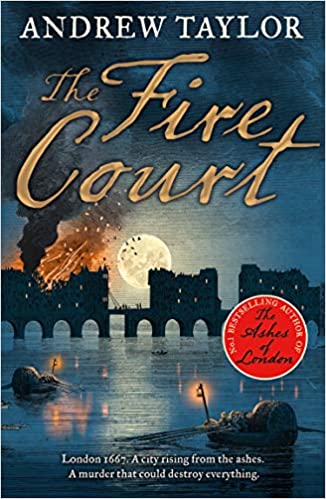
Review 1874: The Fire Court

The second book in Andrew Taylor’s Marwood/Lovett series, The Fire Court begins shortly after the Great London Fire that was the setting of the first book. James Marwood’s father wanders off in his senility and discovers a salacious scene in chambers near where the Fire Court sits—a lascivious painting of a woman dressed like a whore stretched out on a couch.

His father comes home with blood on his sleeve babbling about what he has seen, but James thinks he has experienced a senile delusion. However, a few days later the body of a woman is discovered nearby in a pile of rubble. She is dressed up like a whore, but she is not one. She is Celia, the widowed niece of Mr. Poulton, a client of Mr. Hakesby.

Hakesby has given refuge to Cat Lovett, who has fled her family. She is now going by the name of Jane Hakesby, supposedly Mr. Hakesby’s cousin and servant. But Mr. Hakesby is very frail, suffering from an ague. Cat has been helping him with his architecture work, and he badly needs the custom of Mr. Poulton, who has a case before the Fire Court.

The Fire Court’s mission is to make decisions quickly about competing rights of property so that London can be rebuilt. Mr. Poulton wants to develop some property called Dragon yard that is mostly owned by himself and his niece Celia, and Hakesby is drawing up the plans. But Philip Limbury, an upperclass personage with influence at court, has some rights to Dragon Yard and also wants to develop it. Marwood is sent to look into the death of Celia, and he soon realizes that his father must have seen her murdered in the apartments of Mr. Gromwell, his father’s description of where he went being so vivid. Marwood begins to believe there is some sort of conspiracy going on involving the Fire Court, and both he and Cat are soon in danger.

Although I felt the characters in this book took too long to realize they were involved in real estate conspiracies, this was another complex and interesting novel in this series. The 17th century setting seems convincing, and James and Cat are interesting characters.

Related Posts

The Ashes of London

Merivel: A Man of His Time

The Bookman’s Tale

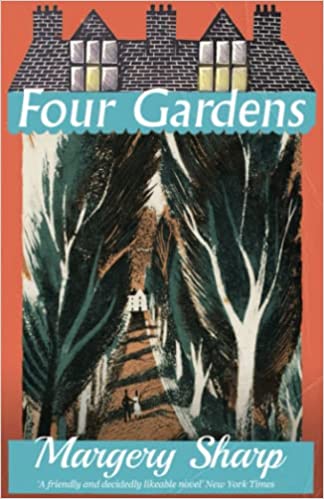
Review 1871: Four Gardens

Furrowed Middlebrow calls Four Gardens one of Margery Sharp’s most beloved books. At first, I thought the novel was just okay, but gradually it won me over. It’s essentially a character study of Caroline, a woman born into the Victorian era who has to learn to adapt to more modern times.

The novel begins with Caroline as a teenage girl, still in the 19th century. She comes from an ordinary middle-class family and recognizes a big divide between herself and the people she knows and the others from the Common, the area where the wealthier people live. She and her family, for example, work on the annual festival, but they are not invited to it.

In the neighborhood is a deserted house with extensive gardens. Although it is trespassing, Caroline sneaks in there and meets Vincent, an upper-class boy. During the summer, she runs off to meet him in the garden. But once he sees her with her family, he stops coming.

Beginning with this disappointing first romance, Four Gardens follows Caroline as she marries, has children, meets with a change of fortune, gets through World War I, and continues into middle age and older. She is an endearing heroine, realistically experiencing the changes of the times. It’s an affectionate and lovely novel.

Related Posts

Harlequin House

Rhododendron Pie

Cluny Brown

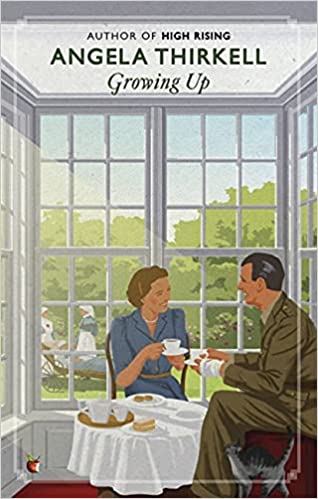
Review 1864: #ThirkellBar! Growing Up

Growing Up takes us to Beliera Priory, the home of Sir Harry and Lady Waring. The Warings have moved to the servants’ quarters, because the Priory has been taken over as a convalescent hospital. Nearby is a secret base, and the Warings receive a request to house an officer who is stationed there along with his wife. Although they are expecting their niece Leslie on a convalescent leave, they agree to billet the couple in their larger extra room.

To our delight, the couple turns out to be Noel and Lydia Merton, and in their exchanges of news with the Warings, we get to hear about almost everyone from the previous books. The Warings have been busy during the war, but the Mertons bring a little extra interest to their lives.

Leslie’s arrival is marked by a stranger carrying her case from the station. In the dark, she can barely see him, but he turns out to be Philip White, now a Colonel, whose disastrous romance with Rose Birkett was a feature of Summer Half. Leslie finds herself immediately interested in Philip.

In this novel, we are treated to the courtship of Selina, the Warings’ maid, by three men (a private young enough to be her son, a sergeant with eye trouble who is a greengrocer by trade, and Jasper, the Warings’s mysterious half-gypsy gamekeeper); the return of Tommy Needham, the fiancé of Lydia’s best friend Octavia Birkett, missing an arm; the goings-on at the Winter Overcotes (which you will be delighted to know is near Summer Underclose) railway station; as well as, of course, the progress of Leslie’s romance. Tony and Mrs. Morland make a brief appearance as do other old friends. Another delightful novel by Thirkell.

Related Posts

Summer Half

Cheerfulness Breaks In

High Rising

Review 1862: Strange Journey

Polly Wilkinson, a middle-class suburban housewife and mother, is leaning on her garden gate, tired from housework. She sees a woman in a Rolls Royce stopped in traffic and wishes she was that woman. For a moment, she is, but it doesn’t last long and she thinks the experience is a daydream.

After that, Polly is periodically removed from her life and takes the place of aristocratic Lady Elizabeth Forrester. After some initial confusion about what is happening, she believes Elizabeth is causing this exchange, and she is put in some awkward positions, such as finding herself in the middle of a fox hunt when she can’t ride. She purposefully makes Elizabeth do things she doesn’t usually do, such as play bridge brilliantly, in a sort of revenge. She also returns home to find the furniture moved and her children demanding stories she’s not familiar with. What could be causing these body exchanges?

I wasn’t sure I was going to like this novel, which reminded me of The Victorian Chaise-Longue, but it grew on me. It wasn’t as dismal as the other novel, and I liked how Polly’s more open and positive personality had an effect on Elizabeth’s life while Elizabeth’s confidence helped Polly and her husband’s career.

Of course, the novel comments on class issues, but Cairnes’s representation of Polly’s suburban life is so realistic that I was surprised to find Cairnes came from a background closer to Elizabeth’s. She doesn’t skewer or patronize the suburban characters. If anything, Polly’s frank kindness opens Elizabeth’s eyes to some truths. Sadly, (small spoiler) the class divide is still strong enough in 1930’s England that the women can’t remain friends in the future.

I received this novel from the publishers in exchange for a free and fair review.
Related Posts

The Victorian Chaise-Longue

The Squire

Mamma

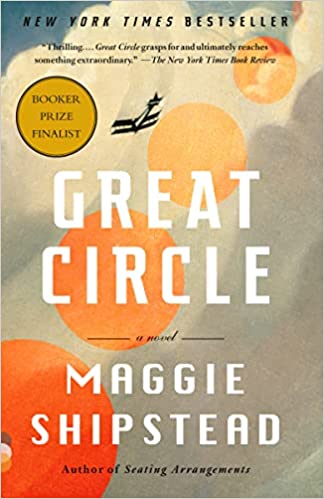
Review 1861: Great Circle

After getting fired from a hit TV series with a cult following for damaging the brand, Hadley Baxter thinks her career might be over. However, she is approached about starring in an independent film about the life of Marian Graves, an early aviator who disappeared in 1950 while attempting to circumnavigate the earth via the poles.

Although the novel sometimes follows Hadley as she tries to figure herself out, its main focus is on Marian and her twin brother, Jamie. As babies, they are on their father’s ship when it sinks, and because he chooses to save them rather than go down with his ship, he serves time in jail. They are raised in Missoula, Montana, by their alcoholic artist uncle, who lets them run wild.

When a pair of barnstormers stop over, Marian is bit by the flying bug. She is already doing men’s work, so she begins working harder to earn enough for flying lessons. But no one will teach her until she meets Barclay Macqueen, a bootlegger.

Great Circle is a broad-ranging novel that takes us from bootlegging in the West to serving mining camps in Alaska to ferrying planes in England before the flight around the world. I found Marian’s story more compelling than Hadley’s but still found the novel fascinating. Since I read it, it has been nominated for the Booker prize, so is part of my project.

Related Posts

West with the Night

Circling the Sun

Straight on Till Morning

Review 1858: The Night Hawks

D. I. Harry Nelson calls forensic archaeologist Ruth Galloway to a site on the coast where a body was discovered nearby by some metal detectorists. The same detectorists, a club called the Night Hawks, have also found a trove containing a skeleton.

Ruth, as the new department head, has hired her replacement, David Brown, who is already irritating her. She finds him coming along to excavate the skeleton despite herself.

Although the young man found along the coast turns out not to have drowned, and in fact, is a local ex-con, the cause of his death is not immediately apparent. Shortly thereafter, two of the Night Hawks report hearing shots at a remote farm. A young policeman is the first onto the scene, where he discovers what appears to be the murder/suicide of a scientist and his wife, Douglas and Linda Noakes. A few days later, the young policeman is dead from an apparent virus, the same as, it turns out, killed the young man found by the sea.

This novel mixes in local folklore with an intriguing mystery. Further, it seems to be moving along Ruth’s relationship with Nelson, the married father of her child, even though they don’t actually spend much time together in this one. I’m still finding this series enjoyable.

Related Posts

The Lantern Men

The Dark Angel

The Chalk Pit

Review 1849: Much Dithering

Jocelyn Renshawe is a young widow who has always done what is expected of her, that expectation arising from two older ladies, Mrs. Pallfrey, her aunt, and the Honourable August Renshawe, her mother-in-law. She leads a quiet life, mostly doing good works. At the beginning of the novel, she is about to suffer a visit from her mother, Ermyntrude.

Ermyntrude is the most selfish being in this novel, which is full of them. She finds her daughter a bore, and her only reason for visiting her is because she is what Lambert calls a “baby-stealer” and what we would call a cougar. She is interested in cementing her affair with Adrian Murchison-Bellaby, whose parents have just taken a house near the village of Much Dithering, where Jocelyn lives. Ermyntrude wants to show Adrian’s parents how suitable she would be as a wife. However, when Adrian meets Jocelyn, Ermytrude is unable to see that he falls in love with her daughter.

In a thunderstorm on the way back from one of her good deeds, Jocelyn accepts a ride from a stranger who is having trouble finding Much Dithering. He is Gervase Blyth, who has unexplained business in the area.

Soon, Jocelyn unaccountably has three men in love with her. But the one she prefers is most likely to force her out of her protective shell.

It’s not very hard to guess the outcomes of this entertaining light novel, but that doesn’t make it any less fun to read. Its characters’ foibles are all too human, but still funny. This was a perfect light read for me from my Classics Club list.

Related Posts

Rhododendron Pie

The Blue Sapphire

Wild Strawberries