Review 1755: The Snow-Woman

For nearly half a century, Maude Barrington has been grieving for her three brothers who died in World War I. To the rest of the world she has been cold, letting friendships fall away, living with just her maid Millie, and having just a few neighbor acquaintances.

Then one day, an old frenemy, Lionel Crozier, invites himself to tea. Thinking of him as malicious, Maude doesn’t know what to expect but is not surprised when he arrives with a hugely pregnant young woman from a lower class named Teddie Parker. Soon, the girl begins to give birth on Maude’s couch.

Once Teddie has been dispatched to the hospital, Lionel tells Maude he wants her to come to France, where an old friend, Charles, a famous expert on modern art, is dying. Although Maude has done nothing for years, she agrees to go, and thus begins a kind of opening up, where she reconciles with old friends.

This experience continues when she arrives home and gets more involved, through Millie, with Teddie and her family. The result is the revelation of long-held secrets and a new life for Maude.

Although I wondered why Maude wasn’t curious about how Lionel knew Teddie or why he would have brought her to Maude’s house, and although I also wondered at some point where the novel was going, it turned out to be thoroughly satisfying and heart-warming. Another win for Gibbons.

The Woods in Winter

A Pink Front Door

Nightingale Wood

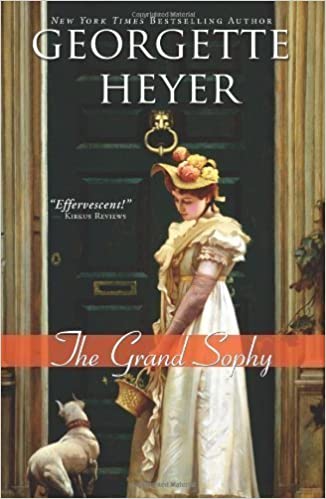
Review 1753: Faro’s Daughter

Max Ravenscar is exasperated when his aunt, Lady Mablethorpe, comes to consult him about Adrian, his young cousin for whom he is a trustee. She reports that Adrian has fallen in love with a girl from a gambling den and means to marry her. Ravenscar assumes the girl will have to be bought off.

When he meets her in her aunt’s home, which has indeed been converted into a gambling den, he is surprised at her well-bred appearance and demeanor. However, when he makes his offer, he finds she has turned into a termagant.

Deb Grantham, for her part, has no interest in entrapping naïve young men into marriage. Nor is she interested in Lord Ormskirk, who unfortunately holds some of her aunt’s debts and the mortgage to her aunt’s house. However, she is so angered by Ravenscar’s proposals that she decides to pretend she wants to marry Adrian and to behave as vulgarly as possible.

Even though this is not one of my very favorite Heyer novels, it is still great fun. It has some potentially melodramatic twists to it that are saved from seriousness by a feisty heroine who is not to be defeated.

Frederica

Sylvester, Or the Wicked Uncle

The Talisman Ring

Review 1751: Last Friends

This final novel in the Old Filth trilogy gives us the last pieces in the puzzle of the complex relationships described in the first two books. It tells of the origins of Terry Veneering, the lifelong rival of Edward Feathers (known as Old Filth) who finally became a friend.

Last Friends begins in the same place as Old Filth, with the memorial service for Edward Feathers. Much of this novel is presented through the eyes of two minor characters in the trilogy, Dulcie and Fiscal-Smith. Veneering is a mysterious figure in the other two books of the trilogy, his origins unknown but subject to many rumors. It turns out that Fiscal-Smith has known him from boyhood in a northern manufacturing town, the son of a schoolgirl and a Russian dancer rumored to be a gentleman, who was badly injured as a young man and had to be supported by his wife.

This final tale is enthralling and brings a fitting ending to this great trilogy.

Old Filth

The Man in the Wooden Hat

The Singapore Grip

Review 1746: The Hand That First Held Mine

Best of Ten!

It’s the mid-1950’s, and Lexie Sinclair has already made arrangements to leave her family home in Devon when she meets Innes Kent. He is a stylish magazine editor whose car has broken down on their road. When she tells him she is coming to London, he asks her to look him up. Instead, he looks her up.

Lexie takes up an exciting life as part of the Soho art scene. She and Innes are the loves of each other’s lives even though he is married. His wife has, however, taught her daughter Margo to hate Lexie even though she and Innes have been split up for years.

In present-day London, Elina and Ted have just had a baby. The birth was difficult, and Elina is having a hard time coping with the pressures of motherhood. At the same time, Ted, whose memory is notoriously poor, has begun having flashes of memory that do not correspond to what he understands of his life. Slowly, these two stories connect.

Maggie O’Farrell is always wonderful, I find, but this novel had me sobbing. It is beautiful and tragic as it explores the themes of motherhood and family secrets.

The Vanishing Act of Esme Lennox

After You’d Gone

Instructions for a Heat Wave

Review 1743: The Family Upstairs

Here’s another book that qualifies for RIP XVI!

Libby Jones knows that she is adopted and that on her 25th birthday she’ll receive some sort of inheritance. However, she is floored to find she has inherited a house in Chelsea that is worth millions.

The house has a dark history, though. Twenty-four years ago, Libby was found in a cradle in the house with four dead people, an apparent cult suicide. Her teenage brother and sister were missing.

Alternating with Libby’s discoveries is the narrative of Henry Lamb, her brother, who was 10 years old when first Justin and Birdie and more fatefully, David Thomsen and his family moved into the Lambs’ house. Slowly, David begins bringing Henry’s infatuated mother and weak father under his thumb.

We also hear from Lucy, another former inhabitant of the house, who is barely surviving, homeless on Italian streets with her two children and her dog. She needs to get to England and to do so, must beg for help from her abusive ex-husband.

This novel feels like it is building to a suspenseful ending, but its ending is surprising and ambiguous. I wouldn’t exactly class it as a thriller, but it is dark and interesting.

Related Posts

The Girls

The Widow’s House

Dark Places

Review 1735: #1976 Club! Sleeping Murder

With the 1976 Club looming, I picked out some books to read for October that were published in 1976. Sleeping Murder also qualifies for RIP XVI! As usual, on this first post I’m also listing anything else I’ve reviewed published in 1976. As far as I know, there are only two:

Newlywed Gwenda Reed is house hunting along the south coast of England for herself and her husband Giles, both newly arrived from New Zealand. When she comes across a house in Dillmouth, she immediately feels at home there, although she experiences a fleeting panic on the stairs. Nevertheless, she buys the home.

Gwenda is residing in it to oversee updates to the house when she begins to experience something odd. She expects the stairs down from the terrace to be in one place but they are in another. When workmen remove some bushes where she thinks the steps should be, they find the stairs used to be there. Similarly, she keeps trying to walk through the wall in the dining room where she thinks there should be a doorway. When the workmen examine the wall, they say it had a door there. She imagines a particular wallpaper in what used to be the nursery, and when a blocked cupboard in that room is opened, she sees that wallpaper inside.

Gwenda is most upset because she’s had a vision of a woman dead at the bottom of the stairs and realized it was Helen. But she has no idea who Helen is. Feeling confused, she decides to consult friends in London. Accompanying the group out for the evening is her friends’ aunt, Miss Jane Marple. After she explains what’s been happening, Miss Marple says she should find out if she ever lived in England as a child.

Inquiries find that Gwenda lived in the house when she was three. At the time, her father had a second wife named Helen. But Helen supposedly ran off with another man. Gwenda and Giles find that Helen’s half brother, Dr. Kennedy, still lives in the area. He has some letters that she sent right after she left but hasn’t heard from her since.

Gwenda and Giles begin to believe that Helen was murdered. Did Gwenda’s father kill his wife, or did someone else?

It was hard for me to judge whether this was a difficult mystery, because I vividly remembered a TV production of it. However, knowing the identity of the killer made me appreciate how skillfully Christie salts in the clues without giving too much away. The characters are clearly defined, and Miss Marple is at her cleverest.

Related Posts

4:50 from Paddington

At Bertram’s Hotel

Murder at the Vicarage

Review 1732: A Day in the Death of Dorothea Cassidy

Here’s another book for RIP XVI, although a cozy one.

People in the town of Otterbridge are shocked when the body of Dorothea Cassidy, the vicar’s wife, is found murdered in the park. Most of the people in town loved her, she was so vibrant and enthusiastic.

Inspector Ramsey and Sergeant Hunter are having difficulty retracing her movements on the day before. Almost everyone who saw her is lying in some way. Old Walter Tanner found her car in his driveway that morning, and only he admits to disliking her, saying she was constantly after him to approve of changes she wanted to make to the church.

The Inspector Ramsey books are one of Cleeves’s earlier series. I have read all of her Vera Stanhope and Jimmy Perez books and a couple of stand-alones. Although this one has a clever premise, it feels less polished than the others. Cleeves often lets readers know some of what her suspects are thinking, but information about them is introduced naturally in the other books, for example, in conversations between characters. Here, we no sooner meet a character than we are told several facts about the person, a device which seemed clumsy to me. Also, character development seems quite a bit sketchier.

Related Posts

The Sleeping and the Dead

The Long Call

Blue Lightning

Review 1731: Old Filth

Best of Ten!

From his birth and continuing through his adolescence, Edward Feathers was abandoned or taken away from every person he loved. As an adult, he was a still, stiff man unable to love.

After the death of his wife, Betty, Sir Edward, or Old Filth as he is known in the world of law where he is a prominent lawyer, begins re-examining the events of his past. He also makes attempts to connect with people important to him, but these attempts are abortive. Slowly, all the things he has never spoken of are revealed.

Written in sterling prose, Old Filth is a mesmerizing story about the Raj Orphans, children who were shipped to England at an early age from the Far East. The novel is touching and completely gripping. And for those who loved it like I did, hooray! It’s the first of a trilogy.

The Cat’s Table

The Garden of the Evening Mists

The Singapore Grip

Review 1726: To Calais, In Ordinary Time

It’s 1348, two years after the battle of Crécy, which won Calais back from the French to the English. Will Quate is betrothed to Ness, the prettiest girl in his Cotswold village, but his liege lord, Sir Guy, wants him to join a group of archers on their way to defend Calais. Will would rather stay, but he bargains for a document showing he’s a free man. Sir Guy tells him he will send along the paper with Captain Laurence Haket in exchange for five pounds once he has won his fortune.

Will agrees to go. In fact, his attitude toward Ness seems ambivalent. He doesn’t seem to care that she had an affair with Haket and became pregnant. Will’s friend Hab is plainly in love with him, but Will doesn’t seem inclined.

Sir Guy’s daughter Bernadine is incensed that Sir Guy has betrothed her to a man his own age when she is in love with Laurence Haket. Inspired by La Roman de la Rose, she feels she is entitled to a more romantic life, so she runs away, following Haket on his way to Calais.

Another voice on the journey is Thomas Pitkerro, a proctor, who is sent along with the archers on his way to his home in Avignon to give last rites, if needed. Thomas is afraid of the plague, which is said to be moving north from Italy and France.

To Calais, In Ordinary Time echoes its medieval inspirations with its tale of adventures while on a journey. It does so in more than just plot, however, for it is written with only words in use in the time it was set. Thomas, who is writing letters and keeping a diary, writes in a stiff, bombastic style that thankfully loosens up . The novel is narrated in a style a little less formal than the speech of Bernadine, which contains some French modes of expression. Several times the point is made that her workers do not understand many of the words. The speech of Will and the characters around him is littered with expressions native to the Cotswolds.

This attempt is similar to that of Paul Kingsnorth in The Wake, which I read several years ago—written to be readable to modern audiences but to have the feel of Old English (in the case of The Wake, that is). This effort doesn’t seems as likely to me except in the speech of the characters of the lowest status, which has a flow to it. The dialogue between characters of higher status seems overly elaborate, even pretentious, and perhaps echoes written work of the time.

Meek doesn’t do much to get readers interested in his characters, so at first I had difficulty becoming involved in the novel. After a while, I got more interested. I read this novel for my Walter Scott prize project.

Related Posts

The Wake

The Last Hours

The Illuminator

Review 1725: Cluny Brown

Best of Ten!

Mr. Porritt, the plumber, is worried about his niece, young Cluny Brown, because, he says, she does not know her place. Why, the other day she went to the Ritz just to see what it was like. When he catches Cluny about to take a bath in a gentleman’s lovely bathtub after she made a plumbing call, Mr. Porritt decides to take advice and send Cluny into service.

She ends up as a parlor maid in Devonshire for Lady Carmel and Sir Henry. There, although she’s not very adept at being a parlor maid, she finds she likes the country and she befriends a golden lab belonging to Colonel Duff-Graham, who allows her to take the dog out for walks.

In the meantime, Lady Carmel’s son Andrew has met Mr. Belinski, an eminent man of letters who has had to abruptly flee Poland and is barely getting by. Andrew invites Mr. Belinski to stay at his parents’ manor, where he can write. Andrew himself is preparing to propose to the beautiful Betty Cream.

Cluny is struck by Mr. Wilson, the chemist, and he rearranges his shop’s closing day to take walks with her. There’s something about Cluny, who is direct and forthright and doesn’t seem to understand customary boundaries.

This is a wonderful comic novel, absolutely delightful, and my first by Margery Sharp (I have reviewed one that I read after this one). I’ll be looking for more.

The Stone of Chastity

Beneath the Visiting Moon

Joanna Godden