Review 1678: The World My Wilderness

Seventeen-year-old Barbary Deniston has grown up running wild in occupied France and was a member of the enfante maquis of the French Resistance. Now that the war is over, she doesn’t seem to know the difference and is still involved with the maquis, which is hunting down collaborators. Her mother, Helen, was neglectful while happy with her stepfather, but now that he has died, they’ve had a falling out. Helen decides to send her to London to live with her father, Gulliver. Also going is her stepbrother Raoul, who is to study and learn his uncle’s business.

Barbary is a fish out of water in her father’s upper-middle-class home. He is too busy with work to pay attention to her, and his wife, Pamela, dislikes her. In many ways immature, Barbary believes her parents would reunite if it weren’t for Pamela and her baby son, so she is determined to dislike them. Her father enrolls her at the Sloane and just assumes she goes there, but she and Raoul roam the streets and find a ruined section of London that reminds them of home. Soon, they are associating with deserters and thieves.

Macaulay treats all of her flawed characters with empathy, but it was hard for me to relate to Barbary. However, this novel made me realize how chaotic post-war France and London must have been. I haven’t read any other books that deal with that subject.

Related Posts

The Wardrobe Mistress

The Death of Bees

Warlight

Review 1677: Sisters

September and July move suddenly from Oxford with their mother to a decrepit and dirty house on the moors. They have lived there before—the house belongs to their father’s family—but to July the house seems freighted with a depressing atmosphere and full of odd noises.

Something bad happened at school, but July can’t remember what it was. Her depressed mother spends all her time in bed, leaving July and September to fend for themselves. Judging by their games, I thought at first that the girls seemed only about ten or eleven, but we find out later they are several years older. September is the leader, insistent and fiery, sometimes cruel. July is the appeaser, but she has trouble with her memory and sometimes has waking dreams.

In a section from their mother Sheela’s point of view, we learn that she worries September might be demonstrating the same kinds of traits that made Sheela afraid of the girls’ father. Her relationship with him, it appears, was of both love and hatred. Sheela has also worried about the closeness between the two girls, which shuts her out. They behave like twins even though they are 10 months apart.

This novel is a fabulously atmospheric character study. It pulls us forward, making us wonder what is going on. What happened at school? What will happen next? The writing is at times poetic in quality.

Related Posts

Everything Under

Mountains of the Moon

All the Birds, Singing

Review 1669: Young Anne

Young Anne is Dorothy Whipple’s first novel but unfortunately is the last one I’ll be reviewing, because I’ve read and reviewed them all. Like many first novels, it is at least somewhat autobiographical.

We meet Anne at age five and see her again at eleven and eighteen before the bulk of the novel when she is an adult, but these ages are enough to get to know her. At five, she is prone to misunderstand her parents. Her father is severely critical of her while he spoils his oldest son. He is a martinet, and Anne becomes defiant of him as she grows older. Her mother doesn’t care about anything happening in the household.

As Anne gets older, she becomes quite naughty, but she is sent away to school because she laughs at her father while he is singing. This is shortly after she destroys her father’s copy of Boswell and knocks all the berries off a holly bush while getting carried away playing schoolteacher.

As a young woman, Anne loses her father, and the household is broken up. She is sent to live with her Aunt Orchard, who constantly complains about her ingratitude. Her only comfort is the maid, Emily, who has always been her staunch supporter and follows her to work in Aunt Orchard’s house. That and her friendships with Mildred and Mildred’s cousin George.

I found the character of Anne very appealing as she, in her straightforward way, has trouble navigating in society. Some of the scenes, especially with Mildred’s kind but social-climbing mother or the one where Aunt Orchard reveals her true self to the rector, are quite funny. This novel seemed true to life and was sometimes very touching. I liked it a lot.

Related Posts

Greenbanks

High Wages

Because of the Lockwoods

Review 1668: The Vicomte de Bragelonne

My edition of the Collected Works of Alexandre Dumas explains that The Vicomte de Bragelonne was originally published as a massive work but is traditionally published in English as either three or four separate novels: The Vicomte de Bragelonne, Ten Years Later, Louise de la Valliere, and The Man in the Iron Mask. I read the first book, which was quite long in itself.

I felt I was at a disadvantage in reading this book because it is one of the D’Artagnan novels and I haven’t read The Three Musketeers for many years or Twenty Years After ever. Although all four of the original characters appear, I felt that I didn’t understand their relationships to each other. As for the title character, who is the son of Athos, although he makes a couple of appearances, this first novel in the set is about D’Artagnan.

In the beginning of the novel, Louis XIV is a young king, but he has been under the control of Cardinal Mazarin for most of his life. D’Artagnan is the lieutenant of the musketeers, and he overhears when Charles II of England comes penniless to the king to ask for money and men to take back his kingdom. Louis’s finances are kept strictly in the Cardinal’s hands, so Louis goes to the Cardinal to ask for the money or men. The Cardinal, who has made himself wealthy at the kingdom’s expense, tells Louis there is no money and he can’t spare any men. When D’Artagnan sees Louis send Charles away with nothing despite wanting to help him, he resigns in disgust, determined to help Charles.

D’Artagnan’s friend Athos, now the Comte de la Ferre, also wants to help Charles. He was present at the beheading of Charles’s father and knows the Charles I buried a million livres at Newcastle. Athos determines to fetch the money.

This novel seems disjointed. More than half of it deals with the two missions on behalf of Charles, while the rest deals with Louis finally coming into power and sending D’Artagnan on a mission. Perhaps as a complete work, with all its parts, it would seem more coherent, but at this time I was not willing to put in the time to read the whole thing.

I read this for my Classics Club list.

Related Posts

The Black Tulip

La Reine Margot

Captain Paul

Review 1663: The Woman in Blue

Elly Griffiths is getting much better at fooling me than she was in the first few Ruth Galloway books, so that is all to the good.

Ruth’s friend Cathbad is house- and cat-sitting in Walsingham when the cat gets out one night and runs into the cemetery. There, Cathbad sees a young blond woman wearing a blue cloak. He is about to offer help when the cat trips him up and the woman disappears. The next morning she is found strangled.

That day Ruth has an appointment to meet Hilary, an old school friend, for lunch in Walsingham. She is astonished to find that her friend has become a priest. Hilary shows her some threatening letters she’s received, apparently because she’s a female priest.

When Ruth gives DCI Nelson the letters, he seems inclined to think they might be connected to the murder. A few nights later, the women priests, who are attending a conference, go out to dinner, a dinner to which Ruth is invited. Afterwards, one of them is found strangled.

Although Ruth uncovers a clue, she is not directly involved in the solution of the murders. That’s okay, though, because Griffiths has created an ensemble cast of strong characters. If Ruth isn’t out there sleuthing in every book, Griffiths gets around the problem of the unlikelihood of an amateur sleuth being involved in so many murders. The Ruth Galloway series continues to be interesting and engaging.

Related Posts

The Ghost Fields

The Outcast Dead

A Dying Fall

Review 1662: The Poison Thread

Dorothea Trueblood is a youngish Victorian heiress who prefers to spend her days pursuing charitable causes rather than in socializing. Her conservative father wants her to marry as highly as possible, but she has secretly engaged herself to a police constable. Something keeps her from breaking the news to her father, even though she is of age.

She is fascinated by phrenology, so one of her charities is Oakgate Prison, where she visits prisoners in hopes of measuring their heads. Therefore, she is excited when Ruth Butterham, a young maid who murdered her employer, comes to the prison.

Ruth begins to tell Dottie her story, and it’s not long before Dottie realizes that Ruth is telling her she killed people by putting bad thoughts into the sewing she was doing for them. Dottie doesn’t find an enlarged organ of deceit in Ruth, but she can only assume she is lying.

This gothic novel has quite a lot going for it. It pins you to the page while you wonder where it is going. I was suspicious of Dottie at first, thinking her interest in Ruth a bit salacious. But I liked Ruth more. This is quite a nice dark book.

Related Posts

Akin

Burial Rites

Dark Enchantment

Review 1658: Georgiana, Duchess of Devonshire

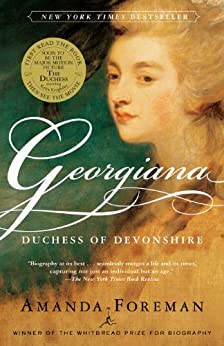
My curiosity about this subject was piqued by seeing the movie starring Kiera Knightly. Predictably, the movie exaggerated the story of Georgiana’s home life and left out her role as a serious political negotiator. (Those scenes of her on the podium don’t really count.) For the Duchess of Devonshire was a complicated person, intelligent but too trusting, generous but also profligate, adored by most but not by her own husband, a savvy politician, a serious amateur scientist, an author who never published under her own name, and an important figure in 18th century social and political life whose legacy was either purposefully erased by rivals or too-proper Victorian descendants or overlooked by historians.

Georgiana’s home life was exciting enough to provoke the prim, for, married at 16 to a husband who was cold and unloving, she was full of insecurities that eventually led her to live most of her married life in a ménage with her husband and Lady Elizabeth Foster, her husband’s mistress. Although Bess Foster seldom missed an opportunity to undercut her even after her death because she envied her position, Georgiana always considered Bess her best friend despite her mother’s and children’s detestation of the woman (with good reason).

Aside from Georgiana’s loyal support of the Whig Party and Mr. Fox, who may have been her lover, an overarching concern of her life was debt. Georgiana and her family all shared the trait of an inability to live within their means, despite having fortunes at their disposal. Georgiana missed several opportunities for the Duke to settle her debts by being too ashamed to admit them all, so all her life she was constantly juggling money, borrowing from one person to pay another or gambling away money meant to pay her debts.

Georgiana was a flawed but fascinating woman, and this biography reveals not only her life but her times to the reader.

Related Posts

Queen Anne: The Politics of Passion

Alexander Hamilton

The Black Count

Review 1657: The Wouldbegoods

In my return to my project of reading the collected works of E. Nesbit, among others, I realized I had forgotten how charming and funny her first Bastable novel, The Story of the Treasure Seekers, was. The Wouldbegoods is the second entry in the Bastable series.

The Bastable children have a habit of unwittingly causing havoc, and after a disastrous attempt to make a jungle while acting The Jungle Book, the children and their guests, Danny and Daisy, are shipped off to the country to stay with the uncle of Albert (referred to as Albert-next-door in The Treasure Seekers). Albert’s uncle is a writer usually installed in his study, which gives the children lots of unsupervised scope to get into trouble. So, they decide to form a society called the Wouldbegoods to try to be good. Of course, their attempts all go sadly awry.

Their decision to hand out free lemonade to passersby results in a fight with some unruly men and boys. Giving a tramp some coins ends up with them being trapped at the top of a tower. All their attempts at play go out of control, such as when they create a zoo in the paddock and the dogs chase the sheep into a stream.

One of the biggest charms of this novel as well as its predecessor is the “anonymous” narration by Oswald, who has obviously read a lot of florid literature. I think this series is funny for children but even funnier for adults, because the children have a naïve way of believing legends or taking things literally that will tickle adults while children may not see what’s coming. These books are delightful.

Related Posts

The Story of the Treasure Seekers

The Railway Children

The Lark

Review 1656: Edward II

I haven’t read any Christopher Marlowe plays since college, so when I made up my Classics Club list, I picked Edward II, because I didn’t remember reading it. And it’s true, it didn’t ring any bells except through reading fiction about his reign until I got to the part about the line in Latin that could be read in two ways.

The play begins with the return, after Edward’s accession, of his favorite Gaveston, who had been banished to France. Edward has summoned him with a love letter, and Gaveston tells us straight out that he’s going to use Edward’s homosexuality to manipulate him. And he does. Almost the first thing Edward does is throw the Bishop of Coventry into jail and give all his possessions to Gaveston. Although Mortimer, in particular, is bothered by how “basely born” Gaveston is, the main complaint is his greed: “While soldiers mutiny for want of pay/He wears a lord’s revenue on his back.” Basically, he’s bankrupting the kingdom.

Further, Edward is slighting his queen, Isabella of France, who seems at first an innocent victim. But things are going to get a lot more interesting.

In Marlowe’s plays, government is usually corrupt. He’s not very interested in appeasing power. Usually, this corruption is a result of greed or sex—in this case both.

I have always found Shakespeare to be a great deal more poetic than Marlowe, but Marlowe’s plays have their power. This one also has the benefit of being a great deal more true to the actual events than most of Shakespeare’s history plays are, but of course Shakespeare was interested in appeasing power.

Related Posts

The Lily and the Lion

The She-Wolf

Henry VI Part I

Review 1655: Warlight

In 1945, Nathaniel and Rachel’s parents enter their young teen children into boarding school and leave for a year in Singapore. Hating school, the two children run away and end up at home in the care of their parents’ friend and boarder, whom they call The Moth.

Their lives become chaotic. Their house is filled with eccentric people. Nathaniel and Rachel grow apart, Rachel going off on her own while Nathaniel skips school to help the mysterious man called The Darter engage in low-level criminal activities.

They never see their father again, and it becomes apparent that their mother is engaged in some sort of espionage, which eventually proves dangerous for them.

This moody novel is intricately plotted, so that its secrets are revealed slowly, like peeling an onion. As Nathaniel becomes a man, he begins to look into the truths behind his formative years. What really went on? What did he know but forget? What was he oblivious to? This novel is dark, enigmatic and deeply engaging. I read it for my Walter Scott prize project.

Related Posts

The Cat’s Table

Manhattan Beach

Abigail