Review 1584: Milly Darrell

When Mary Crofton attends a charmless school to learn to be a governess, she is befriended by an heiress, Milly Darrell. Milly is a beautiful and good-natured girl whose life becomes complicated when her widowed father remarries.

Augusta Darrell doesn’t like Milly, but the situation changes for the worse with the reappearance in the area of a neighbor, Angus Egerton. Before he returns, the girls hear the story of his falling out with his mother after he fell in love with a girl of low birth. When his mother prevented the marriage, he swore never to return while his mother was alive and was said to have lived dissolutely. His mother dead, he returns to try to repair his dilapidated estate.

It is easy to guess that Mrs. Darrell has something to do with this story but not so easy to see how that will affect the plot. This thickens when Milly and Angus fall in love with each other.

This novella is a typical sensation work of its time. It is short and fun to read. For some reason, though, the publisher has chosen to add an alternate ending which, while not materially different from the original, is a travesty of purple prose—an indication of a lack of discrimination on their part.

Related Posts

Aurora Floyd

The Mystery of Mrs. Blencarrow

Diana Tempest

Review 1582: The Mirror and the Light

Best of Ten!
At last, Hilary Mantel has produced this long-awaited third volume of her Thomas Cromwell trilogy, begun with Wolf Hall. One of the remarkable traits of this trilogy is that it lives fully within the thoughts of its main character, and never has a character been so thoroughly drawn.

The Mirror and the Light begins with the beheading of Anne Boleyn, which Cromwell has largely brought about at the urging of Henry VIII. Indeed, he has been avenged against most of the people who ruined his first and beloved master, Cardinal Wolsey, and Anne Boleyn was one of them.

However, his service is now devoted to that of his current master, Henry VIII. He sees that service to bring down Henry’s enemies but also to save Henry from the worst of his excesses. One of his first acts is to save Mary Tudor’s life by bringing her to obedience to her father. He also works to keep the realm within the Protestant religion. So, after the death of Henry’s third queen, Jane, following childbirth, he tries to find Henry a wife who will bring him allies from the Protestant German states. For England is alone and open to attacks from all Catholic countries.

I know my Tudor history, so I knew all along how this would end. The novels show a man who can be ruthless but who is also charitable, kind, and loyal. Not all of his cheerful, unruly household of semi-adopted sons turn out to be as loyal to him.

The last thirty pages or so of this novel had me in tears. For me, there can be no better compliment to a book.

Related Posts

Wolf Hall

Bring Up the Bodies

Queen’s Play

Review 1581: Somewhere in England

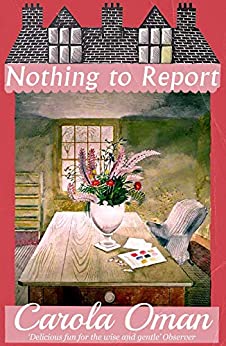
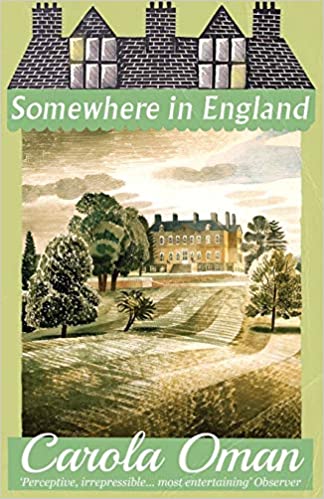
When I received a review copy of Somewhere in England from Furrowed Middlebrow, I realized that it was a sequel. So, I ordered the previous book, the delightful Nothing to Report, to read and review first.

To introduce the plot of Somewhere in England, I have to include a spoiler or two for the previous book. The novel begins with 18-year-old Pippa Johnson, who is about to take a position in a war hospital established in the family home of Mary Morrison, the main character of the previous book. In between novels, Mary Morrison married Kit Hungerford, who had purchased her family home. Now, Mary Hungerford is administering the hospital.

The first part of the novel has to do with Pippa meeting the hospital staff and villagers. It is more concerned with the social side of things than the war work as we meet familiar characters again. Elisabeth, who made her debut the summer of 1939 in the previous book, is a nurse whose fiancé has died, and she is rude to young Pippa. Lalage is friendly and will make a good nurse, but her sister Rosemary and mother Marcelle continue with their selfish ways. Most people, though, are occupied with some kind of war work.

The second part of the novel returns to the point of view of Mary, who is constantly dealing with difficult situations all the while worried for her husband overseas.

I enjoyed this novel, but it is hard to describe. It was fun to revisit the characters of Nothing to Report and see how they’re doing during the war. I think that as a sequel it stands well enough alone, but my enjoyment was enhanced by having read Nothing to Report first.

Related Posts

Nothing to Report

Northbridge Rectory

Atonement

Review 1579: A Room Full of Bones

Dr. Ruth Galloway is asked to attend the opening of a coffin that was found in the remains of a medieval church. It is marked as if it is the coffin of St. Augustine Smith, but the saint was supposedly buried in the cathedral. However, that coffin was found to be empty.

When Ruth shows up for the ceremony at the little museum belonging to Lord Smith, she at first thinks no one is there. Then she finds the body of the curator, Neil Topham, lying next to the coffin.

There are several plots in this novel, but Ruth isn’t as directly involved in them as in previous books. There is the mystery of who killed the curator. Then, an Australian indigenous man named Bob Woonunga rents the house next to Ruth’s while he attempts to get Lord Danford Smith to return some aboriginal skulls. Later, Lord Smith mysteriously dies after a short fever and hallucinations. While the police investigate these deaths, they are also trying to find the source of some high-quality drugs in the area.

Ruth herself has been keeping away from DCI Harry Nelson, the father of her daughter, since his wife Michelle figured out the situation. She runs into Max, an archaeologist who was interested in her when she was pregnant, and begins a tentative relationship.

This mystery was much more difficult to guess because of its many plot threads. Actually, it wasn’t so much a mystery as a thriller, with the police in danger instead of Ruth. Still, I remain interested in these characters and happy to read another in the series.

Related Posts

The Crossing Places

The Janus Stone

The House at Sea’s End

Review 1578: After the Party

In 1938, Phyllis Forrester and her family return to England from a long period of living abroad. Phyllis has been yearning to be near her two sisters, so they settle down on the Sussex coast.

Through her sisters, Phyllis gets involved with two different sets of people, with some overlap. Her socialite and snobbish sister Patricia introduces her to an upperclass group interested in social events. Her activist sister Nina is involved in the new Peace Party that runs educational classes and camps for youngsters. It’s not too difficult to figure out that their revered leader is Oswald Mosley.

It’s difficult to decide whether Phyllis is an unreliable narrator through innocence, obliviousness, or lying. I think most likely both of the first two. Certainly, this novel downplays the most negative aspects of Mosley’s party. Anti-semitism is mentioned but is not emphasized, and Phyllis denies the group is Fascist, which of course is what Mosley thought would be best for England. No mention at all is made of the blackshirts or links to Germany. But perhaps Connolly trapped herself into this point of view by using Phyllis as the narrator. In any case, for me the effect was a sort of whitewashing of this movement.

The novel starts slowly and takes a long time to get to its meat, which is the imprisonment of Phyllis and her husband without any due process. If Phyllis can be believed, her activities were fairly benign and this imprisonment was uncalled for. It also involves a betrayal.

I didn’t have much sympathy for Phyllis or really anyone in her circle. The socialites early on are involved in an incident of throwing a terrified pig off a balcony, which some of them seem to think is funny. Although Phyllis doesn’t seem to think it was funny, she also doesn’t seem horrified by it, either. It’s not clear to me what the author’s intent is toward any of her characters unless she is criticizing the class as a whole, both in their leisure and political activities. If so, the criticism is muted.

Periodically, we hear from Phyllis in 1979 when she is being interviewed by someone. If anything, her views have become more right wing. I found this novel rather unsatisfying. Is it a sympathetic one for someone unfairly imprisoned or does it chillingly depict these upperclass people? The novel is one I read for my Walter Scott project.

Related Posts

The Remains of the Day

Hons and Rebels

The House of Mitford

Review 1575: Nothing to Report

Best of Ten!
The circumstances by which I came to read this novel were a bit different from usual. I received Somewhere in England by the same author as a review copy, but when I sat down to read it, I realized it was a sequel to Nothing to Report. So, I immediately sent off for this novel so that I could read them in order.

Mary Morrison, Button to her friends, is an unmarried middle-aged woman living in a village near London in 1939. She has been forced to sell the family home, which is now a school. From her cottage, she seems to be at the center of village life, often being called on for advice, running a woman’s society, and living a busy social life.

Her childhood friend, Catha, Lady Rollo, and her family have returned from years in India and want her to help them find a house. Catha’s youngest son, Tony, a surly university student and would-be revolutionary, is hanging around Mary Morrison’s house trying to avoid his family. Mary’s widowed sister-in-law, Marcelle, has just announced her plans to vacate London and move in with Mary, bringing her daughter Rosemary. Rosemary, in preparation for the move, has shipped her piano to Mary’s house. Mary herself has been trying to organize gas mask training. Finally, Catha’s daughter, Elizabeth, is preparing for her debut to society. In short, things are chaotic. Slowly, events work up to World War II, of course.

I was delighted to read this novel, which I found charming. It has some very funny scenes, such as Lady Rollo’s preparations for going to Ascot, and is at other times quite touching. I loved this book.

Related Posts

Northbridge Rectory

Bramton Wick

Mariana

Review 1571: The Stranger Diaries

Here’s a final book for RIPXV!

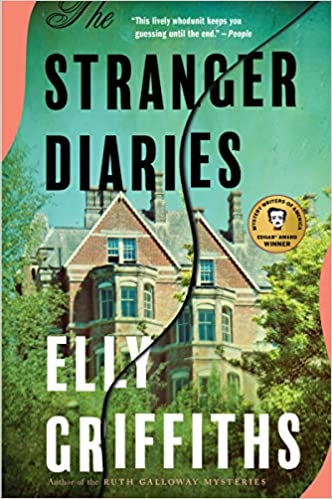
I have been following Elly Griffiths’ Ruth Galloway mysteries, which I enjoy, but Galloway’s homage to the gothic novel, The Stranger Diaries, is something else again. I thought it was a stand-alone, but Goodreads has it marked as Harbinder Kaur #1, so perhaps there will be more.

Clare Cassidy is a schoolteacher who is writing a book about R. M. Holland, a Victorian gothic writer whose home is now occupied by Clare’s school. He was also the author of a horror story called “The Stranger.”

When she arrives at school, Clare is horrified to discover that her friend Ella was murdered in her home. Later, when Detective Sergeant Harbinder Kaur comes to interview her, Clare learns that a piece of paper with “Hell is empty” was found with the body. Although Clare tells the police that the quote is from The Tempest, she does not say that it is also used in “The Stranger.” Another thing that Clare doesn’t tell police is that Ella had a one-night stand with Rick Lewis, their married department head.

Later, when Clare goes to check her diary to see what she wrote about Ella and Rick, she finds that someone has written a message in her diary. When the handwriting is compared to that of the note by the body, it is the same.

This tribute to gothic literature is atmospheric and truly scary at times. I thought it was terrific.

Related Posts

The Fifth Petal

The Crossing Places

The Janus Stone

Review 1569: The Seagull

Here’s another book for RIPXV!

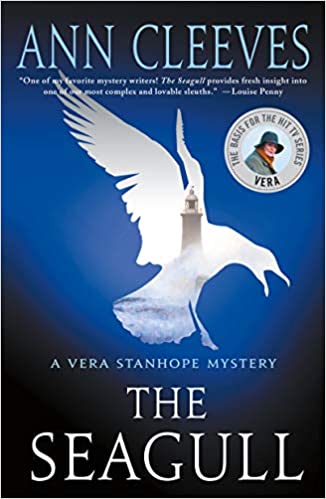
Disgraced former superintendent John Brace is dying in prison, so he asks Vera Stanhope to visit him. He tells her he has information about the disappearance years ago of Robbie Marshall. He will tell her where Robbie’s body is if she will check in on his daughter, Patty Keane, a single mother with mental health problems.

Vera does, so Brace tells her he discovered Robbie dead one night and buried him in a culvert on St. Mary’s Island. When the police investigate the scene, they find two bodies in the culvert, a man and a woman.

The team’s investigations seem to indicate that the female may be Mary-Frances Lascuola, the mother of John Brace’s daughter, a junkie who vanished a few years before Robbie did. Then, Gary Keane, Patty’s ex-husband, is found dead. A common denominator that seems to link all of the people the team is investigating is the Seagull, once an upscale nightclub that burned down years ago. Another common link seems to be the Gang of Four, a group of wildlife buffs whose members were John Brace, Vera’s father Hector, Robbie Marshall, and a shadowy character known as the Prof.

This is another complex and interesting mystery by Cleeves. Her novels are always atmospheric with believable characters and difficult mysteries.

Related Posts

The Glass Room

Harbour Street

The Moth Catcher

Review 1567: Beneath the Visiting Moon

It is the summer of 1939. The Fontaynes are dreaming along in their stately but crumbling home, left without much money since the death of Mr. Fontayne, who had been a noted thinker and politician. Unusually for them, they attend a local dance, where 17-year-old Sarah meets and falls immediately in love with Sir Giles Merrick, a middle-aged diplomat. Sarah begins a series of attempts to develop more of a life for herself so that she can meet more people and perhaps see more of Sir Giles, her hazy mother Elisabeth seeing no attraction in anything but staying home.

The Fontaynes have been trying to sell their house. When they learn that an “artsy” family is leasing a house of no distinction, the children urge their mother to call on them in hopes the family will buy Fontayne. This meeting has unexpected consequences, for soon Elisabeth has agreed to marry Mr. Jones, an orchestra conductor on rest cure.

The Jones children, Peter and Bronwen, are more sophisticated than the Fontaynes and take delight in mocking things the Fontaynes like. The Fontaynes particularly find 13-year-old Bronwen, who has written a book that is being published and constantly quotes poetry, to be ghastly. Shortly after the marriage, Sarah decides it’s time to get a job.

I found this novel delightful and was disappointed to learn it was Cavan’s last, for she became a playwright later on, encouraged by Noel Coward. It’s a vivid picture of life in an eccentric household right before everything is about to change.

Full disclosure: I received a copy of this novel from the publisher in exchange for a free and fair review.

Related Posts

Not at Home

Guard Your Daughters

The Great Fortune

Review 1565: A Struggle for Fame

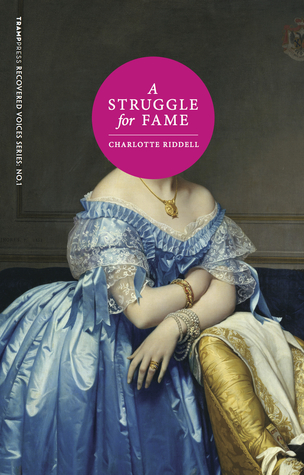
After reading The Uninhabited House, I looked for more books by Charlotte Riddell and came across the Recovered Voices series published by Tramp Press and this book, A Struggle for Fame. A Struggle for Fame is Riddell’s semi-autobiographical novel about the publishing industry.

Although Glen Westley is the main character in the novel, it follows the progress of two Irish young people who meet on the ship from Ireland and both end up in London’s literary milieu. Through poor investments, Glen’s father has lost the family home and all his money. She determines that they will travel to London so she can try to make a living as a writer.

On the ship, they meet Barney Kelly, a young chancer who is looking for a way to make money.

Glen works hard at good literary fiction and is repeatedly rebuffed by editors even while being told she has promise. Barney, on the other hand, falls into an opportunity to write articles for a journal. The novel makes clear that Glen has much more ability than Barney, but he is able to make a living at writing much earlier than Glen. It is clear from the beginning that the novel is about Glen’s rise and fall, but we are drawn in to see what happens.

A lot of characters are vividly drawn and quite Dickensian in their idiosyncrasies. It is fairly obvious that Riddell is depicting, sometimes satirically, publishers and authors she knew. Although written in 1883, the novel has observations about gender and ability that still apply today.

Related Posts

The Uninhabited House

The Blazing World

The Muse