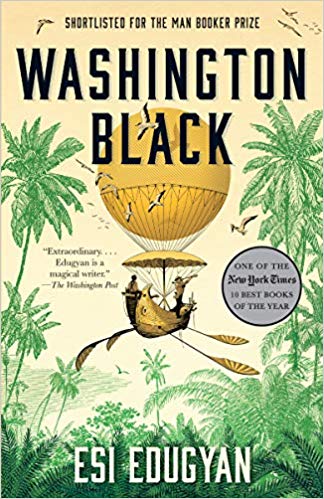
Review 1403: Washington Black

Best of Ten!
Washington Black is a twelve-year-old field slave on the Barbados plantation of Faith in 1830 when a new master arrives. Masters are to be feared, but it soon becomes clear that the new master is cruel and thinks nothing of the death of a slave.

Washington and his protector, the old woman named Kit, are alarmed when one evening they are summoned to the master’s house. They are expected to wait table while the master entertains his brother, Christopher, although they have no training. After the dinner, the brother asks for Washington to wait on him personally.

Christopher, or Titch, as he asks to be called, is a man with a scientific mind. He is working on an airship he calls Cloud Cutter, which he plans to launch from a mountain at the top of the plantation. Once Titch sees how exactly Washington draws, he begins to involve him in his experiments.

The master is away when Titch’s cousin Philip arrives. He brings some news that disturbs the plans of both Titch and the master. Then a terrible event occurs. Because Washington is present for it, he knows it means his death. Titch knows it, too, and the two flee the plantation in the Cloud Cutter.

Washington’s life becomes one of adventure overshadowed by fear. Although during the novel he travels to the Arctic, Upper Canada, England, and eventually Morocco, for years he fears being recaptured.

This novel is part adventure story, but it has the more serious aim of exploring the bonds between the exploiter and the exploited. Titch is a mystery to Wash, a seemingly compassionate man who yet abandons him in the Arctic. For years, Wash believes him to be dead, but then he hears he is alive. This sends him on more journeys to try to find and understand his mentor.

I thought this novel was fascinating, especially the descriptions of sea creatures when Wash begins studying them in Upper Canada. Later on, he begins to build the world’s first public aquarium.

I liked Edugyan’s Half-Blood Blues, but I was really caught up in the story of Wash’s life. This novel applies to my Man Booker Prize project, but I would have read it anyway.
Related Posts

Half-Blood Blues

The Known World

The Good Lord Bird

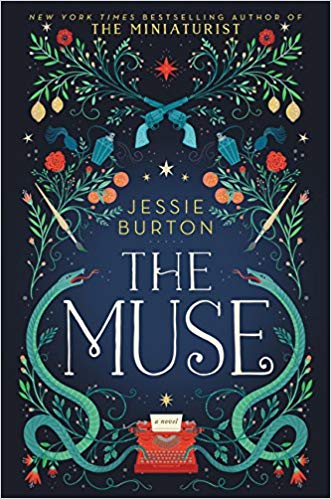
Review 1401: The Muse

In 1967 London, Odelle Bastien has been making her way with difficulty. Although she is well educated, her race and origins in Trinidad are keeping her from getting a job. Then she gets a break. Marjorie Quick hires her as a secretary in an art institute and makes friendly overtures.

Odelle finds Quick mysterious. She asks Odelle about herself but tells her nothing. She does, however, encourage Odelle to write.

Odelle has also met Laurie Scott, a young man who is interested in being more than her friend. His mother has just died, leaving him only an unusual painting. To support himself, he intends to try to sell it. Odelle encourages him to bring it to the Skelton Institute, her workplace. When Quick sees the painting, she has a strong reaction to it.

In 1935, Harold Schloss, an art dealer, has fled Vienna with his family. Unfortunately, he has chosen Spain, which will soon be little safer, to flee to. His daughter Olive has been accepted at Slade, but she hasn’t told her father. He believes that women can’t be artists, just dabblers.

Olive meets Isaac Robles, an artist, and his sister Irene. Both are servants for the house the Schlosses are renting. Olive is struck by Isaac’s good looks and begins painting in a new style with vibrant colors.

The novel follows these two time threads as it explores the mystery of the painting. Who painted it, and how did it end up in London? How does Quick know about it?

I was struck by Burton’s weird and wonderful The Miniaturist, so much so that as soon as I finished reading it, I bought this book. I found The Muse to be a bit more mundane, with few surprises. For a long time, I was much more interested in Odelle’s section than Olive’s, particularly because Olive makes a decision about her art that I found shocking and unbelievable. In theme, this novel is similar to The Blazing World, and in an action taken by an artist, but with a crucial difference.

Also, like some other bloggers, I am wearying of the dual time-frame format. I am beginning to think it is a little lazy. After all, it seems easier to write half a book about two historical time periods (or one depending upon the time chosen for the more recent period) than a whole book about one. One of the delights of The Miniaturist was how it immersed me in the period. This novel doesn’t really do that.

Mind, it’s not a bad novel, and many people will like it. I just found it a disappointing follow-up to Burton’s first book.

Related Posts

The Miniaturist

The Blazing World

The Clockmaker’s Daughter

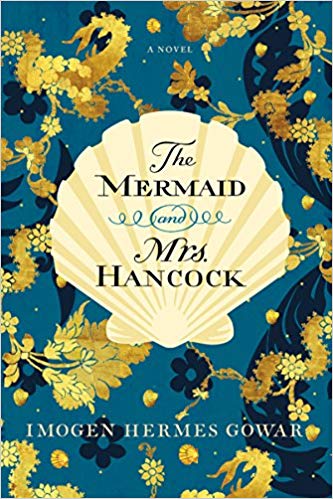
Review 1399: The Mermaid and Mrs. Hancock

In 1785, Jonah Hancock is a merchant who is waiting for his ship to arrive. It is delayed, and he has heard nothing for a long time, but such is the life of a merchant. Finally, his captain arrives but without his ship, which he has sold to purchase, of all things, a mermaid.

Mr. Hancock doesn’t quite know what to do with the wizened, grimacing creature with the fish tail, especially as it is dead and Captain Jones has sold his ship for £2000 less than it is worth. But the Captain blithely believes the mermaid will make his fortune—he should exhibit it.

Angelica Neal’s protector recently died, leaving her with nothing. Her friend, Mrs. Frost, worried about their household expenses, urges her to return to the house of Mrs. Chappell, the bordello owner, but Angelica is hoping to attract a protector rather than to fall back in debt to Mrs. Chappell. Unfortunately, she falls in love at the party Mrs. Chappell gives to exhibit Mr. Hancock’s mermaid, with a young lieutenant who doesn’t come into his fortune for years.

I enjoyed this peculiar novel, which seems solely a historical novel but contains a whimsical dash of the supernatural. I was interested in both Angelica and Mr. Hancock as characters, as well as some of the others. There is an odd subplot about a girl who runs off from Mrs. Chappell that, while not unfinished, takes some part of the narration and then vanishes from the book until the end. I wasn’t sure of the point of that story line.

In fact, the entire novel sort of meanders past the point where you think it will end, making for an unexpected last 100 pages.

Related Posts

Viper Wine

The Mermaid’s Child

Pure

Review 1398: The Arlington Inheritance

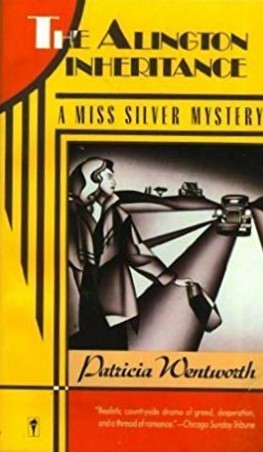
The identity of the criminal is not a secret in The Arlington Inheritance. Instead, the suspense lies with how Miss Silver, Wentworth’s Marple-like sleuth, will find and put together the clues.

My friend and I have been trading books lately, and she loaned me this one. At the time, she commented that she didn’t like the repetition. More about that later.

Jenny Hill’s guardian, her old governess, Miss Garstone, dies unexpectedly in a hit and run accident. When she is dying, she tries to tell Jenny about a letter written from her father to her mother. Her father died in the war, and her mother was injured shortly thereafter, not speaking again until she died shortly after Jenny was born.

After Miss Garstone’s death, her sister immediately descends to claim her property and grudgingly gives Jenny the little chest that is supposed to contain the letter. But when she opens it, no letter is there.

Jenny has nowhere to go, but Mrs. Forbes, her neighbor across the road, offers her a job as governess for her two girls, Meg and Joyce. Jenny was born in Mrs. Forbes’s house, owned at the time by her father, but as he didn’t marry her mother, Jenny as a baby was dispossessed by Mr. and Mrs. Forbes, her father’s nearest relatives.

Jenny thinks she is in love with Mac Forbes, who is occasionally attentive to her, but when she is away from him, she has doubts. When Mac visits this time, he seems to be paying more attention to her. However, Jenny overhears a conversation that chills her. She hears Mac tell his mother that Jenny’s father did marry her mother. Rather than tell Jenny, he plans to marry her, assuring himself the possession of the house and property.

Appalled, Jenny runs away from home, but trouble comes after her.

Wentworth draws some appealing although mostly one-dimensional characters in Jenny, some of her relatives, and Miss Silver. Occasionally, I mildly enjoyed this effort even though Wentworth’s writing style deals in a lot of repetition. Someone will recount something that has happened, that we already know about, sometimes several times. It’s not done for a reason, for example, to show that a witness is leaving something out, but simply seems to be her style and makes the book slightly longer. This doesn’t occur until the crime, though, which happens well into the book (as far as we know). After that, it can certainly be annoying.

Related Posts

Coffin, Scarcely Used

Antidote to Venom

The Horizontal Man

Review 1389: Murder in the Mill-Race

Murder in the Mill-Race is apparently E. C. R. Lorac’s 36th Chief Inspector Macdonald mystery, which means I have pleasure in store if only I can find others. I reported recently that I’d gotten up the nerve to request books from several publishing companies, and Poisoned Pen Press immediately sent me four books from their British Library Crime Classics. This was one of them.

When Anne Ferens, the new doctor’s wife, first meets “Sister” Monica, the warden of the children’s home in Milham in the Moor, she is taken aback by the dichotomy between the Sister’s reputation as a saint and her freakish appearance. What’s worse, Anne fears that the children are being terrorized by her. She soon learns the woman has a poison tongue, starting rumors by denying her belief in the scandal she’s trying to suggest.

Then Sister Monica’s body is found in the mill-race. The village is quick to assume the death was an accident. But Sergeant Peel is still bothered by the death a year before of Nancy Bilton, a resident of the home who was found dead in the same place. Peel finds the village just as closed as it was before. No one knows or saw anything. So, the authorities call in Chief Inspector Macdonald and Inspector Reeves. They soon ascertain that the death was no accident.

I enjoyed this mystery very much. It pays more attention to character than many of the books in this series, and the characters are believable. The mystery is not one of the over-complicated ones of the period. I guessed the identity of the killer but did not guess the motive except in general. The Ferens are a charming couple, and I liked the two detectives. This novel is a good choice for this series.

I received this book from the publishers in exchange for a fair and honest review.

Related Posts

Weekend at Thrackley

Murder at the Manor

The Sussex Downs Murder

Review 1388: Aurora Floyd

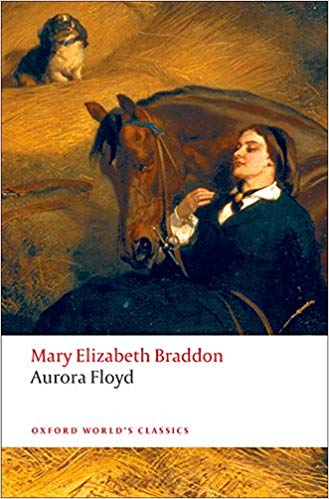
The heiress Aurora Floyd is the apple of her elderly father’s eye. At 19, she is dark and high-spirited, with a flashing eye and an air of pride. She has just returned from finishing school in Paris when Captain Talbot Bulstrode notices her.

From a family that prides itself on its blemishless past, Bulstrode is looking for a pure and wholesome wife. He is disdainful of Aurora’s interest in horses and racing. Altogether, he feels he would like his wife to be more like her cousin, Lucy Floyd. Nevertheless, he can’t take his eyes off Aurora even though there seems to be a shadow over her.

Aurora has another admirer, John Mellish, a large, bluff Yorkshireman who worships her at first sight. In the beginning, Aurora pays little attention to either man. Then she seems to favor Captain Bulstrode.

Aurora has a secret, however, that will threaten her happy future. It is not a difficult secret for the reader to guess, but when a murder is committed, she finds that it must come out.

Mary Elizabeth Braddon was a writer of popular Victorian sensation novels, combining melodrama, intense emotion, and crime. Her best-known work is Lady Audley’s Secret, so if you are familiar with that, you know what to expect. The story evokes some true suspense, and the main characters are either likable or despicable, as intended. Occasionally, Braddon departs into little lectures, some of them loaded with literary allusions. They reminded me of some of Dickens’s writing, only I found them a little cumbersome and overbearing. Still, this novel is readable and generally moves forward at a good pace. I enjoyed it.

Related Posts

The Mystery of Mrs. Blencarrow

Diana Tempest

The Shuttle

Review 1387: The Glass Room

Inspector Vera Stanhope responds to a request from her neighbor, Jack Tobin, to find out where his wife, Joanna, has gone. She left abruptly, leaving only a note saying she needed space, but Jack is worried because she’s been behaving oddly and has stopped taking her medication for bipolar disorder.

Joanna isn’t hard to track down. She’s attending an institute at Writer’s House on the coast. When Vera arrives, however, she finds that one of the lecturers, Tony Ferdinand, has been found dead, stabbed with a knife, his body laid out awkwardly in the glass room, a sun porch where he liked to sit. Moreover, Joanna has been found in the hall with a knife.

Things don’t look good for Joanna, who was supposed to meet Ferdinand at the time he was killed. Shortly, however, the coroner verifies that the murder weapon was not the knife, which Joanna found lying in the room outside the glass room.

Nina Beckworth, another lecturer for the institute, begins writing a murder mystery set at the institute. In it, she imagines a body on the terrace, with the furniture and other trappings of the scene just so. Soon, the body of Miranda Barton, the founder of the institute, is found in exactly those circumstances. Vera realizes that someone is playing games.

Almost as soon as it was mentioned, I recognized the motivation for the murder and thereby the murderer. What I didn’t understand was how that linked to the victims. Cleeves is so clever with her red herrings and side plots, however, that by the end of the novel I was suspecting someone else, or rather, the original suspect and one other. This is another excellent detective novel from Cleeves.

Related Posts

Silent Voices

Telling Tales

Hidden Depths

Review 1386: Once Upon a River

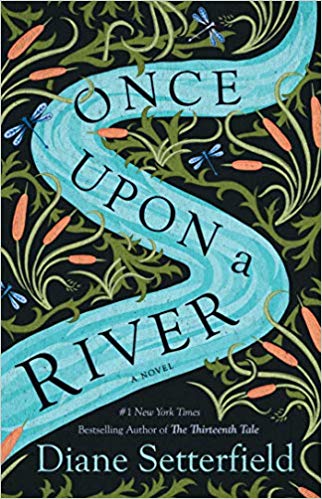
Here we are with another novel that was difficult for me to rate. On the one hand, it is more fairy tale-like than is usually my taste. On the other hand, it kept my attention. Yet again, it presents us with a mystery that isn’t very difficult to solve.

In an inn along the Thames at an unspecified period in time, the patrons and owners occupy themselves with telling tales. One dark night, however, a tale comes right to the house. A man staggers in, all beaten and bloody, carrying what appears to be a puppet. It turns out to be a little girl, apparently dead. Indeed, when the local nurse, Rita, is summoned, she sees that the girl has dilated pupils and no pulse. But something doesn’t seem right, and the girl comes back to life.

She doesn’t speak, however, and no one knows who she is. The injured man, Henry Daunt, only saw her in the flood before he lost his boat.

Soon, there are several possible identities for the girl. Robert Armstrong finds a letter for his son, Robin, from a woman begging for help for her and his daughter. When Robert goes to her, she has just committed suicide and no one knows what happened to her four-year-old daughter, Alice. Lily White, the parson’s housekeeper, says the girl is her sister, Ann. Then the Vaughns claim her. Two years ago, their daughter, Amelia, was kidnapped. When they paid the ransom, the girl was not returned.

There are problems with all these stories. Robert Armstrong has never seen his grandchild, and his son, Robin, seems to be unsure whether the girl is Alice. Sadly, Robin is frequently up to no good. Lily is far too old, in her forties, to have a four-year-old sister. Finally, although Helena Vaughn is convinced the girl is Amelia, Anthony Vaughn, Rita can see, clearly doesn’t believe it.

Lots of secrets come out before we learn who the girl is, or rather, because I thought it was obvious, have it confirmed. In addition, there are lots of subplots, like a stolen pig, a runaway boy, a mysterious visitor, that all somehow related to the book’s central mystery.

The novel has some really rotten bad guys, as all fairy tales must have. It also has some very likable characters, in particular, Henry Daunt, Rita, and Mr. and Mrs. Armstrong. I think that readers who enjoy fairy tales will like this book and some others will, too.

Related Posts

Wylding Hall

Mortal Love

Arcadia Falls

Review 1381: Miss Ranskill Comes Home

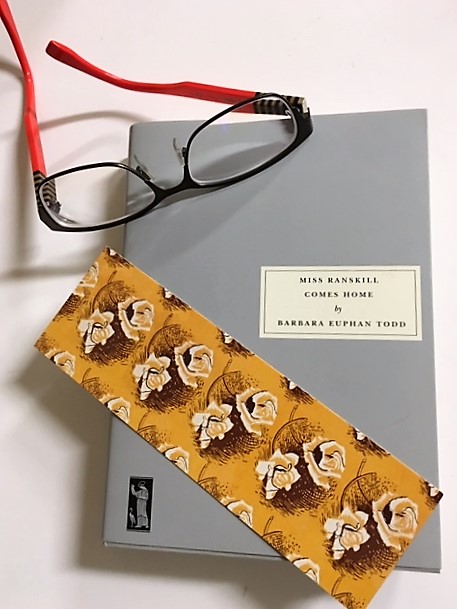
When I read that Miss Ranskill Comes Home is about a woman stranded on a desert island, I thought of some romantic comedies from the 50’s. But the novel is more serious than that. It’s about a woman struggling to find her place in a world completely changed.

The novel opens with Miss Ranskill burying the Carpenter, which is what she called the man who was her companion on the desert island where they both have been stranded since falling overboard. The Carpenter died, but he left her the boat he’d been building. When she casts off, hoping to encounter a ship, she occupies herself with the stories they used to tell each other about going home.

Miss Ranskill is picked up by a ship, but World War II has begun since she was lost. She doesn’t understand how the world works or have any papers. She gets off to a bad start after she arrives in England when she leaves her escort out of embarrassment. Even when she returns to her sister, she is made to feel like an encumbrance. Having lived literally stripped to the essentials, she doesn’t feel much sympathy for wartime bureaucracy or the pleasure some seem to take in their deprivations.

This novel is an unusual one. At times I didn’t buy what happened to Miss Ranskill after she returned home, particularly her reception. I also got irritated with her seeming determination to ignore the rules of wartime, even if some of them were silly. Still, this is a thoughtful examination of some of the attitudes of that time and ultimately a touching story.

Related Posts

Mariana

The Great Fortune

Robinson Crusoe

Review 1376: A Harp in Lowndes Square

In a lonely attic, a neglected child sits and makes clothing for her doll out of old clothes. Everyone is out, surely, but she hears voices on the stairs. These voices belong to her two children, twenty years in the future.

Those children are twins, Vere and James, who have been taught by their mother that all time is simultaneous. The two do indeed experience flashes of visions and sounds from other times, events that occurred in the room years before.

Vere and James’s happy growing up, along with their sister, Lalage, is interrupted by the death of their father. The family is left in financial difficulties and must move from their suburban home to a small house in London. This brings their mother, Anne, back into the orbit of her own mother, the formidable Lady Vallant.

It is clear that, when she returns from visits to her mother, Anne appears to be more worn than usual. Anne’s children know that the two don’t get along and suspect that Lady Vallant harasses Anne. However, a chance remark reveals to them an aunt they didn’t know existed, Myra, who died when she was young.

Vere and James receive impressions of serious events that are not talked about. They begin trying to find out the secrets in their family’s past.

This novel is a ghost story but not in the sense of one meant to scare. It reflects Ferguson’s interest in houses and her sense that actions taken in a room stay in that room’s atmosphere. This idea also occupied A Footman for a Peacock, which I found considerably less likely than this novel, which is set during World War I.

I like a ghost story, but this novel has more going on than that. It’s a story of how family events can affect the lives of others who weren’t even alive when they happened. It’s a good character study of Vere, who cares deeply about a few people but is meticulous and reticent in nature. It is also about a chaste love affair with an older man—and his wife. I didn’t really understand the charms of that relationship, but I very much enjoyed this novel.

Related Posts

A Footman for the Peacock

Alas, Poor Lady

The Priory